
 By Culture Expert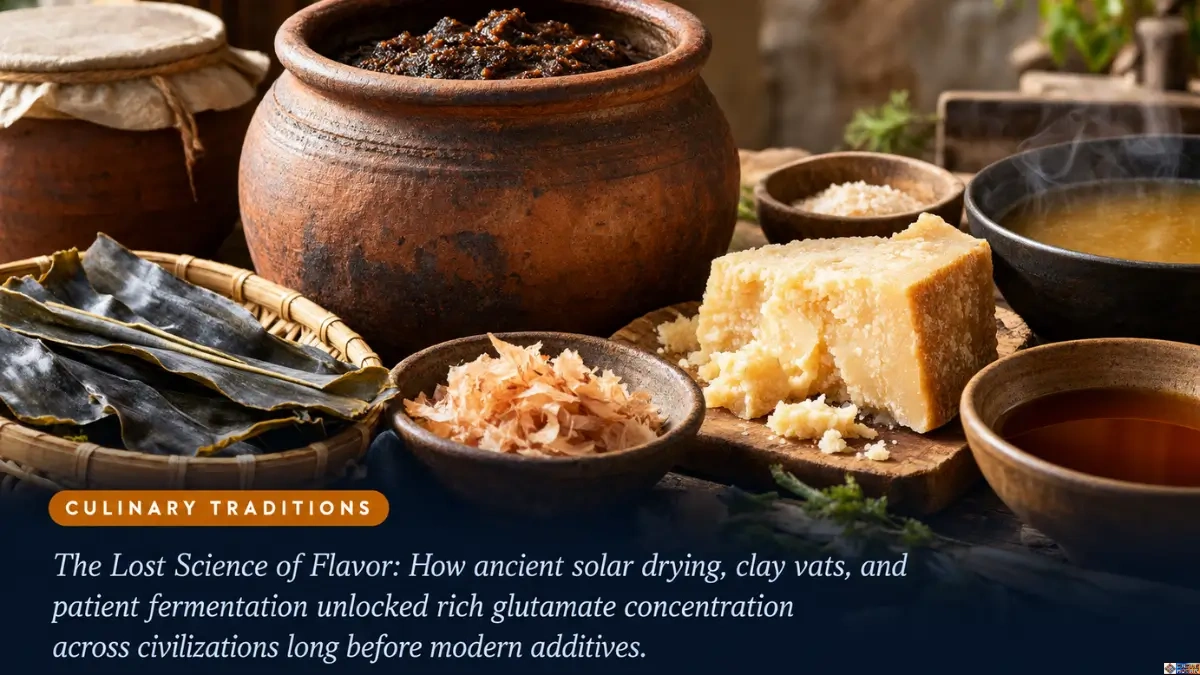
The Problem: We Lost the Patience Our Ancestors Never Had to Question
I’ll say the quiet part first. Most home cooking today tastes thinner than it did a century ago, and it isn’t because our ingredients got worse. It’s because we stopped waiting. Ancestral umami cooking depended on time — weeks of salting fish in Roman coastal towns, months of koji working through soybeans in a Kyoto warehouse, years for a wheel of cheese to develop its crystalline tang. Modern kitchens, understandably, don’t have that kind of patience built into them anymore. We reach for a bouillon cube instead.
That shortcut isn’t a moral failing. It’s a real trade-off, and it costs real flavor. If you’ve ever made a soup that tasted “fine” but not alive, you’ve felt the gap that ancestral umami cooking used to fill. The good news is that closing it doesn’t require a Roman fish-salting pit in your back garden. It requires understanding what those ancient cooks actually figured out, and borrowing a handful of their techniques — some of which take twenty minutes, not twenty months. That’s the whole premise of ancestral umami cooking: it isn’t nostalgia for its own sake, it’s a working toolkit that still outperforms most shortcuts on the market.
1. What Is Umami, and Why Does Ancestral Cooking Keep Rediscovering It?
Umami is the fifth basic taste, alongside sweet, sour, salty, and bitter, and it was formally identified only in 1908. Japanese chemist Kikunae Ikeda was eating a bowl of kombu dashi and noticed a savoriness that didn’t fit into the four known tastes. He spent a year isolating the responsible compound from twelve kilograms of dried kelp and found it was glutamate — an amino acid. He named the sensation umami, roughly “delicious essence,” and patented a way to produce it commercially as monosodium glutamate the same year.
What makes umami such an interesting case for food historians is that Ikeda didn’t invent the flavor. He explained it. Cooks across entirely disconnected civilizations — Rome, Japan, the Korean peninsula, West Africa, coastal Peru — had already spent millennia arriving at the same destination through completely different routes. That’s the real story behind Ancestral Umami Techniques: people who had never heard of an amino acid nonetheless learned, through trial, error, and taste, exactly which combinations of salt, time, and microbes would concentrate it.
The science backs up why their instincts worked. Glutamate on its own is pleasant, but it becomes dramatically more intense when paired with a second class of umami compounds called ribonucleotides — inosinate (found in meat and dried fish) and guanylate (found in dried mushrooms). Combine the two families and the perceived umami intensity multiplies rather than adds, often seven or eight times stronger than either compound tasted alone. This is exactly why Japanese dashi pairs glutamate-rich kombu with inosinate-rich dried bonito flakes, and why an Italian nonna instinctively finishes a meat ragù with a fistful of parmesan. Neither cook needed a laboratory. They needed generations of tasting.
2. Roman Garum: How an Empire Ran on Fermented Fish
Long before Japan systematized umami, Rome had already built an empire-spanning industry around it. Garum was a fermented fish sauce made by layering small fish — anchovies, mackerel, sardines — with salt in open vats and leaving the mixture in the sun for weeks. Enzymes already present in the fish guts broke down proteins into free amino acids, glutamate among them, producing a liquid so intensely savory that a few drops seasoned an entire dish. Roman writers mention it constantly; Pliny the Elder describes it, not entirely flatteringly, as made from “the guts of fish and the other parts that would otherwise be considered refuse.”
The archaeology backs the texts up in vivid detail. In 2009, excavations at Pompeii uncovered a sealed garum workshop — now nicknamed the Garum Shop — frozen mid-production by the eruption of Vesuvius in 79 CE, its clay vessels still packed with the salted remains of a late-summer catch. Nearby, the merchant Aulus Umbricius Scaurus branded his amphorae with his own name and slogans boasting his garum was the finest in the empire, which tells you something important: this wasn’t a rustic peasant condiment, it was a prestige product with recognizable brands, roughly two thousand years before the phrase “artisanal” existed. Grades varied by quality — the clear, pressed liquamen was the premium product, while the leftover solids, hallex, were sold cheaper.
Garum eventually faded from most of Europe by around the ninth century, a casualty of trade disruption and shifting palates, and what survives now are its cousins: colatura di alici from Italy’s Amalfi Coast, and the fish sauces of Southeast Asia. If you want to understand how deliberate that fermentation process actually was, and how closely it mirrors Ancestral Fermentation Rituals practiced on the other side of the world, garum is the clearest surviving case study we have.
3. Koji: The Mold That Became Japan’s National Treasure
If garum shows what fermentation can do to protein through enzymes already present in the raw ingredient, koji shows what happens when a culture deliberately cultivates a microorganism to do the work instead. Koji is the domesticated mold Aspergillus oryzae, grown on steamed rice or soybeans since at least the Nara period (710–794 CE) and possibly earlier, tied to the deep history of Japanese sake brewing. The mold secretes enzymes that break down starches into sugars and proteins into free amino acids — glutamate very much included — which is why miso, soy sauce, sake, and mirin all carry that same savory backbone even though they end up tasting nothing alike.
The scale of koji’s cultural importance is easy to underestimate from outside Japan. In 2006, the Brewing Society of Japan formally designated Aspergillus oryzae the country’s “national fungus,” a rare honor for a mold, and reflective of just how much of the national cuisine — soy sauce, miso, sake, mirin, rice vinegar, shochu — depends on it. Historically, specialist spore merchants called moyashi-ya cultivated and sold pure koji starter, protecting the trade closely enough that regulations grew up around it by the medieval period.
Related koji-style fermentations also power Korean meju blocks (used for doenjang and gochujang) and Chinese jiuqu starters, which tells you this wasn’t a one-off invention — it was a solution multiple East Asian cultures converged on for the same underlying problem: how do you turn a pile of plain soybeans into something with real depth?
For readers who want the fuller mechanics of how salt interacts with these fermentations at a molecular level, I’ve laid out the details separately in The Biochemistry of Salt-Glaze Fermentation, which covers the enzyme kinetics that koji, garum, and salt-cured meats all quietly share.
4. Salt, Sun, and Time: Traditional Umami Preservation Methods Worldwide
This is where ancestral umami cooking gets genuinely global, and where it becomes obvious that no single culture “owns” the idea. Wherever people needed to preserve a harvest and happened to notice the leftover food tasted better, a tradition grew up around it.
Fermented cabbage is one of the clearest examples. Traditional sauerkraut — made by nothing more than salt, cabbage, and time — relies on lactic acid bacteria to both preserve the vegetable and deepen its flavor; I’ve written more on the specific mechanics in Traditional Sauerkraut Fermentation. Korean kimchi runs on a related principle with the added complexity of fish sauce or salted shrimp folded in for extra glutamate, and that same fermented, funky backbone shows up in unexpected modern places, including the gochujang glaze on a Korean Hot Dog sold from a street cart in Seoul or Los Angeles.
Aged dairy tells a parallel story in Europe. Parmigiano-Reggiano develops its intensely savory crystalline texture over eighteen to thirty-six months of aging, during which proteolytic enzymes free enormous amounts of glutamate — enough that a well-aged wedge rivals soy sauce for raw umami concentration. You can see the same aging logic at work in Georgian Khachapuri Regional Varieties, where regional cheeses carry very different umami intensities depending on how long they’re cultured, and in the layered dairy traditions covered in Heritage European Butter Varieties, where slow cultured butters pick up their own savory, tangy complexity.
North Africa and the Mediterranean built umami through preservation and slow braising rather than fermentation alone. Preserved lemons, salted and left to soften for weeks, anchor the intensely savory base of a tagine — I’ve broken down the full method in How to Cook Traditional Moroccan Tagine — and the same patient, low-and-slow approach shows up in how a proper Traditional Moroccan Couscous Recipe is built up in layers over hours rather than minutes.
The Americas contributed their own distinct routes to the same flavor. In Mexico, the char and slow vertical roasting behind a proper How to Make Mexican Street Tacos al Pastor plate concentrates meat proteins into free amino acids through the Maillard reaction, a heat-driven cousin of what fermentation does with time instead of fire. Across the wider region, the fermented and slow-cooked traditions collected under Hispanic Cultural Foods reflect centuries of exactly this kind of ingenuity, often born from necessity rather than luxury.
Southeast Asia and the Philippines independently arrived at a garum-like solution: fish sauce. Filipino patis and bagoong, made by salting and fermenting fish or shrimp over months, function almost identically to Roman liquamen, and they remain foundational to the dishes covered in Filipino Cuisine and the specific regional standouts explored in Authentic Filipino Food.
Italy deserves its own mention, since so much of what people think of as “Italian flavor” is really ancestral umami cooking wearing a different name — sun-dried tomatoes, aged parmesan, cured anchovies, and slow-reduced sauces all show up across Italian Pasta Shapes and Sauces and trace back through the longer arc covered in What Is the History of Italian Cuisine?.
None of these traditions borrowed from each other in any direct sense. They converged, independently, on the same biochemistry, which is a genuinely remarkable pattern once you notice it across Ancestral Fermentation Techniques practiced continents apart. It’s also the clearest evidence that ancestral umami cooking was never a single invention passed along a trade route — it was reinvented, over and over, by people solving the same problem with whatever they had on hand.
5. Indigenous Umami-Building Techniques: Smoke, Fat, and Concentration
It’s worth being precise here rather than tidy, because the honest picture is more interesting than a neat parallel. Across much of North America, Indigenous nations built savory depth primarily through smoking, drying, and fat rendering rather than heavy fermentation. Pacific Northwest nations smoked and dried salmon for months of storage, concentrating its natural glutamate and inosinate in the process. Plains nations developed pemmican — pounded dried meat combined with rendered fat and dried berries — an intensely dense, savory ration that could last years without spoiling, doing through dehydration and fat what koji does through enzymes. Documented fermentation in these specific culinary traditions is comparatively limited and unevenly recorded, and I want to say that plainly rather than overstate it.
Fermentation is much better documented further south. Andean communities developed tocosh, a fermented potato product, while Indigenous groups across the Amazon and Brazil developed cauim, a fermented beverage traditionally started using saliva enzymes from chewed cassava or sweet potato — a technique with real precedent elsewhere in the fermented-beverage world, and one that produces genuine umami-adjacent depth alongside its alcohol content. The common thread across all of these traditions, north and south, isn’t a shared recipe. It’s a shared discovery: concentrating and transforming protein, by whatever method the local climate and ingredients allowed, makes food taste more satisfying and keeps it edible longer.
6. The Rise, Fall, and Return of MSG: Untangling the Clean-Label Myth
No article on umami is complete without addressing monosodium glutamate directly, because its reputation has swung harder than almost any other ingredient in food history. After Ikeda’s 1908 discovery, he and businessman Saburosuke Suzuki commercialized MSG within a year, and it became a normal seasoning across East Asia and, eventually, the world.
Then, in 1968, a letter published in a US medical journal linked “Chinese restaurant food” to headaches and other symptoms, coining the term “Chinese Restaurant Syndrome.” The claim spread fast and stuck for decades, disproportionately targeting Chinese-American restaurants in a way that food historians now widely recognize carried an uncomfortable undercurrent of bias. The science, however, never held up.
The FDA asked the independent Federation of American Societies for Experimental Biology to review the evidence in the 1990s; the resulting report found MSG safe, noting only mild, transient symptoms in a small number of people who consumed large amounts (three grams or more) without food — far beyond what a typical seasoned dish contains. The FDA continues to classify added MSG as Generally Recognized As Safe, a position shared by the EU’s food safety authority.
That hasn’t stopped a persistent “clean label” instinct in modern food marketing, where “No MSG” still appears on packaging as a selling point, even though the glutamate in a ripe tomato or a wedge of parmesan is chemically identical to the glutamate in a shaker of MSG. This is precisely why ancestral umami cooking has become genuinely useful again, not just historically interesting: a well-executed garum-style fermentation, a patient koji ferment, or a properly aged cheese delivers the same flavor compound the “clean label” movement is quietly trying to avoid naming, through a process nobody could object to on a food label. It’s the same molecule, arrived at more slowly.
7. Bringing Ancestral Umami Into Your Own Kitchen Today
You don’t need a Roman fermentation pit or a Kyoto koji room to put any of this to use. A few genuinely accessible starting points:
- Make a quick dashi. Steep kombu in cold water overnight, then gently warm it — never boil, which turns it bitter — and add dried bonito flakes for the glutamate-inosinate synergy described above.
- Try a small home ferment. A simple sauerkraut or a basic miso, if you’re patient, are both realistic entry points into the same fermentation logic that built garum and koji.
- Reach for aged, not fresh, when you want depth. Aged parmesan, sun-dried tomatoes, and cured anchovies concentrate glutamate far beyond their fresh counterparts, sometimes by four times or more.
- Layer glutamate with inosinate. Pair a mushroom broth with a splash of fish sauce, or finish a tomato sauce with parmesan and a few anchovies, and the umami intensity compounds rather than simply adds.
I think about this often through the lens of what I’d call Somatic Seasoning — the idea that flavor isn’t just chemistry, it’s a bodily, remembered experience, tied up with the specific Somatic Food Memory of a grandmother’s kitchen or a coastal Roman town two thousand years gone. That’s part of why Dining Rituals and the broader question of Food Rituals in Different Cultures matter as much as the ingredients themselves — umami has always been social, built around The Commensal Architecture of Shared Vessels, whether that’s a shared dashi pot or a communal tagine.
If any of this has you curious to go further, it’s worth asking yourself which direction actually appeals. Are you drawn to making your own ferments, like a small batch of miso or koji at home? Do you want to attempt an authentic historical recipe start to finish? Or are you chasing one specific regional tradition — East Asian, Mediterranean, or something further afield? Each answer points somewhere different, and Culture Mosaic’s broader library of Heritage Cooking Techniques, Regenerative Heritage Recipes, Traditional Recipes from Around the World, and deep dives like Italian Culinary Traditions and USA Famous Dishes is built to follow whichever thread you pull.
There’s even a case for starting your morning on the same principle — the fermented, umami-rich breakfasts common in long-lived populations are a running theme in our piece on the Centenarian Breakfast Routine.
For a genuinely global reference point beyond this article, the Umami Information Center maintains an extensive database on ancestral umami cooking traditions and their scientific basis, and it’s worth an afternoon of browsing if this topic has hooked you the way it’s hooked me.
Comparison Table: Ancestral Umami Techniques Around the World
Comparison Table: Approximate Free Glutamate Content by Food
Figures are approximate ranges compiled from published food-science sources and vary by variety, brand, and fermentation length; see Sources below. Notice how closely the top of this list overlaps with the techniques covered above — that overlap is not a coincidence, it’s the entire logic of ancestral umami cooking in one table.
Frequently Asked Questions
1. What exactly is ancestral umami cooking, and how is it different from just using MSG?
Ancestral umami cooking refers to the pre-industrial techniques — fermentation, aging, drying, and slow reduction — that cultures used to concentrate naturally occurring glutamate and related compounds in food, long before anyone had isolated or named the taste. MSG delivers the same glutamate molecule instantly, in a single ingredient. The chemistry is identical either way; the difference is entirely in the process and the layered flavor complexity that a slow ferment or aging process builds up alongside the glutamate itself, including the acids, esters, and aromatic compounds a shortcut simply can’t replicate.
2. Is umami actually a real, distinct taste, or is it just a mixture of salty and savory?
It’s a genuinely distinct, scientifically confirmed basic taste. Kikunae Ikeda proposed it in 1908, but it wasn’t until the early 2000s that researchers identified specific glutamate taste receptors on the tongue, confirming umami operates through its own dedicated sensory pathway rather than being a blend of the other four tastes. It’s now taught alongside sweet, sour, salty, and bitter as one of the five basic tastes.
3. Is MSG actually safe, given how long it’s been controversial?
Yes, according to the overwhelming weight of current evidence and every major food safety body that has reviewed it, including the FDA and the EU’s food safety authority. The controversy traces back to a single 1968 letter that coined “Chinese Restaurant Syndrome,” a claim that decades of controlled research have failed to substantiate at normal dietary levels. The FDA classifies added MSG as Generally Recognized As Safe, noting that only very large single doses taken without food produce mild, temporary symptoms in a small subset of sensitive individuals.
4. What’s the easiest ancestral umami technique to try at home?
A quick kombu-and-bonito dashi is the fastest entry point — steep kombu in cold water overnight, warm it gently without boiling, then add bonito flakes for a few minutes and strain. It takes under thirty minutes of active effort and demonstrates the glutamate-inosinate synergy that underlies most of the world’s great savory broths. From there, a basic home sauerkraut is the easiest fermentation project, needing only cabbage, salt, and patience.
5. Which fermented foods have the most umami, and are they all interchangeable?
Dried kombu, aged soy sauce, and well-aged parmesan tend to top most published glutamate tables, though they aren’t interchangeable in practice because each carries its own dominant compound and flavor profile — kombu and soy sauce lean heavily on glutamate, while dried fish and cured meats contribute inosinate instead. The most dramatic results usually come from combining a glutamate-rich ingredient with an inosinate- or guanylate-rich one, rather than relying on any single ancestral umami source alone.
Sources
1. Umami Information Center, “Kikunae Ikeda” — umamiinfo.com/ikedakikunae/
2. Ajinomoto Group, “Who Identified Umami and When?” — ajinomoto.com/umami/discovery-of-umami
3. Yoshida, Y., “Glutamate: from discovery as a food flavor to role as a basic taste (umami),” American Journal of Clinical Nutrition — pubmed.ncbi.nlm.nih.gov/19640953/
4. Smithsonian Magazine, “Culinary Detectives Try to Recover the Formula for a Deliciously Fishy Roman Condiment” — smithsonianmag.com
5. NPR, “Fish Sauce: An Ancient Roman Condiment Rises Again” — npr.org
6. Wikipedia, “Aulus Umbricius Scaurus”
7. Umami Cart, “What Is Koji? The Complete Guide to Japan’s Fermentation Mold” — umamicart.com
8. Wikipedia, “Miso”
9. Fond Kitchen, “Umami Foods: Ranked List and How to Cook With Them” — fond.kitchen
10. Academy of Nutrition and Dietetics (andeal.org), “Umami in Foods” white paper
11. U.S. Food and Drug Administration, “Questions and Answers on Monosodium Glutamate (MSG)” — fda.gov
12. Ajinomoto Group, “Changing Perceptions on MSG” — ajinomoto.com
13. Recipes & Roots, “Indigenous Food Preservation Techniques” — recipesandroots.ca
14. PMC/NCBI, “Microorganisms present in artisanal fermented food from South America” — ncbi.nlm.nih.gov/pmc/articles/PMC9499260/