
 By Culture Expert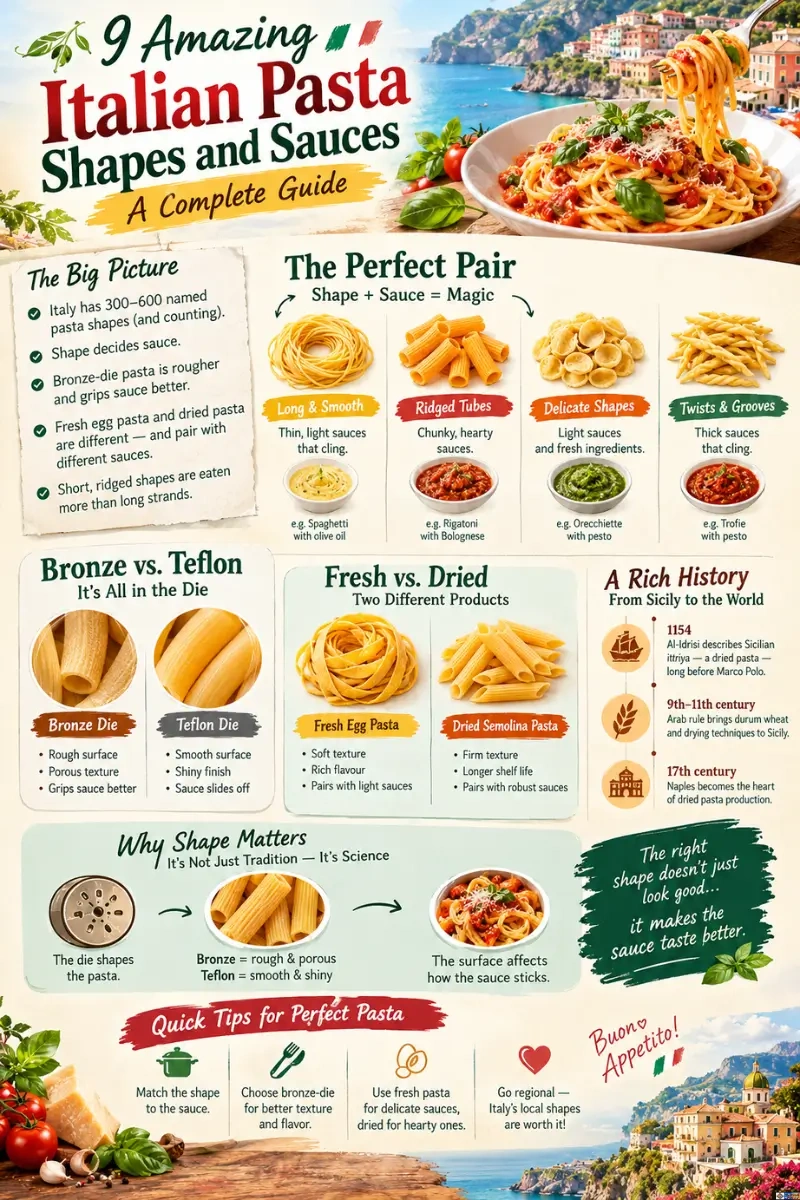
Quick Summary
- Italy has somewhere between 300 and 600 named pasta shapes, depending on who’s counting — food historians rarely agree on one number.
- Understanding Italian pasta shapes and sauces comes down to one rule: shape decides sauce. Long, smooth strands want thin sauces that cling. Ridged tubes want chunky ones. Delicate shapes want a light hand.
- Bronze-die extruded pasta has a rough, porous surface that grips sauce. Teflon-extruded pasta is smoother and shinier, and sauce slides off it.
- Fresh egg pasta and dried semolina pasta are legally and practically different products in Italy, and they pair with different sauces for good reason.
- Italians eat short, ridged shapes more than long strands, despite the popular belief that long pasta dominates Italian cuisine.
I bought the wrong pasta once — not the wrong brand, the wrong shape. I made a delicate white clam sauce and tipped it over a box of smooth penne that was on sale. Within two minutes, every drop of that sauce had slid to the bottom of the bowl, and I was left chasing clams around a plate of naked pasta. It’s a small, humbling kitchen failure, and it happens to a lot of home cooks who assume pasta is interchangeable. It isn’t. Shape and sauce are a matched pair, and Italy spent centuries working out which pair goes together.
That’s what this guide is for. Not a museum tour of noodle trivia, but a working reference: which Italian pasta shapes and sauces actually belong together, why the pairing rules exist, and how to use them so your next carbonara, ragù, or pesto behaves the way it’s supposed to.
How Many Pasta Shapes Actually Exist?
Any honest catalogue of Italian pasta shapes and sauces has to start by admitting nobody agrees on the total. Ask ten Italians how many pasta shapes exist and you’ll get ten different answers, usually somewhere between 300 and 600. Some estimates edge close to a thousand once you count every regional dialect name for the same basic shape. The truest answer is: nobody has ever finished counting, because new shapes are still invented, and old ones survive in a single village and nowhere else.
Bigoli, a thick, rough spaghetti pressed through a hand-cranked bronze press, belongs to the Veneto. Strozzapreti, whose name translates — a little gruesomely — to “priest stranglers,” is an Emilia-Romagna specialty. Trofie, twisted for the sole purpose of catching pesto in its grooves, comes from Liguria and almost nowhere else. Most of these never leave their home region, let alone reach a supermarket shelf abroad.
What matters more than the exact count is the logic behind it. Every one of those shapes was engineered — usually by hand, usually generations ago — to do a specific job with a specific sauce. That’s the throughline that connects a nonna in Puglia rolling orecchiette on her thumb to a factory in Emilia-Romagna extruding rigatoni through a bronze die. The shape is never decorative. It’s function first.
A Short, Surprising History of Italian Pasta
Here’s the part that surprises most people: Marco Polo did not bring pasta back from China. That myth has been debunked so many times by food historians it’s almost embarrassing to repeat, but it persists anyway. The real story is older and, frankly, more interesting. The Arab geographer Al-Idrisi, writing for the Norman king Roger II in 1154, described a Sicilian town called Trabia producing a string-shaped dried dough — itriya — in quantities large enough to export across the Mediterranean to both Muslim and Christian territories. That’s more than a century before Marco Polo ever set foot on a ship bound east. Dry pasta, in other words, was already a Sicilian export industry when Polo was still a child.
Arab rule in Sicily, which lasted from the ninth century into the eleventh, brought durum wheat and drying techniques that turned fresh dough into a shelf-stable staple — a food that could survive long sea voyages without spoiling. From Sicily, pasta moved north through the peninsula, adapting to local wheat, local water, and local taste.
Naples became the industrial heart of dried pasta production by the seventeenth century, its warm coastal air ideal for the slow drying that gives good pasta its structure. If you want the fuller arc — how Italian food went from regional survival cooking to a global identity — I’ve traced what is the history of Italian cuisine and the broader Italian culinary traditions that grew out of it elsewhere on Culture Mosaic.
Why Shape Decides the Sauce: The Science of Bronze-Die Extruded Pasta
Here’s the mechanism, and it’s simpler than people expect. Dried pasta is made by forcing dough through a die — a metal disc with holes cut in the exact cross-section of the finished shape. The material of that die changes everything downstream. A bronze die leaves the pasta’s surface matte, porous, and faintly rough, almost like fine sandpaper. A Teflon die leaves it glassy and smooth. Run your finger over a strand of each and you can feel the difference before you’ve even cooked either one.
That roughness isn’t cosmetic. It’s the entire mechanism by which sauce clings to pasta instead of pooling underneath it. Bronze die extruded pasta has microscopic tears and craters in its surface that trap starch, olive oil, and sauce in a way a smooth strand simply cannot. This is why serious Italian producers print “trafilata al bronzo” on the box, and why a plate of bronze-cut rigatoni holds a ragù so much better than the same shape cut through Teflon.
Why does texture — smooth versus ridged — matter? Because the surface area of contact between pasta and sauce is the entire game. A smooth, thin strand like capellini wants a thin sauce it can slip through — a bit of oil, garlic, maybe a scattering of herbs. Anything heavier just sinks. A ridged tube like rigatoni or penne rigate has grooves cut into its outer wall specifically to grab and hold thicker, chunkier sauces — a slow-cooked ragù, a rustic vegetable sauce with texture. Smooth pasta gives you a clean, light bite. Ridged and rough pasta gives you a bite loaded with sauce in every groove. Neither is better. They’re built for different jobs.
Traditional Italian Pasta Shapes and Sauces, Region by Region
Traditional Italian pasta shapes and sauces are, almost without exception, products of geography. A region’s climate decided its wheat. Its wheat decided its dough. Its dough decided its shapes. And its shapes decided which sauces made sense.
| Region | Signature Shape | Classic Sauce | Why It Works |
|---|---|---|---|
| Emilia-Romagna | Tagliatelle | Ragù alla bolognese | Flat egg ribbons carry a slow meat ragù without breaking apart |
| Liguria | Trofie | Pesto alla genovese | Tight twists trap the ground basil, pine nut, and cheese emulsion |
| Lazio | Bucatini / Tonnarelli | Amatriciana / Cacio e pepe | Thick, hollow or square strands stand up to guanciale, tomato, and hard cheese |
| Puglia | Orecchiette | Cime di rapa | The cupped shape scoops bitter greens and garlic-oil in one bite |
| Campania | Paccheri | Ragù napoletano / seafood | Wide tubes hold slow-cooked tomato sauce or whole shellfish |
| Sicily | Busiate | Pesto alla trapanese | The loose coil catches a rustic almond-tomato pesto |
| Tuscany | Pici | Cacio e pepe / ragù | Hand-rolled, thick, and irregular — built for rustic, heavy sauces |
None of these are arbitrary. Bucatini’s hollow core is designed to trap a bit of oily amatriciana sauce inside the tube itself, so every bite delivers sauce from the outside and a small surprise from within. Orecchiette’s dimpled cup exists for one reason: to scoop up small, chopped greens and garlic that would slide right off a flat noodle. The shape came first. The sauce followed.
The Authentic Italian Pasta Pairing Guide: 9 Classic Combinations
This is the heart of any authentic Italian pasta pairing guide, and if you remember nothing else about Italian pasta shapes and sauces from this article, remember these nine. They’re the pairings that Italian home cooks and chefs return to again and again, because they’ve been tested — sometimes for centuries.
- Spaghetti + Aglio e Olio. Thin, smooth, and neutral. Garlic and olive oil coat it evenly without overwhelming it.
- Tonnarelli or Bucatini + Cacio e Pepe. Square-cut or hollow strands with enough surface texture to hold a pecorino-and-pepper emulsion that would slide off something thinner.
- Orecchiette + Cime di Rapa. The cupped shape was built for scooping chopped bitter greens.
- Trofie + Pesto alla Genovese. Tight spirals trap a thick basil paste that would otherwise slip off a flat noodle.
- Tagliatelle + Ragù alla Bolognese. Wide, porous egg ribbons that soak up a slow-simmered meat sauce.
- Rigatoni + Sausage and Tomato Ragù. Deep exterior ridges grip chunky, meaty sauces; the wide tube holds sauce inside too.
- Paccheri + Seafood or Slow-Cooked Tomato. Cannon-sized tubes built for whole clams, mussels, or a rich, reduced sauce.
- Pici + Cacio e Pepe or Wild Boar Ragù. Thick and hand-rolled, Tuscan pici is dense enough to stand up to rustic, heavy sauces.
- Tortellini or Ravioli + Butter and Sage. Stuffed pasta needs almost nothing — the filling is the point, and a simple butter sauce lets it speak.
Fresh vs. Dried Pasta: Why the Pairing Rules Change
Here’s a distinction most pairing guides skip entirely: fresh and dried pasta are not the same product, and Italian law treats them that way. Under Presidential Decree No. 187 of 2001, dried pasta made from durum wheat semolina and water is one legally defined category; egg pasta with a minimum egg content is another; fresh and stabilized pasta — which is permitted to use softer wheat flours that dried pasta cannot — is a third. This isn’t bureaucratic trivia. It explains why a Bolognese nonna’s fresh tagliatelle behaves completely differently on the fork than a box of dried spaghetti from the supermarket.
Fresh egg pasta is soft, porous, and slightly absorbent even before it hits the sauce. It’s built for rich, buttery, or creamy sauces and slow-simmered ragùs that it can soak into rather than just coat. Dried semolina pasta is firmer, denser, and holds its structure through a longer cook — which makes it the better partner for olive-oil-based sauces, tomato sauces, and anything where you want the pasta to keep some bite (al dente) rather than turn tender and yielding. Neither is “better” than the other; they’re built to behave differently, and swapping one for the other in a recipe changes the dish more than most people expect.
Geography still plays a role here too. Pasta di Gragnano, a dried durum-wheat pasta from the town of Gragnano near Naples, earned Protected Geographical Indication status from the European Commission in 2013 — a formal, legal recognition that the specific water, climate, and slow-drying tradition of that one town produces a texture you genuinely cannot replicate elsewhere. That’s not marketing language. It’s registered in EU law.
Creamy Italian Pasta Shapes and Sauces That Break the “Rules”
Every pairing rule has a graceful exception, and cream sauces are where Italian cooks get a little more permissive. Creamy Italian pasta shapes and sauces tend to favor medium ribbons or short tubes with enough surface area to carry a heavier, fat-based sauce without drowning in it. Fettuccine Alfredo — genuinely a Roman dish, not the Americanized version most people picture — works because the ribbon’s width holds a butter-and-parmesan emulsion in a thin, even coat. Penne alla vodka works for the same reason short tubes work everywhere else: the ridges and the hollow core both grab sauce.
The one rule that doesn’t bend: cream sauces are heavy, so avoid pairing them with anything too thin or too smooth. A cream sauce on capellini just slides to the bottom of the bowl, the same failure as my clam-sauce disaster, just with cream instead of broth.
Best Italian Pasta Shapes and Sauces: Classic Picks vs. Unique Shapes
If you’re building a home pasta repertoire, start with the shapes that do the most work across the most sauces, then branch into the region-specific ones that reward a bit of curiosity.
| Category | Shape | Best For | Skill Level |
|---|---|---|---|
| Everyday classic | Spaghetti | Tomato, garlic-oil, seafood | Beginner |
| Everyday classic | Penne rigate | Chunky vegetable or meat sauces | Beginner |
| Everyday classic | Fusilli | Cold pasta salads, pesto, chunky sauces | Beginner |
| Unique regional pick | Strozzapreti | Rustic ragù, mushroom sauce | Intermediate |
| Unique regional pick | Garganelli | Ragù, cream, or butter-sage | Intermediate |
| Unique regional pick | Busiate | Trapanese pesto, seafood | Intermediate |
| Wildcard | Su filindeu (“threads of God”) | Broth, on special occasions only | Advanced — hand-pulled in one Sardinian town |
That last one is worth a mention purely because it’s so strange. Su filindeu is a hand-pulled pasta so fine and labor-intensive that, for years, only a handful of women in the Sardinian town of Nuoro knew how to make it, traditionally reserved for a religious festival and served in sheep broth. It’s not a shape you’ll cook on a Tuesday. But it’s proof that “unique pasta shapes” isn’t marketing language — some of these things really do exist in exactly one kitchen on Earth.
What Pasta Shape Do Italians Eat the Most?
Every conversation about Italian pasta shapes and sauces eventually lands on this question. For all the regional variety, the data on what pasta shape Italians actually reach for most often tells a slightly different story than the postcard image of a spaghetti-twirling tourist. Italians consume more pasta per person than anyone else on the planet — around 23 kilograms a year according to the International Pasta Organisation, more than double the per-capita consumption of Greece, the next-highest country in Europe.
But Italian households lean toward short, ridged shapes — penne, fusilli, rigatoni — more than the long strands most of the world pictures when they think “Italian food.” Long pasta remains popular, especially spaghetti, but it’s short, sauce-gripping shapes that dominate the weekly rotation in most Italian kitchens.
That’s worth sitting with for a second. The image of Italian pasta that’s been exported globally — a fork twirling spaghetti — isn’t actually the shape Italians themselves cook most. It’s a reminder that authenticity and popularity abroad don’t always line up.
Pasta as Ritual, Not Just Recipe
There’s a reason Italian pasta courses come with their own unhurried pace, their own order at the table, their own quiet rules about what goes with what. Pasta in Italy isn’t fuel — it’s a dining ritual, a course with its own weight in the meal, eaten with attention rather than distraction.
The smell of garlic hitting hot olive oil, the particular sound of pasta water at a rolling boil, the starch-clouded water saved in a mug by the stove — these are small physical habits, but they’re the backbone of how a dish actually comes together. I think of it as a kind of somatic seasoning: cooking that’s guided as much by smell, sound, and touch as by a written recipe.
That sensory memory runs deep. Ask most Italians about their favorite pasta dish and you’ll get a story about a kitchen, not a restaurant — a piece of somatic food memory tied to a specific person’s hands. The heritage cooking techniques behind a good ragù or a properly emulsified cacio e pepe were passed down that way, hand to hand, long before anyone wrote them into a cookbook. Even the deep savoriness of a good parmesan-and-tomato sauce comes down to the same ancestral umami techniques — slow reduction, aged cheese, patience — that show up across almost every food culture that’s figured out how to make simple ingredients taste like more than the sum of their parts.
More Culinary Heritage to Explore
If pasta’s pull for you is really about the deeper story — how a place, a climate, and a few generations of cooks turn plain ingredients into something with real identity — that thread runs through a lot of what we cover at Culture Mosaic. Parmesan’s sharpness, like so many fermented foods, comes down to the same slow biochemistry behind the biochemistry of salt-glaze fermentation, and if you want to see fermentation traditions carried forward with real intention, we’ve covered ancestral fermentation rituals and the more hands-on ancestral fermentation techniques that underpin them, alongside a very different but related craft in traditional sauerkraut fermentation.
The instinct to build an entire cuisine around one staple, shaped by geography and passed down by hand, isn’t unique to Italy either. Morocco does something similar with grain — read our guides to the traditional Moroccan couscous recipe, the fuller authentic Moroccan couscous story, and how to cook a traditional Moroccan tagine — and you’ll notice the same pattern: shape and method dictated by what the land provides. We’ve traced that same instinct through regenerative heritage recipes more broadly, and through food rituals in different cultures around the world.
That pattern holds well beyond the Mediterranean, too. We’ve followed it into how to make Mexican street tacos al pastor, the wider landscape of Hispanic cultural foods, the surprising history behind the Korean hot dog, a rundown of USA famous dishes, and two deep dives into Filipino cuisine and authentic Filipino food that show the same shape-follows-geography logic at work on the other side of the world. If longevity and daily food ritual interest you as much as history does, our piece on a centenarian breakfast routine is a natural next stop, and our roundup of traditional recipes from around the world pulls a lot of these threads together in one place.
For a purely visual reference — useful if you want to match a shape you’re holding in a supermarket aisle to a picture — Kikkoman publishes a solid Italian pasta shapes and sauces field guide worth bookmarking alongside this one.
Frequently Asked Questions
Here are the five questions readers ask most often about Italian pasta shapes and sauces, answered directly.
How many pasta shapes actually exist?
Nobody has an exact figure, and that’s the honest answer. Most food historians place the number of distinct Italian pasta shapes somewhere between 300 and 600, with some counts running even higher once every regional and dialect variant is included. Italy’s twenty regions each developed pasta shapes suited to local wheat, water, and sauces, often in near-total isolation from one another before Italian unification in 1861 — which is why so many shapes exist in only one town or valley and have never been mass-produced.
What pasta shape do Italians eat the most?
Contrary to the international image of spaghetti-twirling, Italian households lean toward short, ridged shapes — penne, fusilli, and rigatoni among them — more than long strands. Italy also eats more pasta per person than any other country in the world, at roughly 23 kilograms per capita per year according to the International Pasta Organisation, more than double the per-capita figure of Greece, the next-highest country in Europe.
What is the difference between fresh and dried pasta pairings?
Fresh egg pasta is soft and slightly absorbent, which makes it a natural match for rich, buttery, or slow-simmered cream and meat sauces it can soak into. Dried semolina pasta holds a firmer, al dente bite through cooking, which suits olive-oil-based, tomato, and lighter sauces better. Italian law (Presidential Decree No. 187/2001) treats the two as legally distinct products with different permitted ingredients, which is part of why swapping one for the other changes a dish more than most people expect.
Why does the texture — smooth versus ridged — matter?
Texture controls how much sauce actually stays on the pasta rather than pooling in the bowl. Ridged or rough surfaces, especially those from bronze-die extrusion, create microscopic grooves and tears that trap sauce, oil, and starch. Smooth, Teflon-extruded pasta has a glassier surface that sheds sauce more easily, which is why it pairs better with thin, simple sauces rather than thick or chunky ones.
What’s the best way to match a pasta shape to a sauce if I’m just starting out?
Start with one simple rule: thin and smooth pasta wants thin sauces, and thick, ridged, or hollow pasta wants thick, chunky, or meaty sauces. From there, let the sauce’s texture guide the shape — a smooth tomato sauce works on almost anything, but a sauce with visible chunks of sausage, vegetable, or meat needs a shape with ridges or a hollow core to actually carry those pieces. When in doubt, reach for a shape from the region the sauce comes from; that pairing has usually already been tested for a few hundred years.
Sources
- International Pasta Organisation, World Pasta Day data and per-capita consumption figures
- Il Sole 24 ORE, reporting on Italian pasta production, exports, and consumption
- Snopes, fact-check on the origins of pasta and the Marco Polo myth, referencing Al-Idrisi’s 1154 account of Trabia, Sicily
- “The Arab Roots of Italian Pasta,” Missed History, on Al-Idrisi’s Tabula Rogeriana and Arab Sicily
- Presidential Decree (Decreto del Presidente della Repubblica) No. 187 of 9 February 2001, Italian Official Gazette, governing the production and labeling of pasta products
- European Commission Implementing Regulation (EU) No. 969/2013, registering “Pasta di Gragnano” as a Protected Geographical Indication
- Granoro and Benedetto Cavalieri, manufacturer documentation on bronze-die versus Teflon-die pasta extrusion
- ITALY Magazine, “So, How Many Pasta Shapes Are There?”