
 By Culture Expert
Quick Summary. Diwali diya lighting meaning and history in one breath: a diya is a small earthen oil lamp, and lighting a row of them marks the return of light, prosperity and freedom on the new-moon night of Kartika. Clay lamps of the same basic shape turn up at Harappan sites dated to roughly 3300–1800 BCE. Written references to Diwali lamp-lighting run from a seventh-century Sanskrit play to an eleventh-century Persian traveller. Hindus, Jains and Sikhs each hang a different story on the same flame. Diwali falls on Sunday 8 November 2026 in the UK, and the thing that actually goes wrong with diyas is fire, not luck.
Ask ten people why we light diyas on Diwali and you’ll hear one answer ten times. Good beats evil. Light beats dark. True. Also about as informative as saying a wedding is “about love”.
Here’s the problem. The short answer has swallowed the long one. A child asks why little clay pots line the windowsill, a parent reaches for the one-liner, and both walk away faintly short-changed. If you grew up in the diaspora, that gap stings: you inherited the ritual and lost the reasons. If you didn’t, you may be setting out tea lights because they look pretty, unsure whether you’re honouring something or just decorating.
I think that’s fixable in one sitting. Diwali diya lighting meaning and history is a bigger subject than any greeting-card caption allows, but it isn’t a hard one. Below, I trace where the lamp came from, why three faiths read it three ways, what science does and doesn’t support, and what to do when one tips over on the doorstep. Seven facts. Sourced. No filler.
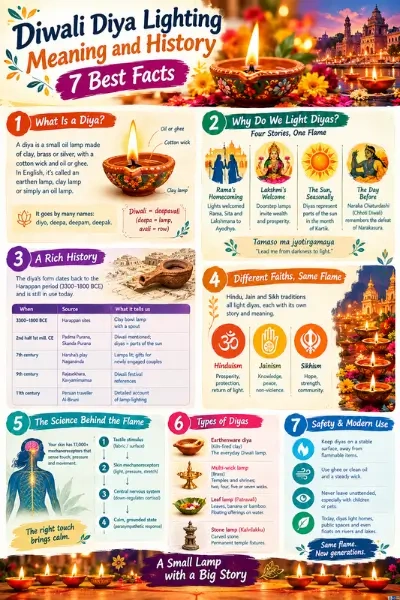
1. What Is a Diya, and What Is a Diya Called in English?
A diya is a small oil lamp: a bowl of clay, brass or silver, a cotton wick, and oil or ghee to burn. In English you’ll see it called an earthen lamp, a clay lamp, or simply an oil lamp. The spellings wander (diyo, deepa, deepam, deepak) because the object travels across a dozen languages. For a quick reference on Diwali diya lighting meaning and history), Wikipedia’s article on the diya lamp is a fair first stop. Treat it as a map, not the territory.
The festival’s own name does half the work. Diwali comes from the Sanskrit deepavali: deepa, lamp; avali, row. A row of lamps. Not one lamp. I find that quietly radical, because it says the point was never a single perfect flame. It was many small ones, set side by side.
What are diya lamps used for the rest of the year? Plenty. They burn in daily home prayer, in the arti ritual where light is waved before a deity, at births, and at festivals such as Karthikai Deepam in the Tamil-speaking south. They sit in Hindu, Sikh, Buddhist and Jain worship alike. A diya emoji even joined Unicode in 2019.
2. Why Do We Light Diyas on Diwali? Spiritual Significance in Four Stories
There is no single answer, and anyone offering one is simplifying. These are the four threads I see most often.
Rama’s homecoming. The best-known story. Rama, Sita and Lakshmana return to Ayodhya after fourteen years of exile and the defeat of Ravana, and the city’s people light the streets to welcome them. It’s the version most British children hear, and the one behind Ayodhya’s modern record-setting spectacle (more on that in fact seven).
Lakshmi’s welcome. In Hindu iconography, diyas are associated with Lakshmi, goddess of wealth and fortune. One popular belief says doorstep lamps are there so she can find your house. I’d file that under devotional custom rather than scripture; the sources I checked present it as tradition, not text.
The sun, seasonally. The Skanda Purana, completed in the second half of the first millennium CE, describes diyas as standing for parts of the sun, the cosmic giver of light and energy, as it shifts through the month of Kartik. Older, stranger and more astronomical than the Ramayana reading. I like it for exactly that.
The day before. Many Hindu households mark Naraka Chaturdashi, “Chhoti Diwali”, which in Krishna’s story recalls the defeat of the demon Narakasura. In 2026 it falls on Saturday 7 November.
Under all four runs a Sanskrit prayer you’ll hear around now: tamaso ma jyotirgamaya, “lead me from darkness to light”. That single line is the emotional engine of the festival. Everything else, the sweets, the rangoli, the fireworks, is built on top of it.
3. What Is the History of the Diya? Reading the Evidence
Start with the object. The Chhatrapati Shivaji Maharaj Vastu Sangrahalaya in Mumbai describes the earliest Indian lamp as a small clay bowl with a beak-like projection, called panti in Marathi and diya in Hindi, and notes that the form appears from the Harappan period (3300–1800 BCE) and is still in use today. Let that sit. A Bronze Age pinch-pot lamp and the one on your windowsill are, structurally, cousins.
The festival is a separate question, and here the evidence arrives in layers rather than as a founding date.
Look at what that table doesn’t contain: a moment when someone invented Diwali. The scholar Gode spent a landmark paper arguing that festivals can’t be understood without a chronological account of their sources, and the trail above is exactly that kind of reconstruction. The lamp is older than the texts. The festival’s name keeps shifting, Dipapratipadotsava, then Dipamalika, then Deepavali, while the flame stays put.
Wikipedia’s summary, and many historians, describe Diwali as likely a fusion of older harvest festivals. I’ve laid out the same harvest-meets-religion pattern across other celebrations in Ancient roots of modern festivals, and it’s a useful lens here. Any honest account of Diwali diya lighting meaning and history has to admit this much: the lamp is the constant, and the stories are the variable.
4. What Do the Clay, Oil, Wick and Flame Stand For?
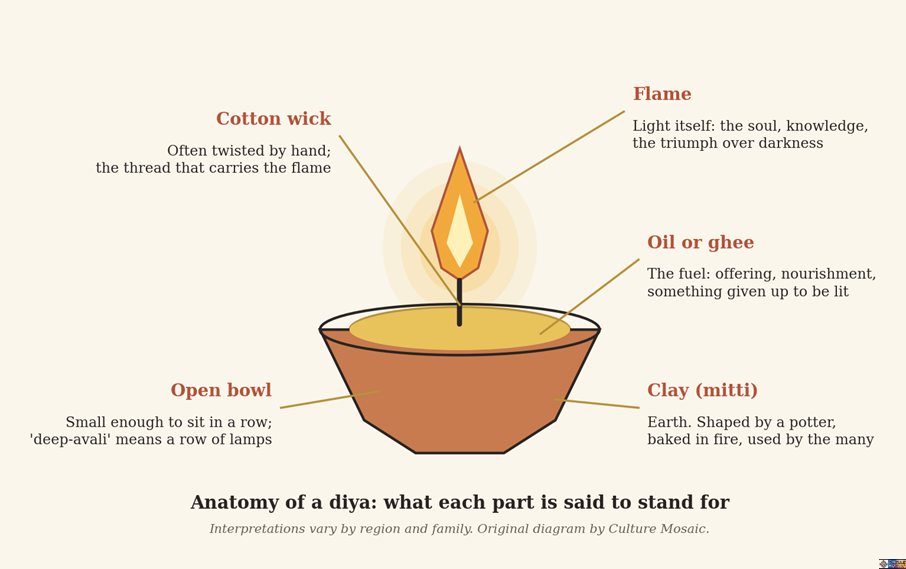
Original diagram: what each part of a diya is said to stand for. Interpretations vary by region and family.
Museum labels in Mumbai put it plainly: in India, the lamp symbolises the human body and the flame symbolises the soul. Everything else is commentary, and good commentary at that.
Unveiling the Beauty of the Diya: Understanding Cultural Craft
The reading I find most affecting is the clay. A diya is earth, shaped by a potter’s hands, baked in fire, and cheap enough that everyone can afford a row. At Ayodhya’s 2025 festival, the Uttar Pradesh government said the lamps were crafted by local artisans from the Prajapati and Kumhar potter communities, and a pre-event report put roughly 16 lakh of the 26 lakh lamps as handmade by about 40 potter families, with the rest from industrial units, groups and the public. Light that depends on a craft. I’d argue that’s the layer of Diwali diya lighting meaning and history that greeting cards skip.
A diya lighting ceremony at home is usually simpler than people fear. The house is cleaned and tidied (Rajasekhara noted whitewashed homes in the ninth century, so some things never change), small lamps go at entrances and boundaries, and they’re lit in the evening around the family puja. Customs differ by region and household. Follow the one you were handed, or ask the elders for it.
5. How Do Hindus, Jains and Sikhs Read the Same Flame?
Same lamp. Different memory. Diwali diya lighting meaning and history looks quite different from a gurdwara courtyard than from a Jain temple or a Hindu living room, yet the objects on the ground are nearly identical.
Reflections published on the judiciary.uk site note that Sikh and Hindu households alike decorate homes and shops with small oil lamps, written “divas” in British usage, set in rows at windows and doors. The same page cites a line from the Guru Granth Sahib (Ang 791): “(When) the lamp is lit, darkness is dispelled.” You can feel why the same object works across traditions. Darkness is a universal problem. A small flame is a universal answer.
If you’d like Diwali set beside Hanukkah, Yuanxiao and Loy Krathong, I’ve compared them in cultural light festivals, and the wider map of faith calendars is in Religious Festivals in the World. Britain’s festival year is increasingly shaped by diaspora communities, a thread I follow in Ethno Cultural Festivals Heritage. For Diwali among the long-standing heritage calendars, see Traditional World Festivals Cultural Heritage.
6. What Is the Scientific Reason Behind Lighting a Diya, and What If One Falls?
Short answer: most of the viral claims are weak. You’ve seen them. Ghee lamps purify the air. Mustard-oil flames repel insects. I looked for peer-reviewed support and didn’t find any for either.
Here is what does exist, with a flag attached first. The two small emissions studies I found were published in the Interdisciplinary Journal of Yagya Research, a journal devoted to Vedic fire-ritual research, so it isn’t a neutral venue. One compared ghee and peanut-oil lamps and found no significant difference on most pollutants, except carbon monoxide, which was about 16% lower for ghee. Another compared soot from kerosene, vegetable oils and ghee and concluded that ghee’s particles looked structurally less hazardous than kerosene’s. That’s a modest result. “Cleaner than kerosene” is a low bar, and any flame indoors still makes particles. The same journal’s study of full yagya fires recorded very high particle levels, which is a useful reminder that sacred smoke is still smoke. Open a window.
So the Diwali diya lighting meaning and history that science can actually test is narrower than the folklore. The more defensible reasons are cultural. A shared, visible act, repeated on the darkest night of the season, does something for a household that no air-quality chart measures. That’s my view, not a lab result.
What happens if a diya falls down by mistake?
I couldn’t trace a rule on this in the textual sources I checked, so it reads as household custom that varies by family and region. Some people treat a fallen or blown-out lamp as an omen. Many simply relight it and carry on. Ask an elder in your own tradition. What I can document is the real risk, which is fire. London Fire Brigade said firefighters attended more than 250 fires over the Diwali period in 2017, and it has repeatedly traced flat fires to tea lights left burning at home shrines. Its advice, echoed by Kensington and Chelsea council, which names diya lamps specifically: never leave them unattended, keep them away from curtains and furniture, use a stable fire-resistant holder, and choose LED lights in flats.
7. How Do You Light Diyas This Diwali? A Practical Guide for 8 November 2026
Diwali (Lakshmi Puja) falls on Sunday 8 November 2026, with the five days running from Dhanteras on Friday 6 November to Bhai Dooj on Tuesday 10 November, according to Drik Panchang’s UK calculations. For the exact puja time in your town, check your local mandir.
Here is a simple sequence that puts Diwali diya lighting meaning and history into practice in a British home:
- Pick your lamps. Handmade clay diyas if you can, ghee or oil, and a fresh cotton wick.
- Place them on a stable, fire-resistant surface, well away from curtains, papers and sleeves.
- Light them in the evening, shrine first, then the doorway, then the windows.
- Stay in the room while they burn. If you can’t, switch the rest to LED.
- Let them burn down in sight, or snuff them yourself.
One weird extra, because tradition has more range than a row of clay: a leaf lamp. The patravali, a floating lamp made from leaves or a banana stem, is a documented lamp form, and a leaf diya floated in a wide bowl of water is a gentle way to bring something handmade to the table. Keep it away from anything that burns, and never leave it unattended.
Where Diwali lighting is happening now
Leicester’s Golden Mile on Belgrave Road has hosted illuminations for over 40 years and is widely described as the biggest Diwali celebration outside India. The city’s tourism listing centres Diwali Day on 8 November 2026, though listings disagree on the 2026 switch-on ceremony and fireworks, so check Leicester City Council before you travel. In London, Diwali on the Square is listed for Sunday 25 October; confirm with the Mayor of London’s site. If you’re setting off fireworks, the usual 11pm curfew is extended to 1am on Diwali night. These lights are a kind of temporary public infrastructure, built only to bring people together, an idea I audit more broadly in Ephemeral Social Infrastructure. For other celebrations worth planning around, the Global Cultural Festivals Guide and Unique cultural festivals are good next stops.
The proof that the lamp still matters
Scale first. Ayodhya’s Deepotsav has climbed from 1.71 lakh lamps in 2017 to 26,17,215 in 2025, a figure the Uttar Pradesh government says Guinness representatives verified by drone count. For wider context on festival size, see the Top 20 Biggest Festivals in the World.
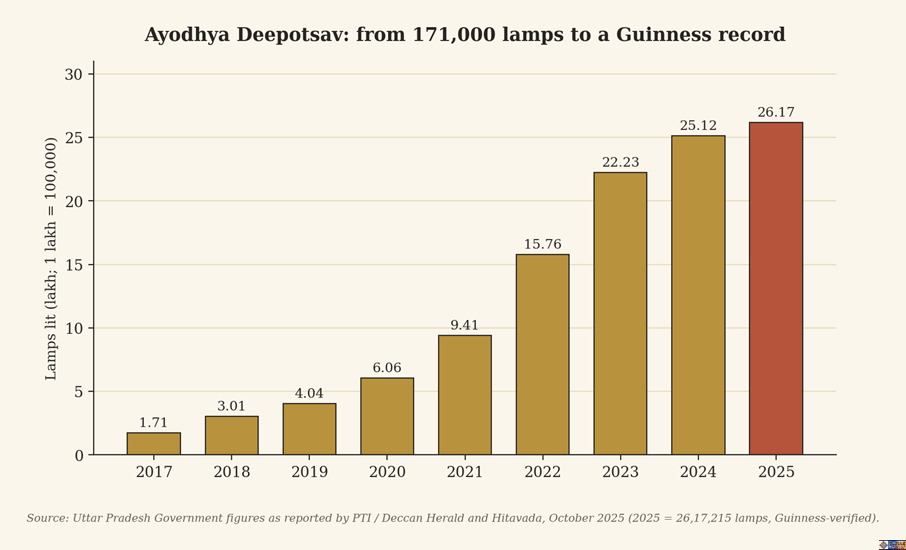
Original chart: lamps lit at Ayodhya Deepotsav, 2017–2025, from Uttar Pradesh Government figures.
Recognition second. On 10 December 2025, during the twentieth session of UNESCO’s intangible heritage committee at Delhi’s Red Fort, Deepavali was inscribed on the Representative List of the Intangible Cultural Heritage of Humanity, under “social practices, rituals and festive events”. It became India’s sixteenth element on the list. India’s culture minister called the listing a responsibility: to keep Deepavali a living heritage.
And the quiet question, the waste. A clay lamp is earth, and it goes back to earth. A foil tea-light cup doesn’t. If you’re choosing between them, I’d pick clay every time, for the craft as much as the compost. The wider conversation about leaving less behind sits in Regenerative Festival Culture and The post concert hangover, and if you’re curious about why shared ritual lands in the body, the discussion continues in Ancestral Somatic Rituals 2026.
You’ll light one lamp, and then another beside it. A row, then, not a lamp.
Frequently Asked Questions
1. What is a diya called in English?
In English a diya is most often called an earthen lamp, a clay lamp or an oil lamp. It is a small bowl, usually kiln-fired clay but sometimes brass or silver, holding oil or ghee and a cotton wick. Regional names include deepa, deepam, diyo and deepak, and the festival name Diwali comes from deepavali, meaning a row of lamps. If you see “divas” in British writing, that is the same object in another spelling.
2. What are diya lamps used for?
Diwali is the headline use, but diyas also appear in daily home prayer, in arti (waving light before a deity), at births, and at festivals such as Karthikai Deepam in the Tamil-speaking south. They are used in Hindu, Sikh, Buddhist and Jain worship. In temples they may be brass lamps with several wicks; at home, a plain clay diya does the job. That range of use is why Diwali diya lighting meaning and history can’t be separated from everyday devotion.
3. Why do we light diyas on Diwali, and what is their spiritual significance?
Traditions give different reasons. Many Hindus light them to recall Rama’s return to Ayodhya and to welcome Lakshmi. Jains mark Mahavira’s attainment of nirvana, and Sikhs observe Bandi Chhor Divas for Guru Hargobind’s release in 1619. Across all of them the lamp stands for knowledge over ignorance and hope over despair, expressed in the prayer “lead me from darkness to light”. That shared symbolism is the core of Diwali diya lighting meaning and history.
4. What happens if a diya falls down by mistake?
I couldn’t find a rule on this in the textual sources I checked, so it is best understood as household custom that varies by family and region. Some people see a bad omen; many simply relight or replace the lamp and carry on, and an elder in your own tradition is the best guide. The practical priority is safety: put out any spilled flame, clear the oil, and relight only on a stable, fire-resistant surface. Fire is the genuine risk, as London Fire Brigade has warned repeatedly.
5. What is the scientific reason behind lighting a diya?
There is no strong scientific case for the popular claims that diyas purify the air or repel insects, and I found no robust peer-reviewed support for them. The small studies that exist, published in a niche journal on Vedic ritual research, measured emissions: ghee and peanut-oil lamps were similar on most pollutants, and ghee soot looked less hazardous than kerosene soot. Any flame indoors still produces particles, so ventilate the room. The more defensible reasons are cultural: a shared, visible act marking the darkest night of the season.
Sources
- Tribune India, “Deepavali inscribed on UNESCO’s Intangible Cultural Heritage List” (10 December 2025). https://www.tribuneindia.com/news/india/deepavali-inscribed-on-unescos-intangible-cultural-heritage-list
- DT Next / PTI, “India’s Deepavali inscribed on UNESCO Intangible Cultural Heritage list”. https://www.dtnext.in/news/national/indias-deepavali-inscribed-on-unesco-intangible-cultural-heritage-list-856158
- Chhatrapati Shivaji Maharaj Vastu Sangrahalaya (CSMVS), Mumbai, “Harappan clay panti” and “The Swans of Light: The Indian Lamps”. https://csmvs.in/deepavali
- Wikipedia, “Diya (lamp)”. https://en.wikipedia.org/wiki/Diya_(lamp)
- Wikipedia, “Diwali” (history section: Padma and Skanda Puranas, Nagananda, Kavyamimamsa, al-Biruni, de’ Conti). https://en.wikipedia.org/wiki/Diwali
- JSTOR Daily, “A History of Diwali” (on Gode’s “Studies in the History of Hindu Festivals”, including the 1030 CE al-Biruni and 1119 CE Kannada inscription references). https://daily.jstor.org/a-history-of-diwali
- UCSF Diversity, “Diwali” fact sheet (Jain and Sikh observances). https://diversitybch.ucsf.edu/sites/g/files/tkssra5176/f/Diwali.pdf
- Judiciary of England and Wales, “Diwali reflections from the judiciary”. https://www.judiciary.uk/diwali-reflections-from-the-judiciary/
- London Fire Brigade, “Use LED candles at Diwali, London Fire Brigade urges” (2018). https://www.london-fire.gov.uk/news/2018-news/use-led-candles-at-diwali-london-fire-brigade-urges
- Royal Borough of Kensington and Chelsea, “Candle safety this Halloween and Diwali” (30 October 2024). https://www.rbkc.gov.uk/newsroom/candle-safety-halloween-and-diwali
- Royal Borough of Greenwich, “Diwali” (fireworks curfew and safety tips). https://www.royalgreenwich.gov.uk/info/200201/community_safety_and_environment/2316/autumn_tips/3
- Shukla, Sursaut and Kumar, “Reduced Carbon Monoxide Emission in Ghee Lamp than Peanut Oil Lamp”, Interdisciplinary Journal of Yagya Research (2022). https://journals.dsvv.ac.in/ijyr/article/view/271
- “Comparative Physicochemical Characterization of Particulate Matter Emitted from Diya”, Interdisciplinary Journal of Yagya Research. https://journals.dsvv.ac.in/ijyr/article/view/298
- “Particulate Matter and Gaseous Emissions from Yagya Fume in Open and Closed Door Environment”, Interdisciplinary Journal of Yagya Research. https://journals.dsvv.ac.in/ijyr/article/view/273
- Deccan Herald / PTI, “Ayodhya Deepotsav: New world record with 26.17 lakh diyas” (19 October 2025). https://www.deccanherald.com/amp/story/india%2Futtar-pradesh%2Fayodhya-deepotsav-new-world-record-with-2617-lakh-diyas-2128-people-performing-aarti-together-3769719
- The Hitavada, “Deepotsav: New world records with 26.17 lakh diyas” (20 October 2025). https://www.thehitavada.com/Encyc/2025/10/20/deepotsav-new-world-records-with-2617-lakh-diyas-2128-people-performing-aarti-together.html
- Free Press Journal, “Ayodhya Set To Shine With 26 Lakh Diyas For Deepotsav 2025”. https://www.freepressjournal.in/amp/india/uttar-pradesh-news-ayodhya-set-to-shine-with-26-lakh-diyas-for-deepotsav-2025
- Hindutone, “The 5-Day Diwali Festival in the UK 2026” (Drik Panchang UK dates; secondary listing). https://hindutone.com/festivals/diwali-2026/5-day-diwali-festival-uk-2026-dhanteras-bhai/
- Hindutone, “Diwali 2026 UK” (Diwali on the Square listing; secondary listing). https://hindutone.com/festivals/diwali-2026-uk/
- TripProf, “Where to spend Diwali 2026” (Leicester Diwali Day 8 November, citing the city’s tourism site; secondary listing). https://tripprof.com/en/blog/best-cities-diwali-festival-of-lights/
- Radical Storage, “Diwali in Leicester 2026” (2026 switch-on and fireworks details; secondary listing, confirm with Leicester City Council). https://radicalstorage.com/travel/?p=84691
- Patrika, “Diwali 2025: The tradition of lighting lamps” (doorstep-lamp custom for welcoming Lakshmi). https://www.patrika.com/en/religion-and-spirituality/diwali-2025-the-religious-tale-of-the-lamps-birth-is-linked-to-the-sun-know-the-beliefs-and-facts-associated-with-it-20035137
Culture Mosaic is a UK-based publication covering cultural heritage, civic life and global traditions. Explore more at Culture mosaic.