
 By Culture Expert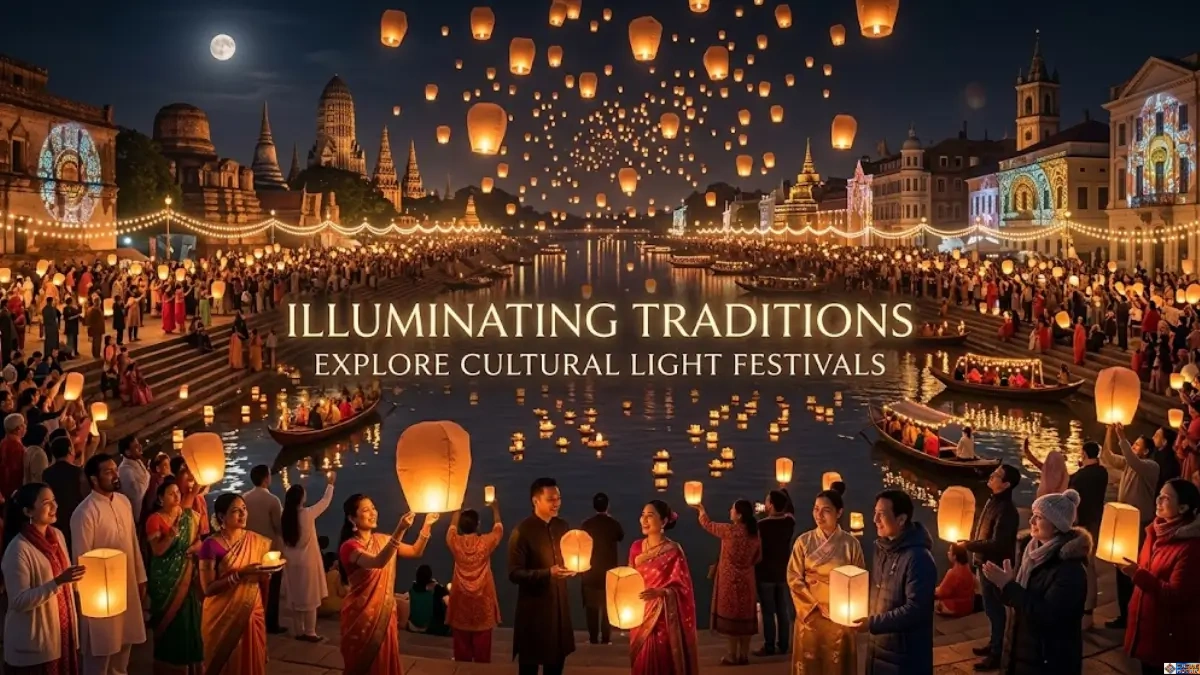
Quick Summary
Cultural light festivals are ceremonies, in nearly every civilisation I’ve studied, that use fire, lanterns, or illumination to mark a turning point — the end of a harvest, the shortest day of the year, a spiritual victory, a return home. Diwali, Hanukkah, China’s Lantern Festival, Thailand’s Yi Peng and Loy Krathong, Sweden’s St Lucia’s Day, and Lyon’s Fête des Lumières are among the oldest and largest.
In the UK, the picture has shifted fast: Lumiere, the country’s flagship light-art biennial, staged its final Durham edition in November 2025 after sixteen years, while garden and estate light trails such as Christmas at Kew and Blenheim Palace Illuminated have multiplied to fill the gap. Below, I walk through where these traditions began, what light actually symbolises across faiths, which lantern festivals draw the biggest crowds, and how the sustainability conversation is reshaping all of it — including sky lanterns, which conservation groups now flag as a genuine wildlife hazard.
Losing a festival you love stings more than people expect. I’ve had readers in Durham tell me, quite plainly, that Lumiere going dark felt like losing a family Christmas tradition — not a metaphor, an actual grief. If that’s you, stick around. The tradition itself isn’t dying. It’s scattering, mutating, and turning up in gardens, harbours, and temple courtyards across the world, often more accessible than the flagship event ever was.
1. What Actually Counts as a Cultural Light Festival?
Here’s where I get pedantic about cultural light festivals as a category, because the term gets stretched to cover two genuinely different things. One is ceremonial: light used as ritual, tied to a specific religious or agricultural calendar, passed down through families rather than commissioned by a council. Diwali’s diyas and Hanukkah’s menorah both sit here — the light isn’t decoration, it’s the whole point of the act. The other is contemporary light art: large-scale projection, laser and LED installations, usually free, usually winter, usually designed to pull footfall into a city centre during its darkest, quietest months. Lumiere belonged to this second category, and so does Vivid Sydney.
Cultural light festivals, in the fullest sense I use the phrase, span both camps — and I’d argue the boundary between them is getting blurrier every year, since even devout, centuries-old festivals now borrow LED technology, and secular light-art biennials increasingly lean on the imagery of older, sacred traditions. I’ve laid out the wider picture of how festivals hold communities together, on and off the light-and-lantern theme, in Traditional World Festivals: Cultural Heritage.
2. Where Did Lantern Celebrations Begin? A History of Lantern Festivals
Any honest history of lantern festivals has to start in China. The oldest, best-documented lantern tradition on record is China’s Yuanxiao Festival, and its roots go back roughly 2,000 years to the Han dynasty. According to the Records of the Grand Historian, Han emperors held vigils for the deity Taiyi at dusk, keeping lantern flames burning through the night to pray for a prosperous year — a court ritual that eventually spilled into the streets.
It hardened into a proper public spectacle under the Tang dynasty, when authorities famously lifted the usual night curfew in the capital so people could wander the streets under lantern light, and it reached its most extravagant form under the Ming, when celebrations ran for ten straight days.
The festival now falls on the fifteenth day of the first lunar month, the first full moon of the new year, and it lands on 3 March in 2026. Families still eat round, chewy rice balls called tangyuan — the shape and the word both echo tuanyuan, meaning reunion — and lanterns strung with riddles remain one of the few genuinely interactive folk games left standing in the modern calendar.
I’ll be honest: most Western write-ups of “lantern festival history” flatten centuries of dynastic change into a single origin myth about a maid named Yuanxiao tricking an emperor. It’s a lovely story, and it’s worth telling. It just isn’t the whole history, and pretending it is does the tradition a disservice.
3. What Do Light and Fire Actually Symbolise?
Strip away the specifics and a pattern emerges that I find genuinely striking after years of comparative fieldwork: light almost never symbolises light for its own sake. It stands in for something else — knowledge over ignorance in Diwali’s Sanskrit framing, purity and rededication in Hanukkah, protection from disease in Lyon’s founding legend, wishful release in Thailand’s floating khom loy. Deepavali itself comes from Sanskrit deepa (lamp) and avali (row) — literally “a row of lamps” — and ancient texts including the Padma Purana and Vishnu Purana reference the festival by name.
The symbolism of light in cultural traditions tends to cluster around three ideas, in my experience: transition (marking the turn from one season, year, or spiritual state to another), protection (warding off darkness, illness, or malevolent forces), and memory (commemorating an ancestor, a miracle, or a rescue). Almost every festival on this list ticks at least two of the three. That’s not coincidence — it’s what makes fire and light such durable ritual material in the first place. You can’t easily fake a flame, and you can’t ignore one in a dark room.
4. Festivals of Light in Different Religions
No survey of cultural light festivals is complete without the religious calendar, since most of the oldest examples started life as devotional acts rather than public spectacle. Ask “what is the famous festival of lights?” and most people in the UK will say Diwali — fairly, given its scale. Diwali, or Deepavali, is celebrated by well over a billion people across Hindu, Sikh, Jain, and Buddhist communities, and it has no single origin story because each tradition attaches its own meaning to it. For Hindus in the north, it commemorates Rama’s return to Ayodhya after defeating Ravana; for Jains, it marks Mahavira’s attainment of nirvana; for Sikhs, it recalls Guru Hargobind’s release from imprisonment. What holds constant is the lamp.
Hanukkah runs on a different clock but the same underlying logic. It marks the Maccabees’ recapture of the Second Temple in Jerusalem around 164 BCE, after a three-year revolt against Seleucid rule, and the Talmudic account of a single day’s oil miraculously lasting eight. The nine-branched hanukkiah — eight candles for the eight nights, plus the shamash used to light the rest — has become one of the most recognisable objects in Jewish material culture, and museum collections trace its stylistic range from the first century BCE to the present.
Christianity has its own quieter version in Sweden’s Sankta Lucia celebrations on 13 December, where candle-crowned processions mark the saint’s feast day close to the winter solstice, a pairing that long predates today’s festival calendar. I’d point readers curious about the wider religious landscape to Culture Mosaic’s own survey of religious festivals in the world, and to Parenta’s parent-facing rundown of the same territory for a UK schools angle.
5. What Is the Biggest Lantern Festival in the World?
Scale is where cultural light festivals really start to compete with each other, and the numbers get genuinely staggering. By sheer visual density, nothing beats Chiang Mai during Yi Peng and Loy Krathong, which fall together around the full moon of the twelfth Thai lunar month — 24–25 November in 2026. Yi Peng, rooted in northern Lanna culture, sends khom loy sky lanterns drifting upward as an offering to the Buddha; Loy Krathong, celebrated nationwide, is the water-facing counterpart, where small floating krathong are set adrift to thank — and apologise to — Phra Mae Khongkha, the goddess of the rivers.
In modern Chiang Mai the two have essentially merged into one multi-night event, and it’s the closest thing I’ve seen to a festival that lights both the sky and the water in a single evening.
By attendee count, Vivid Sydney is the heavyweight: 2024’s edition pulled 2.42 million visitors across 23 nights, its third-largest turnout on record, and the festival has previously injected over AU$119 million into the New South Wales economy in a single run. Outside Asia, the Toronto Chinese Lantern Festival — built around 50-foot illuminated steel-and-paper sculptures — is generally cited as the largest lantern festival held outside Asia. None of these figures are static, and if you’re chasing scale for its own sake, Top 20 Biggest Festivals in the World is worth a look for context beyond the light-specific field.
6. What Happened to the UK’s Flagship Light Festival — and What’s Replacing It?
Here’s the part that actually prompted me to write this piece. Lumiere launched in Durham in 2009, produced by the London arts company Artichoke, and grew into what Durham County Council itself calls the UK’s light art biennial — more than 1.3 million visitors and roughly £43 million of economic impact across its run. In October 2025, Durham County Council announced that November’s edition would be the last “in its current format,” citing escalating costs and a wider funding reset. It closed, fittingly, with community-made lanterns — a project called Glimmer, strung with messages from local residents — rather than a single spectacular finale.
I won’t pretend that’s a small loss. Lumiere shaped how an entire generation of UK cities think about winter tourism, and it directly inspired the wave of estate and garden light trails that have since become a genuine seasonal industry: Christmas at Kew’s three-kilometre trail through the Royal Botanic Gardens, Blenheim Palace Illuminated at the UNESCO-listed Oxfordshire estate, RHS Wisley Glow, Chester Zoo’s lantern trail, and dozens of smaller municipal and country-house events now run every November through January.
They’re commercial where Lumiere was free, and they’re spread across dozens of sites rather than concentrated in one city — but the underlying appetite for standing outside in the cold looking at something glowing hasn’t gone anywhere. If your winter calendar is built around live events more broadly, Best UK Folk Festivals covers a parallel story of a beloved event closing and a successor stepping in.
7. Are Modern Light Festivals Actually Sustainable?
Sustainability is the debate that follows cultural light festivals into every planning meeting I’ve sat in on, and rightly so. This is the section I get the most pushback on, so let me just say it plainly: sky lanterns are not the harmless gesture they look like. Even lanterns marketed as biodegradable can take years to break down, and their wire frames have been documented strangling and trapping wildlife and livestock long after the flame has gone out; several countries and UK local authorities now restrict or ban mass releases outright for exactly that reason.
That doesn’t mean the underlying tradition — Yi Peng’s sky lanterns among them — is wrong to exist. It means organisers are, increasingly, swapping paper-and-wire lanterns for reusable LED versions, or shifting the “release” moment to drone shows and projection instead.
There’s a second, quieter environmental cost too: light pollution. Bright, blue-rich LED installations can disrupt nocturnal wildlife and human sleep cycles alike, and researchers working with dark-sky advocacy groups have flagged the loss of a visible night sky as its own kind of cultural erosion, particularly for Indigenous communities whose calendars and stories are built around specific stars.
The festivals doing this well — and Lumiere’s own carbon-impact assessment with A Greener Future was a genuine attempt at it — favour warmer, lower-intensity, downward-directed lighting and community-made lanterns over imported disposable ones. It’s a slower, less Instagram-ready approach, and I think it’s the right one. Culture Mosaic has covered the waste side of live events more broadly in The Post-Concert Hangover and in Regenerative Festival Culture, both worth reading alongside this if sustainability is your real interest here.
8. A List of Cultural Light Festivals Around the World
The table below lines up nine cultural light festivals covered in this piece so you can see origin, timing, and scale side by side at a glance.
| Festival | Where | Timing | Type | Scale |
|---|---|---|---|---|
| Diwali / Deepavali | India & global diaspora | Oct/Nov (lunar) | Hindu, Jain, Sikh, Buddhist | 1bn+ observe worldwide |
| Hanukkah | Jewish communities worldwide | 8 nights, Nov/Dec (Hebrew calendar) | Jewish religious | Global Jewish diaspora |
| Yuanxiao (Lantern Festival) | China & Chinese diaspora | 15th day, 1st lunar month (3 Mar 2026) | Folk / Han dynasty origin | Nationwide, ~2,000 yrs old |
| Yi Peng & Loy Krathong | Chiang Mai & Thailand | 12th lunar month full moon (24–25 Nov 2026) | Buddhist / folk | Millions nationwide |
| Sankta Lucia | Sweden & Scandinavia | 13 December | Christian / folk hybrid | National observance |
| Fête des Lumières | Lyon, France | Around 8 December, 4 days | Religious origin, now civic art | Millions of visitors |
| Lumiere (final ed. 2025) | Durham, UK | Biennial, November | Contemporary light art | 1.3m+ visitors over 16 yrs |
| Vivid Sydney | Sydney, Australia | May/June, 23 nights | Light, music & ideas | 2.4m+ visitors (2024) |
| Toronto Chinese Lantern Festival | Toronto, Canada | Summer season | Folk-inspired art installation | Largest outside Asia |
9. So Which Cultural Light Festival Should You Actually Plan Around?
If you want scale and don’t mind crowds, Vivid Sydney or Chiang Mai’s Yi Peng-Loy Krathong pairing deliver spectacle at a size nothing in Europe currently matches. If you want something rooted and quieter, Lyon’s Fête des Lumières still runs its original candle-in-the-window tradition alongside the projection shows, and it costs nothing to walk the old town on 8 December and watch. If you’re in the UK and mourning Lumiere specifically, Christmas at Kew and Blenheim Palace Illuminated are the closest things going, even if you’ll need a ticket this time.
And if you’d rather explore cultural festivals that have nothing to do with light at all — Culture Mosaic’s Ethno Cultural Festivals Heritage, Latino Cultural Festival, and Global Cultural Festivals Guide are good next stops.
Whatever you choose, go in November or December expecting cold hands, a long queue, and — if the festival’s any good — a moment where you stop taking photos and just look. That’s usually the point.
Frequently Asked Questions
1. What is the best light festival in the world?
“Best” depends entirely on what you want from it. For sheer scale, Vivid Sydney (2.4 million-plus visitors most years) and Thailand’s combined Yi Peng and Loy Krathong celebrations in Chiang Mai are the standouts. For history and intimacy, Lyon’s Fête des Lumières, running in some form since 1852, and Durham’s now-retired Lumiere both earned genuine devotion from residents rather than just tourists. I’d resist crowning a single “best” — a family-run Diwali celebration in someone’s home carries a weight no ticketed light trail can replicate.
2. What is the famous festival of lights?
In global search terms, this almost always means Diwali, the Hindu, Jain, Sikh, and Buddhist festival celebrated by well over a billion people each autumn. Hanukkah, the Jewish festival of lights, runs on a separate calendar and history but shares the “festival of lights” title in English-language usage, so it’s worth clarifying which one a source means.
3. What are some cultural festivals?
Beyond light-specific events, cultural festivals span everything from harvest and religious observances to civic and heritage celebrations. Culture Mosaic has profiled a wide range, including the Washington Whiskey Rebellion Festival as a good example of a heritage event built around a specific historical moment rather than a season or faith, plus Festivalle 2026 among our own recent coverage.
4. What is the biggest Lantern Festival in the world?
By visitor volume and physical scale of the installations, the Toronto Chinese Lantern Festival is generally cited as the largest lantern festival staged outside Asia. Within Asia, China’s own Yuanxiao Festival celebrations and Thailand’s Yi Peng draw comparable or larger crowds, though attendance is harder to pin down precisely since celebrations happen simultaneously across hundreds of towns rather than a single ticketed site.
5. Are sky lanterns safe to release at a festival?
Not reliably, no — and I say that as someone who finds them genuinely beautiful. Even biodegradable versions can take a long time to break down, their wire frames pose a documented entanglement risk to wildlife and livestock, and stray lanterns are a recognised fire hazard, which is why a growing number of UK local authorities and festival organisers now restrict mass releases or substitute reusable LED lanterns instead.
Sources
1. StudyCLI, “Lantern Festival History and Traditions” — studycli.org
2. The World of Chinese, “A Festival of Lights: How Lanterns Illuminate the Yuanxiao Festival Across China” — theworldofchinese.com
3. China Highlights, “Chinese Lantern Festival” — chinahighlights.com
4. Sahapedia, “Diwali: Origins and the Evolution of the Festival of Lights” — sahapedia.org; National Geographic, “Explaining the history of Diwali” — nationalgeographic.com
5. Jewish Museum Berlin, “Hanukkah — 8 Facts about the Jewish Feast of Dedication” — jmberlin.de
6. Jewish Museum of Florida-FIU, “Festival of Lights” exhibition notes — jmof.fiu.edu
7. Parenta, “Religious Festivals Around the World” — parenta.com
8. Wikipedia, “Yi Peng festival”; UME Travel, “Yi Peng Lanterns Festival 2026 & 2027” — umetravel.com
9. Destination NSW, “Vivid Sydney” official visitor figures — destinationnsw.com.au
10. Wikipedia, “Toronto Chinese Lantern Festival”
11. Durham County Council, “Lumiere, the UK’s light art biennial, returns with spectacular 2025 line-up” — durham.gov.uk
12. Durham County Council, “Final Lumiere to take place in 2025” — durham.gov.uk; Wikipedia, “Lumiere (festival)”
13. Londonist, “Illuminating Light Festivals And Trails In London This Winter” — londonist.com
14. Earth911, “5 Traditions That Are Terrible for the Environment” — earth911.com
15. arXiv, “Whitening the Sky: light pollution as a form of cultural genocide” — arxiv.org/abs/2001.11527
Culture Mosaic is a UK-based publication covering cultural heritage, civic life, and global traditions. Explore more at Culture Mosaic. For further reading on lantern traditions, see this cultural light festivals guide, and for a broader look at how modern festivals trace back to ancient ritual, see Ancient Roots of Modern Festivals.