
 By Culture Expert
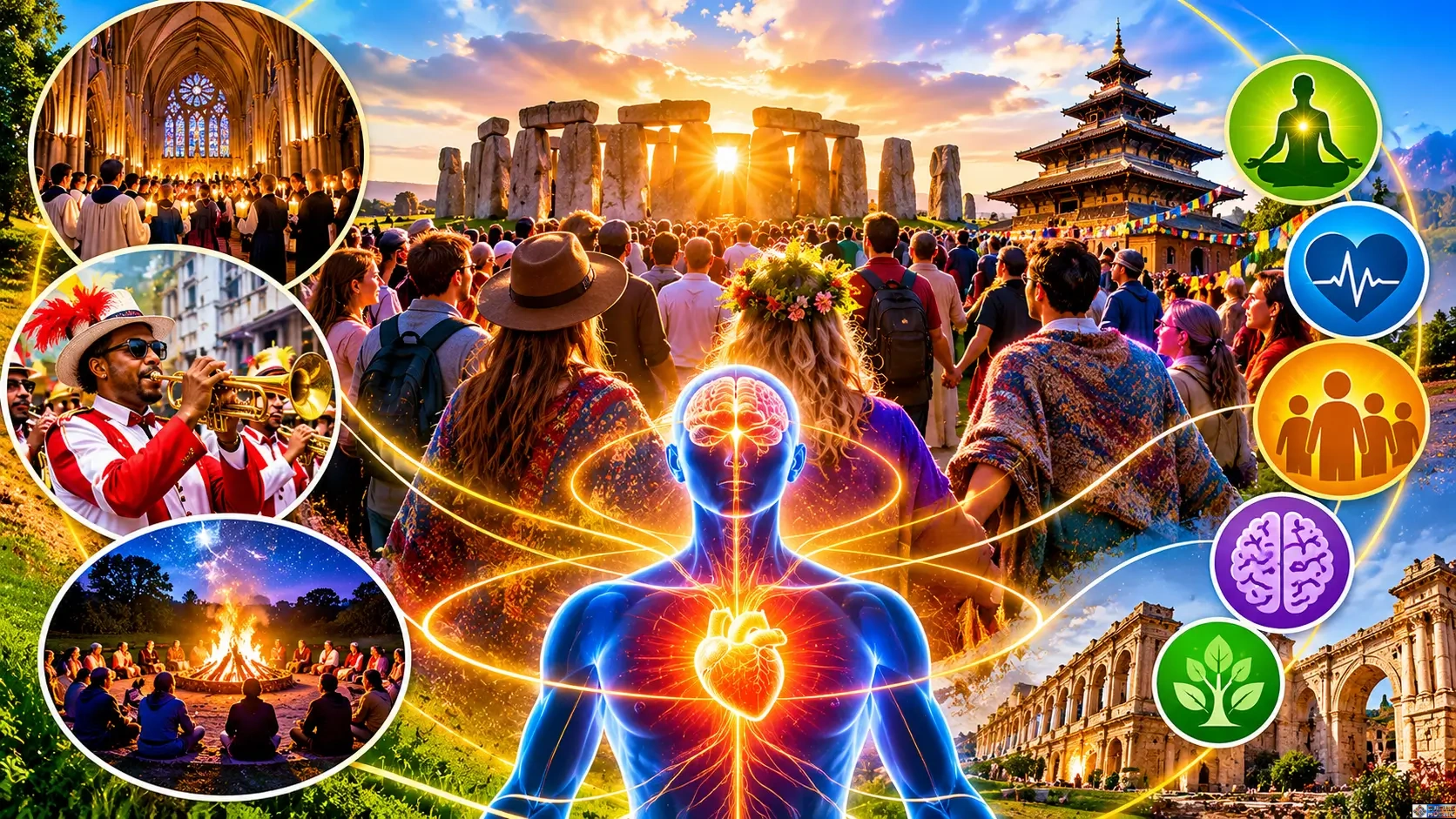
The Somatic Architecture of Collective Ritual: How Physical Space Shapes the Body in Collective Ritual
I’ve spent enough time standing in fields at 4 a.m. — notebook in one pocket, cold coffee in the other — to know that a crowd doesn’t behave the same way in every space. Put the same three thousand people in a car park and they mill. Put them in a stone circle facing a sunrise, or funnel them down a cordoned street behind a steel band, and something else takes over. Shoulders drop. Breathing lines up. Strangers start moving like they know each other.
That shift has a name. The somatic architecture of collective ritual is the study of how physical space — its shape, its boundaries, its sightlines, the way sound bounces off it — gets inside the body during a shared ceremony and changes what that body does. Not metaphorically. Measurably, in heart rate and pain threshold, as the studies below show. A Budapest workshop on The Somatic Architecture of Wellbeing Culture borrows the same root idea for studio working culture in architectural practice: built environments act on bodies.
This isn’t a festival calendar. It’s the anthropology behind why people still gather in circles, in processions, and in packed fields to do, physically and together, what they could just as easily read about at home.
Quick Summary
- Spatial shaping: The somatic architecture of collective ritual is the study of how a physical space — a stone circle, a temple square, a cordoned-off street — shapes what a body does during a shared ceremony, and how that shaping produces the feeling people call unity.
- Measurable effervescence: Émile Durkheim named the emotional charge of a successful gathering collective effervescence in 1912. Researchers have since tracked a version of it directly, in heart rate.
- The biology of synchrony: Moving in time — chanting, dancing, walking a procession in step — raises pain threshold, a standard proxy for endorphin release. That is one physical reason group ritual bonds people rather than just entertaining them.
- The power of geometry: The shape of a space (circular, radial, linear) decides whether a crowd faces inward toward one another or outward toward a spectacle, and that single choice changes the kind of togetherness on offer.
- Cultural pressure: Britain’s ritual architecture is under strain. Several long-running festival sites have closed, shrunk, or moved in recent years, which is its own evidence for how much the physical container matters.
1. Ritual Space Is a Nervous-System Technology, Not Decoration
Ask most people what “architecture” means at a festival and they’ll picture a stage, a marquee, bunting. Fair enough. But somatic architecture treats a ritual space the way an engineer treats a bridge: as something built to carry a specific load. Here, the load is bodies moving in relation to one another.
A stone circle carries that load differently from a straight street. A temple courtyard carries it differently again. The load itself — several hundred nervous systems trying to feel like one thing for an hour — stays constant across every tradition I’ve looked at, from West Country solstice gatherings to South Asian temple processions (our guide to Traditional World Festivals Cultural Heritage covers the wider map). What changes is the container. The container decides whether people end up facing each other or facing a spectacle, standing still or moving in step, silent or chanting.
That’s the unglamorous core of the somatic architecture of collective ritual. Space is not a backdrop to the ritual. It’s one of the ritual’s working parts.
2. Effervescence Is Real, and Now It’s Measurable
The French sociologist Émile Durkheim never stood in an Australian desert. He built The Elementary Forms of Religious Life (1912) from the written accounts of ethnographers, chiefly Baldwin Spencer and Francis Gillen, who had watched Arunta totemic ceremonies first-hand. His argument: ordinary life is mostly “profane” — hunting, gathering, admin, essentially — punctuated by rare occasions when the whole group assembles and something intensifies. He called that intensification collective effervescence, and argued it was the actual engine of religion, not belief handed down first and felt second.
For most of the twentieth century that stayed a beautiful idea with no instrument attached. Then a research team including Ivana Konvalinka and Dimitris Xygalatas went to San Pedro Manrique, in Spain, where villagers walk barefoot across coals at an annual midsummer ritual. They fitted fire-walkers, and their watching friends and family, with portable heart monitors. The coals sat around 677°C. The results, published in PNAS in 2011, showed that fire-walkers’ heart-rate patterns synchronised with those of related spectators, and not with unrelated people standing right beside them. Social closeness shaped the pattern.
That matters well beyond the lab; our guide to Ethno Cultural Festivals Heritage covers the wider field. It means the sense of belonging people report after a big shared event isn’t just a story they tell afterwards. Something physiological happened, in company, and it happened because of where they were standing when it did.
Civic ritual runs on the same logic. US re-enactments such as the Washington Whiskey Rebellion Festival do for a modern crowd what totemic gatherings did for Durkheim’s Arunta: they turn an ordinary field into sacred ground for an afternoon, simply by getting people to move through it together, at the same pace, toward the same point. For the long view on how old that habit is, see Ancient roots of modern festivals.
3. Your Body Votes Before Your Mind Does
Within the somatic architecture of collective ritual, effervescence is the feeling and synchrony is the mechanism, and the clearest evidence comes from Oxford, not a field study. Bronwyn Tarr, working with Robin Dunbar’s group, ran Brazilian teenagers through dance sessions that varied two things: how energetically they moved, and how closely they moved in time with each other. Both variables independently raised pain threshold (a reliable stand-in for endorphin release) and reported closeness to the group. Combine high exertion with tight synchrony and you get the biggest effect of all.
A follow-up experiment gave participants either naltrexone, which blocks the body’s opioid receptors, or a placebo. The synchrony boost to pain threshold was blunted in the naltrexone group. That is strong evidence that the body’s own opioid system, not imagination, is doing some of the bonding work.
I’d put it more bluntly than most of the papers do. When a crowd chants, sways, or processes in step, the body registers safety and kinship before a single thought about “community” has formed. The mind narrates the ritual afterwards. The body cast its vote during it.
4. The Shape of the Room Decides Who You Become
This is where the anthropologist Victor Turner is unavoidable. Working with the Ndembu of what is now Zambia, Turner argued that rites of passage move people through a liminal stage — “betwixt and between” their old and new social roles — and that liminal crowds tend to produce communitas: a flattened, intensely bonded state where normal hierarchy briefly stops applying. He later extended the idea to festivals, describing large public gatherings as a scheduled, sanctioned dose of exactly this state.
Space either produces communitas or blocks it, and it does so through blunt physical decisions. A circle — Stonehenge, a fire ring, a drum circle — puts every participant in view of every other and no one at the front. A radial or processional layout — a carnival route, a pilgrimage road — produces a shared direction of travel, which bonds a crowd around momentum rather than mutual eye contact. Neither is better. They’re different tools, and mixing them up (a stage-and-spectacle crowd in a shape built for mutual witnessing, or vice versa) is a reliable way to make an event feel flat even when the music and the guest list are right.
| Ritual space | Movement pattern | Boundary type | Dominant sense | Typical somatic effect |
|---|---|---|---|---|
| Stone circle (e.g. Stonehenge) | Static, inward-facing | Fixed monoliths, open sky | Sight — alignment, sunrise | Anticipatory stillness, collective hush |
| Temple square / mandala courtyard | Slow circumambulation | Walled or colonnaded perimeter | Rhythm — repeated circling | Meditative entrainment, loss of time sense |
| Street procession (e.g. carnival route) | Linear, forward-moving crowd | Barriers, buildings either side | Sound — bass, chant, whistle | Escalating arousal, release |
| Open festival field | Loose, radial, self-organised | Fencing at the edge only | Multi-sensory, low structure | Improvised bonding, higher variance |
Britain’s own civic calendar makes the point without needing an ancient example. Cultural light festivals work almost entirely through darkness and directed movement. You walk toward the light, in a queue, at a controlled pace, and the pacing itself is the ritual technology, doing quietly what a Balinese temple procession does loudly. A row of Diwali lamps along a street does something similar; our piece on Diwali diya lighting meaning and history explains why the lit path matters. Compare that with a Latino cultural festival built around an open plaza and a dance floor rather than a route. The somatic contract is completely different, closer to Turner’s circle than his procession, and it produces a looser, louder kind of communitas rather than a hushed one.
Scale changes the physics too. Once crowds run into the millions, at events of the kind ranked in the Top 20 Biggest Festivals in the World such as Kumbh Mela or Rio Carnival, pure circular design stops being possible and organisers fall back on radial zoning: concentric rings around a sacred centre, with movement channelled along spokes. Same logic as a stone circle, engineered at a scale Durkheim never had to think about. Cemeteries work as ritual rooms too: the candlelit graveside vigils behind Why is the Day of the Dead celebrated? turn a place of absence into a crowded, warm, deliberately shaped one.
5. Can the Somatic Architecture of Collective Ritual Heal Trauma — or Just Fake It?
This is the claim I’d push back on hardest, because it gets repeated online with far more confidence than the evidence supports. It’s true that synchronised, embodied group ritual — drumming circles, communal walking, structured group movement — shows up in trauma-informed community work. The mechanism isn’t mysterious: shared rhythm and safe physical proximity can down-regulate a stressed nervous system, and a well-designed space (soft boundaries, no forced eye contact, clear exits) supports that far better than a badly designed one.
Xygalatas’s firewalking data is a useful corrective. The ritual is genuinely intense and genuinely bonding. It’s also dangerous, arousing, and not something anyone would recommend as therapy. Effervescence is powerful. Power isn’t the same as healing.
Religious architecture has managed this tension for millennia, which is worth remembering before treating “somatic healing space” as a new invention. The processional geometry inside a mosque’s sahn, a Gothic nave, or a Hindu temple’s sequence from mandapa to inner sanctum was built over centuries to hold grief, awe, and collective memory without letting either tip into chaos. Our guide to Religious Festivals in the World surveys the range. That’s the real design brief behind most sacred space, and it’s a far more careful one than much contemporary “ritual space” borrows.
6. Modern Life Keeps Building Rituals Without Bodies — and We Feel the Loss
Here’s the problem, stated plainly: Britain has spent the last decade quietly losing some of its own somatic architecture, one festival site at a time, mostly for money rather than malice. Durham’s Lumiere light festival confirmed its final edition in 2025 after more than a decade of biennial runs, with garden light trails at places like Kew and Blenheim stepping in as a different, more commercial kind of successor.
Long-running folk gatherings, covered in our Best UK Folk Festivals piece, have closed, merged, or reinvented themselves as multi-venue formats over the same period. Our guide to World Folk Music shows how widely that tradition travels. None of this is a conspiracy. It’s rising costs, changing licensing, and pressure on land. But the effect on the somatic side is the same either way: fewer purpose-built containers for the somatic architecture of collective ritual to work in.
I think that scarcity is part of what people are describing, without quite the vocabulary, when they talk about the post concert hangover — that flat, oddly grief-adjacent feeling after a big shared event ends. Turner would say you’ve been ejected from communitas back into ordinary social structure faster than your nervous system was ready for, with nowhere nearby to process the drop. A litter-strewn field, fenced off within hours, is a somatic environment too. It’s just built for extraction rather than integration.
There’s a money angle worth naming honestly. Our piece on What Is the Economic Impact of Music Festivals shows how much local economies now depend on turning these grounds around fast for the next paying event. Efficient land use and generous, un-rushed liminal space pull in opposite directions, and right now efficiency is winning most of the arguments.
7. What This Means If You’re Planning — or Just Attending — a Gathering
None of this is only academic. If you organise events, or simply choose which ones to go to, the somatic lens gives you something practical to look for.
- Ask what shape the crowd will be in, not just what the lineup is. Circular and radial layouts (see the table above) produce mutual-witnessing communitas; processional and linear ones produce momentum-driven bonding. Pick the shape that matches what you want people to feel.
- Protect the exit as carefully as the entrance. The post-event flatness is a design problem as much as an emotional one. A slow, gradual de-rig gives nervous systems time to come down; a fast strike-and-clear doesn’t.
- Look for events built around continuity rather than one-off spectacle. The regenerative festival culture movement — smaller footprints, sites reused year after year — is rebuilding exactly the stable, repeatable architecture that one-off mega-events struggle to offer. Smaller, harder-to-find underground cultural festivals often keep that container tight by design.
- Treat temporary infrastructure as part of the ritual. Fencing, signage, toilet placement and stage sightlines all shape movement whether anyone designed them for that or not. More on this in Ephemeral Social Infrastructure.
- The wildcard: go back to the site the morning after. Walk the empty field alone, slowly, along the route the crowd took. It’s odd, a bit melancholy, and the fastest way I know to feel how much of the night was held by the ground itself.
Treat the somatic architecture of collective ritual as a design brief, not a vibe. If you want to go further, there’s a companion piece, Ancestral Somatic Rituals 2026, on specific historic ritual technologies, alongside our wider Global Cultural Festivals Guide a look at Cultural Festivals Worldwide, and a roundup of unique cultural festivals worth experiencing in person. Planning a trip around one? Event-Centered Escapes covers that side. Hunting for events built this year? Festivalle 2026 is one of the newer UK entries applying some of these design principles directly.
A festival is not just its programme. It is, physically, a piece of architecture built to move a crowd’s nervous system from separate to shared and, ideally, back again gently. Get that container wrong and no lineup fixes it. Get it right and, as the heart monitors in Spain suggested, people leave still carrying a little of each other’s pulse.
Frequently Asked Questions
What does “somatic architecture” mean in a collective context?
In a collective setting, the somatic architecture of collective ritual means designing or reading physical space for its effect on the body — posture, movement, breath, arousal — rather than purely for its visual style. A ritual space is somatic architecture whenever its layout (circular, radial, processional) is doing measurable work on the nervous systems moving through it, whether or not anyone designed it consciously for that purpose.
How do physical spaces alter collective ritual dynamics?
Space changes ritual dynamics mainly through sightlines and direction of movement. A circular space (a stone circle, a drum circle) puts every participant in view of every other, producing Victor Turner’s “communitas”, an intense, flattened sense of equality. A linear or processional space (a carnival route, a pilgrimage road) builds shared momentum toward a destination, producing a more escalating kind of bonding. Boundary type matters too: fixed monoliths and open sky create anticipatory stillness, while street barriers and buildings channel sound and energy into a more driving, rhythmic arousal.
Why is somatic architecture linked to healing collective trauma?
Synchronised, embodied group movement — walking, drumming, chanting together in a safely bounded space — can down-regulate a stressed nervous system, which is why it appears in some trauma-informed community practice. The mechanism (shared rhythm and safe proximity easing arousal) is plausible, but it is worth being cautious about overclaiming. Research on rituals like Spanish firewalking shows collective ritual is genuinely bonding and genuinely intense, not automatically therapeutic. Well-designed space can support healing; it isn’t a substitute for it.
What are some examples of somatic principles applied to architecture?
Stonehenge’s alignment with the midsummer sunrise turns astronomy into a bodily experience, with thousands of people physically orienting toward one point at one moment. Temple courtyards designed for circumambulation use repetitive movement to induce a meditative, time-loosened state. Carnival and parade routes use linear crowd corridors, sound systems and controlled pacing to build and release collective arousal along a fixed path. Even light-festival trails, which move visitors through darkness at a controlled walking pace, apply the same principle at a gentler intensity.
What is collective effervescence, and how does it relate to ritual movement?
Collective effervescence is the term Émile Durkheim used in 1912 for the surge of shared emotional energy that occurs when a group gathers and acts as one. It stayed a theoretical concept until a 2011 study fitted fire-walkers and their relatives with heart monitors at a Spanish ritual and found their heart rates synchronised with those of related spectators. Movement — walking together, dancing in time, chanting in unison — appears to be one of the main ways this synchrony is produced, which is why ritual movement and effervescence are so often discussed together.
Sources
- Durkheim, É. (1912). The Elementary Forms of Religious Life. Foundational text introducing “collective effervescence.”
- Spencer, B. & Gillen, F. J. (1899). The Native Tribes of Central Australia. Ethnographic source for Durkheim’s account of Arunta ceremony.
- Konvalinka, I., Xygalatas, D., Bulbulia, J., et al. (2011). “Synchronized arousal between performers and related spectators in a fire-walking ritual.” Proceedings of the National Academy of Sciences 108(20): 8514–8519.
- Xygalatas, D., Konvalinka, I., Bulbulia, J., & Roepstorff, A. (2011). “Quantifying collective effervescence: Heart-rate dynamics at a fire-walking ritual.” Communicative & Integrative Biology 4(6): 735–738.
- Tarr, B., Launay, J., Cohen, E., & Dunbar, R. (2015). “Synchrony and exertion during dance independently raise pain threshold and encourage social bonding.” Biology Letters 11(10): 20150767.
- Tarr, B., Launay, J., & Dunbar, R. (2017). “Naltrexone blocks endorphins released when dancing in synchrony.” Adaptive Human Behavior and Physiology.
- Turner, V. (1969). The Ritual Process: Structure and Anti-Structure. Source for “liminality” and “communitas.”
- English Heritage. Stonehenge summer solstice alignment statements.