
 By Culture Expert
Quick Summary
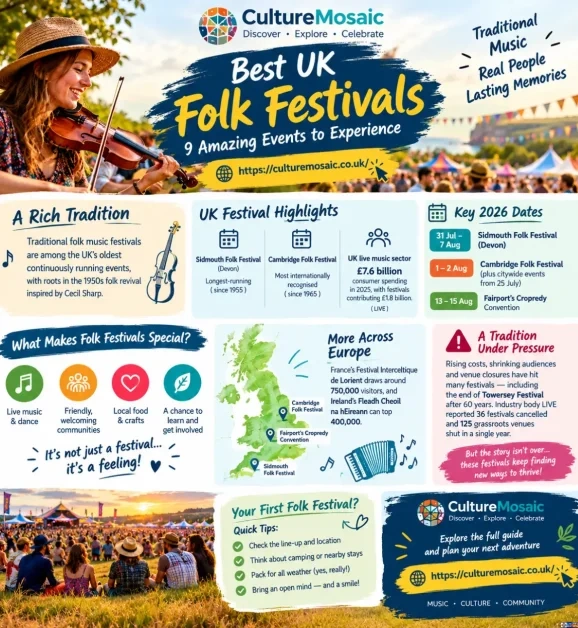
- Traditional folk music festivals are among the UK’s oldest continuously running music events, several tracing back to the 1950s folk revival sparked by collectors like Cecil Sharp.
- Sidmouth Folk Festival (Devon, running since 1955) is the UK’s longest-running folk gathering; Cambridge Folk Festival (since 1965) is its most internationally recognised.
- The UK’s live music sector generated £7.6 billion in consumer spending in 2025, with festivals contributing an estimated £1.8 billion of that, according to industry body LIVE.
- Key 2026 dates: Sidmouth Folk Festival, 31 July–7 August; Cambridge Folk Festival, 1–2 August (plus citywide events from 25 July); Fairport’s Cropredy Convention, 13–15 August.
- Europe hosts folk gatherings on an even bigger scale: France’s Festival Interceltique de Lorient draws roughly 750,000 visitors, and Ireland’s Fleadh Cheoil na hEireann can top 400,000.
Say the words “folk festival” to a stranger and watch what happens. Half of them picture a wet field, a man with a beard, and a fiddle that’s slightly out of tune. That reaction is the whole problem in miniature. A tradition that shaped English, Scottish, Irish, and Welsh identity for centuries has, somewhere along the way, become a punchline rather than an inheritance. I think that’s a genuine loss, not just a branding problem.
The people who run these festivals feel it too. In 2024, Towersey Festival closed its gates for the last time after sixty years as the UK’s longest-running independent festival, done in by rising costs and a shrinking audience of exactly the kind that keeps grassroots culture standing. It wasn’t alone. Industry body LIVE reported thirty-six festivals cancelled and a hundred and twenty-five grassroots music venues shut permanently in a single recent year. Numbers like that aren’t abstract. They mean a fiddle teacher with no room to book, a Morris side with nowhere to perform, a sixteen-year-old singer who never gets to hear what a five-hundred-year-old ballad sounds like sung live, badly, joyfully, by a room full of strangers.
Here’s the encouraging part. Folk festivals keep finding ways to survive, and some are doing more than surviving. Towersey’s organisers relaunched within a year as Found Festival. Cambridge City Council rebuilt its own festival’s format for 2026 rather than let it lapse. Sidmouth, the oldest of the lot, just keeps going, eight days by the sea, barely changed in outline since 1955. What follows is a working guide to that whole living circuit: what these festivals actually are, where to find the best of them in the UK and across Europe in 2026, and how to plan a first visit without wasting a ticket on the wrong one.
What Are Traditional Folk Music Festivals?
A traditional folk music festival is a gathering built around music, song, and dance passed down through oral and community tradition rather than written for the concert hall. Unaccompanied ballads. Dance tunes on fiddle and melodeon. Morris sides and sword dancers in the street. Sea shanties bellowed in a pub back room. The informal “session,” where anyone with an instrument pulls up a chair and joins in. It’s participatory by design. Nobody expects silence and a standing ovation. They expect you to clap along, off the beat if necessary, and mean it.
The modern UK circuit grew directly out of the early twentieth-century folk revival, when collectors raced to write down songs and dances before they vanished from living memory. Cecil Sharp founded the English Folk Dance Society in 1911; it merged with the older Folk-Song Society, founded in 1898, to form the English Folk Dance and Song Society (EFDSS) in 1932. Cecil Sharp House, EFDSS’s London headquarters, opened in 1930 and hosted the world’s first International Folk Dance Festival five years later. That institutional backbone matters, because most of the festivals in this guide grew out of it, directly or by descent. For a working Traditional Folk Music Festivals list maintained county by county, EFDSS’s own network of contacts remains one of the most reliable references going.
None of this is frozen in amber, either, and I’d push back on anyone who treats it that way. A folk festival that only ever plays songs collected before 1930 is a museum, not a living tradition. The better festivals mix old ballads with new songwriters working in the same idiom, and that friction between old and new is precisely what keeps the form breathing. Our related piece on Ethno Cultural Festivals Heritage looks at how other cultures manage that same balancing act.
A Tradition Under Real Pressure
It’s worth sitting with the scale of the problem before jumping to the good news, because the good news only makes sense against it. Towersey wasn’t a fringe event. It began in 1965 as a one-day village fete raising money to repair a war memorial hall, and it grew, over sixty years, into one of the most respected independent folk festivals anywhere. Its founders’ grandchildren, who inherited the running of it, said plainly that economic pressure, not falling interest, forced the closure in 2024.
That’s the uncomfortable truth about grassroots culture. Interest can hold steady while the economics collapse underneath it anyway. Rising site costs, insurance, and staffing have squeezed independent festivals across the board; the Association of Independent Festivals recorded seventy-eight grassroots gatherings cancelled, postponed, or wound down completely in a single recent year. Multiply Towersey’s story by seventy-eight and you get a sense of how much informal, unglamorous cultural infrastructure quietly disappears without anyone outside the folk world noticing.
I’d rather be honest about that risk than pretend every festival on this list is guaranteed to exist in five years. Some won’t be. That’s exactly why showing up matters more than nostalgia does.
The Comeback: How Folk Festivals Are Reinventing Themselves
So what does a working solution actually look like? Not sentiment. Structural change. Towersey’s directors didn’t try to resurrect the old festival unchanged; they launched Found Festival the following year at the same Buckinghamshire estate, deliberately smaller, roughly two thousand attendees instead of five thousand, and built to be financially sustainable rather than merely beloved.
Cambridge did something similar from the opposite direction. Facing rising infrastructure costs and falling ticket sales, Cambridge City Council scaled its historic festival back to a two-day core weekend at Cherry Hinton Hall for 2026, while spreading additional concerts across venues in the city for the surrounding week. Council leaders were candid that continuing in the old format simply wasn’t financially viable. The reinvented version keeps the festival’s spirit, in their own words, its heart, its friendship, its music, while asking less of a stretched budget.
This is, in miniature, what What Is the Economic Impact of Music Festivals? gets at in more depth: festivals aren’t a nostalgic add-on to a local economy, they’re load-bearing, and when the load gets too heavy something has to give. The festivals surviving into 2026 are, almost without exception, the ones willing to change shape rather than break.
Traditional Folk Music Festivals List: The UK’s Essential Circuit
Here’s a working traditional folk music festivals list covering the events most likely to still be running, and worth planning a trip around, through 2026 and beyond. It isn’t exhaustive; smaller county festivals number in the hundreds. But this is the backbone of the English circuit specifically, alongside its Oxfordshire, Yorkshire, and Shropshire cousins.
| Festival | Location | Running Since | Character |
| Sidmouth Folk Festival | Sidmouth, Devon | 1955 | Week-long, town-wide, dance-heavy, the UK’s oldest |
| Cambridge Folk Festival | Cherry Hinton Hall, Cambridge | 1965 | The most internationally famous; roots and singer-songwriter crossover |
| Whitby Folk Week | Whitby, North Yorkshire | 1965 (Folk Week from 1981) | 600+ events, strong sword and Morris dance tradition |
| Fairport’s Cropredy Convention | Cropredy, Oxfordshire | 1980 | Folk-rock reunion weekend, one of the biggest single-site camping folk events |
| Shrewsbury Folk Festival | West Midlands Showground, Shropshire | 2006 | August Bank Holiday staple; patrons include Oysterband and Show of Hands |
| Found Festival (successor to Towersey) | Claydon Estate, Buckinghamshire | 2025 (Towersey ran 1965-2024) | Smaller, deliberately sustainable rebuild of a 60-year festival |
A pattern is worth flagging here: almost every one of these traces back to the same mid-1960s window, the moment the folk revival stopped being a collector’s project and became a public festival circuit. That’s not a coincidence. It’s the same generation that grew up on Cecil Sharp’s collected songs turning them into a summer tradition of their own. Our broader survey of Traditional World Festivals Cultural Heritage traces the same generational pattern in other countries’ festival calendars.
Cambridge Folk Festival: What Is the Biggest Folk Festival in the UK?
Ask a casual music fan to name a UK folk festival and Cambridge is almost always the answer. It’s the one that’s booked Joan Baez, an early Bob Dylan, Richard Thompson, Billy Bragg, and Paul Simon over its sixty-year run, and it has the international press coverage to match. In that sense, yes, Cambridge Folk Festival is the biggest folk festival in the UK by reputation.
But reputation and scale aren’t the same thing, and I think it’s worth separating them. Cambridge’s core weekend at Cherry Hinton Hall has a total audience of roughly 14,000, including crew and staff. Sidmouth, by contrast, is a town-wide festival with no single capacity limit, running over eight days and hosting more than seven hundred separate events across pubs, gardens, and marquees throughout the town. Measured by sheer volume of music-making, Sidmouth arguably wins. Measured by global name recognition, Cambridge does. It depends what you’re actually asking.
Cambridge’s 2026 edition reflects its new, leaner format: concerts at the Cambridge Corn Exchange on 25 and 26 July, a week of citywide performances from 27 July, and the traditional two-day outdoor weekend at Cherry Hinton Hall on 1 and 2 August, with headliners including Frank Turner, Richard Thompson, and Suzanne Vega.
Traditional Folk Music Festivals in England: Beyond the Big Two
Cambridge and Sidmouth get the headlines, but the traditional folk music festivals in England worth your calendar space go well beyond those two.
Whitby Folk Week, held across North Yorkshire’s clifftop seaside town during the August bank holiday week, leans harder into dance than either of the bigger festivals: long sword, rapper sword, clog, and Morris teams perform in the street between more than a hundred concerts spread across dozens of pub and hall venues. It began in the late 1960s as a weekend event and became a full week in 1981, and it still carries a slightly rowdier, more community-run feel than Cambridge’s polished programming.
Fairport’s Cropredy Convention, meanwhile, is the odd one out on this list: a single-band reunion festival, thrown every August by Fairport Convention, the group most responsible for inventing British folk-rock in the late 1960s. It’s less a folk festival than a folk-rock festival, and it draws thousands of campers to a small Oxfordshire village for one long weekend of electric fiddles and beer tents.
Shrewsbury Folk Festival, the youngest of the established names here, launched in 2006 and moved to the West Midlands Showground the following year. It’s built a reputation as one of the best-organised weekends on the circuit, with patrons Oysterband and Show of Hands lending it credibility among serious folk audiences without losing the family-friendly camping-festival atmosphere.
UK Folk Festivals 2026: Dates Worth the Diary Space
For anyone building out a summer around UK folk festivals in 2026, here is the core calendar as it currently stands:
- Sidmouth Folk Festival – 31 July to 7 August, Sidmouth, Devon
- Cambridge Folk Festival – 25 July to 2 August (citywide events plus the 1-2 August Cherry Hinton Hall weekend)
- Fairport’s Cropredy Convention – 13 to 15 August, Cropredy, Oxfordshire
- Whitby Folk Week – August bank holiday week, Whitby, North Yorkshire
- Found Festival – 22 to 24 August, Claydon Estate, Buckinghamshire
A word of caution, since dates and even survival can shift year to year in this sector: always confirm against the festival’s own site before booking travel or camping. The financial pressures covered earlier aren’t hypothetical, and a lineup announced in spring has occasionally needed reshuffling by summer.
Traditional Folk Music Festivals in Europe: How Britain Compares
Britain didn’t invent the folk festival, and it certainly doesn’t run the biggest one. Traditional folk music festivals in Europe operate on a different scale entirely in places, and the comparison is genuinely useful for calibrating what “big” means in this world.
| Festival | Country | Scale | Focus |
| Festival Interceltique de Lorient | Brittany, France | ~750,000 visitors, 10 days in August | The world’s largest Celtic festival, drawing performers from every Celtic nation |
| Fleadh Cheoil na hEireann | Ireland (host town changes yearly) | Up to 400,000+ visitors, late August | Ireland’s national Irish-traditional-music competition and festival |
| Rudolstadt Festival | Thuringia, Germany | ~60,000 visitors, first weekend of July | Germany’s largest folk, roots, and world music festival |
| Falun Folk Music Festival | Falun, Sweden | Mid-July, running since the mid-1980s | One of Scandinavia’s longest-established folk and world music gatherings |
The contrast is instructive. Lorient’s crowd alone dwarfs the combined attendance of every UK folk festival on this list put together, because it draws on a shared Celtic identity spanning Brittany, Ireland, Scotland, Wales, Cornwall, Galicia, Asturias, and the Isle of Man, not one national tradition. Fleadh Cheoil operates more like a national competitive circuit than a single event, with regional qualifiers feeding into the main festival. Against that backdrop, Britain’s folk scene reads as smaller, more scattered, and, I’d argue, more intimate. You’re less likely to be one face in three-quarters of a million at Sidmouth. That’s a genuine trade-off, not a weakness. Readers curious about how sensory, community-scale festivals compare across borders should also see our piece on Multi-Sensory Folk Revivals.
What Are the Top 10 Music Festivals for Folk Fans?
People searching “top 10 music festivals” usually mean the giants: Glastonbury, Coachella, that tier. For a folk-focused reader, though, a more useful top ten looks like this, ranked here by a mix of scale, heritage, and how essential each one is to the tradition it represents:
- Festival Interceltique de Lorient (France) – the largest Celtic gathering on earth
- Fleadh Cheoil na hEireann (Ireland) – the definitive Irish traditional music festival
- Cambridge Folk Festival (England) – the most internationally recognised UK folk event
- Sidmouth Folk Festival (England) – the UK’s oldest, and arguably its most immersive
- Rudolstadt Festival (Germany) – continental Europe’s biggest folk and world music weekend
- Whitby Folk Week (England) – the UK’s premier dance-focused folk gathering
- Fairport’s Cropredy Convention (England) – folk-rock’s flagship reunion event
- Falun Folk Music Festival (Sweden) – Scandinavia’s long-running folk showcase
- Shrewsbury Folk Festival (England) – the newest of the UK’s big four, and arguably the best run
- Found Festival (England) – small by comparison, but the direct continuation of a sixty-year tradition worth watching
That’s a deliberately folk-specific answer to a question the internet usually answers with arena-rock names. I’ll stand by it. If you only ever go to the mainstream “top ten,” you will never hear a five-hundred-year-old ballad sung a cappella by four hundred strangers who all somehow know the words.
How to Choose and Plan Your First Folk Festival
Three practical suggestions, and then one that’s a little outside the box.
First, match the festival to your tolerance for structure. Cambridge and Shrewsbury run tight, ticketed programmes with clear stages and set times, which suits anyone who wants to plan a day in advance. Sidmouth and Whitby are looser and town-wide; you’ll do more wandering between pub sessions than following a schedule, which some people find liberating and others find chaotic.
Second, budget for camping gear, not just a ticket. Nearly every festival on this list runs on-site or nearby camping as the default accommodation, and Cambridge specifically warns that its site has no cashpoints and card-only bars, so plan payment methods before you arrive, not after.
Third, go to at least one workshop or dance class rather than only watching concerts. The whole point of a participatory tradition is that it doesn’t work as a spectator sport. A half-hour ceilidh dance lesson will teach you more about what folk music is for than three hours of watching a stage from a folding chair.
Now the wildcard: skip the headline stage entirely on your first evening and find the smallest room on site instead, the folk club corner, the late-night session in a marquee that isn’t on the printed schedule. That’s usually where the actual tradition is happening, unpolished and unamplified, and it’s the closest a modern festival gets to what a folk gathering looked like before anyone put up a main stage. For readers who want to build a whole trip around that idea, our piece on Transformative Micro Festivals takes it further, into the smaller, single-village events that never make anyone’s top ten list but arguably matter just as much.
Why Folk Festivals Matter: Guarding Living Heritage
It’s worth ending on the academic case, because it’s easy to treat all of this as leisure and miss the heritage function underneath it. UNESCO’s Convention for the Safeguarding of Intangible Cultural Heritage, adopted in 2003, explicitly recognises oral traditions and performing arts as heritage on par with monuments and buildings, and folk song traditions from multiple countries now sit on its Representative List. The underlying logic applies regardless of formal treaty status: a ballad passed from singer to singer for two hundred years is exactly the kind of cultural asset that disappears the moment nobody performs it live anymore.
That’s the deeper reason festivals matter more than nostalgia does. A song surviving only in an archive, however well catalogued, is not the same as a song still sung in a pub session by someone who learned it from their grandmother. Festivals are the mechanism, more or less the only mechanism left, by which oral tradition actually stays oral. Losing Towersey wasn’t just losing a nice weekend out. It was losing one specific thread in a transmission chain that, in some cases, runs back centuries. For a longer look at how communities elsewhere manage that same transmission problem, Culture Mosaic’s wider heritage reporting at Culture Mosaic is a useful next stop.
Frequently Asked Questions
What are some popular folk festivals in the UK?
The most popular UK folk festivals include Sidmouth Folk Festival in Devon (the UK’s longest-running, since 1955), Cambridge Folk Festival at Cherry Hinton Hall (since 1965, the most internationally known), Whitby Folk Week in North Yorkshire, Fairport’s Cropredy Convention in Oxfordshire, and Shrewsbury Folk Festival at the West Midlands Showground. Found Festival, the recently launched successor to the sixty-year-old Towersey Festival, is also worth watching as it establishes itself.
What is the biggest folk festival in the UK?
It depends how you measure “biggest.” Cambridge Folk Festival is the most famous and internationally recognised, with a core weekend audience of roughly 14,000 at Cherry Hinton Hall. Sidmouth Folk Festival, however, is arguably bigger in total scale: it runs town-wide across eight days with no single attendance cap, hosting more than seven hundred separate events. Cambridge wins on reputation; Sidmouth wins on sheer volume of music-making.
What are folk festivals, exactly?
Folk festivals are gatherings centred on traditional, community-based music, song, and dance passed down through oral tradition rather than composed for formal performance. They typically combine ticketed concerts with informal, participatory elements: pub sessions where anyone can join in, ceilidh and barn dances open to all skill levels, and street performances by Morris, sword, or clog dance sides. The emphasis on participation, rather than passive listening, is what distinguishes a folk festival from most other music festivals.
What are the top 10 music festivals for folk music specifically?
A folk-focused top ten looks different from the mainstream arena-rock list. It would typically include Festival Interceltique de Lorient (France), Fleadh Cheoil na hEireann (Ireland), Cambridge Folk Festival (England), Sidmouth Folk Festival (England), Rudolstadt Festival (Germany), Whitby Folk Week (England), Fairport’s Cropredy Convention (England), Falun Folk Music Festival (Sweden), Shrewsbury Folk Festival (England), and Found Festival (England).
Do you need to know folk music already to enjoy a folk festival?
No, and this is one of the biggest misconceptions keeping people away. Folk festivals are built for participation at every level: beginner ceilidh dance classes are standard, sing-around sessions in pubs welcome newcomers who don’t know a single verse, and most festivals programme a mix of traditional material alongside contemporary singer-songwriters who are far more accessible to a first-time audience. Turning up with zero prior knowledge is, if anything, closer to how the tradition has always worked.
Sources
- English Folk Dance and Song Society – Our History
- English Folk Dance and Song Society – Cecil Sharp
- Cambridge Folk Festival – official site
- Cambridge City Council – Cambridge Folk Festival to return in 2026
- Sidmouth Folk Festival – official site
- House of Lords Library – Cultural and economic contribution of live music in the UK
- UNESCO Intangible Cultural Heritage – Collection of Traditional Music
- UK Folk Festivals – England festival listings