
 By Culture Expert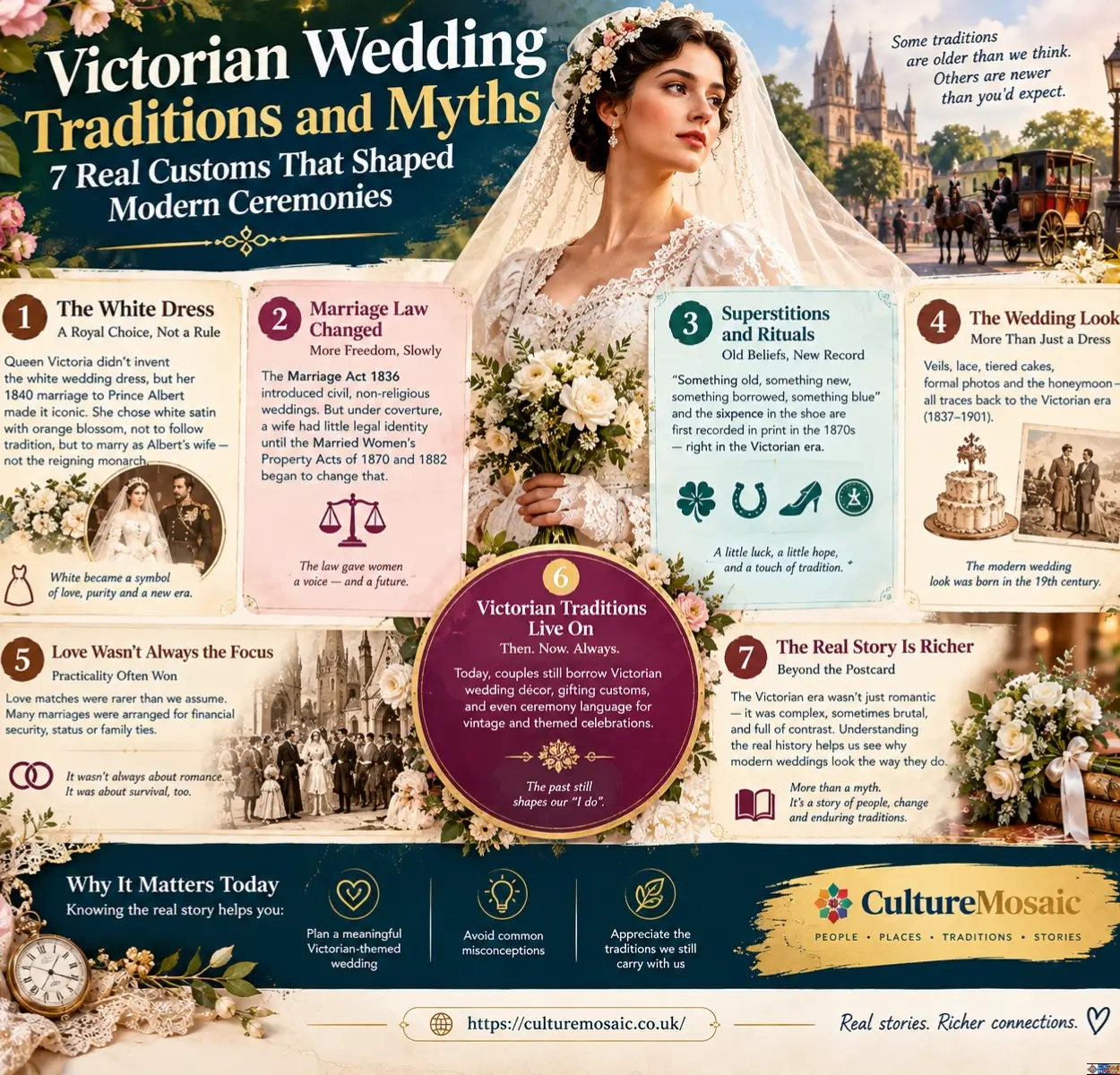
Quick Summary
- • Victorian wedding traditions gave the modern West its entire wedding “look” — the white dress, the veil, the tiered cake, and the honeymoon all trace to the period between 1837 and 1901.
- • Queen Victoria’s 1840 marriage to Prince Albert popularised the white wedding gown; it was not the sole origin of white bridalwear, but it fixed the association in the public imagination through the new mass-circulation press.
- • Marriage law changed dramatically under Victoria too — the Marriage Act 1836 introduced civil, non-religious weddings, while coverture stripped a wife of independent legal identity until the Married Women’s Property Acts of 1870 and 1882 began to reverse it.
- • Superstitions such as “something old, something new, something borrowed, something blue” and the sixpence in the shoe are first recorded in print in the 1870s, squarely inside the Victorian era.
- • Modern couples still borrow Victorian wedding décor, gifting customs, and even ceremony language for vintage and “Victorian wedding theme” celebrations today.
The Problem: Everyone Assumes They Know Victorian Weddings — Most People Are Wrong
Say “Victorian wedding” and most people picture the same postcard: a woman in a stiff white gown, a lace veil, a church full of hushed relatives. It’s a tidy image. It’s also incomplete, and in places, it’s simply wrong.
I’ve spent years working through parish registers, etiquette manuals, and the fashion plates of the period, and the real story is stranger and more interesting than the postcard. White wasn’t mandatory. Love matches were rarer than we assume. And the woman standing at the altar was, in the eyes of English law, about to lose a good deal of her legal identity the moment she said “I do.”
That gap between myth and record matters if you’re planning a Victorian-theme wedding, researching Victorian wedding traditions for a project, or just trying to understand why modern British weddings look the way they do. Get the details wrong and a themed wedding turns into costume rather than history. Get them right, and you’re drawing on 64 years of genuinely rich, occasionally brutal, occasionally tender custom.
Empathy: Why This Confusion Persists
It’s not really anyone’s fault. The Victorian era spans over six decades — a woman marrying in 1840 and one marrying in 1899 lived through wildly different economic and social conditions, yet both get flattened into the same “Victorian bride” shorthand. Add to that a wedding industry that has spent 150 years borrowing selectively from the past — a veil here, a “vintage” font there — and you get a folk memory that’s part fact, part marketing.
I’d also say the sources themselves are uneven. Working-class Victorian marriages left far thinner paper trails than the aristocracy’s, so the well-documented royal wedding of 1840 has come to stand in for an experience that, in truth, only a small fraction of Victorian brides could afford to copy.
The Solution: A Clear, Sourced Walk Through What Actually Happened
So let’s go through the real Victorian wedding traditions properly — attire, ceremony, ritual, and the social scaffolding around it — the way I’d explain it to an intelligent friend who wanted the real version, not the postcard.
1. The Origin of the White Wedding Dress
Here’s the correction I make most often: Queen Victoria did not invent the white wedding dress. White bridal wear already existed among the upper classes and in court dress before 1840, and cultures going back to ancient Egypt, Greece, and Rome had used white in wedding contexts for entirely different reasons.
What Victoria did was something more specific and, in its way, more interesting. On 10 February 1840, marrying Prince Albert at the Chapel Royal, St James’s Palace, she deliberately set aside the crimson velvet and ermine robes of state and chose a white satin gown trimmed with orange blossom — a flower long associated with fertility and virtue. According to the Victoria and Albert Museum, that choice was a personal statement: she wanted to marry as Albert’s wife, not as the reigning monarch, and the softness of white said exactly that.
The gown itself was made from Spitalfields silk and trimmed with hand-worked Honiton lace, a deliberate boost to the struggling Devon lace industry. What turned one queen’s dress into a national custom, though, wasn’t the fabric — it was print. The 1830s and 1840s saw an explosion of illustrated magazines aimed at middle-class women, and they described Victoria’s gown, her orange blossom, her satin slippers, in loving detail. Within a decade, brides across Britain and America were copying a look most of them had only ever seen in an engraving.
It’s worth being honest about the limits of this story, too. For most of the century, white remained a luxury. A white gown showed you could afford a dress that couldn’t survive daily wear and tear — most working women married in their best existing dress, later dyed and reworn for church or visiting. The “one-day dress” is a much later, twentieth-century invention.
2. How Victorians Actually Married: The Ceremony and the Law
The Victorian wedding ceremony script looked more familiar to modern eyes than the dress did. The Book of Common Prayer’s marriage rite — “to have and to hold,” “till death us do part,” the exchange of a ring — was already centuries old by 1837 and needed no updating. What changed underneath it was the law.
Before 1837, if you weren’t marrying in the Church of England (or, with restrictions, as a Quaker or Jew), your options were narrow. The Marriage Act 1836 changed that by creating civil marriage in register offices and allowing Nonconformist chapels and Catholic churches to register their own buildings for legally binding weddings. For the first time, a couple could marry without a clergyman present at all.
What the law didn’t touch, for most of the century, was what happened to a woman’s legal identity afterwards. Under the doctrine of coverture, a wife’s separate legal existence was effectively absorbed into her husband’s on the day of the wedding — she could not independently own property, sign contracts, or keep her own earnings. The Married Women’s Property Acts of 1870 and 1882 dismantled this piece by piece, letting wives keep wages, inheritances, and property in their own name. It’s a detail that rarely makes it into “Victorian wedding traditions gifts” listicles, but it shaped exactly what a wedding day meant for the bride standing at the altar — a genuine legal threshold, not just a ceremonial one.
3. Courtship, Correspondence, and How Victorians Said “I Love You”
Direct declarations of love were considered forward, especially early in courtship, so the Victorians built an entire secondary language around restraint. Flowers carried meaning (the “language of flowers,” or floriography, assigned specific sentiments to specific blooms). A gentleman’s calling card left with a folded corner signalled particular intentions. Love letters — and the Victorians wrote enormous numbers of them — used careful, often coded phrasing, saving open declarations for the point at which a proposal was genuinely likely to be accepted.
Courtship itself was heavily chaperoned, particularly among the middle and upper classes, where an unmarried woman was rarely alone with a suitor. That supervision eased gradually as the century wore on and as more social space — croquet lawns, seaside resorts, church socials — opened up for young people to actually get to know each other before a proposal.
4. Superstitions That Still Follow Brides Today
If there’s one part of Victorian wedding culture that survived almost unchanged, it’s the superstition. The rhyme “something old, something new, something borrowed, something blue, and a silver sixpence in her shoe” has no confirmed origin earlier than an 1871 short story about “marriage superstitions,” with newspaper reports of brides actually following it appearing within five years. Each line does real symbolic work: the old item ties the bride to her family and past; the new one to optimism; the borrowed item — traditionally something from a woman with a happy marriage — was meant to transfer luck; and blue warded off the evil eye and stood for fidelity.
Other Victorian wedding superstitions were less charming. Peacock feathers were considered unlucky in a household. Seeing the bride in her dress before the ceremony was thought to invite disaster. May weddings were widely avoided as unlucky, a belief with roots stretching back to Roman festivals for the dead. Rain on the day, by contrast, was sometimes read as a blessing — tears of joy from the heavens, according to folklore collected in the period.
5. Gifts, Trousseaus, and the Wedding Breakfast
Wedding gifts in the Victorian era followed strict etiquette. Guests gave to the household, not the individual — silverware, linens, and clocks were common, chosen to outfit a new home rather than to please personal taste. A bride from a family of means assembled a trousseau months in advance: linens, undergarments, and dresses, often marked with her new initials before the wedding itself.
The reception itself was called a “wedding breakfast,” regardless of the actual hour, because weddings by law had to take place before noon for most of the period. It was typically a seated meal at the bride’s family home rather than a rented venue, followed by speeches and the cutting of a rich fruitcake — the ancestor of the modern tiered wedding cake, which itself became fashionable in imitation of Victoria’s own three-hundred-pound wedding cake in 1840.
6. Decor, Flowers, and the Victorian Aesthetic
Victorian wedding décor leaned heavily on abundance: orange blossom (real or wax), heavy florals, lace, and — as photography became affordable later in the century — carefully staged wedding portraits. Colour symbolism mattered throughout the home and the church: white and cream for purity, deep greens and burgundies for the richer aesthetic of the mid-to-late century “High Victorian” style that a modern “Victorian wedding theme” usually recreates. Orange blossom crowns, worn by the bride, were considered almost as essential as the dress itself by the 1860s.
7. Class, Region, and the Edwardian Turn
It’s worth stressing how differently this all played out by class. An aristocratic wedding might involve months of preparation, elaborate trousseaus, and coverage in the society pages. A rural labourer’s wedding could be arranged and concluded within a week, in a plain dress, with a modest meal afterwards — closer in spirit and scale to many of the Irish wedding traditions still practised in the poorer parishes of the British Isles at the same time.
By the time Victoria died in 1901, Edwardian wedding traditions had already begun softening some of the stiffness of High Victorian style — lighter fabrics, simpler silhouettes, shorter engagements among the fashionable set — while keeping the white dress, the veil, and most of the underlying ceremony intact. The throughline from 1840 to today is remarkably direct.
How Victorian Wedding Traditions Compare Across Class and Culture
Look closely and you’ll notice Victorian wedding traditions share a deep grammar with marriage customs everywhere — mark the threshold with symbols the community will recognise. You can see the same logic at work in Ancient Roman wedding traditions, in the Roman wedding night ritual, and further afield in Cherokee wedding traditions, where corn and specific colours of cloth carry meanings comparable to the Victorian sixpence and orange blossom. If you enjoy tracing these parallels, our roundup of marriage rituals in different cultures through an anthropological lens goes considerably further afield.
A Note on Health and Hygiene
One question I get asked surprisingly often concerns what feminine hygiene was actually like in the Victorian era, since it bears directly on how practical a long white dress and lengthy ceremony really were. The honest answer is: rudimentary by modern standards. Reusable cloth pads, rags, and homemade sanitary devices were the norm; commercial disposable products didn’t reach the British market in any meaningful way until the very end of the century. Menstruation itself was rarely discussed openly, even between mothers and daughters, which adds useful context to why so much of Victorian courtship and marriage language relied on euphemism rather than plain speech.
Modern Victorian Wedding Traditions: What Couples Borrow Today
Modern couples staging a Victorian-theme wedding tend to pick and choose rather than recreate the whole period, and that’s sensible — some of it (coverture, chaperoned courtship) nobody actually wants back. What survives well: the orange blossom, deep jewel-toned florals against cream and gold, a tiered fruitcake, hand-written vows echoing Book of Common Prayer cadence, and the sixpence-in-the-shoe superstition, which modern jewellers still sell as a small keepsake coin. Victorian mourning jewellery motifs — lockets, cameos — have also found their way back into bridal accessories, stripped of their original funerary association.
For couples drawing on other heritage traditions alongside a Victorian aesthetic, it’s worth browsing how Christian wedding traditions intersect with the Victorian ceremony script, or how broader wedding traditions common across cultures map onto the same 1837–1901 timeframe. Couples blending heritages sometimes look at Mexican wedding traditions or Italian wedding traditions for the bride alongside Victorian elements, and the results — when done with real research rather than aesthetic borrowing — tend to be the most memorable.
Don’t Let the Postcard Version Be the Last Word
Real Victorian wedding traditions gave the modern West its visual grammar — white, lace, orange blossom, tiered cake — while sitting on top of a legal and social structure that constrained the bride in ways the imagery never shows. Knowing both halves is what separates a genuinely researched Victorian-theme wedding, article, or costume from a pretty guess. If you’re planning around this era, use the real record: it’s stranger, more layered, and ultimately more romantic than the shorthand version most of us grew up with.
For a broader survey of how different cultures have handled this same moment, Culture Mosaic has covered best wedding traditions worldwide, cultural marriage traditions, the Crown family’s own wedding traditions, and customs among the Red Clay Tribe — each a reminder that the Victorians were one chapter in a much longer human habit of ritualising the wedding day. For a well-illustrated visual primer on the same period, PBS’s Victorian Wedding Traditions feature is worth a look.
Frequently Asked Questions
1. Did Queen Victoria really invent the white wedding dress?
No. White bridal wear predates her 1840 wedding, and several ancient cultures used white in wedding contexts long before. What Victoria did was popularise the white gown among the Victorian middle class through her own widely illustrated wedding, turning an existing but uncommon choice into the dominant Western bridal colour within a generation.
2. What are some traditional British wedding traditions rooted in Victorian wedding traditions?
The “something old, something new, something borrowed, something blue” rhyme, the sixpence in the shoe, the wedding breakfast, the multi-tiered fruitcake, and orange blossom as bridal decoration all either originated or became firmly fixed as British custom during the Victorian period, and most are still recognisable at British weddings today.
3. What were Victorian marriages actually like for women?
It depended heavily on class, but every married Victorian woman, regardless of wealth, was subject to coverture until reform legislation began in 1870. This meant a wife’s property, earnings, and legal identity were absorbed into her husband’s on marriage. The emotional experience varied — some Victorian marriages were genuine love matches, others were arranged around family and financial interest — but the legal framework around all of them was the same until the reforms of 1870 and 1882.
4. How did Victorians express love and affection before marriage?
Mostly indirectly. Floriography (the language of flowers), calling cards, and carefully worded love letters allowed courting couples to signal affection without the direct declarations that were considered too forward for early courtship. Direct statements of love were generally reserved for the period immediately around a proposal.
5. Were all Victorian weddings elaborate, formal affairs?
No, and this is probably the biggest misconception. Elaborate, documented weddings belonged mostly to the aristocracy and the prospering middle class. Working-class and rural Victorian weddings were frequently simple, quick, and inexpensive, with a best existing dress standing in for a purpose-made gown and a modest meal replacing the formal wedding breakfast.
Sources
Victoria and Albert Museum, “The Victoria Connection,” vam.ac.uk
Wikipedia, “Wedding dress of Queen Victoria”
Smithsonian Magazine, “Queen Victoria Dreamed Up the White Wedding Dress in 1840”
The White House Historical Association, “Queen Victoria’s Wedding Dress, 1840”
UK Parliament, Marriage Act 1836 (6 & 7 Will. 4 c. 85)
Married Women’s Property Act 1882, UK Parliament archives
Victorian City Project, University of St Andrews, “Women and the Law in Victorian England”
Wikipedia, “Something old” (wedding rhyme, first recorded 1871)
PBS Masterpiece, “Unveiling Victorian Wedding Traditions”