
 By Culture Expert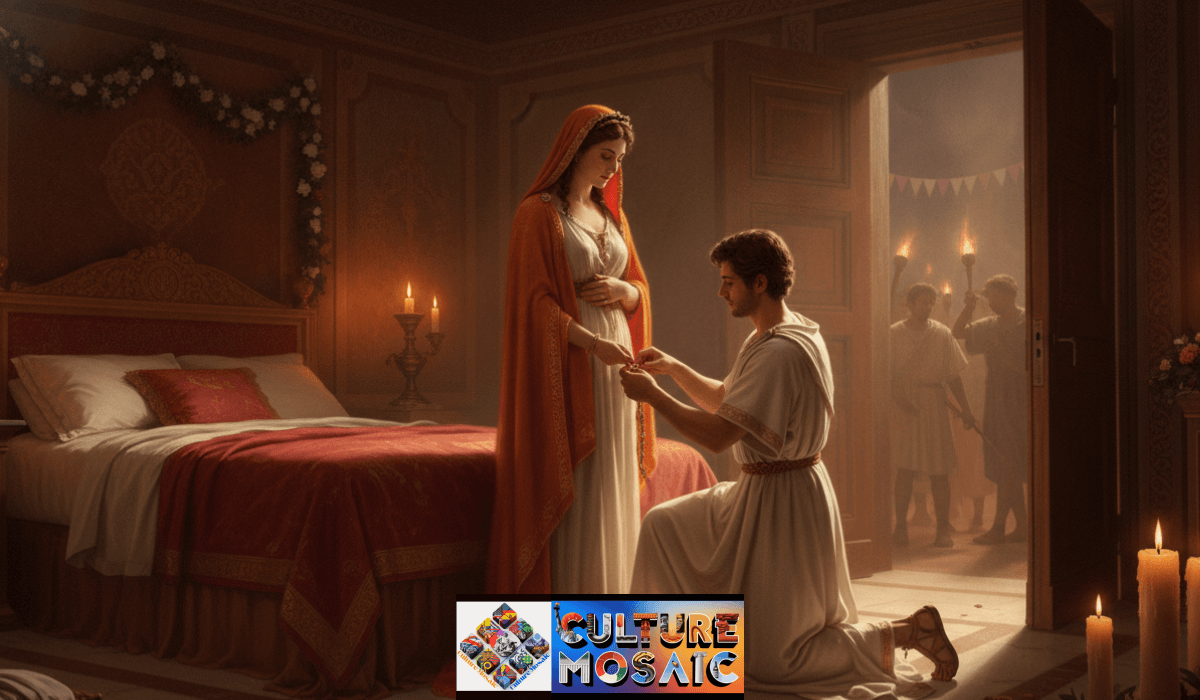
I have spent years reading Roman marriage contracts, funerary inscriptions, and the occasional gossipy letter from someone like Cicero, and I can tell you this much: the Roman wedding night ritual was never just one quiet moment between two newlyweds. It was loud, public, and stitched together with omens, jokes, and a surprising amount of negotiation about gods and grain stores. If you picture hushed candlelight and privacy, you are picturing the wrong century entirely.
What the Roman Wedding Night Ritual Actually Involved
By the time a Roman bride reached her new husband’s threshold, she had already survived a full day of ceremony. The wedding night itself picked up where that ceremony left off, and it was treated as a continuation of the religious contract rather than a separate event. Friends, family, and sometimes a crowd of curious neighbors followed the couple home, singing crude verses meant to ward off bad luck. I find this part genuinely startling when I first encountered it. Privacy was not the goal. Protection was.
The Procession to the Marital Home
The bride’s journey from her father’s house to her husband’s home was a ritual in itself, and it set the tone for everything that followed. Torchbearers led the way, and the flame was no decoration. Romans believed fire purified the path and frightened off any lingering spirits that might want to interfere with the union. The wedding party sang fescennine verses, which were teasing, often crude songs aimed at the couple. I have always thought this custom says something honest about Roman humor: they liked their solemn rituals with a side of mockery.
Crossing the Threshold Without Stumbling
Here is where the Roman wedding night ritual gets genuinely strange to modern readers. The bride was not allowed to step over her new threshold on her own feet. She had to be lifted across it, carried by attendants or sometimes by the groom himself. A stumble was considered a terrible omen, capable of souring the marriage before it had even started in the bedroom. I have seen this explained two different ways in ancient sources, either as a nod to Romulus’s bride-stealing past or as plain superstition about doorways being liminal, dangerous spaces. Both explanations feel true to me.
Inside the Bedchamber: Where the Real Ritual Began
Once inside, the rest of the household did not simply vanish. Roman wedding customs treated the bedroom itself as a stage for several more steps before anything private could happen. A matron called the pronuba, usually a woman who had been married only once, prepared the bride for bed. She was not a chaperone in the modern sense. Her presence carried weight because Romans believed a univira, a woman married to a single man for life, brought good fortune to the new couple. I think this detail gets overlooked constantly, and it shouldn’t, because it tells you how much Romans cared about marital fidelity as a kind of social magic.
The Symbolic Undressing and Bridal Belt
The bride wore a knotted wool belt called the cingulum, tied in what was known as the knot of Hercules. Tradition held that Hercules fathered seventy children, so the knot carried hopes for fertility baked directly into the fabric. The groom was expected to untie this knot himself. I find that detail oddly tender, actually, given how transactional Roman marriage could otherwise be on paper.
Songs, Jokes, and Public Witnesses
Even after the couple reached the bed, the household was not finished. Friends sang the epithalamium, a wedding song meant to bless the union and, frankly, to embarrass the newlyweds a little. Guests lingered outside the bedchamber singing this song, sometimes for a considerable stretch of time. The lyrics ranged from sincere blessings for children and prosperity to outright teasing about what was presumably about to happen inside. Catullus wrote some of the most famous surviving examples, and reading them now still feels a bit like overhearing your loud relatives at a wedding reception.
Why Privacy Mattered Less Than You Think
Modern readers often assume the wedding night was intimate by definition. Roman culture disagreed. The household, the gods, and the wider community all had a stake in whether this marriage produced legitimate children, so witnesses and noise were treated as protective rather than invasive.
The Religious and Legal Weight Behind the Roman Wedding Night Ritual
None of this was decoration. Roman marriage law cared deeply about consummation because it affected inheritance, legitimacy, and property. Under Roman custom, a marriage without consummation could, in certain circumstances, be challenged or dissolved more easily. The wedding night therefore carried legal stakes alongside the romantic ones. I find this the most clarifying fact in the whole topic. Once you understand the legal pressure, every strange custom starts making more sense.
Fertility Symbols and Omens
Fertility ran through nearly every object in the room. The bridal bed itself, called the lectus genialis, sat prominently in the main hall of the house for days afterward as a visible symbol of the union’s purpose. Walnuts were sometimes scattered outside for children to scramble after, echoing the bride’s transition out of childhood. I have always liked this image. It is messy and human in a way that formal Roman religion rarely allows itself to be.
Comparing Roman Customs to Wider Mediterranean Practice
Anyone curious about how these customs sit alongside other ancient traditions should look at the broader picture of Ancient Roman Wedding Traditions, which traces the daytime ceremony that led directly into the night’s rituals.
What Survived Into Later European Wedding Customs
Several elements of that wedding night quietly persisted for centuries, reshaped by Christianity but never fully erased.
The Threshold Custom’s Long Afterlife
The idea that a bride should not stumble crossing a threshold drifted into medieval and even early modern European folklore. I have traced versions of this superstition as far as nineteenth-century England, which honestly surprised me the first time I found it in a regional folklore collection.
Echoes in Modern Wedding Traditions
The custom of carrying a bride across a threshold today, often treated as a sweet gesture, traces a direct line back to Roman anxiety about bad omens. If you want a fuller sense of how customs like this echo across cultures and centuries, the roundup of Best Wedding Traditions Worldwide is worth a read.
A Personal Note on Studying This Ritual
I will be honest about something. The first time I read a full account of the Roman wedding night ritual, in graduate school, I expected something clinical. What I found instead was loud, communal, slightly absurd, and weirdly moving. Romans did not believe love alone made a marriage work. They believed community vigilance, religious correctness, and a fair amount of noise did the heavier lifting. That reframing changed how I read every other ancient wedding custom afterward.
Sources worth consulting include the Getty’s overview of the Roman wedding night ritual, which offers helpful visual and archaeological context for readers who want to go deeper, and broader surveys of Cultural Marriage Traditions for comparative context across regions and eras.
Frequently Asked Questions About the Roman Wedding Night Ritual
What was the purpose of the Roman wedding night ritual?
This ritual served religious, legal, and social purposes all at once. It confirmed the marriage in the eyes of the household gods, satisfied legal requirements around consummation that affected inheritance, and gave the wider community confidence that the union was legitimate. Romans did not separate the romantic and civic sides of marriage the way modern couples often do.
Best practices for understanding this purpose:
- Read primary sources like Catullus rather than relying only on secondhand summaries, since his wedding poems capture the tone better than any modern paraphrase.
- Remember that Roman religion treated the household gods as active participants, not background decoration, in every domestic milestone.
- Keep legal context in mind, since Roman inheritance law gave consummation real practical weight beyond sentiment.
- Compare plebeian and patrician versions of the same night, because social class changed scale without changing meaning.
- Avoid assuming privacy was ever the point. Roman custom assumed witnesses protected a marriage rather than intruding on it.
Did Roman brides have any privacy at all on their wedding night?
Very little, by modern standards. Singers, family members, and the pronuba were all involved in some part of the evening before the couple was finally left alone. The household viewed this involvement as protective rather than intrusive, since witnesses confirmed the marriage’s legitimacy.
Best practices for approaching this question:
- Separate the procession and bedroom-preparation stages from the moment the couple was actually left alone, since sources are clearer about the earlier stages.
- Treat the singing and joking as ritual noise rather than literal surveillance of the couple themselves.
- Notice how the pronuba’s role ended once the symbolic preparations were finished.
- Avoid projecting modern expectations of intimacy onto a culture that prioritized communal validation.
- Read accounts from multiple Roman authors, since individual writers exaggerated or downplayed details depending on their audience.
What was the bridal belt and why did the groom untie it?
The bridal belt, called the cingulum, was tied in the knot of Hercules and worn by the bride as a fertility symbol. The groom’s act of untying it represented the formal beginning of the marriage’s physical and symbolic union, and it carried hopes for the large family Hercules himself was said to have fathered.
Best practices for interpreting this custom:
- Note the specific mythological reference to Hercules, since Romans chose symbols deliberately rather than decoratively.
- Treat the untying as a scripted ritual gesture, not a private spontaneous act, since it likely happened with some degree of awareness from the household.
- Compare this fertility symbol to the walnuts scattered during the procession for a fuller picture of fertility imagery that night.
- Avoid confusing the cingulum with later European bridal sashes, which developed separately and carry different meanings.
- Look at the lectus genialis displayed afterward as a parallel symbol of the same fertility theme.
How did wealth affect the Roman wedding night ritual?
Wealthier households expanded every element of the custom, hiring singers, hosting larger processions, and commissioning more elaborate beds, while poorer families kept the same core structure on a smaller scale. The underlying religious and legal meaning stayed consistent regardless of social class.
Best practices for studying class differences:
- Look for archaeological evidence of household size and layout, since a larger home naturally supported a larger procession.
- Read inscriptions and funerary texts from both patrician and plebeian families for a more balanced view of the custom’s scale.
- Avoid assuming poorer families cared less about the ritual’s meaning simply because they spent less on it.
- Compare written sources, which often favored elite households, against material evidence from more modest homes.
- Remember that scale changed visibility and cost, not the underlying religious logic of the ritual itself.
Which parts of the Roman wedding night ritual still influence weddings today?
The threshold-carrying custom is the most direct survivor, persisting through medieval Europe into many modern wedding traditions. Songs and toasts at modern receptions also echo the spirit of the ancient epithalamium, even though the specific Roman lyrics and structure have long since disappeared.
Best practices for tracing these influences:
- Look at folklore collections from later centuries to track how the threshold custom traveled and changed shape over time.
- Compare modern wedding toasts to the teasing tone of fescennine verses for a sense of continuity in wedding humor.
- Avoid claiming a direct unbroken line for every modern custom, since many practices were reinvented rather than continuously transmitted.
- Read comparative wedding history sources for context on which customs are genuinely ancient versus more recently invented.
- Treat this Roman custom as one influence among several rather than the sole origin point for modern practices.