
 By Culture Expert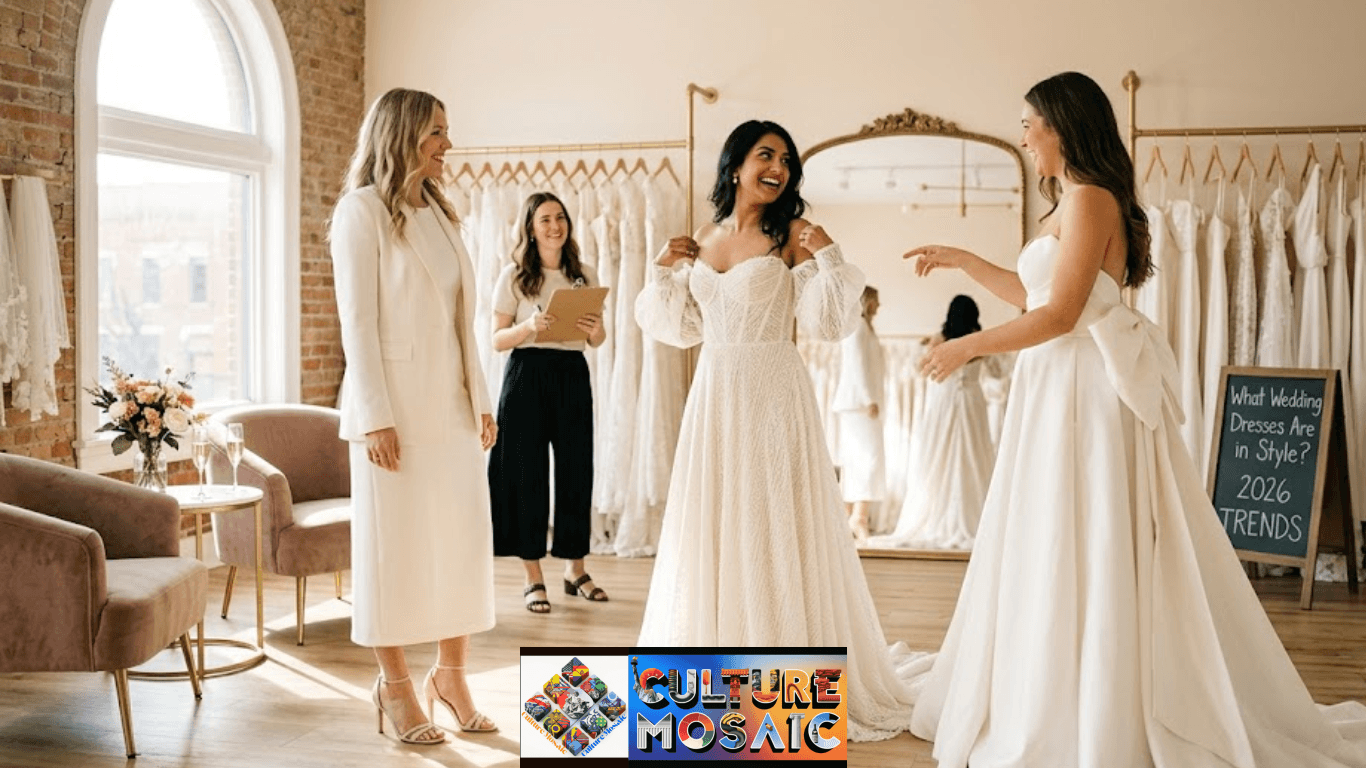
Quick Summary
| QUICK SUMMARY: Short on time? Here’s what wedding dresses are in style in 2026, in one breath: structured A-line and basque-waist gowns are leading; softened corsetry has replaced the rigid boning of a few years back, and detachable sleeves, bows, and overskirts are letting brides wear two or three looks in one dress. Lace is back with real texture, and colour has crept in through champagne, dusty rose, and pistachio tones. The single most flattering silhouette, across nearly every body type, is still the A-line. Most popular silhouette: A-line and basque-waist hybrids. Biggest new detail: detachable sleeves, bows, and overskirts. Trending fabric: textured corded lace and liquid satin. UK-specific trend: mantilla veils, oversized bows, drop waists. Most flattering overall: the A-line—it works on nearly everyone |
The Problem With Wedding Dress Shopping in 2026
I sat across from a bride named Priya in a fitting room in Marylebone that was barely bigger than a wardrobe, twelve dresses deep into her appointment, and watched her shoulders drop an inch every time the zip went up. Not because the dresses were ugly. Because none of them felt like the internet had promised. She’d spent three weeks scrolling wedding boards until every gown blurred into the same shape, and she’d walked in convinced she’d recognise “the one” on sight. She didn’t.
That’s the actual problem with dress shopping right now. There’s more bridal inspiration online than any one person can process, and half of it is a season out of date by the time it lands on your Pinterest board. Brides arrive at appointments carrying screenshots of gowns that were already retired at the last bridal fashion week. Stylists spend the first twenty minutes gently walking people back from a silhouette that photographed well in 2023 but has quietly fallen out of favour.
I understand the exhaustion. Choosing a dress is supposed to feel exciting, not like sitting an exam you didn’t know you’d signed up for. So here’s what I’m doing instead of adding to the noise: telling you, plainly, what wedding dresses are in style right now, based on what’s actually leaving bridal ateliers and landing on real brides this year, not what looked good on a runway nobody attending your wedding will ever see.
Wedding Dress Trends 2026: The Silhouettes Taking Over the Aisle
Start with the shape, because everything else — fabric, colour, beading — sits on top of it. If you only remember one thing about what wedding dresses are in style this year, let it be this: silhouette is doing most of the heavy lifting.
The A-line hasn’t gone anywhere, and I don’t expect it to. It’s the silhouette I recommend more than any other, because it does something clever: it fits at the waist and then simply lets go, skimming rather than clinging. That means it photographs beautifully on a hallway staircase and still lets you eat a full dinner at the reception. But the A-line of 2026 isn’t quite the plain one from a few years ago — designers are pairing it with sculptural bodices and unexpected necklines, so it reads as fresh rather than safe.
The bigger story this year is the basque waist. If you haven’t heard the term, picture a dipped, V-shaped waistline that sits below the natural waist at the front — it elongates the torso and adds real drama without needing acres of fabric to do it. British couturier Phillipa Lepley has reported more brides requesting structured, fitted bodices with this exact silhouette, paired with a corseted waist and a duchess satin skirt. It’s vintage-inflected without tipping into costume.
Corsetry itself has softened. Where boning used to mean rigid, almost architectural structure, this season’s corsets are built with flexibility in mind — you can actually sit down, dance, and breathe. I’ve noticed brides asking for “a corset that doesn’t fight back,” which is about as honest a brief as I’ve ever heard in a fitting room.
And then there’s the trend I think will matter most in five years’ time: modularity. Detachable sleeves, removable overskirts, capes that unclip after the ceremony, statement bows that come off before the first dance — brides are treating the wedding dress less like a single fixed garment and more like a capsule wardrobe for one very long day.
It solves a real problem: you want drama walking down the aisle and comfort by the time the DJ starts. If you’re weighing your own wardrobe options for the day, our guide to Where Can I Rent Wedding Dresses? is worth a look before you commit to buying outright.
Wedding Dress Trends 2026 UK: What British Bridal Week Actually Showed
London Bridal Week told a slightly different story from the American runways, and if you’re planning a wedding on this side of the Atlantic, the distinction matters.
British designers leaned hard into wearability. Stylists at the event kept repeating the same word — “transition” — describing brides who want to shrug off a bolero, unclip a train, or step out of an overskirt without needing a small army of dressers to manage the change. Casablanca Bridal showed a detachable peplum built specifically to add waist volume for the reception; other UK labels showed capes and layering pieces designed to be removed mid-celebration.
Mantilla veils had a proper moment too — that lace-edged, face-framing veil style borrowed from Spanish bridal tradition, reworked here with softer, more contemporary lace. Oversized bows showed up again and again, worn at the back of a bodice or cascading down a train, which tells you the UK bridal scene hasn’t fully let go of its romantic streak even while embracing cleaner silhouettes elsewhere.
And accessories are doing more work than they used to — sculptural earrings and statement hair pieces worn against a plain, structured gown, rather than buried under layers of embellishment.
If any of this has you thinking about cost before commitment, it’s worth reading our breakdown of How Much Are Wedding Dresses UK? — British bridal pricing has its own quirks, and knowing them before your first appointment saves a lot of heartache later.
Wedding Dress Trends 2026 Summer vs. Wedding Dress Trends 2026 Fall
Season genuinely changes what a dress needs to do, and I think too few bridal guides admit that. What wedding dresses are in style shifts almost as much with the calendar as it does with the runway.
Summer 2026 is about movement and lightness. Liquid satin — a softly draped fabric that skims rather than structures — is everywhere, paired with detachable elements that make sense in the heat: a sleeve you can remove before the ceremony even starts, a train you can bustle up before the sun’s fully out.
Colour leans pastel: butter yellow, dusty rose, pale blue, the kind of hues you’d find in an Impressionist garden painting rather than a bridal catalogue. It’s a softer, more forgiving look for a marquee wedding or a beach ceremony where you’ll be on your feet in the heat for hours.
Fall/Winter 2026, by contrast, goes moody. Maggie Sottero’s autumn collection — titled, tellingly, “Lost in Reverie” — leans into velvet shadows, candlelit shimmer, and choker necklines that read as almost gothic-romantic. Dark romanticism is the phrase I keep hearing from designers this season: 3D florals against structural chokers, pearl-trimmed drama, chandelier-crystal beading catching candlelight rather than daylight.
If you’re marrying somewhere with stone walls and low winter light, this is the palette that will actually photograph the way you’re picturing it.
Fabrics, Embellishments and Colour: What 2026 Wedding Dress Styles Are Made Of
Lace is having a genuine renaissance, but it’s not your grandmother’s lace — or rather, it is, reinterpreted. This season’s lacework is corded and dimensional, with embroidered florals and layered appliqué that reads more like wearable art than trim. It has presence without tipping into fussy.
Fabric-wise, silk mikado and organza are both trending for their structure and their ability to hold a sculptural shape, while liquid satin handles the opposite job — drape, movement, ease. Sheer and shimmering capes are showing up as an accessory layer rather than part of the gown itself, giving brides a second “moment” they can remove partway through the day.
On colour: white, ivory, and ecru remain the default, and I don’t think that’s changing any time soon — there’s a reason it’s endured since Queen Victoria wore white satin trimmed with Honiton lace for her 1840 wedding, a choice the Victoria and Albert Museum credits with cementing the tradition across Britain and, eventually, the West. But muted colour is a real and growing trend for anyone who wants to nod at convention without repeating it exactly: champagne, pistachio green, dreamy lilac, and warm blush are all appearing in serious bridal collections this year, not just from niche or alternative designers.
If you’re curious about the history behind the white dress specifically, we’ve gone deeper into it in Why Wedding Dresses Are White.
Embellishment-wise, the micro bow is the detail I’d bet on for 2026 and 2027 both — small, placed with intention, at a waistband or shoulder, rather than the oversized statement bows still trending in the UK. It’s a quieter kind of drama, and it photographs surprisingly well in close-up shots.
Looking Ahead: Wedding Dress Trends 2027
If you’re getting married later than 2026, it’s worth knowing where things are heading, because bridal trends tend to arrive at boutiques about a season before they hit the general public’s radar.
Editors coming out of the most recent bridal fashion weeks are calling the strapless gown’s return the single biggest story for 2027 — but reinvented, not recycled, often paired with the basque-drop waist hybrid or long-line, exposed corsetry rather than the plain strapless bodice of a decade ago. Asymmetry, playful peplums, and continued ’90s minimalism are all following close behind, alongside a bridal midi length for brides who want something less traditional for a second look or a smaller ceremony. None of this contradicts what’s happening in 2026 — it’s more of an evolution than a reset, which is reassuring if you’re shopping this year and slightly anxious about buying something that will look dated in eighteen months. It won’t.
Most Popular Wedding Dresses 2026 — My Picks for Every Kind of Bride
I don’t believe in one universal “best” dress, and honestly, no honest answer to what wedding dresses are in style should pretend otherwise — the best dress is the one that fits your wedding, your body, and your nerve on the day. But if you asked me to sort this year’s trends by bride, here’s how I’d do it:
The quiet luxury bride wants clean lines, minimal embellishment, and fabric that does the talking — think a structured satin sheath or a soft A-line with no visible ornamentation at all. It’s the look that ages best in photographs.
The maximalist bride should lean into everything I’ve described above at once: basque waist, dramatic corded lace, an oversized bow, maybe even a detachable cape for the ceremony. 2026 is unusually forgiving of “more” — designers are genuinely building for this bride, not just tolerating her.
The practical bride — the one thinking about dancing, heat, and not needing help in the bathroom — should go straight to the modular trend. A convertible gown with a detachable skirt or sleeves solves more problems than any amount of careful dress selection ever will.
And here’s my wildcard, the one nobody asks for but more brides should try: a short wedding dress for the reception, worn after a more traditional ceremony gown. It’s a proper trend in 2026, not a gimmick, and it’s the single best decision I’ve seen a bride make for her feet by 10pm.
If any of these directions feel financially out of reach at UK boutique prices, our guide to Affordable Wedding Dresses Europe rounds up options worth the flight, and our piece on Plus Size Wedding Dresses covers cut and fit specifically for curvier brides shopping this season’s trends. For brides who want their gown to do a little more flirting than the average aisle look allows, we’ve also covered the Best Sexy Wedding Dresses trending right now.
Best Wedding Dresses Guest Etiquette: What Not to Wear in 2026
A quick word for anyone attending rather than marrying this year, because “best wedding dresses guest” is one of the most common searches I see, and most of the advice out there is stale.
Couples are increasingly curating what their guests wear, not just what they wear themselves — colour-coded dress codes for garden parties, “aesthetic” briefs that go well beyond black-tie or smart-casual. If you’ve been handed a colour palette or a mood board with your invitation, take it seriously; it’s usually there for the photographs, not to be difficult. Beyond that, the golden rule hasn’t moved an inch: avoid white, ivory, and anything that could be mistaken for it in photographs, even if it isn’t technically bridal. A rich jewel tone, a considered midi length, or a well-cut trouser suit will serve you at almost any 2026 wedding, formal or otherwise.
Related Reading on Culture Mosaic
For more on bridal style this season, explore our companion guide on Latest Trends in Bridal Wear, and browse the rest of Culture Mosaic for our ongoing coverage of fashion, heritage, and cultural traditions across the UK and beyond.
FAQs About What Wedding Dresses Are in Style
What is the most popular wedding dress style right now?
The A-line, paired increasingly with a basque waist, is the most requested style in 2026. It’s fitted through the bodice and flares gently from the waist, which flatters a wide range of body types and works for almost any venue, from a registry office to a country house. Designers are dressing it up with sculptural bodices and richer lace this year rather than leaving it plain.
Which dress is trending now for a wedding?
Beyond the A-line, the biggest single trend is modularity — dresses with detachable sleeves, overskirts, or bows that let a bride change her silhouette between ceremony and reception. In the UK specifically, mantilla veils, oversized bows, and drop-waist gowns are having a strong moment, driven largely by designers showing at London Bridal Week this year.
What is the wedding dress trend in 2026?
There isn’t a single trend so much as a cluster of them: softened corsetry, textured corded lace, muted colour options like champagne and dusty rose alongside classic white, and a clear seasonal split — lighter liquid satin and pastels for summer weddings, moodier velvet and dark romantic detailing for autumn and winter ones.
What style wedding dress is most flattering?
Most stylists, myself included, point to the A-line as the most universally flattering silhouette, because it nips in at the waist and then skims rather than clings, which suits hourglass, pear, apple, and rectangle body types alike. That said, “flattering” is genuinely personal — a fitted mermaid or trumpet silhouette can look extraordinary on the right bride, and trying dresses on in person will tell you more than any body-type chart.
How much should I budget, and is renting or made-to-order worth considering?
UK wedding dress prices vary enormously by designer and fabric, so it’s worth reading a proper price breakdown before your first appointment rather than guessing. Renting has become a genuinely credible option for brides who want a directional or heavily embellished 2026 style without the full retail price, particularly for a dress you might only wear once. Made-to-order, meanwhile, is worth it if you want a specific detail — a colour, a modular element, a particular lace — that off-the-rack simply doesn’t offer this season.
About the Author
Isla Merritt is Culture Mosaic’s bridal style editor, covering wedding fashion, seasonal bridal trends, and the UK boutique scene. She has spent the past several bridal seasons tracking runway shows, London Bridal Week collections, and real-wedding style across Britain and Europe, translating what she sees into practical guidance for brides planning their own day.
Author profile: culturemosaic.co.uk/contact-us
Sources
1. Victoria and Albert Museum, “The Victoria Connection” — vam.ac.uk/articles/the-victoria-connection
2. The Knot, “The Top Wedding Dress Trends of 2026 and 2027” — theknot.com/content/wedding-dress-trends
3. Maggie Sottero, “2026 Wedding Dress Trends” — maggiesottero.com/blog/wedding-dress-trends-2026
4. Martha Stewart Living (via AOL), “The Wedding Dress Trends That Will Define 2026—and Beyond” — aol.com/articles/wedding-dress-trends-poised-define-180000535.html
5. Luxury London, “2026 Bridal Trends” — luxurylondon.co.uk/lifestyle/weddings/2026-bridal-trends
6. The Wedding Edition, “Inside London Bridal Week: Bridal Trends For 2026” — theweddingedition.co.uk/inside-london-bridal-week-bridal-trends-for-2026
7. Essense Designs, “How to Choose a Wedding Dress Silhouette & Style for Your Body Type” — essensedesigns.com/blog/how-to-choose-wedding-dress-styles-silhouettes 8. AOL, “The 5 Trends That Will Define Weddings in 2026, From AI to Aesthetic Dress Codes” — aol.com/articles/5-trends-define-weddings-2026-165940737.html