
 By Culture Expert
Quick Summary Global Bridal Heritage & Color Traditions
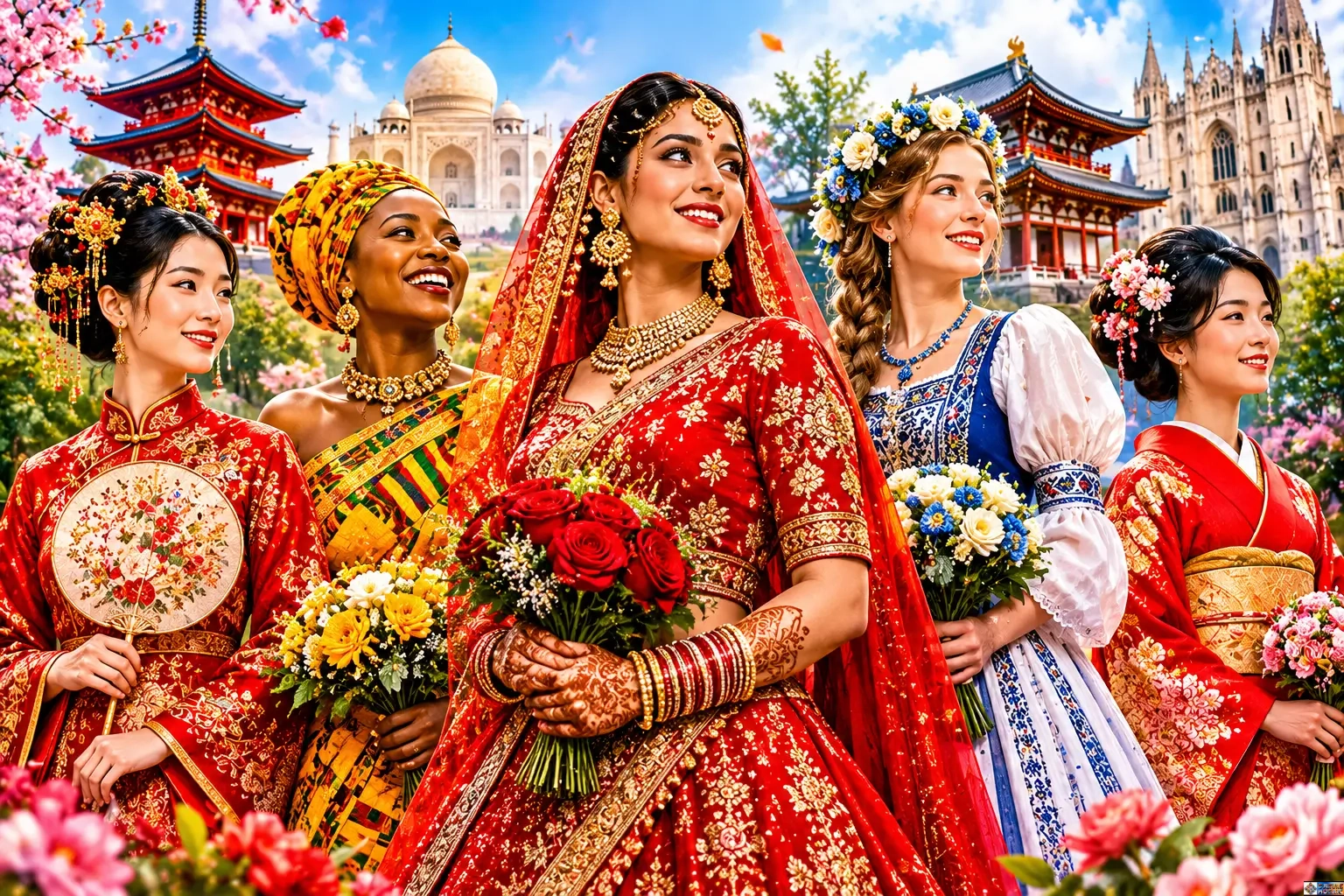
traditional non white wedding dresses are the sacred bridal outfits worn for centuries across China, India, Ghana, Norway, Japan, and Korea.
These garments feature rich tones of red, gold, black, silver, and vibrant hand-woven patterns.
White only became the Western default after Queen Victoria wore it in 1840, taking generations to spread globally. This guide explores six traditions, sacred color meanings, signature fabrics, and how to borrow from them respectfully.
Tired of Endless White Gowns? You Are Not Alone
Open any bridal catalogue and the story is the same: ivory, champagne, ivory again.
If your heritage, your taste, or your sense of celebration points somewhere else, that sameness can feel restrictive—as though your wedding must conform to a single aesthetic blueprint.
Here is the reassuring part: white was never a universal rule. Across the world, brides have entered marriage draped in blazing red silk, woven gold-and-green cloth, black wool, silver filigree, and robes embroidered with phoenixes.
Many of these traditions flourish today, maintained by families and master artisans who understand the profound symbolism embedded within every thread.
This guide from Culture mosaic provides the history, symbolism, and practical styling details. If you want the Western perspective first, read our companion guide on Why Wedding Dresses Are White.
Wedding Dress Colours Around the World: Why White Is the Exception, Not the Rule
Colour on a wedding day is rarely mere decoration. It is an explicit message about luck, family lineage, social status, and communal hope.
Because of this, the cultural significance of wedding dress colors differs sharply around the globe. Red can embody joy and protection, gold signals royalty and wealth, while white can represent purity in one country and mourning in another.
What did Western brides wear before white became the standard?
Before the 1840s, a Western bride simply wore her finest dress in whatever color suited the current fashion. A Country Life study notes that historic marriage gowns were seldom white and were frequently silver, crimson, or black.
Research from the Smithsonian Magazine corroborates this timeline. Prior to the Victorian era, women chose high-quality garments that could easily serve post-wedding social functions.
On 10 February 1840, Victoria married Prince Albert in a white silk-satin gown trimmed with Honiton lace, paired with a veil and orange-blossom wreath (Royal Collection Trust; SFO Museum).
While often credited with inventing the white wedding, textile historians clarify that elite women had previously worn white; Victoria transformed a passing fashion into an enduring standard.
The Smithsonian adds that white did not become routine for most families until the 1950s. White stained easily, making a single-wear gown an impractical luxury for most households.
For the complete Western historical timeline, read our deep dive on Why Wedding Dresses Are White.
Why is white avoided in certain cultural weddings?
In traditional Chinese customs, white and black are closely tied to funeral rites and mourning. As a result, guests and brides historically avoided plain white attire (SCMP).
Similarly, traditional Hindu ceremonies avoid plain white garments during joyous rituals due to their connection with mourning and asceticism (WeddingWire).
Context remains paramount. In Japan, the shiromuku (“pure white”) kimono is worn during Shinto ceremonies, representing a blank slate before transitioning into vibrant colored robes for the reception.
To explore how cultures encode meaning in textiles, read our guides on traditional wedding dress symbolism, Traditional Wedding Dress Cultural Meaning, and Culture and Fashion.
China: Why Do Chinese Brides Wear Red?
The short answer: red is the most auspicious color in Chinese tradition, standing for happiness, vitality, and good fortune (SCMP).
Wearing red on the wedding day is less a fashion choice than a sacred way of inviting positive energy into the marriage.
In northern and central China, a bride may wear a one-piece cheongsam (qipao). In Hong Kong and southern China, the gold standard is the qun kwa (or qun kua): a two-piece ceremonial set featuring a jacket (kwa) and pleated skirt (qun).
Both garments are traditionally red and embroidered with a dragon and phoenix, representing the groom and bride in harmonic balance (SCMP).
An archival piece in Singapore’s national collection illustrates this craftsmanship: a black jacket embroidered with phoenix and peony motifs in gold, silver, and metallic thread, paired with a matching red skirt (Roots.gov.sg).
Southern Chinese families brought the qun kua tradition to Singapore and Malaysia, where it remains a central heritage piece for ethnically Chinese brides (Roots.gov.sg).
During the Ming dynasty, brides wore the fengguan xiapei (“phoenix crown and cloud cape”), a ceremonial ensemble actively revived by modern Hanfu enthusiasts (Wikipedia: Qungua).
Silk forms the traditional foundation for these garments. Elaborate gold and silver thread embroidery can take close to a year to craft, costing up to US$13,000 (SCMP).
- 👑 Key Accessory: Phoenix crown or red headpiece with pearl tassels
- 💍 Jewellery: Solid gold dragon-and-phoenix bangles
- 👠 Footwear: Red embroidered satin shoes
- ✨ Motifs: Double Happiness (囍) symbols integrated into decor and attire
Many families choose the qun kua or a red qipao for the formal tea ceremony before changing into evening attire for the banquet.
For more on color symbolism, see our guide to the traditional red wedding dress, The Cultural Significance of Red Velvet Fabric, and cultural wedding dress motifs.
Stylist’s take: If borrowing from this tradition, select a qipao-cut gown in deep red with understated gold embroidery. Reserve full dragon-and-phoenix motifs for ceremonies where their specific dual symbolism is understood.
India and South Asia: The Red and Gold Bridal Lehenga
Red is considered the most auspicious color for a Hindu bride across South Asia (Wikipedia: Indian wedding clothes).
Garment choices vary by region: North Indian brides favor the lehenga choli, South Indian brides choose rich silk saris, and North-Eastern brides wear the mekhela sador.
Retailers and cultural writers link red directly to love, prosperity, and new beginnings (House of Indya).
This color repeats throughout the wedding ritual itself via red sindoor, red bangles, and crimson bindis.
In many families, the bride’s attire is gifted by the groom’s side as shagun (an auspicious blessing). If selecting your own outfit, discuss options with both families early in planning.
Silk, raw silk, and velvet form the foundation of bridal lehengas, heavily worked with gold thread (zari), beadwork, and sequins.
These designs frequently draw on historic Mughal needlework and Rajasthani artistry (Shobitam).
- 🧣 Key Accessories: Dupatta veil and maang tikka forehead jewel
- 📿 Jewellery: Nostril ring (nath), necklace set, and red-and-gold bangle stacks
- 🌿 Body Art: Detailed mehndi (henna) applied to hands and feet
Modern South Asian brides are expanding their palette to include pastel pink, royal blue, emerald green, and gold (Manyavar).
Regional variations are equally diverse: Kerala brides wear cream-and-gold kasavu saris, while Gujarati brides wear the red-bordered white panetar.
South Canarese Christian brides frequently wear a Western gown for church rites before transitioning into a silk sari for the reception (Wikipedia).
Stylist’s take: For a lighter silhouette, request a modern lehenga in a classic red-and-gold palette, or drape a dupatta over a contemporary gown. Compare silhouettes in our guides on Global bridal wear traditions and Traditional Clothing Styles.
Ghana and West Africa: Kente, Gold and Colour With a Name
In Ghana, the traditional marriage ceremony (commonly called the “engagement”) is a primary cultural event, celebrated independently or alongside a church blessing (Zola).
Kente cloth forms the center of the bride’s ensemble (Adanwomase Kente Village).
Kente is a hand-woven strip cloth crafted by Asante and Ewe weavers from narrow handloom bands sewn together (Hudson Museum).
Originally developed as royal attire, early Kente emphasized indigo and white dyes before incorporating a full spectrum of color (Ayesu et al., 2021).
Every Kente pattern carries a distinct name tied to proverbs, historical milestones, or philosophical concepts (Minneapolis Institute of Art).
- 💛 Gold: Status, royalty, and joy
- 💚 Green: Renewal, growth, and land
- 💙 Blue: Harmony, peace, and sky
A classic bridal choice is the kaba and slit—a tailored blouse and wrapped skirt cut from matching Kente strips, often coordinated with the groom’s wrap (Culture Trip).
Kente is also included in the traditional marriage gift list presented by the groom’s family to the bride and her parents (Remitly).
Brides pair Kente gowns with chunky gold jewelry, colorful beads, and headpieces decorated with stencilled Adinkra symbols (Face2Face Africa).
Bonwire and Adanwomase in the Ashanti Region remain Ghana’s premier weaving centers. Learn more in our article on the Geographic Fingerprinting of Heritage Fibers.
Stylist’s take: When adopting Kente elements outside the culture, work directly with Ghanaian artisans to source authentic handloom cloth rather than mass-produced prints.
Norway: The Bunad, Silver and the Bridal Crown
A traditional Norwegian bride wears her regional bunad (folk costume) paired with an elaborate silver crown.
This look prioritizes fine wool, hand embroidery, and precious metalwork over white lace, making the headpiece the star of the attire.
The bunad includes dozens of distinct regional designs. For example, a Hardanger bunad features a beaded bodice, white apron, and embroidered blouse topped with a silver crown (USC Scalar Archive).
Research from the Vesterheim Norwegian-American Museum highlights that western and northern Norwegian brides wore silver or gilded crowns decorated with dangling spoons and leaf pendants.
Because crowns represented significant wealth, local church parishes or wealthy landowners owned them and rented them to brides for their wedding day.
Metalwork served a dual purpose: it functioned as portable family wealth and provided spiritual protection, with dangling pendants believed to ward off evil spirits (Nordic Heritage Museum).
Modern Norwegian brides often pair a contemporary gown with an inherited or rented silver crown, creating a hybrid look (Eragem).
Key accessories include silver filigree brooches (sølje), a silver-plated belt, and heirloom jewelry passed down through generations.
Stylist’s take: A deep-hued wool or velvet dress adorned with silver filigree jewelry echoes the Nordic aesthetic respectfully without claiming a specific regional bunad. Read our guide on What is Heritage Fashion to learn more.
Japan: From Shiromuku White to Colourful Iro-Uchikake
A traditional Japanese bride transitions through a deliberate sequence of garments on her wedding day, moving from white into rich color.
Part One (Shiromuku): During the Shinto ceremony, the bride wears a heavy white outer kimono called a shiromuku (from shiro meaning white, and muku meaning pure).
The Victoria and Albert Museum notes that this white ensemble signifies the bride’s willingness to adapt—or be “dyed”—to the customs of her new household.
Part Two (Iro-Uchikake & Hikifurisode): For the reception, she exchanges the white outer robe for an iro-uchikake—a brightly colored, padded outer kimono featuring a trailing hem (Morikami Museum).
The Kyoto National Museum notes that both the white shiromuku and the black patterned hikifurisode (a long-sleeved trailing kimono) remain central to Japanese wedding traditions.
Brides wear long swinging sleeves (furisode) for the last time during their wedding reception, symbolizing their transition out of single adulthood (Kent State University Museum).
Luxury uchikake robes are crafted from heavy silk brocade woven with gold and silver thread, displaying auspicious motifs like cranes, pine trees, and plum blossoms.
Accessories include a white silk hood (wataboshi) or structured band (tsunokakushi) paired with intricate hair ornaments (kanzashi).
Stylist’s take: A scarlet or deep indigo silk dress featuring crane embroidery and a wrap bodice echoes the uchikake silhouette without replicating sacred ceremonial regalia. Discover more styling ideas in Modern Cultural Wedding Dresses.
Korea: The Wedding Hanbok, Hwarot and Wonsam
A Korean bride’s ceremonial look layers a vibrant hanbok under a richly embroidered outer coat, crowned with a jeweled headpiece.
The foundation consists of a jeogori (cropped jacket) and chima (full pleated skirt).
During the family pyebaek ceremony, the bride layers a formal ceremonial robe—a hwarot or wonsam—over her base hanbok (Clothing and Textiles Research Journal).
Hanbok color combinations carry deep meaning: a crimson skirt paired with a green or yellow jacket represents vitality, growth, and Yin-Yang harmony (The Knot).
The hwarot is a long silk coat featuring wide multi-colored sleeve bands and extensive hand embroidery.
Family members historically stitched custom motifs—peonies for wealth, lotus flowers for nobility—into the hwarot before passing it down (Brooklyn Museum).
Commoners during the Joseon period typically wore the green silk wonsam due to the high cost of hwarot tailoring (SAGE).
Accessories include the jokduri coronet, a long ornamental hairpin (binyeo), a red waist belt (daedae), and red cheek dots (yeonji gonji).
Stylist’s take: Pair a red skirt and jacket, or wear an embroidered overcoat over a modern gown. Explore dual-heritage styling in our guide on multicultural wedding attire.
Meaning of Red Wedding Dress in Different Cultures: Side-by-Side Comparison
Red leads global bridal traditions, but specific color meanings vary by region. Compare these six global heritage styles at a glance:
| Tradition | Typical colours | Key fabrics | What it symbolises | Signature accessories |
|---|---|---|---|---|
| China | Red with gold and silver embroidery | Silk | Happiness, luck, fortune; dragon and phoenix marital balance | Phoenix crown, gold jewellery, red shoes |
| India (North) | Red with gold; modern pastels, ivory, blue | Silk, raw silk, velvet, zari | Love, prosperity, new beginnings | Dupatta, maang tikka, bangles, mehndi |
| Ghana (Asante) | Kente in gold, green, blue, orange | Strip-woven cotton or silk | Status, renewal, peace; named proverbs | Gold jewellery, beads, head decoration |
| Norway | Regional bunad colours; silver crown | Wool, embroidery, silver | Family lineage, wealth, protection | Silver crown, sølje brooches |
| Japan | White shiromuku to coloured uchikake | Silk brocade | Adaptability, purity, reception joy | Wataboshi, hair ornaments |
| Korea | Red skirt, green top, embroidered robe | Silk | Yin-Yang harmony, vitality, prosperity | Jokduri coronet, binyeo, daenggi ribbon |
Three overarching themes emerge across these global traditions:
- Red and gold dominance: China, India, and Korea prioritize red silk paired with gold or silver embroidery.
- Prominence of headwear: Regional crowns and coronets serve as high-impact, portable heritage elements.
- Sequential outfit changes: Multi-look wedding days in Japan, China, and Korea highlight that single-gown weddings are a modern Western convention.
To see how global palettes are evolving, explore our forecasts on the Colour of the Season 2026 and the Latest Trends in Bridal Wear.
Etiquette Questions: Bad Luck, Family Pressure and What Guests Should Wear
Is it bad luck for a modern bride to reject a white dress?
No tradition in this guide treats a non-white gown as unlucky.
In fact, Chinese and Hindu customs treat plain white as a mourning color to avoid during celebrations.
Because the Western white dress became widespread only in the mid-20th century (Smithsonian), choosing red, gold, blush, or navy aligns closely with historic global norms.
Friction usually stems from family expectations rather than luck. Solve this by wearing a traditional gown for the ceremony and a contemporary look for the reception.
Can wedding guests wear red to a culturally diverse wedding?
Guest dress codes depend directly on the cultural context:
- Chinese weddings: Avoid red (reserved for the bride) as well as white and black (mourning colors).
- Indian weddings: Avoid red to allow the bride sole ownership of her traditional shade; select other bright, festive colors instead.
- Ghanaian weddings: Guests are encouraged to wear vibrant traditional Kente or African prints.
- Universal Rule: Plain white remains the standard color to avoid across almost all cultures unless requested.
For more guest styling guidance, read our notes on multicultural wedding attire.
How to Choose Your Own Non White Wedding Dress: A Stylist’s Practical Guide
Once you understand the history, focus on tailoring a dress that fits your aesthetic, budget, and family customs.
Traditional non white wedding dresses with sleeves
Sleeves are built directly into many heritage silhouettes.
Korean hwarots feature wide hand-covering sleeves, Japanese uchikake robes require full sleeves, and Chinese qun kua jackets are long-sleeved by design.
If you prefer a Western cut, choose a long-sleeve crepe or lace gown in a jewel tone, incorporating heritage embroidery along the cuffs or neckline.
Traditional non white wedding dresses plus size
Many heritage garments are designed to drape rather than conform to rigid sizing.
Saris, lehenga skirts, Kente wrap skirts, and wrapped kimonos adjust easily across body shapes.
Ask custom dressmakers about built-in seam allowances and how embroidery patterns adjust during sizing. Read our guide on Plus Size Wedding Dresses for details.
Non traditional wedding dresses for older brides (including the UK)
Global traditions carry no age limits for color.
Older brides frequently choose structured silks or velvets in burgundy, emerald, navy, or antique gold, paired with statement jewelry.
Review current UK market options in What Wedding Dresses Are in Style and Latest Trends in Bridal Wear.
Alternative and unusual coloured wedding dresses in the UK
Alternative bridal shades are widely available from independent UK designers.
Flattering non-white shades include blush, sage green, champagne, dusty blue, deep red, and midnight navy.
For high-contrast drama, consider a black lace overlay over an ivory base.
Match your color choice with versatile silhouettes like a What is a mermaid wedding dress? or a modern greek style wedding dress. Taffeta fabric holds deep jewel tones with exceptional sheen.
Cheap alternative wedding dresses in the UK
Authentic hand embroidery is labor-intensive, but three strategic approaches keep budgets manageable:
- Hire: Renting bridal attire and crowns is a long-standing tradition. See Where Can I Rent Wedding Dresses.
- Heirlooms: Restyle inherited family garments, such as vintage saris or qun kua jackets.
- Mix and Match: Pair a simple base gown with one statement heritage piece, such as an embroidered jacket or bridal dupatta.
Check cost breakdowns in How Much Are Wedding Dresses UK? and Affordable Wedding Dresses Europe.
Before you commit: a quick checklist
- Confirm whether a garment has restricted ceremonial functions within the culture.
- Verify color and motif meanings with cultural representatives or family elders.
- Account for custom artisan lead times (often 3 to 10 months).
- Plan a secondary outfit if balancing traditional and Western preferences.
- Support authentic craftspeople and heritage weaving communities directly.
Frequently Asked Questions About Traditional Non White Wedding Dresses
1. Which cultures traditionally wear non-white wedding dresses?
Many do. Red is traditional in China and India. Ghanaian brides wear kente cloth in gold and green. Norwegian brides wear regional bunads with silver crowns. Korean brides wear embroidered hanboks, and Japanese brides change from white shiromuku kimonos into colourful uchikake robes.
2. Why do Chinese brides wear red?
Red is the most auspicious colour in Chinese culture, standing for happiness, luck and good fortune, and the dragon and phoenix embroidered on the dress represent the groom and the bride (SCMP). Because red is so strongly the bride’s colour, guests are advised to avoid it.
3. What did Western brides wear before white became the standard?
Before Queen Victoria’s 1840 wedding, brides wore their best dress in the fashion of the time, which could be silver, red, or even black (Country Life). White gowns existed in the late eighteenth century and were not Victoria’s invention, but her wedding made the look famous. White did not become routine for most women until the mid-twentieth century (Smithsonian Magazine).
4. Can I wear a traditional dress from a culture that is not mine?
There is no single rule, but the respectful approach is consistent. Ask people from the culture what the garment means, find out whether it has a ceremonial role (such as a qun kwa for a tea ceremony or a hwarot for pyebaek), buy from craftspeople who work in the tradition, and credit them. If the garment is tied to a specific rite or rank, an “inspired by” design is the safer choice. Our pieces on Modern Cultural Wedding Dresses and heritage fashion go deeper on this.
5. Is it bad luck to skip a white wedding dress?
No. White as a standard is a recent Western convention, and several of the traditions in this guide treat white as a mourning colour. What matters is that the colour has meaning to you and your families. If a relative objects, a two-outfit day (traditional first, Western second) is a common compromise, as seen in Japanese weddings with their change from shiromuku to coloured kimono (V&A).
Your Next Step
If one tradition above resonated with you, trust that initial spark.
Select the color or headpiece that caught your attention, then take three concrete steps this week:
- Research the specific ceremonial meaning with cultural practitioners.
- Consult master artisans early regarding tailoring lead times.
- Decide whether the piece serves as your primary gown, a reception outfit, or an accent detail.
Explore more cultural fashion history in Ancient Ethnic Heritage Symbols, Regenerative Textile Traditions, and Fashion 2026.
A note on method: the cultural facts in this guide come from the museum, academic, news and cultural sources listed below. The comparison table and the three patterns after it are my own analysis of those sources. I have not run original polls or interviews, so any retailer or blog source is flagged in the text as a commercial or secondary view.
Sources
History of the white wedding dress: Queen Victoria’s wedding dress, Royal Collection Trust; When did the bride start wearing white? Country Life; Queen Victoria Dreamed Up the White Wedding Dress in 1840, Smithsonian Magazine; Queen Victoria’s wedding, SFO Museum.
China: How Chinese wedding dresses are made, South China Morning Post; Chinese wedding dress (top and skirt), Roots.gov.sg / National Heritage Board; Qun belonging to Sin Mee Kuen, Roots.gov.sg; Qungua, Wikipedia (citing Queensland Museum).
India: Indian wedding clothes, Wikipedia; Why red lehenga or sarees are important, House of Indya (retailer); Timeless appeal of red, Manyavar (retailer); Red lehenga, Shobitam (retailer).
Ghana: Kente textile, Victoria and Albert Museum; Asante Kente Cloth, Minneapolis Institute of Art; Kente Cloth: A Look Inside 40 at 40, Miami University Art Museum; Kente Cloth Project, Hudson Museum, University of Maine; Ayesu et al., Aesthetic and Philosophical Meanings of Indigenous Asante Kente (2021); Bonwire Kente Museum; Traditional Ashanti wedding fashion, Culture Trip; Ghanaian wedding guide, Adanwomase Kente Village; Wedding traditions in Ghana, Remitly; Six major ethnic groups and their wedding outfits, Face2Face Africa; What to expect at a Ghanaian wedding, Zola.
Norway: Bridal crown, Vesterheim Norwegian-American Museum; Tinn Bridal Hat, Nordic Museum; Nordic wedding customs, Nordic Heritage Museum; Folk costumes and traditional attire, USC Scalar; Norwegian wedding and engagement traditions, Eragem.
Japan: Kimono (shiromuku), Victoria and Albert Museum; Kimono, Victoria and Albert Museum; Japanese Wedding Costumes, Kyoto National Museum; Raiment for Receptions, Kent State University Museum; Threads of Silver & Gold, Morikami Museum.
Korea: Hwarot, Wikipedia (citing Brooklyn Museum); What is a hanbok? The Knot; Korean wedding dress article, Clothing and Textiles Research Journal (SAGE).
Guest etiquette: Respect someone else’s big day, SCMP; Red Is for the Bride, Not You, Who What Wear; The colours you can’t wear to a wedding, WeddingWire; Ghanaian traditional wedding, WeddingWire; Alternatives to white, Bijoux Bridal.