
 By Culture Expert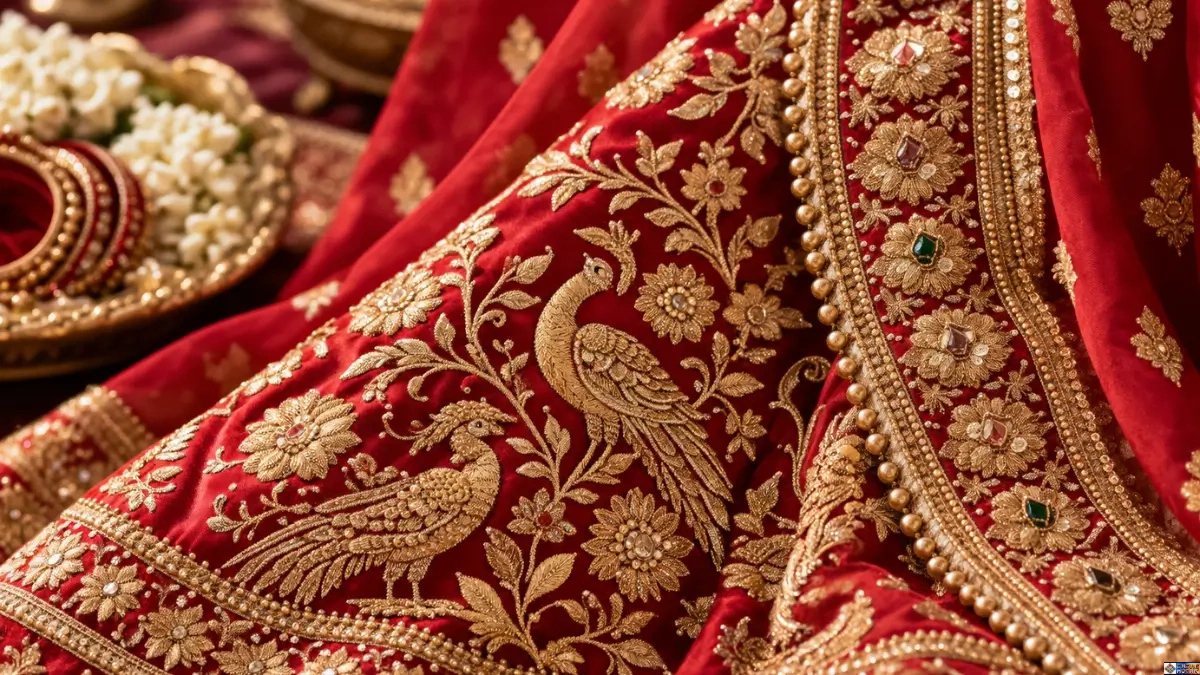
QUICK SUMMARY
- ● Wedding dress motifs aren’t decoration for its own sake. A stitch, a colour or a fold is usually doing a job — warding off harm, marking status, or wishing fertility on a marriage.
- ● Red beats white across huge parts of Asia because white has meant mourning there for centuries, not because anyone set out to invert a Western rule.
- ● Slavic vyshyvanka embroidery clusters at the collar, cuffs and hem: the openings where older belief said misfortune could slip in.
- ● You don’t have to choose between a white gown and your heritage. A sash, an embroidery panel, jewellery, or a second ceremonial outfit can let both traditions sit in the same wedding.
- ● A dress heavy with meaning doesn’t have to retire to a garment bag. Cut down, dyed, or reworked, it can carry its motifs into a cocktail dress or a christening gown for the next generation.
I’ve spent years with textiles that never made it into a museum case — the family wedding dresses folded into tissue paper in someone’s spare room, brought out once a decade for a daughter or niece to try on. Almost every time, the person unwrapping it asks me the same question: what does this actually mean? Not “is it pretty.” They can see that. They want to know why their grandmother’s dress has a particular flower stitched at the collar, or why the sash is that exact shade of red, or why an aunt gasped when a bride threatened to dye the whole thing ivory.
That’s the gap I want to close. Most bridal content treats cultural wedding dress motifs as a mood board — a scroll of pretty photos captioned “so vibrant!” and nothing underneath. If you’re planning a wedding meant to carry your family’s history, that’s worse than useless. You end up either flattening a real tradition into decoration, or feeling too nervous to touch it at all. So let’s go region by region, motif by motif, and get at what these patterns were actually doing on a bride’s body — protection, fertility, rank, memory — and how you can use that, respectfully, on your own wedding day.
I’ll link out to Culture Mosaic pieces on specific traditions as we go, and to the museums and researchers whose work I’m drawing on. For a broader survey first, Traditional Wedding Dress Cultural Meaning is a good companion piece to this one.
1. A Wedding Dress Motif Is a Language, Not a Look
Curators at the Metropolitan Museum of Art put it plainly in their study of historic bridal wear from Asia and the Middle East: fabric, colour and decorative motifs on wedding garments were chosen for specific meanings, tied to a woman’s change in social status and to shared wishes for fertility, prosperity and a secure union. That’s the throughline running under every example in this piece. Whether it’s a dragon curling across Chinese silk or a diamond stitched into a Ukrainian collar, the motif is there to do something, not just to look good doing it.
I’ll be straight about my bias here: I find the “pretty pattern” framing of most bridal culture content pretty thin. A motif with centuries of belief behind it deserves better than a caption calling it “so striking.” So each section below pairs a pattern with what it was actually meant to accomplish.
Looking at wedding dress across cultures this way — as a set of working symbols rather than a style catalogue — changes what you notice. For the wider survey of how this plays out across South Asian, East Asian, Nigerian and Celtic wedding wear specifically, Modern Cultural Wedding Dresses goes broad. This piece goes narrow, into the motifs themselves.
2. Why Do Many Asian Cultures Wear Red Instead of White?
Ask a Western wedding guest why Chinese or Indian brides wear red, and you’ll often get some version of: white means purity there, so red must be the opposite. That’s backwards. Red isn’t a rebellion against white — it’s its own tradition with its own logic, and white simply carries a different, harder association across much of Asia: mourning, not modesty.
The V&A’s own account of twentieth-century Chinese bridal wear is a good place to start. A 1953 gun gua in the museum’s collection — a black blouse and red skirt worn for a traditional tea ceremony — is embroidered in gold thread with a dragon and a phoenix, the auspicious pairing that stands for groom and bride together. Later brides swapped the two-piece gua for a fitted red qipao or cheongsam, sometimes with a Western veil sitting on top of it, but the colour and the dragon-and-phoenix motif carried straight through.
South Asian bridal wear follows a related but separate logic. A red lehenga or sari, heavy with zari or zardozi gold threadwork, marks a Hindu or Sikh bride’s transition into married life; the colour is tied to fertility and prosperity, not to any dialogue with Western white.
Japan complicates the “red not white” rule nicely, and I like it for that. A traditional shiromuku is pure white — but the white here isn’t a borrowed Western idea of purity. It reads as a blank canvas: the bride enters her wedding without the colours of her husband’s family, ready to be “dyed” into them. Many brides then change into a red or gold uchikake later the same day, so red still shows up. Just second, not first.
Table 1: Traditional Wedding Dress Colors Around the World
| Culture / Region | Traditional Colour | What It Symbolises | Signature Motif |
|---|---|---|---|
| China | Red, gold thread | Luck, joy, warding off evil | Dragon and phoenix pairing |
| South Asia (Hindu/Sikh) | Red, sometimes gold | Fertility, prosperity, transition to married life | Zari / zardozi metallic threadwork |
| Japan | White, then red/gold | Purity as a “blank canvas”; later, celebration | Uchikake outer robe embroidery |
| Ukraine / Slavic Europe | White linen, red and black thread | Protection, life force, fertility | Geometric diamonds, floral tree of life |
| Yoruba, Nigeria | Red (Alaari) or beige (Sanyan) | Joy and prosperity, or elite restraint | Hand-woven Aso-Oke strip patterns |
| Britain (pre-1840) | Varied, practical colours | Everyday reusability | Regional lace and embroidered muslin |
| Britain (post-1840) | White | Purity, social display, royal precedent | Lace overlay, orange-blossom trim |
3. What Do Geometric and Floral Patterns Symbolize in Slavic Wedding Dresses?
Ukrainian and wider Slavic bridal embroidery works on a completely different visual grammar from Chinese silk, but the underlying job is identical: encode a wish, and place it somewhere it can do good.
The Center for Russian, East European and Eurasian Studies at the University of Kansas has documented how sharply this embroidery varies by region — Lviv-area work favours geometric cross-stitch with deliberate gaps that give the pattern a raised, three-dimensional look, while Volyn embroidery is plainer and stricter, worked mostly in red, blue and black. Both sit inside the same tradition: the vyshyvanka, the embroidered linen shirt or blouse that Ukrainian brides have worn under a flower wreath for generations.
- Geometric patterns — diamonds, crosses, zigzags — read as protective, a kind of stitched barrier meant to stop harm reaching the wearer through a garment’s openings.
- Floral and tree motifs carry the opposite job: not defence, but growth, fertility and the link between one generation and the next.
Colour does its own work alongside the shapes. Red recurs constantly, standing for life and vitality; black grounds it, standing for the earth. Where those two threads meet on a bride’s collar, cuff or hem, you’re looking at centuries of belief compressed into a few square inches of linen.
This tradition matters enough that Ukraine’s culture ministry formally submitted the vyshyvanka for recognition on UNESCO’s Representative List of the Intangible Cultural Heritage of Humanity in May 2026 — a nomination built with input from museums, embroiderers and folk-art researchers, still under review as I write this. Whatever the outcome, that’s not a folksy footnote. It’s a living, actively safeguarded tradition, and cultural wedding dress motifs like this one are exactly why it’s worth safeguarding.
4. How Do Protective Symbols Work on Traditional Wedding Gowns?
Once you notice the “protect the openings” logic in Slavic embroidery, you start seeing versions of it everywhere, dressed differently.
Roman brides are often credited with the flammeum, a bright saffron-red veil said to symbolise fidelity and to shield the bride from harm on the walk to her new household — an early, veil-shaped cousin of the same instinct that puts a Ukrainian diamond motif at a collar. In South Asian weddings, the chura (red and white bangles) and the mangalsutra serve a related dual purpose: visible markers of married status that are also treated as protective. None of these traditions borrowed from each other directly. They arrived at a similar answer independently, which tells you something about how universal the underlying worry is — a new bride is vulnerable, and clothing and jewellery are asked to do something about that.
Table 2: Protective and Symbolic Motifs at a Glance
| Motif | Culture of Origin | Meaning | Where It Appears |
|---|---|---|---|
| Dragon and phoenix | China | Union of masculine and feminine; good fortune | Gua bodice, qipao panels |
| Geometric diamonds and crosses | Ukraine / Slavic Europe | Protection from harm | Collar, cuffs, hem |
| Tree of life | Slavic and Balkan Europe | Continuity between generations | Skirt borders, head-scarves |
| Zari / zardozi metallic thread | South Asia | Prosperity, status, celebration | Lehenga, sari border |
| Flammeum (saffron veil) | Ancient Rome | Fidelity, protection | Bridal veil |
| Alaari strip-weave | Yoruba, Nigeria | Joy, prosperity | Aso-Oke wrapper and blouse |
| Chura and mangalsutra | South Asia | Married status, protection | Wrists, neck |
If you want these garments unpacked piece by piece rather than motif by motif, the Traditional Wedding Dress Cultural Meaning piece I mentioned earlier walks through several of them individually.
5. Traditional Wedding Dress Colors: A Wider Map
It’s worth remembering Britain didn’t always default to white either. Before 1840, most British brides who weren’t aristocrats chose colours and patterns precisely because they intended to wear the dress again afterward — white was impractical, not principled. Only wealthier families could afford silk woven with gold and silver thread that never needed a second life. I’ve gone further into how one royal wedding flipped that logic entirely in Why Wedding Dresses Are White.
In Yoruba culture, colour does status work rather than protective work. Alaari, a vivid red cotton-and-metallic-thread cloth, marks joy and prosperity and turns up constantly at weddings. Sanyan, woven from wild silk in a pale beige, historically signalled elite status and restraint rather than celebration. Same broader fabric family, Aso-Oke, opposite emotional register, depending entirely on the dye.
6. How Can a Modern Bride Blend Her Cultural Motifs Into a Western White Dress?
You don’t have to pick a side. Here’s what I’ve actually seen work, and one option I’d call genuinely unconventional:
- An embroidery panel or sash in the family’s traditional pattern or colour, added to an otherwise plain white or ivory gown. This is the lowest-risk option and the easiest to reverse if you change your mind.
- Heritage jewellery doing the cultural signalling instead of the dress — a chura, a mangalsutra, a maang tikka — so the gown stays Western while the accessories carry the tradition.
- A second outfit for the reception or tea ceremony. Plenty of Chinese brides already do this: marry in white, change into a red qun kwa or qipao later in the day. If buying a second outfit outright isn’t in the budget, Where Can I Rent Wedding Dresses covers exactly this workaround.
- The wildcard: skip the soft, floaty silhouette altogether and pair heritage embroidery with a fitted, figure-skimming cut instead — closer to what you’ll find in Best Sexy Wedding Dresses than in a traditional ballgown. It’s not for everyone. But it’s a genuinely different way to carry a motif than draping it over yards of tulle, and I’ve seen it done beautifully.
Budget shapes which of these you can actually pull off, so get a realistic number before you fall in love with a design. Hand-worked cultural motifs add real cost on top of the dress itself, and How Much Are Wedding Dresses UK? covers the baseline you’re working from. If you’re sourcing outside the UK, Affordable Wedding Dresses Europe is worth a look too.
Fit matters just as much as budget. Plus Size Wedding Dresses is worth reading before anyone assumes heritage embroidery only works on one body type — it translates beautifully onto fuller silhouettes and shouldn’t be treated as an afterthought.
And if you want to see how brides are actually doing this in the UK right now, rather than in theory, Latest Trends in Bridal Wear and What Wedding Dresses Are in Style both track it.
7. How to Repurpose a Wedding Dress Into a Cocktail Dress (Without Losing the Meaning)
If your dress carries real cultural weight — a hand-embroidered panel, family lace, a colour chosen for a reason — the instinct to never touch it again is understandable. I’d push back on it, gently.
To repurpose wedding dress fabric this way, start with the hem: shortened to knee length by a skilled tailor, a full-length gown becomes a genuinely wearable cocktail dress, and a good tailor can build the alteration around the embroidery rather than through it, so the motif survives the transformation intact. Silk dyes evenly if you want to change the colour entirely; lace generally doesn’t, so factor that in if the beading or lacework is the part that matters most to you.
Not every dress needs to become a different dress, either. Some of the most striking things I’ve seen done with a heritage gown involve no cutting at all — just a shadow box or a framed panel that keeps the embroidered section visible on a wall instead of folded away in the dark. Either way, the motifs that made cultural wedding dress motifs worth studying in the first place don’t have to disappear just because the wedding is over.
Frequently Asked Questions
Why do many Asian cultures wear red instead of white for weddings?
Because white has historically read as a colour of mourning across much of East and South Asia, while red has stood for luck, vitality and fertility for centuries — long before Western white bridal fashion existed to react against. China’s red qipao and gua, worn with gold dragon-and-phoenix embroidery, and the red lehengas and saris of South Asian weddings both draw on this older, independent tradition rather than an inversion of it.
What do geometric and floral patterns symbolise in Eastern European and Slavic wedding dresses?
In Ukrainian and wider Slavic embroidery, geometric shapes — diamonds, crosses, zigzags — are traditionally read as protective, forming a stitched barrier at the collar, cuffs and hem. Floral and tree motifs carry a different meaning: fertility, growth and the connection between generations. Colour reinforces both — red for life and vitality, black for the earth.
Which country has the most beautiful wedding dress?
Honestly, I don’t think there’s a real answer to this one, and I’d be suspicious of anyone who gives you a confident single country. What I can tell you is which traditions consistently produce the most technically demanding needlework: Chinese gold-thread gua embroidery, South Asian zardozi metal-thread work, and Slavic vyshyvanka cross-stitch are three of the most labour-intensive bridal textile traditions still practised today. “Most beautiful” depends entirely on which of those visual languages speaks to you.
How can a modern bride blend her cultural motifs into a Western white dress?
A sash or embroidery panel added to a plain gown, heritage jewellery carrying the cultural signalling instead of the dress, or a second outfit change for the reception all work well. None of these requires abandoning either tradition — most brides I’ve spoken with land somewhere between two of these options rather than picking just one.
Can I repurpose my wedding dress into a cocktail dress without losing its meaning?
Yes, and it’s more straightforward than most brides expect. A tailor can shorten the hem and build the alteration around embroidered panels rather than through them, so the motif stays intact. Silk dyes evenly if you want a colour change; lace usually resists dye, so plan around the fabric you actually have rather than the colour you want first.
Sources
- Victoria and Albert Museum, “The Wedding Dress: 200 Years of Wedding Fashion”
- The Metropolitan Museum of Art, “Wedding Attire: Three Cultures, One Celebration”
- Center for Russian, East European & Eurasian Studies, University of Kansas, “Ukrainian Embroidery”
- Euromaidan Press, “Ukraine’s traditional vyshyvanka embroidered shirt submitted for UNESCO cultural heritage recognition” (May 2026)
- Pashione, “2023 Aso Oke Styles” (Alaari and Sanyan fabric terminology)
- David’s Bridal, “How to Repurpose Your Old Wedding Dress”
- Further reading: cultural wedding dress motifs — a global survey of bridal traditions.