
 By Culture Expert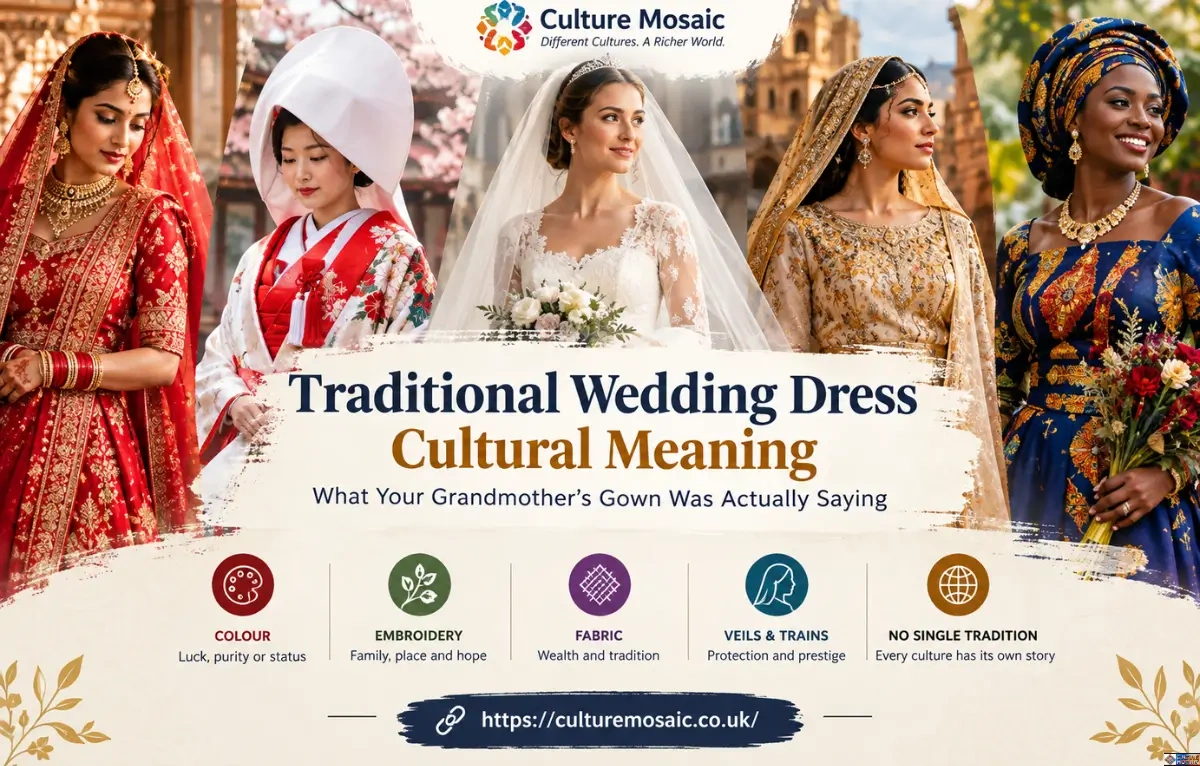
| Quick Summary: White wedding dresses only became standard in Britain after Queen Victoria’s 1840 wedding. Before that, brides wore whatever colour suited their means and their region — red, blue, black, or gold.Red is the dominant traditional wedding dress colour across South Asia and East Asia, tied to fertility, luck, and protection rather than passion or danger.Japan uses white and red in the same ceremony, with each colour marking a different stage of the bride’s transition into a new household.Veils and long trains both trace back to older, more superstitious functions — warding off evil spirits and signalling status — long before they became a fashion statement.No single “correct” bridal colour exists worldwide. Every choice is a deliberate cultural statement, not a default. |
The Problem With Assuming White Is “Traditional”
Here’s the thing that catches most people off guard when I explain this at dinner parties: there is no such thing as a universal traditional wedding dress. Ask a bride in Cardiff and a bride in Chennai what “traditional” means and you’ll get two completely different answers, both correct. The traditional wedding dress cultural meaning behind any garment depends entirely on which tradition you’re standing inside of, and most of us in the UK have only ever stood inside one.
I understand the confusion, honestly. If you grew up watching royal weddings on television, white silk and a long veil probably felt less like a choice and more like a rule — something close to law. Planning your own wedding under that assumption can feel oddly restrictive, even a little flat, once you realise it’s a relatively recent custom rather than an ancient one. The good news is that once you understand where these colours and shapes actually came from, the whole subject opens up. You start to see a wedding dress as a message rather than a uniform, and that makes choosing your own a great deal more interesting.
Why Do Western Brides Wear White? A History of Wedding Dresses on a Timeline
Let’s deal with the elephant in the room first, because it’s the question I get asked more than any other: why do Western brides wear white?
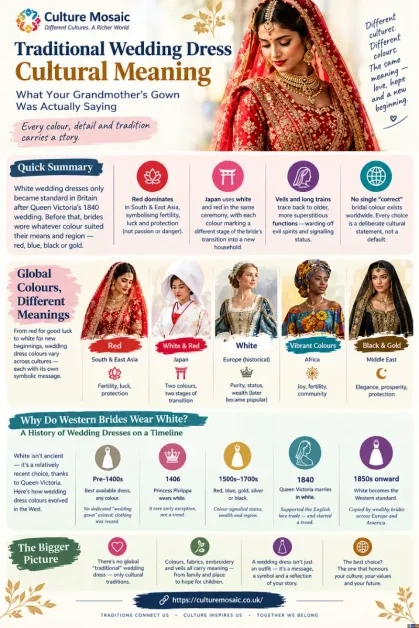
The short answer is Queen Victoria. On 10 February 1840, she married Prince Albert in a gown of heavy white silk satin trimmed with Honiton lace, made by Mary Bettans. It wasn’t a declaration of virginal purity in the way people now assume — it was, in large part, a promotional choice. Victoria wanted to support the ailing English lace trade, and white satin showed off Honiton lace beautifully. The dress worked exactly as intended. Wealthy brides across Britain, Europe, and eventually America began copying her within a decade.
What’s genuinely surprising is what came before. Wedding dresses before 1840 were rarely white by default. The Victoria and Albert Museum’s own bridal collection notes that it was entirely normal for a bride to marry in red, pink, blue, brown, or even black, and that many working women continued choosing coloured or patterned dresses well into the 1840s simply because white was impractical to keep clean and far too expensive to wear only once. Some historians trace the earliest recorded white European wedding gown back to Princess Philippa of England in 1406, but even royal brides after her regularly chose silver or gold instead, since those colours signalled rank more clearly than plain white ever could.
Here’s a simple timeline to keep the sequence straight:
| Period | What Brides Typically Wore | Why |
| Pre-1400s | Best available dress, any colour | No dedicated “wedding gown” existed; clothing was reused |
| 1406 | Princess Philippa wears white, a rare early exception | Personal or dynastic preference, not a trend |
| 1500s–1700s | Red, blue, gold, silver, or black, depending on wealth and region | Colour signalled status; white was hard to maintain |
| 1840 | Queen Victoria wears white satin and Honiton lace | Promoted English lace industry; became fashionable |
| Late 1800s–1900s | White becomes standard for wealthy Western brides | Victoria’s influence spreads through Europe and America |
| Today | White remains dominant in the West; other cultures maintain their own colour traditions | Global fashion blends with regional custom |
So when people ask why Western brides wear white, the honest cultural historian’s answer is: because one particular queen wanted to sell more lace, and it happened to catch on at exactly the right cultural moment.
Wedding Dress Colors in Different Cultures: The Case for Red
Understanding the traditional wedding dress cultural meaning of red requires setting the Western default aside entirely. If white tells a story about purity reinterpreted as fashion, red tells an almost entirely different one. Red wedding dress meaning across most of Asia has nothing to do with danger or seduction — it’s about visibility, vitality, and blessing.
In India, the lehenga or saree is very often a deep, saturated red, connected to the goddess Shakti and to the vermilion Sindoor a married woman continues wearing at her hairline. Gold thread embroidery — Zardozi, historically brought to the subcontinent under Mughal patronage — reinforces the same message of prosperity, alongside lighter Gota Patti ribbon work used for the parts of the outfit that need to move.
In China, the Qun Kua, a red jacket-and-skirt set embroidered with a dragon and a phoenix worked together, represents the joining of yin and yang. The colour is chosen specifically because it’s believed to bring luck and to guard against misfortune, which answers a question I hear constantly: why is red so popular in Asian weddings? It isn’t ornamental. It’s protective, in the same practical sense a charm or a blessing is protective.
Japan complicates the picture beautifully. A bride typically begins her ceremony in the shiromuku, a pure white silk kimono symbolising her readiness to be shaped by her husband’s family, and later changes into a red or gold uchikake for the celebration that follows. White and red aren’t competing choices here — they’re two chapters of the same story, worn on the same day.
Traditional Wedding Outfits Around the World: Top 10 Countries and Their Wedding Dress
For readers who want the fast version, here’s a working shortlist of traditional wedding outfits by country. This is far from exhaustive, but it gives a real sense of how wide the range is.
| Country | Traditional Garment | Dominant Colour(s) | Core Meaning |
| India | Lehenga / Saree | Red, Gold | Fertility, prosperity |
| China | Qun Kua / Qipao | Red, Gold | Marital harmony |
| Japan | Shiromuku / Uchikake | White, then Red or Gold | Purity, transformation |
| Ghana | Kente Ensemble | Gold, Yellow, Green | Royalty, heritage |
| Morocco | Caftan / Takchita | Emerald, Blue, Gold | Lineage, status |
| Nigeria | Iro and Buba (Aso Oke) | Varies, coordinated with groom | Community, unity |
| South Korea | Hanbok / Hwarot | Bold jewel tones | Longevity, harmony |
| Norway | Bunad | Regional wool tones | Heritage, craftsmanship |
| Russia | Sarafan and Kokoshnik | Varies by region | Family lineage, folklore |
| United Kingdom | White Gown | White, Ivory | Purity (post-1840 custom) |
What Do Long Dress Trains or Veils Mean?
Two accessories deserve their own mention, because they carry as much symbolic weight as the dress itself.
The veil is older than the white dress by a very wide margin. In ancient Rome, brides wore a bright orange-yellow veil called the flammeum specifically to make it harder for evil spirits to identify and target them — the logic was protective rather than decorative. Medieval Europe reworked that same garment into a symbol of modesty and status, and in some traditions the veil served a very practical function too, concealing the bride’s face until the marriage contract was finalised. The dramatic moment of “lifting the veil” that still shows up in Western ceremonies today is a direct descendant of that older, more anxious custom.
Long trains developed along a different but related track. Historically, a train that dragged several feet behind a bride was a visible, unmistakable display of wealth — more fabric than any practical garment required, which was precisely the point. The longer the train, the more resources a family had to spare on something purely ceremonial, and the message was received exactly as intended by every guest watching it move down the aisle.
What Do Different Dress Colors Mean in Folklore?
A quick reference, since I get asked this constantly:
- Red — fertility, luck, protection (India, China, parts of Eastern Europe)
- White — purity, transformation, a fresh start (Japan, post-Victorian Britain)
- Gold — wealth, divine favour, royal status (South Asia, Ghana, Morocco)
- Blue — peace, fidelity, harmony (Kente tradition, ancient Rome)
- Black — in parts of pre-Victorian Western Europe, a practical, stain-resistant choice rather than a mournful one; in Ashanti and Ewe custom, red carries the funerary association black holds elsewhere
- Green — growth, renewal, the land itself (Ghana)
Bringing Tradition Into a Modern Wedding
None of this history is meant to talk anyone out of a white gown — plenty of readers will still want one, and there’s nothing wrong with that. What I’d encourage instead is treating the choice as a choice, rather than an assumption.
If you’re currently deciding what wedding dresses are in style this season, it’s worth knowing how much of that trend cycle sits on top of a much older, more varied foundation. Some brides are folding heritage back into a Western silhouette through colour, embroidery, or a second outfit for the reception, echoing the Japanese or Chinese tradition of changing partway through the day.
Budget and practicality matter here too, and Culture Mosaic covers both. If you’re weighing how much wedding dresses cost in the UK, comparing affordable wedding dresses across Europe, or wondering where you can rent a wedding dress rather than buy one outright, those are entirely modern, entirely practical extensions of the same instinct brides have always had — to dress for the occasion within the means available to them.
And if your taste runs toward something bolder, our guides to plus-size wedding dresses and the best sexy wedding dresses sit comfortably alongside this history rather than against it — self-expression through bridal wear is, if anything, the oldest tradition of all.
For a broader view of where bridal fashion is heading next, our roundup of the latest trends in bridal wear is a natural next stop, alongside this useful overview of cultural wedding dress traditions around the world if you’d like a second perspective on the same subject.
A wedding dress, in the end, is one of the few garments most of us will ever wear that’s designed to say something on our behalf. The traditional wedding dress cultural meaning behind it is never accidental.
Frequently Asked Questions
1. Why do Western brides wear white if it isn’t an ancient tradition?
White became standard in Britain and much of the West after Queen Victoria wore a white satin gown trimmed with Honiton lace at her 1840 wedding, partly to support the English lace industry. Wealthy brides across Europe and America copied the look within a decade, and it eventually became the default rather than one option among several.
2. Why is red so popular in Asian weddings specifically?
In Indian and Chinese tradition, red is associated with fertility, luck, and protection rather than passion. In India it connects to the goddess Shakti and the vermilion Sindoor; in China it’s reinforced through dragon-and-phoenix embroidery believed to guard the couple against misfortune.
3. What did wedding dresses look like before 1840?
There was no dedicated “wedding gown” for most of Western history. Brides wore their best existing dress, in whatever colour suited their means — red, blue, brown, or black were all common, and white was largely impractical outside wealthy households because it was so difficult to keep clean.
4. What do long dress trains or veils actually symbolise?
Veils originated as protection against evil spirits in ancient Rome before shifting toward modesty and status in medieval Europe. Long trains functioned as a visible display of a family’s wealth, since the extra fabric served no practical purpose beyond signalling what the family could afford.
5. Is there one “correct” traditional wedding dress colour worldwide?
No. Colour meaning is entirely culture-specific — red signals mourning in Ashanti Kente tradition but prosperity in Indian and Chinese bridal wear, while white signals transformation in Japan and purity in the post-Victorian West. Context always determines meaning.
Sources and Further Reading
- Victoria and Albert Museum, “Wedding Colour” — museum collection notes on pre-1840 British bridal dress
- Wikipedia, “Wedding Dress of Queen Victoria” — designer, materials, and date of the 1840 gown
- Fashion History Timeline, Fashion Institute of Technology, “1840 – Queen Victoria’s Wedding Dress” — academic overview of the dress’s cultural impact
- JSTOR Daily, “A Natural History of the Wedding Dress” — history of Western bridal colour before Victoria
Culture Mosaic |
Questions or corrections? Get in touch with our editorial team.