
 By Dr. Marcus Hale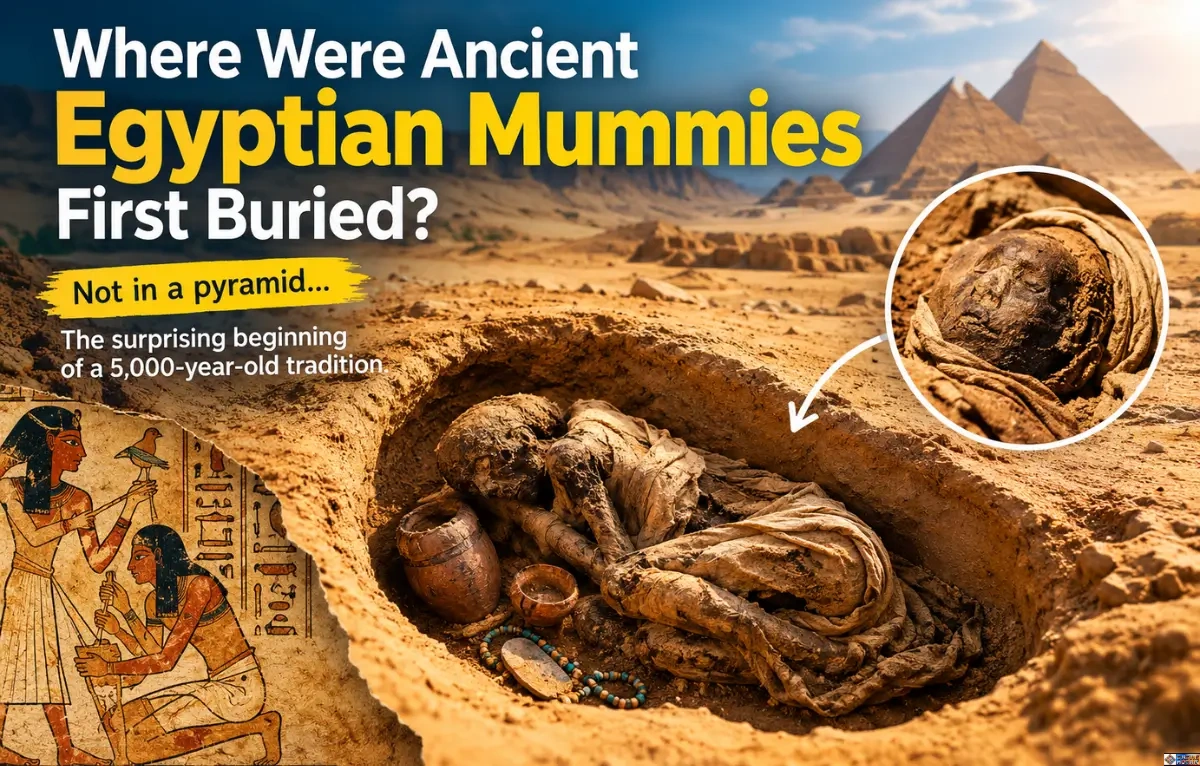
Quick Summary
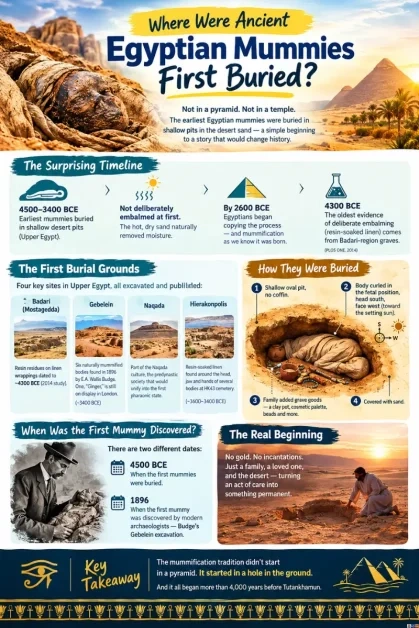
- Where were ancient Egyptian mummies first buried? Not in a pyramid. Not in a temple. The earliest Egyptian mummies were buried in shallow oval pits scooped straight into the desert sand, at prehistoric cemeteries in Upper Egypt such as Badari (Mostagedda), Naqada, Gebelein, and Hierakonpolis.
- These burials date to roughly 4500–3400 BCE, a full two thousand years before Tutankhamun was even born.
- The bodies weren’t deliberately embalmed at first. The hot, bone-dry sand pulled the moisture out on its own, and the desert did the work that priests would later take credit for.
- By the time of the Old Kingdom (around 2600 BCE), Egyptians had noticed what the sand was doing and started copying it on purpose. That’s the moment mummification, as we actually recognize it, was born.
- The oldest confirmed evidence of deliberate embalming — resin-soaked linen — comes from Badari-region graves dated to roughly 4300 BCE, according to a 2014 study in PLOS ONE.
The Question Everyone Gets Wrong
I get asked some version of this question constantly, usually right after someone’s been to a museum and stood in front of a gold sarcophagus. Where did it all start? And almost everyone assumes the answer involves a pyramid, a priest chanting over a body, and seventy days of ritual.
It doesn’t.
I understand the confusion. Every mummy documentary opens with a temple. Every film opens with a tomb. If your entire mental image of ancient Egypt comes from King Tut’s golden mask, it’s a reasonable guess that the mummy tradition began somewhere just as grand. It didn’t. It began in a hole in the ground, wrapped in nothing more than a goat hide, out in the open desert.
I find that gap between expectation and reality is where the real story lives. So let me walk you through it properly.
What Is a “Mummy” in History?
Before I go further, it’s worth pausing on the word itself, because I think that’s where a lot of the confusion starts. I get asked what is mummy in history often enough that I’ve answered it properly elsewhere — but the short version is this: a mummy is simply a body preserved well enough, by nature or by human hands, that soft tissue survives instead of rotting away.
That definition matters here because it means the very first Egyptian mummies were accidents. Nobody set out to make them. The Sahara did it for free.
The First Burial Grounds: Badari, Naqada, Gebelein, and Hierakonpolis
This is the direct answer to where were ancient Egyptian mummies first buried — four specific sites, all excavated and published, not a guess.
Mostagedda, in the Badari region of Upper Egypt. This is the location cited in the landmark 2014 chemistry study that rewrote the mummification timeline. Researchers ran linen wrappings from these graves through gas chromatography and found resin residues dating to roughly 4300 BCE — evidence that Egyptians were experimenting with preservation a full 1,500 years earlier than anyone had proven before.
Gebelein, on the Nile about 40 kilometers south of Thebes. In 1896, the British Museum’s E.A. Wallis Budge excavated six naturally mummified bodies from shallow sand graves here, dated to roughly 3400 BCE. One of them — a red-haired man now nicknamed “Ginger” — is still on display in London, skin and hair intact after more than five thousand years.
Naqada and Hierakonpolis. These sites, along with Abydos, formed the backbone of what archaeologists call the Naqada culture, the predynastic society that would eventually unify into the first pharaonic state. At Hierakonpolis’s HK43 cemetery, researchers found resin-soaked linen wrapped around the head, jaw, and hands of several bodies — a technique that looks almost intentional, dated to around 3600–3400 BC.
What all four sites share is the burial method itself. No coffins. No embalming tables. Just a shallow oval pit, a body curled into the fetal position, head typically pointed south, face turned west toward the setting sun. Family members tucked in a few grave goods — a clay pot, a cosmetic palette, some beads — and covered the body with sand.
That’s it. That’s where it started.
I’ve stood at reconstructions of these grave sites, and there’s something quietly moving about the simplicity. No gold. No incantations. Just a family doing the only thing they could for someone they’d lost, and the desert quietly turning that gesture into permanence.
When Was the First Mummy Discovered?
There’s an important distinction here that trips a lot of readers up, so let me separate two different questions.
When were the first mummies buried? Roughly 4500 BCE, as I’ve covered above.
When was the first mummy discovered by modern archaeologists? That’s Budge’s 1896 excavation at Gebelein — the six bodies I mentioned a moment ago became the first complete predynastic bodies ever recovered intact.
There’s a more recent headline worth clearing up too, because it circulates constantly online. In January 2023, Zahi Hawass and his team pulled a 4,300-year-old gold-leaf-wrapped mummy named Hekashepes out of a sealed shaft at Saqqara. Plenty of outlets ran the story as “oldest mummy ever found.” It isn’t. Hekashepes is the oldest complete, gold-covered mummy of a named individual from the Old Kingdom — impressive, but roughly two thousand years younger than the anonymous bodies from Badari and Gebelein. Even Hawass corrected the record himself when reporters pushed him on it.
Why Did Ancient Egyptians Mummify Their Dead?
Belief, mostly. Not vanity, not fear — belief.
Egyptians held that a person’s spirit needed an intact, recognizable body to return to after death. Lose the body, and you lose the afterlife. That’s a heavy thing to sit with if you actually believe it, and I think it explains the intensity with which the practice developed over three thousand years. Grave goods appear even in the earliest pit burials — pottery, palettes, small amulets — which tells us this belief in continuation after death predates written religion in Egypt entirely.
Once the natural drying of desert sand showed them what an intact body could look like centuries later, the theology and the technique reinforced each other. Preserve the body, protect the soul. It’s a strikingly practical response to an entirely spiritual problem.
The Mummification Process in Ancient Egypt
Here’s the part I think gets skipped over too fast in most explainers: the process we picture — organ removal, natron salt, seventy days, linen wrapping — is an Old Kingdom and later invention. It doesn’t show up in anything close to its familiar form until roughly 2600 BCE, more than a thousand years after those first accidental burials in the sand.
Once it did develop, though, it became remarkably consistent for the better part of three millennia.
The 7 Steps of Mummification
- Purification. The body was washed with water from the Nile, often blended with palm wine, in a ritual cleansing before any physical work began.
- Organ removal. Embalmers made an incision along the left side of the abdomen and removed the liver, lungs, stomach, and intestines — organs that decay fastest and threaten the rest of the body.
- Brain removal. Using a long hooked instrument inserted through the nostril, embalmers pulled the brain out in pieces. Egyptians didn’t consider the brain important, so it was discarded rather than preserved.
- Natron drying. The body was packed inside and out with natron, a naturally occurring salt, and left to dry for about 40 days. This step did the heavy lifting — it’s the deliberate, sped-up version of what desert sand did by accident two thousand years earlier.
- Stuffing and reshaping. Once dried, the body cavity was packed with linen, sawdust, or resin-soaked fabric to restore a lifelike shape that decades of dehydration had collapsed.
- Oiling and wrapping. Embalmers coated the skin in oils and resins, then wrapped the body in layer upon layer of linen strips, tucking amulets between the folds for protection in the next life.
- Final rites. A priest performed the Opening of the Mouth ceremony, symbolically restoring the senses, before the mummy was sealed in its coffin and carried to the tomb.
Start to finish, the whole sequence ran about 70 days — a number that held remarkably steady across most of pharaonic history.
Which Organs Were Left Inside the Mummy?
Only one, for most of Egyptian history: the heart.
Egyptians believed the heart was the seat of intelligence and emotion — the organ that would be weighed against the feather of Ma’at in the afterlife to judge a person’s worth. Removing it would have been unthinkable. Everything else — liver, lungs, stomach, intestines — was extracted, dried separately in natron, and stored in four canopic jars, each protected by one of the four sons of Horus. The kidneys are the odd exception; they’re small, hard to locate through the incision, and were frequently left in place simply because embalmers couldn’t easily get to them.
Were Poor People Mummified?
Sometimes, in a scaled-down way — and this is where I think Egypt’s social structure gets genuinely interesting.
Full mummification with all seven steps was expensive. Natron, linen by the roll, skilled embalmers, a proper tomb — none of that was cheap, and Herodotus himself wrote about tiered pricing, with cut-rate versions available for families who couldn’t afford the full treatment. A recent excavation of mass burials near Saqqara’s necropolis found exactly this pattern in the archaeological record: poorer bodies, wrapped and buried with far less elaboration than royal or noble mummies, but clearly following the same underlying beliefs about the afterlife, just expressed with a lot less gold.
At the far end of the scale, plenty of ordinary Egyptians simply couldn’t afford any embalming at all and were buried directly in the sand, the same way their predynastic ancestors had been three thousand years earlier. In a strange, quiet way, the poorest burials in dynastic Egypt looked almost exactly like the very first ones.
Who Was the First Person to Be Mummified?
There isn’t a name we can attach to it, and I think that’s actually the most honest answer I can give you.
The earliest mummies — the Badari and Gebelein bodies — are anonymous. No inscriptions, no titles, no identity beyond what forensic analysis can tell us: sex, approximate age, general health. “Ginger,” the red-haired man I mentioned earlier, is the closest thing to a household name among them, and even that’s a nickname assigned in the twentieth century — not anything his own family would have called him.
Mythologically, Egyptians told a different story. In their own tradition, the first mummy was the god Osiris, murdered by his brother Seth and reassembled and wrapped by Anubis, the jackal-headed god of embalming. That myth is almost certainly the reverse of what actually happened — the ritual came first, historically, and the god was invented to explain it — but it’s the origin story Egyptians themselves believed, and it shaped every embalming ritual performed for the next three thousand years.
If you want the closest thing to a documented “first named individual,” that’s Hekashepes, the Old Kingdom mummy from Saqqara I mentioned earlier — though calling him “first” is a stretch. He’s simply the oldest one we’ve found with gold wrapping and an inscribed name attached.
How Long Did the Mummification Process Take?
About 70 days, as I mentioned above — worth restating plainly here, since it’s one of the most-searched questions about this whole process on its own. Most of that time was non-negotiable. Natron doesn’t dry a body faster just because a family is impatient, and rushing the process risked decomposition setting in before the salt had finished its work.
For royalty, that same window did double duty. While embalmers worked, the state used the time to finish the tomb, carve inscriptions, and organize the funeral procession — logistics running in parallel with the religious timeline, not after it.
Famous Mummies from Ancient Egypt
Once mummification matured, it produced some of the most recognizable human remains on the planet. A few worth knowing:
- Tutankhamun is the one most people picture first, mostly thanks to that golden death mask, and his tomb was found nearly intact back in 1922. Where King Tut’s mummy rests today, and how King Tut died, are both questions with answers stranger than the popular version.
- Seti I’s mummy might be the best-preserved royal remains we have — the detail still visible in his face after three thousand years is genuinely striking in person. Seti I’s wife has her own overlooked story that deserves more attention than it usually gets.
- Hatshepsut, one of Egypt’s few female pharaohs, had her mummy misidentified for decades until DNA testing finally confirmed which body in the Valley of the Kings was actually hers. Who Hatshepsut was, and why her legacy was later erased, is a story worth its own read.
- The Golden Mummies of Bahariya, a Greco-Roman era cache found in the 1990s, were gilded with far more elaborate ornamentation than the Old Kingdom examples I described earlier — the Golden Mummies of Egypt are worth a look on their own.
Past these four, the most famous Egyptian mummies discovered to date make for a solid rabbit hole if you’ve got the time.
Is There a Real Mummy Alive?
No — and I want to be direct about this, because the question comes up more than you’d think, usually thanks to horror movies and internet urban legends. No mummy has ever been “alive” in any biological sense. What fuels the myth is simply how well-preserved some of these bodies are — Ginger, the Gebelein man I described earlier, still looks startlingly lifelike in photographs, even under museum lighting. That’s the sand doing its job, not anything supernatural.
Facts About Mummies
A few details I find genuinely surprising, even after years of studying this material:
- Egypt’s mummification tradition ran for roughly 3,000 years, from predynastic pit burials through the Roman period.
- Animals were mummified too — cats, crocodiles, and even sacred bulls at Saqqara had their own dedicated cemeteries.
- Egyptians discarded the brain but carefully preserved the heart, believing intelligence and emotion lived there, not in the skull.
- The word “mummy” itself comes from the Persian/Arabic mumiya, referring to bitumen — medieval Europeans wrongly assumed mummies were preserved in tar.
- Some of the oldest mummies were never deliberately embalmed at all. The desert did it for free, thousands of years before anyone thought to try.
The Legacy — and Why It’s Worth Seeing for Yourself
I think the real story here isn’t the gold or the ritual. It’s that Egyptian mummification began as an accident of geography — sand, heat, and no rain — and slowly turned into one of the most sophisticated body preservation systems the ancient world ever produced. The ancient Egyptian mummies preservation techniques that grew out of that accident are worth tracing on their own, and so is the question of how old most Egyptian mummies actually are compared to what most people assume walking into a museum.
The spiritual side of all this interests me just as much as the technical side, honestly. The Egyptian concept of life after death is what made any of this worth doing in the first place, and if you want a genuinely strange footnote to the whole tradition, Egyptian mummy Iliad papyri — fragments of Homer, of all things — turned up wrapped inside mummy cartonnage centuries after these burial customs began.
The British Museum still has Ginger on public display, no appointment needed. Standing in front of him remains one of the strangest, most grounding experiences I can recommend to anyone even mildly curious about where this whole tradition began. Not a pyramid. Not gold. Just sand, and a family that didn’t want to let go.
Frequently Asked Questions
Where were ancient Egyptian mummies first buried?
The earliest Egyptian mummies were buried in shallow sand pits at prehistoric cemeteries in Upper Egypt, including Badari (Mostagedda), Naqada, Gebelein, and Hierakonpolis, dating to roughly 4500–3400 BCE. These weren’t deliberate embalmings — the hot, dry desert sand naturally dehydrated the bodies and preserved them by accident.
How long did the mummification process take?
Once mummification became a deliberate, ritualized practice in the Old Kingdom, the full process took about 70 days: roughly 40 days for natron salt drying, and the remaining time for organ preparation, wrapping, and religious rites before burial.
Were poor people mummified in ancient Egypt?
Yes, though usually with far less elaboration. Wealthy Egyptians received the full seven-step process with fine linen and canopic jars, while poorer families paid for cheaper, abbreviated versions — or, at the lowest end, were buried directly in the sand with little to no embalming at all, much like Egypt’s earliest predynastic burials.
Which organs were left inside the mummy?
The heart was almost always left in place, since Egyptians believed it held a person’s intelligence and would be judged in the afterlife. The kidneys were sometimes left as well, mainly because they were physically difficult for embalmers to reach and remove.
Who was the first person to be mummified?
No individual name survives from the earliest mummies — the Badari and Gebelein bodies are anonymous, identified only through forensic study. In Egyptian tradition, religious beliefs and physical embalming practices grew alongside each other over time, bound together by stories like that of Osiris.
Sources
- Jones, J. et al. “Evidence for Prehistoric Origins of Egyptian Mummification in Late Neolithic Burials.” PLOS ONE, 2014.
- Smithsonian Institution. “Egyptian Mummies.” si.edu.
- British Museum. “Gebelein Predynastic Mummies” collection records.
- Spurlock Museum, University of Illinois. “History: 4650–3050 BCE, Mummification.”
- CBS News / Smithsonian Magazine / Al Jazeera reporting on the Hekashepes mummy discovery, Saqqara, January 2023.
- Popular Science. “300 years of mummies: how Egypt’s tombs rewired the way we study the ancient dead.”