
 By Culture Expert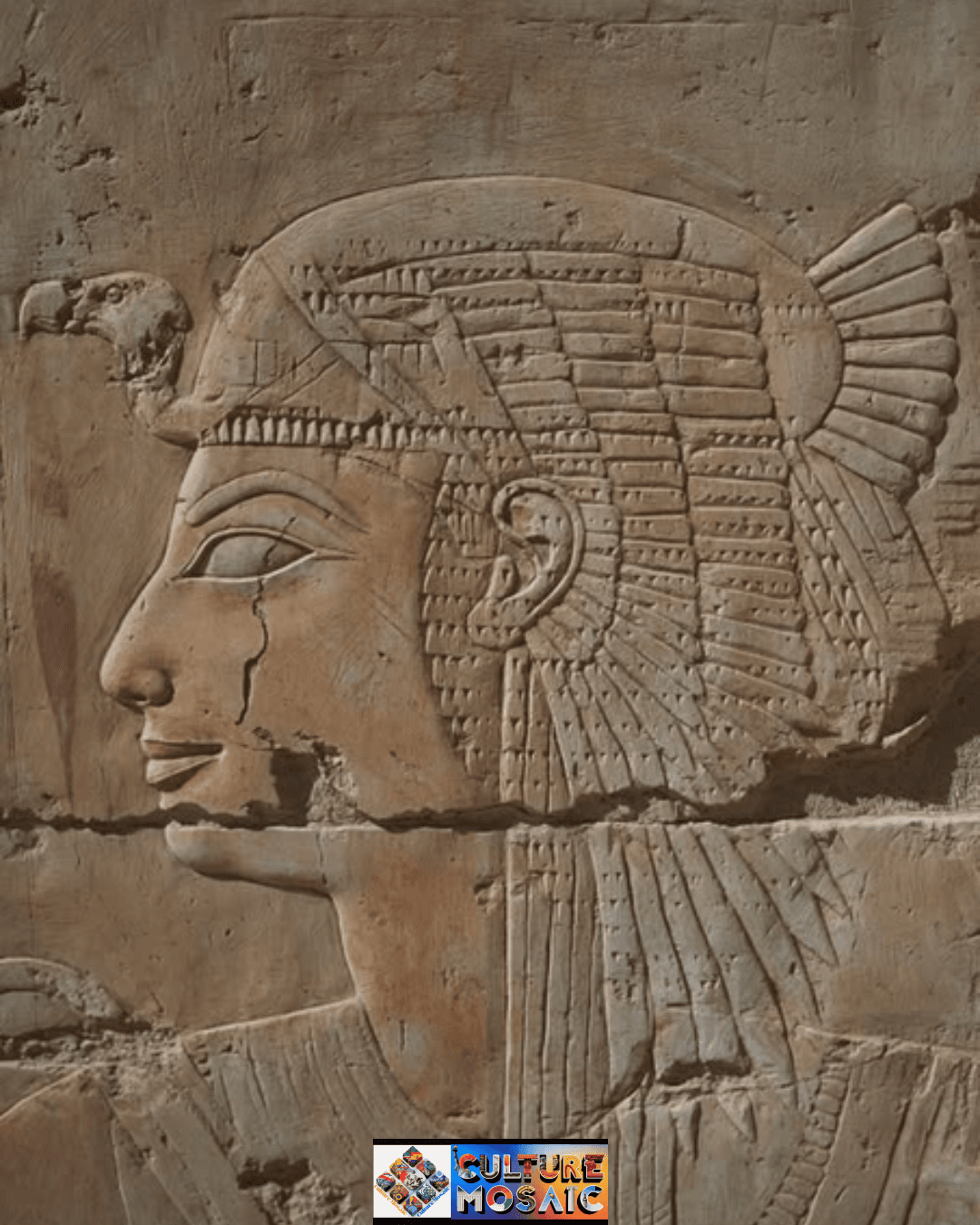
Culture Mosaic — Ancient Egypt
About the Author
Dr. Elena Caruso is an Egyptologist and cultural historian who trained at University College London’s Institute of Archaeology, with fieldwork seasons spent cataloguing temple reliefs in Luxor. She writes for Culture Mosaic, where she covers ancient Egyptian history, burial practice, and the politics of memory in the pharaonic world. You can reach her through the Culture Mosaic contact page.
I still remember the first time I stood in front of Hatshepsut’s mortuary temple at Deir el-Bahari, that long limestone terrace cut into the cliffs like something a modern architect would sketch on a napkin. It doesn’t look three and a half thousand years old. It looks like it was built last week by someone with very good taste and no patience for clutter. And then you learn the woman who built it spent a thousand years erased from her own country’s memory, and the place stops being just beautiful. It starts being personal.
Hatshepsut is one of those figures who gets a footnote in most survey courses and deserves a whole semester. So let’s do this properly.
Who Was Hatshepsut in Ancient Egypt?
Hatshepsut was a female pharaoh who ruled Egypt for roughly two decades during the 18th Dynasty, somewhere around 1479 to 1458 BCE. She didn’t rule as a queen consort standing beside a king. She ruled as king, full stop, with the crook and flail, the false beard, and every royal title a male pharaoh would have carried. If you’re asking who was Hatshepsut in ancient Egypt in the simplest terms possible: she was the daughter of one pharaoh, the widow of another, and eventually a monarch in her own right who governed a kingdom at peace and, by most measures, thriving.
Her reign sits at an odd angle in Egyptian history. She wasn’t a usurper in the dramatic, blood-on-the-floor sense. She was a regent who simply never stepped back down. And that decision, quiet as it must have felt at the time, made her one of the most consequential rulers Egypt ever had.
Hatshepsut’s Family and Early Life
Daughter of Thutmose I
Hatshepsut was born around 1507 BCE, the daughter of Thutmose I and his principal wife, Ahmose. That royal bloodline mattered enormously in Egyptian court politics. Her father was a successful military king who pushed Egypt’s borders deep into Nubia and the Levant, and her mother’s lineage carried the kind of prestige that made Hatshepsut, not any of her half-siblings, the most legitimate heir in the room.
She grew up in a palace that took the god Amun very seriously. Later in life she would lean hard on her connection to Amun to justify her rule, but as a child she was simply the king’s daughter, being groomed the way royal daughters were groomed: for a strategic marriage.
Queen to Thutmose II
Hatshepsut married her half-brother, Thutmose II, which sounds startling to modern ears but was standard practice for Egyptian royalty trying to keep the bloodline concentrated and the succession uncontested. She held the title of Great Royal Wife, the highest a woman could hold short of the throne itself.
Thutmose II’s reign was short and, by most accounts, unremarkable. He died young, leaving the throne to Thutmose III, a boy born to a secondary wife named Isis. The heir was a child. Someone had to run the country in the meantime. That someone was Hatshepsut.
How Hatshepsut Became Pharaoh
At first, she did exactly what was expected of a royal widow with a child heir. She served as regent, managing the machinery of state on behalf of Thutmose III. This was ordinary. Regencies happened. Nobody would have blinked.
What wasn’t ordinary is what came next. Somewhere around year seven of Thutmose III’s nominal reign, Hatshepsut had herself crowned pharaoh. Not co-regent in name only. Full pharaoh, with a throne name, Maatkare, and the complete set of royal titles. Thutmose III wasn’t removed. He kept his position and, remarkably, the two ruled in parallel for years, her image consistently placed first.
She didn’t take the throne by force. She simply never handed it back, and Egypt, for whatever reason, let her keep it.
Historians still argue about how she pulled this off without a civil war. My own read, after years of sitting with the inscriptions, is that she was extraordinarily good at legitimizing herself through religion. She commissioned texts claiming Amun himself had visited her mother and fathered her, essentially writing divine paternity into her own biography. It’s a bold move. It’s also, frankly, brilliant PR for the Bronze Age.
The Bearded Pharaoh: Hatshepsut’s Royal Image
Walk through the Egyptian wing of the Met or the Cairo Museum and you’ll see statues of Hatshepsut wearing the traditional false beard of kingship, her body rendered with the broad shoulders and narrow waist of male pharaonic art. Early in her reign, some images show her in more feminine dress, with the royal titles still female in grammatical form. Later, the imagery hardens into full pharaonic convention: bare-chested, kilted, bearded, unmistakably royal.
This wasn’t vanity or confusion about gender. It was iconographic necessity. The role of pharaoh, as a religious office, was coded male in Egyptian cosmology. To function as king, in the eyes of the priesthood and the gods, she needed to be depicted as one. It’s a strange kind of pragmatism, and I find it one of the more fascinating puzzles in the whole story.
Hatshepsut’s Greatest Achievements
The Expedition to the Land of Punt
One of the most celebrated episodes of her reign was a trading expedition to the semi-mythical land of Punt, likely somewhere along the coast of modern Eritrea, Somalia, or Sudan. The reliefs at Deir el-Bahari record the voyage in extraordinary detail: ships loaded with myrrh trees, ebony, ivory, gold, exotic animals, and incense, along with vivid, almost comic depictions of the obese Puntite queen.
This wasn’t a war of conquest. It was commerce, and it’s telling that Hatshepsut chose to memorialize trade rather than battle on the walls of her own temple. Egypt under her rule was rich, stable, and more interested in incense than in bloodshed.
Deir el-Bahari, Her Mortuary Temple
Her mortuary temple, Djeser-Djeseru, remains one of the great architectural achievements of the ancient world. Built into the cliffs across the Nile from Thebes, it’s a study in restraint: colonnades, ramps, and terraces that echo the landscape instead of fighting it. The temple connects directly to Egyptian ritual and belief around death and rebirth, which you can read more about in our piece on the Egyptian Concept of Life After Death. Hatshepsut wasn’t just building a monument to herself. She was staging her own eternity.
Trade and Egypt’s Golden Years
Beyond Punt, her reign saw an expansion of mining operations, quarrying at Aswan, and a building program that touched temples across the country, including major additions at Karnak. She raised obelisks, some of the tallest ever cut from single blocks of granite, and inscribed them with claims to her own divine legitimacy. Egypt under Hatshepsut wasn’t expanding through conquest so much as consolidating and beautifying what it already held.
Hatshepsut and the 18th Dynasty
The 18th Dynasty was Egypt’s golden stretch, a run of pharaohs that includes Ahmose I, Thutmose III, Amenhotep III, and later the strange, radiant interlude of Akhenaten and Tutankhamun. Hatshepsut sits early in that lineup, and her stable, prosperous reign essentially handed Thutmose III a kingdom he could turn into an empire once he finally ruled alone.
It’s worth sitting with that for a second. Thutmose III is remembered as Egypt’s Napoleon, a brilliant military strategist who expanded Egyptian territory further than almost any pharaoh before him. He inherited the resources and administrative machinery Hatshepsut spent two decades building. Her successors, including the ones connected to the mysteries surrounding Where Is King Tut’s Mummy, all ruled in a dynasty her stability made possible.
Senenmut and the Court Behind the Throne
No account of Hatshepsut’s reign is complete without Senenmut, her chief steward and probably the second most powerful person in Egypt during her rule. He held over eighty titles, tutored her daughter Neferure, and oversaw major construction projects including work at Deir el-Bahari. Ancient gossip, and a fair amount of modern speculation, has linked the two romantically. There’s no hard proof either way, and I’m inclined to leave that particular question exactly where the evidence leaves it: open.
What’s clear is that Senenmut was essential to how Hatshepsut governed. Egypt’s court wasn’t run by one woman alone. It was run by a network of loyal, capable administrators, and Senenmut sat at the center of that network.
How Did Hatshepsut Die?
Hatshepsut died around 1458 BCE, likely in her late forties or early fifties. For decades her mummy was missing, one of the great unsolved cases in Egyptology, in the same league as questions surrounding the Most Famous Egyptian Mummies. In 2007, a team led by Zahi Hawass identified a mummy from tomb KV60 as Hatshepsut, confirmed partly through a tooth found in a small box bearing her name that matched a gap in the mummy’s jaw.
CT scans of the mummy suggest she suffered from diabetes, arthritis, and possibly bone cancer, and may have used a skin lotion containing carcinogenic compounds to manage a chronic skin condition. It’s a strangely intimate detail. Not a warrior queen struck down in glory, but a middle-aged woman dealing with the same slow indignities of aging that anyone might recognize. For more on how mummification and identification work across Egyptian history, our guide to the The Golden Mummies of Egypt walks through the science in more depth.
Why Was Hatshepsut’s Name Erased?
Toward the end of his own reign, decades after Hatshepsut’s death, Thutmose III ordered a systematic campaign to remove her image and name from monuments across Egypt. Cartouches were chiseled out. Statues were smashed and buried. Her name was struck from later king lists entirely.
The motive is still debated. It wasn’t hatred, or at least not simple hatred, since the erasure happened years after her death rather than immediately after his own accession. The leading theory is dynastic housekeeping: Thutmose III may have wanted to smooth the succession line for his own son, Amenhotep II, by erasing the awkward interruption of a female pharaoh from the official record. Erasing her wasn’t personal spite so much as institutional tidiness, which is somehow worse.
Rediscovering Hatshepsut in Modern Archaeology
For centuries, Egyptologists reading the damaged king lists assumed Hatshepsut and Thutmose III were the same person, or that references to a female pharaoh were some kind of scribal confusion. It wasn’t until the nineteenth century that scholars like Jean-François Champollion, working from temple inscriptions, began to piece together that a woman had ruled as king in her own right. The full picture only sharpened in the twentieth and twenty-first centuries, alongside broader work identifying royal remains that also touches on cases like the Egyptian Mummy Iliad Papyri, which shows how much of what we know about this period comes from painstaking textual and physical reconstruction rather than any single dramatic discovery.
Every fragment matters. A broken cartouche here, a mislabeled statue there. Egyptology is slow, patient work, and Hatshepsut’s rediscovery is one of its best success stories.
Why Hatshepsut Still Matters
I think what draws people to Hatshepsut isn’t just that she was a woman who ruled Egypt, though that alone would be reason enough. It’s that she did it without the theatrics history usually demands of its female rulers. No dramatic downfall, no scandal that defines her the way it defines Cleopatra centuries later. Just two decades of competent, prosperous governance, followed by an attempt to erase her that, four thousand years on, failed completely.
That failure is the whole point. You can chisel a name off a wall. You can’t chisel it out of the ground. Understanding who was Hatshepsut in ancient Egypt means reckoning with a ruler who was, by any honest measure, one of the most effective pharaohs Egypt ever produced, and who very nearly vanished from history for it.
FAQs About Hatshepsut in Ancient Egypt
Best practices for getting the basics straight:
- Anchor the dates first. Roughly 1479 to 1458 BCE gives you a frame before you dig into detail.
- Don’t confuse her with Cleopatra. They ruled over a thousand years apart, under completely different circumstances.
- Learn her throne name, Maatkare. Inscriptions rarely use “Hatshepsut” alone.
- Look at primary sources when you can, even in translation. Secondary summaries flatten a lot of nuance.
- And here’s the odd one: read the Punt reliefs before the political history. The trade expedition tells you more about her priorities than any king list does.
Best practices for evaluating her reign fairly:
- Judge her against her era’s standards, not modern ones. Stability and trade were the metrics that mattered.
- Weigh the building program. Karnak and Deir el-Bahari aren’t vanity projects, they’re evidence of real economic capacity.
- Consider the succession she left behind. Thutmose III inherited a functioning empire, not a mess.
- Read her own propaganda skeptically. She wrote her own legitimacy, and it shows.
- Here’s the weird one: judge her partly by what she didn’t do. No purges, no dynastic bloodbath. Restraint is underrated as a leadership trait.
Best practices for understanding this correctly:
- Separate the political role from personal identity. The beard was regalia, not a claim about how she lived day to day.
- Track the shift over time. Early images are more feminine than later ones, which tells you the change was gradual and deliberate.
- Compare her to other female rulers who faced similar constraints across different cultures and eras.
- Read the grammar of her inscriptions. Titles sometimes stayed grammatically feminine even as the imagery went masculine.
- Odd one out: look at how her daughter Neferure was depicted. The visual politics of that generation get genuinely strange.
Best practices for following mummy identification stories:
- Look for physical evidence, not just circumstantial argument. The tooth match is what closed the case here.
- Check who led the research team. Reputable identifications carry named researchers and published methodology.
- Understand CT scanning limits. It reveals disease and injury, not always cause of death with certainty.
- Watch for DNA studies too. They’re increasingly used to confirm royal family relationships.
- The odd habit worth picking up: read the tomb’s excavation history before the identification news. Context changes how convincing a claim feels.
Best practices for comparing ancient female rulers accurately:
- Check the century before comparing. A 1,400-year gap changes everything about context.
- Compare governing style, not just gender. Hatshepsut built; Cleopatra negotiated survival amid empire politics.
- Watch for Hollywood influence on your assumptions. Cleopatra’s popular image owes more to later Roman and cinematic sources than to Egyptian ones.
- Look at how each is depicted in art. It tells you how each culture wanted her remembered.
- Last one, and it’s a genuine curiosity: compare their afterlives instead of their reigns. Hatshepsut was erased and rediscovered; Cleopatra was never forgotten at all.
 Dr. Marcus Hale