
 By Culture Expert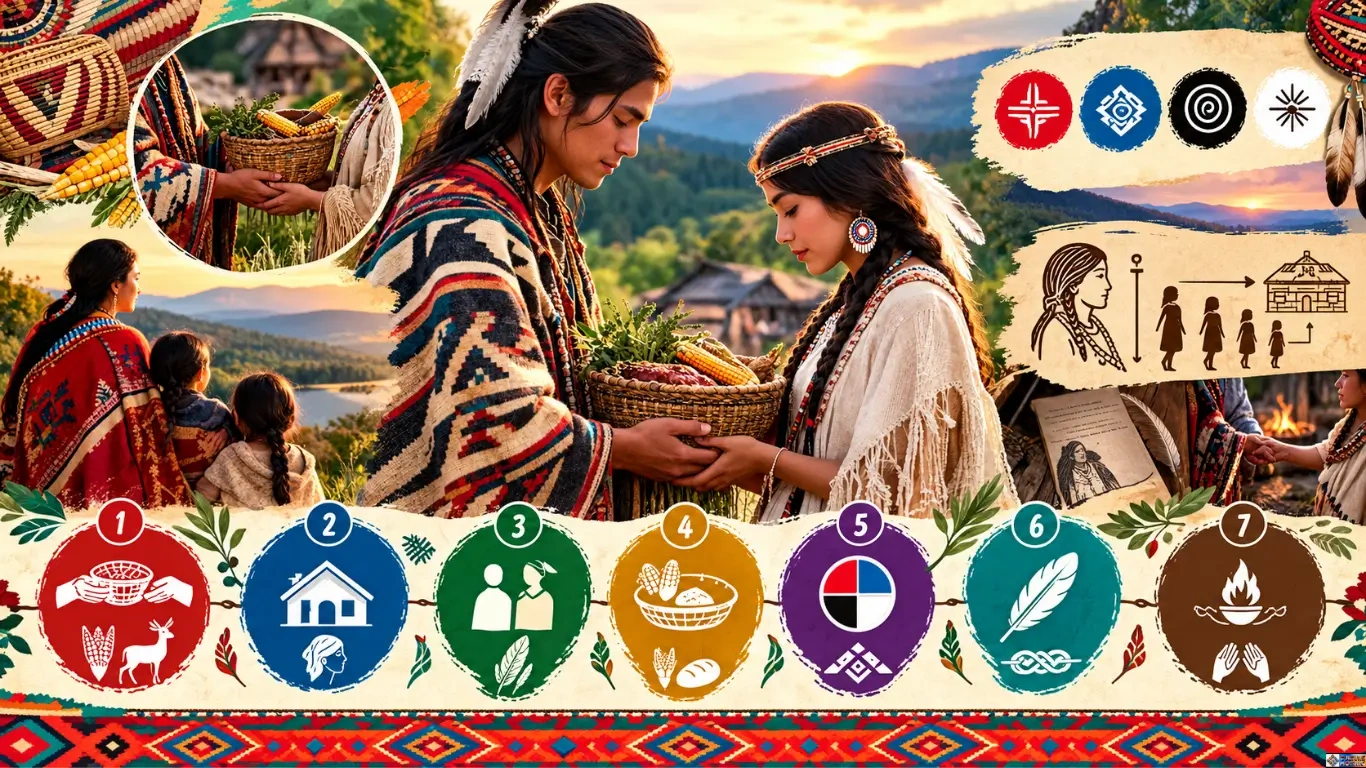
| Quick Summary: Traditional Cherokee weddings centered on a basket exchange of corn and venison, not vows or rings. Cherokee society was matrilineal and matrilocal. The bride’s family kept the home, the land, and the children. The famous “Cherokee wedding blessing” recited at weddings today did not come from the Cherokee at all. It began as fiction in a 1947 novel. The Cherokee sacred colors, red, blue, black, and white, come from a shamanic color-direction system recorded by ethnographer James Mooney in 1900. Cherokee Nation citizens can marry entirely under tribal law today, officiated by a Cherokee Nation-licensed minister. No state license is required. The Cherokee word for “wife” is “adali’i.” Husband is uyahi. |
I have spent a long time chasing down where these Native American Cherokee wedding traditions actually come from, and where they didn’t. Type “Native American Cherokee wedding traditions” into a search bar and you’ll get a flood of nearly identical wedding blog posts, all repeating the same poem, the same blanket ceremony, the same claims of ancient origin. Some of it is real. A surprising amount of it is not. And if you’re planning a wedding that honors Cherokee heritage, or you’re simply curious how it actually worked, that gap matters.
Here’s the discomfort I want to name directly: nobody wants to borrow a culture’s most sacred moment and get it wrong. Couples write to me worried they’ll offend someone, or worse, that they’ll pay a stranger online for a “traditional ceremony” that has nothing to do with the Cherokee at all. That worry is well founded. The Cherokee Nation itself has had to publicly warn people about exactly this.
So before we get into the beautiful parts, corn baskets, joined blankets, sacred fire, I want to walk through what’s documented, what’s reconstructed, and what’s simply invented. This is the kind of question that anthropology has been sorting through for a century: how do you separate a living tradition from a romanticized one? At Culture mosaic, that’s the question we try to answer honestly, not just decoratively.
A Matrilineal Nation: The Real Structure Behind Cherokee Marriage
Start with the part that almost never makes it into wedding blogs: traditional Cherokee society was matrilineal and matrilocal. Clan membership, property, and even the home itself passed through the women, not the men. A man moved into his wife’s household when he married her. If the marriage ended, he was the one who left, walking back to his mother’s clan, while the house, its furnishings, and the children stayed with her.
Historian Theda Perdue, whose research on Cherokee women remains the standard academic reference on the subject, documents that women controlled the farmland, held seats in local councils, and exercised real authority within the household long before European contact reshaped Cherokee gender roles.
The Cherokee Nation’s own clan system, seven clans in total, passed through the mother’s line, and marrying within your own clan, or your father’s clan, was strictly forbidden. Cherokee elders believed this rule protected the community from the health problems that come with close intermarriage, generations before European science reached the same conclusion.
That matrilineal backbone is the single most important fact people miss about Native American Cherokee wedding traditions. It wasn’t a footnote. It was the whole architecture of the marriage.
Courtship Before the Ceremony
Before any wedding, there was courtship, and it had its own rhythm. Cherokee heritage writers describe an annual gathering where unmarried women, dressed and adorned to resemble cranes, danced before the eligible men of the surrounding clans, a kind of community-sanctioned introduction. A young man who wanted to court a woman sent a female relative, often his aunt, to speak with the girl’s mother on his behalf. Only after her family agreed could he bring his first gift: a haunch of venison, carried to her household as proof he could provide.
This detail matters because it reframes the whole tradition. Courtship wasn’t private and romantic in the way a modern couple might picture it. It was a negotiation between families and clans, conducted mostly by women, long before the couple stood in front of anyone to marry.
The Basket Ceremony: Corn, Venison, and Native American Marriage Facts
If there’s one Cherokee wedding custom with the strongest grounding in the historical record, it’s the exchange of food. The groom brought meat, usually venison, to show he could hunt and provide. The bride brought corn or bean bread, to show she could farm and nourish the household. Some accounts describe this as a formal basket ceremony, with the bride’s mother presenting a woven basket holding an ear of corn or a loaf of bread.
Anyone researching Native American Cherokee wedding traditions in depth will run into this custom quickly; it’s compiled from Cherokee community sources and the American Indian Heritage Foundation, and it’s one of the better-documented pieces of the ceremony still practiced today.
There’s a deeper layer here, too. In Cherokee cosmology, the first man, Kanati, was a hunter, and the first woman, Selu, was the source of corn itself. Every basket exchange echoes that origin story. Men hunted. Women farmed. The wedding gifts weren’t decorative. They were a working division of labor, offered as a promise.
Historians note that the wedding itself was often remarkably brief. One nineteenth-century account describes the entire ritual, the exchange of gifts in place of vows, lasting barely half an hour. No long ceremony, no officiant sermon. Just two families exchanging what they could provide, in front of witnesses who mattered.
The Cherokee Wedding Blanket Ceremony
This is the custom most people mean when they picture a Cherokee wedding, and it’s also where I need to be the most careful. As one longtime chronicler of the ceremony put it plainly: no complete record of a traditional Cherokee wedding ceremony survives in the historical literature. What circulates today is a reconstruction, pieced together by Cherokee families and cultural practitioners trying to honor what was likely lost during removal, disease, and forced assimilation.
With that caveat honestly stated, here’s the version most commonly practiced. The bride and groom each wear a blue blanket over their shoulders, symbolizing their separate lives and their individual weaknesses. An elder or spiritual leader prays over the couple. Close relatives then step forward with a single large white blanket and drape it over both of their shoulders together, covering their combined life, its hardships along with its joys. In some versions, the couple drinks together from a two-spouted wedding vase; managing not to spill is taken as a good omen for the marriage ahead.
It’s a genuinely moving image, and I understand why it has become the visual shorthand people picture when they hear “Native American Cherokee wedding traditions,” and why it shows up constantly as a native american blanket ceremony wedding across the wedding industry. Just hold it with the right context: this is a living, evolving practice rebuilt by Cherokee people themselves, not an unbroken ancient script.
For comparison, plenty of cultures build a unity ritual into the wedding day. Christian ceremonies often use a unity candle, as we cover in What Are Christian Wedding Traditions. Irish weddings use the literal tying of hands in Irish Wedding Traditions, which is where the phrase “tying the knot” actually comes from. Mexican ceremonies drape a lazo, a ribbon or rope, across the couple’s shoulders, a custom we detail in Mexican Wedding Traditions.
Ancient Rome had its own physical gestures of union, explored in our piece on the Roman Wedding Night Ritual and more broadly in Ancient Roman Wedding Traditions. If you want the wider sweep of how different peoples solve the same problem, symbolizing two lives becoming one, our roundup of Best Wedding Traditions Worldwide and our deeper look at Cultural Marriage Traditions are good next stops. We’ve also written about regional Cherokee variations in our piece on Red Clay Tribe Wedding Traditions, and on ceremonial regalia in Crown Family Wedding Traditions.
The Sacred Colors of the Cherokee
Why blue and white, specifically? The answer sits inside a much older Cherokee color system, one that has nothing to do with weddings on its own. Ethnographer James Mooney, who lived among the Eastern Band of Cherokee in the late nineteenth century, recorded the traditional color-direction associations used in Cherokee shamanic formulas back in 1900:
- Red — East. Success, triumph, power.
- Blue — North. Defeat, trouble, unsatisfied desire.
- Black — West. Death.
- White — South. Peace, happiness, purity.
- Beyond the four cardinal points, yellow represented the sky above, brown the earth below, and green the sacred center, where the fire burns.
Blue’s association with hardship and unresolved trouble is exactly why the individual blankets worn before the ceremony are blue. It isn’t a random color choice. It’s shorthand, drawn from a genuinely old symbolic language, for the separate, unresolved lives the couple is leaving behind. White, the color of the South and of peace, is why the shared blanket that follows is white. The color logic holds up. That’s part of what makes this piece of Native American Cherokee wedding traditions feel authentic, even in its reconstructed form.
Cherokee Wedding Dress and Native American Wedding Dresses Today
Clothing is one of the most visible parts of Native American Cherokee wedding traditions today, and modern Cherokee wedding dress leans on garments with real documented history, not costume-shop invention. Cherokee women often wear the tear dress, a calico or cotton style with a fitted bodice, gathered skirt, and diamond-shaped sleeves, named for the tradition of tearing the fabric into shape rather than cutting it with scissors, which were scarce on the frontier. Grooms frequently wear a ribbon shirt, loose-fitting with rows of colorful ribbon trim, a style shared across several Southeastern and Plains nations.
Rings weren’t part of the historical picture at all. The exchange of food filled that symbolic role. Where contemporary couples do want rings, cultural jewelers now work in sterling silver set with turquoise for the bride and opal for the groom, a modern layer added onto an old tradition rather than something pulled from the historical record. It’s worth noting, too, that plenty of brides blend heritage pieces with a more contemporary silhouette, the same instinct you’ll see in Italian Wedding Traditions for Bride, where lace veils carry generations of family history into a modern dress.
What Is a Cherokee Wife Called?
In the Cherokee language, a wife is adali’i. A husband is uyahi. A romantic partner more generally is unaligohi. These aren’t ceremonial titles so much as everyday kinship words, the way “wife” and “husband” function in English.
There’s a more striking title worth knowing, even though it isn’t a marriage term: Ghigau, or “Beloved Woman.” Cherokee clans awarded this honor for life to women of extraordinary courage or wisdom, and a Ghigau sat on the Council of Chiefs with real voting power, including authority over the fate of war captives.
Nanyehi, known in English as Nancy Ward, is the most famous Beloved Woman in Cherokee history. It’s not a wedding tradition. But it tells you everything about how much authority Cherokee women held inside marriages and clans alike, and it’s the kind of detail that gets left out when people flatten Cherokee culture into wedding-blog aesthetics.
The Truth About the Cherokee Wedding Prayer
Here’s where I have to be blunt, because it’s the single most repeated piece of misinformation on this topic. Search “Cherokee wedding prayer” or “Cherokee wedding blessing” and you’ll find the same poem everywhere, usually beginning with some version of “Now you will feel no rain, for each of you will be shelter to the other.” It shows up on Etsy prints, wedding programs, and framed calligraphy sold as an authentic Cherokee wedding blessing.
It isn’t Cherokee. It isn’t even genuinely Native American. The poem was written in 1947 by Elliott Arnold, a non-Native novelist, for his Western novel Blood Brother, and it was fictional dialogue attributed to Apache characters. After the book’s 1950 film adaptation, Broken Arrow, popularized the lines, the poem took on a life of its own, and over the following decades it got relabeled as “Cherokee,” “Navajo,” and simply “Indian,” depending on who was selling it. Folklorists have a specific word for this pattern: fakelore, invented material dressed up and sold as genuine tradition.
I’m including this not to be a killjoy about a pretty poem. I’m including it because the Cherokee Nation has had to publicly warn people about the exact same pattern showing up in ceremony services, not just poetry. Their own cultural FAQ cautions couples about people online falsely claiming to be traditional Cherokee medicine men or “shamans,” a title that has no place in actual Cherokee belief, who charge fees to perform or teach ceremonies they have no real connection to.
If you want words that carry real weight, ask a Cherokee community member, a tribal cultural office, or a licensed Cherokee Nation officiant, rather than a print shop.
Cherokee Nation Marriage Law Today
Here’s a fact that surprises most non-Cherokee readers: the Cherokee Nation is a sovereign government with its own marriage law, separate from state law. Cherokee Nation citizens can marry entirely under tribal jurisdiction. There’s no requirement to obtain a state marriage license. Instead, a religious or spiritual leader licensed by the Cherokee Nation performs the ceremony, contacts the Cherokee Nation District Court, and the signed certificate is filed as the official record of marriage.
That sovereignty is exactly why the warning above matters so much. A “traditional Cherokee ceremony” performed by someone with no tribal connection or license isn’t just culturally hollow. It carries no legal weight within the Nation either. The real thing runs through the Cherokee Nation’s own court system, not a wedding vendor’s marketing copy.
Native Wedding Traditions Beyond the Cherokee
It’s worth zooming out for a moment, because the pattern here isn’t unique to the Cherokee. Native wedding traditions across North America share a similar shape, a sacred fire, a shared meal, a blanket or garment joined together, even when the specific symbols differ from nation to nation. The Navajo include cornmeal in their ceremonies. Some Plains nations favor a shared drinking vessel rather than a blanket. What are some unique Native American marriage traditions across these different nations?
Mostly variations on the same idea: physical objects standing in for a promise, witnessed by a whole community rather than sealed with a private vow. If you’re curious how broadly that idea travels, our piece on Marriage Rituals in Different Cultures Anthropology walks through the pattern across continents, and our general primer on What Traditions Are Common in Weddings covers the recurring themes you’ll find almost everywhere a couple gets married.
This is exactly why native american wedding traditions deserve more care than a single viral blog post can give them; each nation’s customs are specific, not interchangeable. What stays with me, honestly, is how much of Cherokee marriage custom ran through the women. The land, the home, the clan line, the final word on whether a marriage held or ended. That’s not the story most wedding content tells. It’s the one worth telling anyway.
Frequently Asked Questions
What are some unique Native American marriage traditions?
Beyond Native American Cherokee wedding traditions specifically, weddings across different Native nations often include a sacred fire ceremony, where individual fires representing the bride and groom are merged into one central flame; a shared meal symbolizing provision, corn and venison for the Cherokee, cornmeal for the Navajo; and communal witnessing, since these unions were historically sealed by family and clan agreement rather than a private vow between two people. A two-spouted wedding vase, sipped from simultaneously by the couple, appears in several Southwestern traditions as well.
What is a Cherokee wife called?
The Cherokee word for “wife” is “adali’i.” Husband is UYAHI. These are everyday kinship terms in the Cherokee language, not special ceremonial titles reserved for the wedding itself.
What are the sacred colors of the Cherokee?
Four colors anchor the traditional Cherokee color-direction system, recorded by ethnographer James Mooney in 1900: red for the East, symbolizing success and triumph; blue for the North, symbolizing defeat and trouble; black for the West, symbolizing death; and white for the South, symbolizing peace and happiness. Yellow, brown, and green represent the sky, the earth, and the sacred center. In weddings, blue is worn individually before the ceremony, and white is shared afterward, a direct echo of this older symbolic system.
What is the Cherokee wedding blessing?
The poem widely shared online as a “Cherokee wedding blessing” isn’t Cherokee at all. It was written in 1947 by novelist Elliott Arnold for his book Blood Brother, originally as fictional Apache dialogue, and popularized by the 1950 film Broken Arrow. Over time it was relabeled and sold as Cherokee, Navajo, and generically “Native American.” Folklorists classify it as fakelore. Actual Cherokee blessings and prayers exist, but they belong to specific community and ceremonial contexts, not printed keepsakes.
Do Cherokee couples need a state marriage license?
Not if they’re marrying as Cherokee Nation citizens under tribal law. The Cherokee Nation is a sovereign government with its own marriage code. A Cherokee Nation-licensed officiant performs the ceremony, and the signed certificate is filed with the Cherokee Nation District Court instead of a state office.
Sources
1. Cherokee Nation. “Frequently Asked Questions – Culture.” cherokee.org.
2. Perdue, Theda. Cherokee Women: Gender and Culture Change, 1700–1835. University of Nebraska Press, 1998.
3. Cherokee Phoenix. “The Cherokee Clan System.” cherokeephoenix.org.
4. Mooney, James. History, Myths, and Sacred Formulas of the Cherokees. Bureau of American Ethnology, 1900.
5. “Indian Wedding Blessing.” Wikipedia, citing Elliott Arnold’s 1947 novel Blood Brother and the 1950 film Broken Arrow.
6. Woodward, Grace Steele. The Cherokees. University of Oklahoma Press, 1963.