
 By Culture Expert
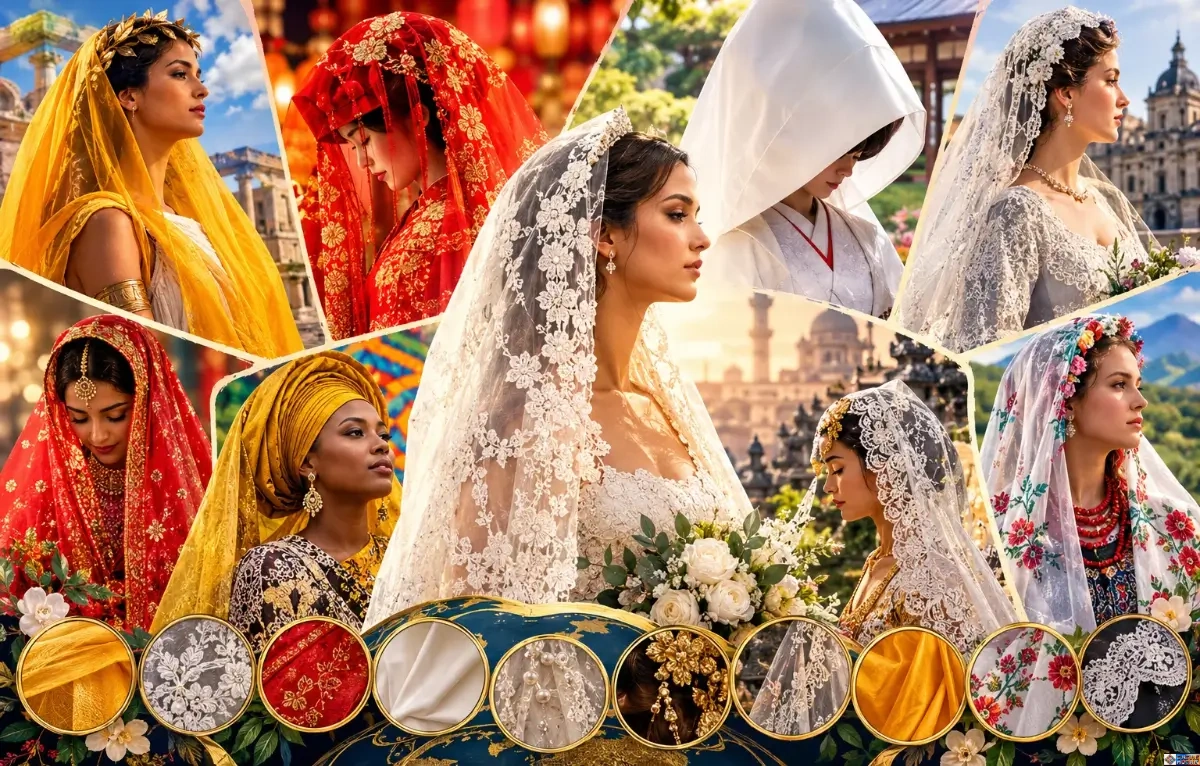
Global bridal veil traditions share one core idea: the veil is a threshold cloth. It marks the moment someone crosses from one life into another, and each culture stages that crossing in its own color:
- Ancient Rome: Wore flame-yellow to evoke sacred protection and bright omens.
- China: The red honggaitou conceals the bride until lifted by the groom’s weighing rod.
- Japan: The white watabōshi hood hides the bride from everyone except the groom during the ceremony.
- Britain: Queen Victoria’s 1840 lace veil popularized the iconic white look British brides still recognize.
Type “bridal veil” into a search bar and the screen fills with tulle. Fingertip length. Cathedral length. A price in pounds. That is the shop window, and it tells you almost nothing about the cloth itself.
If you are planning a wedding that carries two families’ histories, or you simply want to know why a bride covers her face and who is allowed to lift the cloth, the shop window leaves you stranded. You can’t tell what the veil means. You can’t tell whose hands should touch it. You can’t even tell whether the thing in your basket is a heritage object or a costume, and to the people whose heritage it is, that difference is weighty. The frustration is fair.
So I’ve drawn the map instead. This guide walks through twelve traditions across eight regions, from a flame-yellow Roman veil to a Filipino veil pinned across two shoulders at once. If you want a second, shorter overview of global bridal veil traditions from an events company’s side of the table, the UAE-based La Table Events has one. Here at Culture mosaic, though, we care most about the evidence under the story.
A word on method. I haven’t run a reader poll or conducted interviews for this piece, and I won’t pretend otherwise. What I can offer is original analysis: the comparison tables and the timeline below are my own, built from museum records, scholarly reviews and ceremony accounts by people who have lived these rites. Where a claim rests on a vendor page or a family blog instead of a scholar, I say so.
Why Do Brides Wear Veils? The Threshold Idea
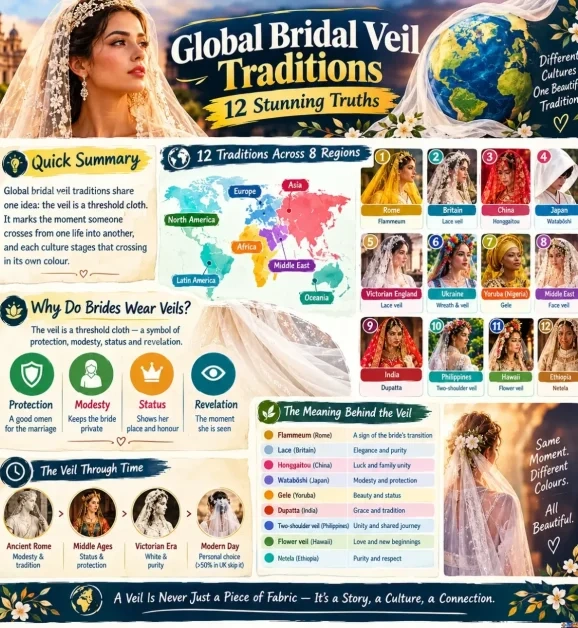
Strip away the lace and the answer, across global bridal veil traditions, is simple. A wedding is a crossing, and cloth is one of the oldest ways humans have found to mark one. Cover someone and you announce that something is about to change. Uncover them and you announce that it has.
Why Did Brides Originally Wear Veils?
Nobody can hand you one clean origin, and I’d distrust anyone who does. In Rome, married women of standing veiled their heads to signal modesty, what the Romans called pudicitia, and the bride’s flammeum grew out of that wider habit. The other origin stories, evil spirits, a groom who couldn’t be allowed to see what he was getting, are repeated with tremendous confidence and thin evidence. I treat them as folklore until someone shows me the source.
What Does the Wedding Veil Symbolize?
Across the twelve global bridal veil traditions below I count four jobs. Protection: a good omen for the marriage, as with Rome’s yellow veil or China’s lucky red. Modesty: the Jewish bedeken and Japan’s watabōshi hood. Status: Ukraine’s married-woman’s cap, the Yoruba gele, a Roman matron’s covered head. Revelation: almost everywhere, the unveiling is the point, the moment someone sees someone.
Notice what is missing from that list. Purity as a universal. The idea that a white veil announces a bride’s innocence is mostly a nineteenth-century British frame, and we will meet its author in section 2. If you want to see where veils sit among the rest of the wedding kit, start with What Traditions Are Common in Weddings and Cultural Marriage Traditions.
What Are the Other Historical Meanings of the Veil?
Plenty. A veil has marked rank, as in the laws and customs that let respectable women cover their heads. It has been a shared covering, as in the Filipino ceremony. It has been a stage prop, hiding a bride until the exact moment a family wanted her seen. Wedding veils explained at their simplest: cloth with a job, and the job changes with the century.
Cultural Wedding Veil Customs Around the World: At a Glance
Here is my side-by-side of the twelve global bridal veil traditions. Treat it as an index; the detail follows.
| Region & Tradition | The Covering | Colour & Cloth | Who Handles It, & When |
|---|---|---|---|
| 1. Rome Western Europe | Flammeum | Deep yellow; fabric unspecified | Bride wears it in the procession to her husband’s house |
| 2. Britain Western Europe | Lace veil | White; Honiton lace (Victoria) | Worn over a wreath; face left visible in 1840 |
| 3. Spain Western Europe | Mantilla | Black or white; silk lace or tulle | Held up by a peineta comb; black worn by the madrina |
| 4. Ukraine Eastern Europe | Vinok, then ochipok | Flowers, later wax; embroidered cap; red-led dress | Swapped at the wedding, in front of the bride’s girlfriends |
| 5. Jewish Custom Middle East & Diaspora | Bedeken veil | Not specified in sources | Groom lowers it before the chuppah |
| 6. Iran Middle East | Bridal veil & shared cloth | Fine silk or white canopy; termeh on spread | Bride lifts hers in front of mirror; women hold canopy |
| 7. South Asian Muslim South Asia | Dupatta | Often a shawl or scarf | Elders cover and uncover couple in arsi mushaf |
| 8. China East Asia | Honggaitou | Red; square of satin or silk | Groom lifts it with a weighing rod |
| 9. Japan East Asia | Watabōshi or tsunokakushi | White silk | Worn through ceremony; hood comes off indoors |
| 10. Philippines Southeast Asia | Veil & yugal cord | Large white veil; silk or rosary cord | Veil and cord sponsors place both over the couple |
| 11. Nigeria, Yoruba Africa | Gele, veil, false-bride veil | Aso-oke and other cloth | Groom’s spokesperson lifts the decoy’s veil |
| 12. Mexico Latin America | Mantilla & lazo | Lace; rosary or beaded rope | Padrinos place the lazo; bride keeps it |
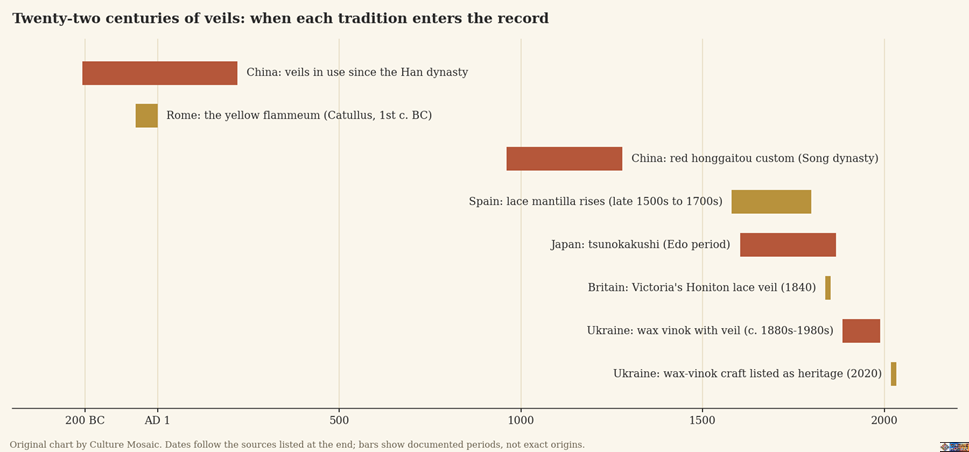
Original chart by Culture Mosaic. Bars show documented periods rather than exact origins.
1. Western Europe: Rome’s Flammeum and the Original “Yellow Veil”
Start with colour, because it surprises people. The Roman bride did not wear white. She wore a veil called the flammeum, a deep yellow the colour of a candle flame, and in Karen Hersch’s study of the Roman wedding, as reviewed in the Bryn Mawr Classical Review, the evidence lands on a distinctive yellow. If anyone has ever asked you about a wedding “under the yellow veil”, this is the oldest answer I can document.
The veil did two jobs at once. It evoked the veil of the Flaminica Dialis, the priestess-wife of Jupiter’s high priest, who could never divorce her husband, so wearing something like it was a good omen for a lifelong marriage. And it was theatre. The bride walked in procession from her father’s house to her husband’s, a public crossing with the cloth on her head. Romans even heard a pun in it: the verb for a woman marrying, nubere, sits close to nubes, “cloud”. The bride was clouded over.
You will see the claim that the flame colour frightened off evil spirits. Popular retellings repeat it constantly. I can’t pin it to an ancient source, so I file it under folklore. For the modern Italian bride, see Italian Wedding Traditions for Bride; Ancient Roman Wedding Traditions covers the full rite, and the Roman Wedding Night Ritual piece picks up where the veil came off.
2. Western Europe: Britain’s White Lace Veil, Made in Devon
Every British bride who has picked a white veil is quoting, loosely, one morning: 10 February 1840. Queen Victoria married Prince Albert in white satin trimmed with Honiton lace, and her lace veil matched the flounce of the dress. Here is the detail that gets lost. The Times reported that she wore a wreath of orange blossom with the lace veil thrown over it, though not so as to hide her face.
So the most famous veil in British history was not a screen. It was a flourish. The V&A explains that she chose handmade Honiton lace partly because skilled lacemakers were struggling against machine-made lace, and white showed it off best. Then fashion plates, adverts, valentine cards and sheet music did the rest, selling the white dress and lace veil as romantic propriety and purity. By the 1860s wealthy brides were copying her; the museum holds the Honiton veil Eliza Penelope Clay wore for her wedding in 1865. That, in a paragraph, is wedding veil history for most of Britain, and one short chapter of global bridal veil traditions.
I think this is the most useful correction in the whole article. The white tulle veil isn’t the tradition. It is one local, fairly young one, with an exceptional publicist. Royal weddings kept the machine running, as Crown Family Wedding Traditions explores, and the story of the dress is told in Modern Cultural Wedding Dresses. For the longer arc, read our companion piece, History of the bridal veil. And in Celtic and Irish ceremonies the weight falls on cords and hands rather than cloth: see celtic wedding traditions and customs and Irish Wedding Traditions.
3. Western Europe: Spain’s Mantilla and the Black Veil Question
Lace, comb, shoulders. The Spanish mantilla frames the face instead of covering it: silk lace or tulle, usually held up by a high comb called a peineta. Lightweight ornamental versions came into use in Spain’s warmer regions towards the end of the sixteenth century, and lace ones were popular by the seventeenth and eighteenth. White suits a church wedding. Black is traditional for a woman meeting the Pope.
Which brings us to black veil symbolism, a phrase that ought to make a bride flinch. In much of the West, black cloth over the head reads as mourning. In Spain black lace is formal and festive. At the 2004 wedding of the future King Felipe, Queen Sofía wore a black lace mantilla and peineta in her role as madrina, the groom’s mother, by the account of a royal-hats blog. A museum catalogue record quoting a Spanish blogger says the mantilla now turns up almost only at bullfights, Holy Week and weddings.
A caution. Wedding guides repeat that Spanish brides once wore black dresses and black veils to signal devotion until death. I haven’t found museum-grade evidence for that. It’s lovely lore. I’d still call it lore.
4. Eastern Europe: Ukraine’s Wreath-to-Cap Swap and Other Symbolic Wedding Head Coverings
Some of the most potent symbolic wedding head coverings aren’t veils at all. In traditional Ukrainian culture an unmarried girl wore a flower wreath, the vinok. At the wedding it was replaced by the ochipok, a cap covering the whole head, which she wore for the rest of her life. The word vinok is even related to the word for the wedding ceremony itself, vinchannya.
The Russian Museum of Ethnography’s catalogue entry for a wedding costume from Yekaterinoslav Province, photographed in 1909, describes the swap as a change of social status, carried out while the bride ritually mourned her maidenhood in front of her girlfriends. From then on a married woman did not appear in public bareheaded. That is the threshold logic behind global bridal veil traditions in its purest form. Over the cap she could add a namitka, a long thin cloth wound round the head, the original Slavic head covering, which could also hide the face. The costume leaned red, a colour the museum reads as beauty, youth and fertility.
There’s a twist the “authentic” blogs skip. A wax wreath with a veil, borrowed from Polish peasants in the mid-nineteenth century, spread through villages in Vinnytsia region and stayed in bridal use until about the 1980s; in 2020 the craft entered Ukraine’s national inventory of intangible cultural heritage. Since the revolution of 2014 the flower vinok has moved back into everyday dress. Heritage isn’t frozen. Rites like this travel by word of mouth, which is why Why is Oral Storytelling Important makes a good companion read.
5. Middle East and the Jewish Diaspora: The Bedeken, a Veil Lowered by Hand
Just before the chuppah, at many Ashkenazi weddings, the groom, with fathers and rabbi and friends singing around him, covers the bride’s face with a veil. The Yiddish word is bedeken, “covering”. She wears it until the end of the ceremony under the canopy.
Two scenes from Genesis sit behind it. In one, Rebekah sees Isaac across a field, takes her veil and covers herself. In the other, Jacob wakes up married to Leah because the bride delivered to him was veiled (Genesis 24:65 and 29:23-25). The traditional explanations follow neatly: the groom checks he has the right woman, and the veil stands for modesty. The Jewish Theological Seminary offers a gentler reading, in which the veil lets a bride keep something separate and her own, even inside the union.
My Jewish Learning notes that the custom of veiling ebbs and flows with modern trends, which is the honest summary of most veil customs anywhere. Whether a couple keeps it is a question for their family and rabbi.
6. Middle East: Iran’s Sofreh Aghd, Where a Mirror Does the Unveiling
In a traditional Persian ceremony the bride enters veiled. Seated beside the groom before the sofreh aghd, the spread of symbolic objects laid on a cloth, she lifts her veil, and the first thing he sees of her is her reflection in the mirror in front of them. The mirror stands for eternity. Some accounts have the groom lifting the veil himself, so it’s worth asking how a particular family does it.
Overhead, a second cloth does a different job. Unmarried or happily married female relatives hold a fine shawl or white canopy above the couple’s heads and take turns grinding sugar cones over it, so that sweetness falls on them like snow. A bride’s veil and a shared canopy, side by side: a nice reminder that cloth can cover one person or two. Termeh, Iran’s handwoven cloth, belongs on the spread.
7. South Asia: The Dupatta, the Mirror and the Arsi Mushaf
South Asia holds more veil customs than one section can honour, so I’ll follow a single thread: the arsi mushaf. Arsi is the Hindi word for mirror; mushaf is the Arabic word for a copy of the Quran. The writer Rana Safvi describes it as common in Awadh and in families of Awadhi origin, held after the nikah. Traditionally, in arranged marriages, it was the first time the couple saw each other.
The couple sit covered by a dupatta, the Quran placed between them, a mirror close by. The bride sits head bent while elders guide the ritual and her sisters and aunts tease the groom. Safvi adds that the groom is asked to trace the Surah Ikhlas on the bride’s forehead with his finger. Then, at last, he sees her face in the mirror.
This isn’t only nostalgia. In a Maharani Weddings feature on a Pakistani wedding in Ontario, the bride writes that the groom’s family lifted her head covering and they saw each other first in the mirror. “We have the mirror hung up in our home now,” she says. A veil that ends up as a household object. I find that more moving than any tulle.
8. East Asia: Red Bridal Veil History and China’s Honggaitou
Red bridal veil history starts with a square of red cloth. The honggaitou, literally “red head cover”, was worn by Han Chinese brides over the face before the wedding night, with a red wedding dress. Veils have been used in China since the Han dynasty, and the red bridal custom can be traced to the Song, when middle- and upper-class women wore it. Red means luck, happiness and celebration; white, traditionally, belongs to mourning.
The moment I’d point you to is the lifting. In traditional practice the groom lifts the veil with a weighing rod. A Nanjing magazine describes him unveiling his seated bride this way, an act the phrase chen xin ru yi names, roughly “everything as you wish”. A cloth, a rod, a pun. Nothing in Western bridal ritual is quite so witty.
Today most Chinese brides wear a white gown and veil in the Western manner, according to the Wikipedia summary of the scholarship, yet the red custom continues in modern China too. Both exist side by side, sometimes on the same day.
9. East Asia: Japan’s Watabōshi and Tsunokakushi
Two headpieces, one idea. The watabōshi is a white silk-floss hood worn with the all-white shiromuku kimono. Its purpose is to hide the bride’s face from everyone except the groom until the end of the ceremony. It is worn only outside the reception hall and comes off indoors. The tsunokakushi is a rectangle of white silk that covers the topknot of the bride’s wig.
You will read that tsunokakushi means “horn-hiding”, that it conceals the horns of jealousy and ego, and that the bride is promising to be gentle and obedient. That’s the popular reading. The Wikipedia entry cautions it may be folk etymology, and the headdress may have begun in the Edo period as something women wore to visit Buddhist temples, perhaps under a different name, sumi kakushi, “hairline hider”. I like the horn story. I wouldn’t print it in a programme as fact.
White carries its own reading: a Japanese costume-heritage site says shiromuku suggests a bride ready to be “dyed” in the colours of her husband’s household. Interpretations, again, not rules.
10. Southeast Asia: The Filipino Veil and Cord, Worn by Two
This is the one veil among global bridal veil traditions here that covers a couple. In a Filipino Catholic wedding the veil sponsors, usually a married couple chosen by the bride and groom, pin one side of a large white veil to the groom’s shoulder and drape the other over the bride’s head and shoulders. The meaning is unity: the pair clothed as one. Then the cord sponsors lay the yugal, a figure-eight loop of silk or rosary beads, over the veil.
USC’s Digital Folklore Archive records a Filipino American bride who included the yugal, had the officiant explain it aloud and printed a note in the programme because many guests had never seen it. That’s a model for anyone borrowing from their own heritage: name the ritual, explain it. One wedding guide calls the cord’s weight on the shoulders a tactile reminder of shared responsibility, and our notes on Somatic Heritage Practices get at why a ritual you carry on your body sticks harder than one you only watch.
11. Africa: Nigeria’s Gele, the Veil and the False Bride
Africa is a continent, not a custom, and its share of global bridal veil traditions is vast, so please read this as one Yoruba thread. The gele, a sculpted head wrap usually made from aso-oke, is not a veil. But the word means roughly “raised high”, and the practice grew from Yoruba beliefs about the sacredness of the head. Guides to traditional Yoruba bridal dress pair the iro and buba with an ipele shoulder scarf, a gele, a hand fan and, at times, a veil.
The veil’s big moment comes at the engagement ceremony. Yoruba cultural guides describe a game. The groom’s family arrives, haggles, pays, and eventually a lady is ushered in, covered so that her face is hidden. The groom’s spokesperson lifts the veil and announces that this isn’t the flower they travelled to pick. A decoy. A false bride. They pay some more, and the real bride appears. I’ve only found this in cultural guides, not academic sources, so treat it as a reported custom.
The photographer Lakin Ogunbanwo’s series e wá wo mi, shown at Contemporary And in 2019, portrayed Yoruba, Igbo and Hausa-Fulani brides in ceremonial wear, often veiled and alone in the frame. The gallery text reads the Yoruba bride’s gele and feather fan as signs of status and cultural pride.
12. Latin America: Mexico’s Mantilla, Lazo and Padrinos de Velación
Mexican Catholic weddings stack Spanish and Indigenous history, and the veil sits somewhere in the middle. Some brides wear a lace mantilla, the form we met in section 3. The ceremony adds sponsors, the padrinos. The padrinos de velación are the primary ceremony sponsors; the padrinos de lazo place the lazo, a rosary or beaded rope looped over the couple’s shoulders. Afterwards it is removed and handed to the bride as a keepsake.
The word velación deserves a second look. It echoes the early Christian velatio nuptialis, the blessing of a veiled couple, which I trace in our history of the bridal veil. The Filipino ritual in section 10 looks like a cousin: the same Catholic skeleton, a different veil. For more, see Mexican Wedding Traditions.
Wedding Veil Meaning in the Bible, and What the Churches Did With It
Global bridal veil traditions lean on scripture less than people assume. Genesis describes veiled brides. It doesn’t command veiling. Rebekah’s gesture and Leah’s disguise are the two scenes, and Jewish practice built the bedeken on them. Christian custom adds St Paul’s remarks in 1 Corinthians about head coverings in worship, which is partly why church weddings and the mantilla travel together. As far as I know, no mainstream rite requires a bridal veil today; it is custom. What Are Christian Wedding Traditions sets out where veils sit in church ceremonies, and parishes differ, so ask yours.
How Did the White Veil Become a Tradition? And Can You Wear One If You’re Not a Virgin?
The short answer to the first: Victoria in 1840, then a century of publicity, as in section 2. The V&A notes that if a bride was marrying for the first time and could afford it, white became the norm, and fashion sold the whole look as purity.
That is where the second question comes from. Can you wear a veil if you’re not a virgin? Yes. Nothing in these global bridal veil traditions ties the veil to a bride’s sexual history as a rule. Rome’s flammeum was about omen and fidelity. The bedeken is about identity and modesty. The Filipino veil is about unity, the Chinese one about luck. Purity attached itself to the white veil largely through Victorian-era image-making, and the V&A suggests its meaning may have shifted again for contemporary brides. As far as I know, no UK law or mainstream church practice makes anyone’s past a condition of wearing one. If you like the look, wear it.
Who Is Supposed to Lift the Veil at a Wedding?
Among global bridal veil traditions the answer depends entirely on whose wedding it is. In modern Western weddings it is either the bride’s father or escort at the altar, or the groom just before the kiss. Elsewhere:
| Tradition | Who Lifts or Lowers It | When |
|---|---|---|
| Western Church Weddings | Father or escort, or the groom | At the altar, or before the kiss |
| Jewish Bedeken | The groom lowers it | Before the chuppah |
| Persian Sofreh Aghd | The bride lifts it (some accounts say the groom) | Once seated, in front of the mirror |
| South Asian Arsi Mushaf | The bride’s family or elders | After the nikah, with the mirror |
| Han Chinese Custom | The groom, with a weighing rod | Once the bride is seated, before the wedding night |
| Japanese Shinto Wedding | No lifting (hood stays through ceremony) | Removed indoors |
| Filipino Catholic Wedding | Nobody lifts it (sponsors pin it) | During the ceremony |
| Yoruba Engagement | The groom’s spokesperson (for decoy bride) | Before the real bride arrives |
Global Bridal Veil Traditions Prices: What a Veil Really Costs in the UK
Heritage pieces rarely come with a tidy price tag, so here are the numbers I can stand behind, and then some honesty about the rest. Bridebook’s 2026 data puts average UK spending on all wedding accessories at about £449. Its guide puts veils at roughly £50 to £250, depending on style, with custom details costing more, and notes that over half of today’s brides choose not to wear one. A dressmaker quoted on the same page says more than 75 per cent of her brides go without, adding fresh flowers or reworking their mother’s veil instead.
| Item | Typical UK Price | Source |
|---|---|---|
| Bridal veil, depending on style | £50 to £250 | Bridebook, accessories guide (updated July 2026) |
| Headpiece such as a comb or tiara | £100 to £250+ | Bridebook, accessories guide |
| All wedding accessories, average spend | About £449 | Bridebook, accessories guide |
| Handmade tulle veil from a small UK maker | From £45 to £55 | Bridebook supplier listings |
| A veil borrowed from a relative | No purchase cost | Bridebook saving tips |
I couldn’t find reliable benchmark prices for a Chinese honggaitou, a Japanese watabōshi or a Ukrainian vinok sold to UK buyers, and I won’t invent them. The safe rule for any heritage piece: ask the seller who made it, where, and from what, before you pay.
Heritage Wedding Veil Traditions: How to Borrow Without Dressing Up in Someone’s Culture
If one of these global bridal veil traditions moved you, good. Here is how I’d approach it. Ask first. If a custom belongs to a family or community that isn’t yours, ask someone from it what the piece means and who should handle it. Buy from within the tradition where you can, from makers and community suppliers, and ask what the piece is made of. Name it in your programme. The Filipino American bride’s habit of explaining the yugal aloud is the best model I know.
And one weird idea, my own riff and not a documented rite: veil the doorway, not the bride. Hang a length of flame-yellow cloth across the ceremony entrance, Roman style, and let every guest cross it. It costs far less than a cathedral veil, and nobody mistakes it for a costume.
If you’re building a ceremony without a religious script, wedding ceremony rituals non religious is full of ideas that carry meaning without a yard of tulle. Some traditions skip the veil entirely and put the symbolism elsewhere; Native American Cherokee Wedding Traditions and Red Clay Tribe Wedding Traditions are two places to see that. For the wider question of why so many cultures stage a covering and an uncovering, try Marriage Rituals in Different Cultures Anthropology and Best Wedding Traditions Worldwide.
A veil is a strange object. A few metres of cloth, worth a few pounds or a family’s savings, and it means nothing until a hand moves it. A groom’s, with a rod. A rabbi’s blessing. A sponsor’s pin. A mother lifting an old one out of a drawer. Every tradition above is, underneath, a choreography for one small gesture: who gets to move the cloth, and when.
Frequently Asked Questions About Global Bridal Veil Traditions
1. Why does a bride wear a veil over her face?
Because covering marks a threshold. Different cultures read the covering differently. In the Jewish bedeken the groom lowers the veil, traditionally to confirm his bride and to signal modesty. A Japanese watabōshi hood hides the face from everyone but the groom until the end of the ceremony. A Chinese honggaitou keeps the bride covered until the groom lifts it. Across global bridal veil traditions the reason changes with the culture; the idea of a crossing stays the same.
2. Who lifts the veil at a wedding?
It depends on the tradition. At many Western weddings the bride’s father or escort lifts it at the altar, or the groom lifts it before the kiss. In Han Chinese custom the groom uses a weighing rod. In a Persian ceremony the bride often lifts her own in front of a mirror. In a South Asian arsi mushaf elders uncover the couple. Some traditions never lift it at all.
3. Can you wear a veil if you’re not a virgin?
Yes. None of the global bridal veil traditions in this article make a bride’s sexual history a condition of wearing a veil. Rome’s flammeum signalled omen and fidelity, and the Filipino veil signals unity. The purity reading of the white veil grew largely from Victorian-era image-making, and the V&A suggests its meaning may have changed again. As far as I know, no UK law or mainstream church practice requires proof of anything.
4. What is the wedding veil meaning in the Bible?
The Bible describes veiled brides but doesn’t command the practice. In Genesis 24:65 Rebekah covers herself with a veil when she first sees Isaac. In Genesis 29:23-25 Jacob marries a veiled Leah instead of Rachel. Jewish custom built the bedeken on those scenes. Christian meaning, including the idea of a bride’s modesty, was layered on later through church custom.
5. What does a black veil symbolize?
It depends where you are. In much of the West black over the head reads as mourning. In Spain a black lace mantilla is formal and festive. It is worn for Holy Week, by the madrina at weddings, and by women meeting the Pope. A white mantilla suits a church wedding. Context decides whether black means sorrow or ceremony.
Sources and Further Reading
- Hersch, Karen K. The Roman Wedding: Ritual and Meaning in Antiquity. Cambridge University Press, 2010; reviewed in Bryn Mawr Classical Review 2011.03.62. https://bmcr.brynmawr.edu/2011/2011.03.62
- Wikipedia. “Veil” (tertiary source: Roman matrons’ veiling and pudicitia, the flammeum and the nubere and nubes link). https://en.wikipedia.org/wiki/Veil
- Victoria and Albert Museum. “The Victoria connection” (white wedding dress and lace veil). https://www.vam.ac.uk/articles/the-victoria-connection
- Victoria and Albert Museum. Honiton lace wedding veil, 1865 (object O1223045); gallery label quotes The Times on Queen Victoria’s 1840 veil. https://collections.vam.ac.uk/item/O1223045/wedding-veil-unknown
- Textile Research Centre, Leiden. “Queen Victoria’s Wedding Lace,” quoting The Western Times, 15 February 1840. https://trc-leiden.nl/trc-needles/individual-textiles-and-textile-types/secular-ceremonies-and-rituals/queen-victorias-wedding-lace
- Wikipedia. “Mantilla” (tertiary source, used for the dating of lace mantillas and white and black usage). https://en.wikipedia.org/wiki/Mantilla
- Royal Hats. “Spanish Royal Wedding Ten Years On: The Spanish Royal Family” (Queen Sofía’s mantilla as madrina, 2004). https://royalhats.net/2014/08/12/spanish-royal-wedding-ten-years-on-the-spanish-royal-family
- History Museum record, Spanish mantilla, quoting a Spanish blogger on present-day use (secondary, informal). https://historysmc.pastperfectonline.com/webobject/67CAB538-ECDB-4D4F-A383-743447326235
- Russian Museum of Ethnography. Women’s wedding costume, Ukrainians, late 19th to early 20th century, Yekaterinoslav Province. https://catalog.ethnomuseum.ru/entity/OBJECT/750016
- Wikipedia. “Ukrainian wreath”, “Ochipok” and “Wax vinok” (tertiary sources; the wax-vinok entry cites Ukraine’s 2020 national inventory listing). https://en.wikipedia.org/wiki/Ukrainian_wreath
- Jewish Theological Seminary. “Rebecca’s Veil of Independence.” https://www.jtsa.edu/torah/rebeccas-veil-of-independence/
- My Jewish Learning. “Ask the Expert: Veiled Bride.” https://www.myjewishlearning.com/article/ask-the-expert-veiled-bride/
- Wikipedia. “Badeken” (tertiary source, for the ceremony sequence). https://en.wikipedia.org/wiki/Badeken
- Chai and Conversation. “The Persian Wedding Aghd (Ceremony), a Step by Step Journey.” Informal source; variations exist between families. https://chaiandconversation.com/2015/persian-wedding-aghd-ceremony-step-step-journey
- Family Spice. “The Persian Wedding Ceremony: Aghd Demystified” (sugar cones and the cloth held over the couple). https://familyspice.com/the-persian-wedding-ceremony-aghd-demystified/
- Safvi, Rana. “The arsi mushaf ceremony.” https://ranasafvi.com/the-arsi-mushaf-ceremony
- Maharani Weddings. Ontario Pakistani wedding feature (bride’s account of the arsi mushaf). https://www.maharaniweddings.com/top-indian-wedding-vendor-platinum-blog/style/fusion/?page=2
- Wikipedia. “Honggaitou” (tertiary source for Han- and Song-dynasty dating). https://en.wikipedia.org/wiki/Honggaitou
- The Nanjinger. “Red Satin Veil; Weddings Not to Be Left in Rash Hands of Young.” https://www.thenanjinger.com/?p=24838
- Wikipedia. “Shinto wedding” and “Tsunokakushi” (tertiary sources; the tsunokakushi entry flags the folk-etymology caveat). https://en.wikipedia.org/wiki/Tsunokakushi
- Jeepe. “Shiromuku: Japan’s All-White Bridal Kimono Ensemble” (commercial heritage-costume site; interpretation of white). https://www.jeepe.jp/en/articles/shiromuku-japanese-wedding-attire-1772
- Courtly. “12 Filipino Wedding Traditions” (wedding-resource site; veil, cord and sponsor roles). https://www.courtly.com/resources/12-filipino-wedding-traditions
- USC Digital Folklore Archives. “Filipino Wedding Cord” (first-person account of the yugal). https://folklore.usc.edu/?p=85834
- Wikipedia. “Gele (headdress)” (tertiary source for meaning and Yoruba beliefs about the head). https://en.wikipedia.org/wiki/Gele_(headdress)
- Contemporary And. “Lakin Ogunbanwo: e wá wo mi.” https://contemporaryand.com/en/events/lakin-ogunbanwo-e-wa-wo-mi
- Discovery Yoruba. “The Yoruba Traditional Marriage” (cultural guide, non-academic; the false-bride custom). https://discoveryoruba.com/the-yoruba-traditional-marriage-2
- Face2Face Africa. “The Beautiful Extravagance of Nigerian Weddings.” https://face2faceafrica.com/article/the-beautiful-extravagance-of-nigerian-weddings/amp
- Courtly. “Catholic Wedding Traditions” (padrinos de velación and lazo). https://es.courtly.com/resources/catholic-wedding-traditions
- Bridebook. “How Much Do Wedding Accessories Cost? The 2026 Average Revealed”, updated 10 July 2026. https://bridebook.com/uk/article/how-much-do-wedding-accessories-cost
- Bridebook. “How to Save Money on Wedding Accessories.” https://bridebook.com/uk/article/saving-tips-wedding-accessories
- La Table Events. “Cultural Wedding Veil Traditions Around the World” (events-company overview, cited as a trade perspective). https://www.latableevents.ae/cultural-wedding-veil-traditions-around-the-world/
- Genesis 24:60-67 and 29:16-30; 1 Corinthians 11:2-16 (Hebrew Bible and New Testament primary texts).