
 By Culture Expert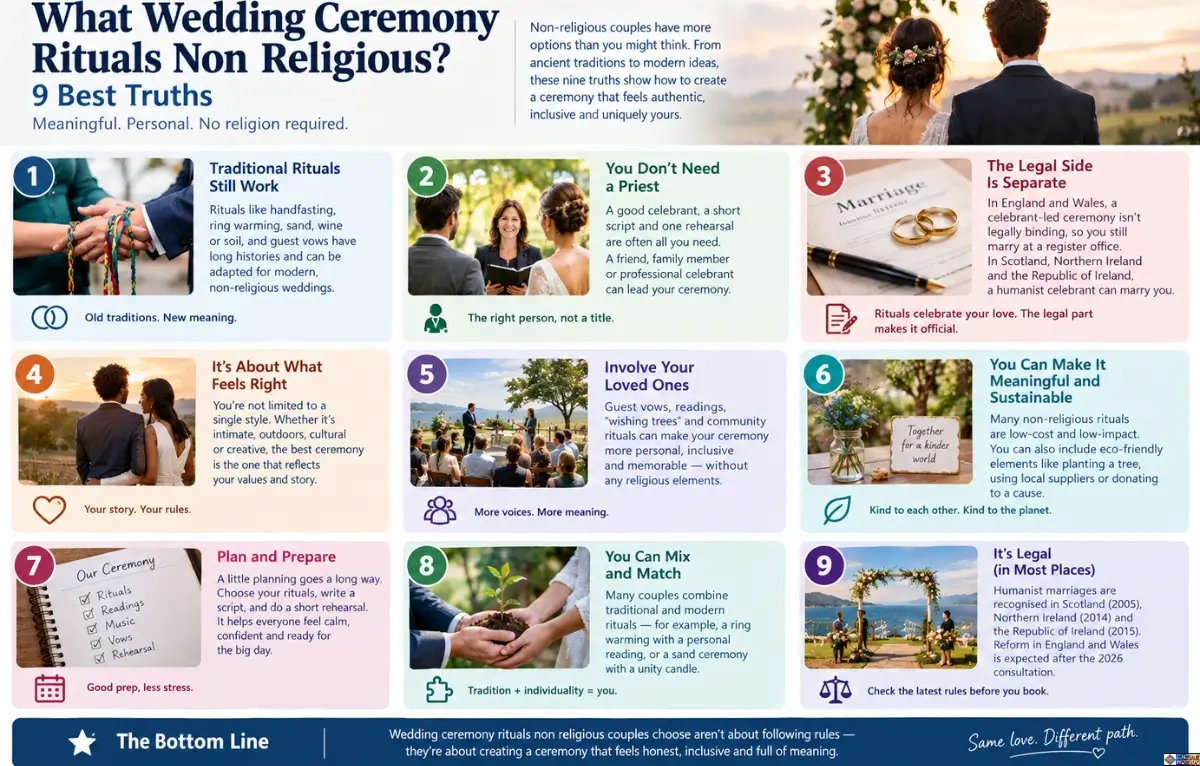
Why So Many Secular Ceremonies Feel Thin
You’ve said no to the church. Fine. Maybe you never went. Maybe you left. Maybe your two families pray to different gods and you’d rather nobody won the argument.
Then you sit down to plan and the options look like a shrug. A register office. A few minutes. A ring, a signature, out. Correct, tidy, and about as moving as a parking permit.
That’s the ache behind this search. You don’t want less meaning. You want the meaning without the doctrine.
Here’s the good news, said plainly: there are plenty of wedding ceremony rituals non religious couples can use, most cost almost nothing, and many are older (or much younger) than the internet claims. This guide separates documented history from wedding-blog folklore, explains the 2026 legal picture, and gives you scripts, steps and a few deliberately odd ideas. If you’d like a photographer’s-eye view too, this guide to wedding ceremony rituals non religious is a friendly companion, though it is a trade blog and not a legal source.
I lean on the Culture Mosaic archive throughout, and if you want the widest lens on the subject, start with Best Wedding Traditions Worldwide.
1. A Secular Wedding Is Not a Civil Wedding
People use “secular”, “civil” and “humanist” as if they were synonyms. They aren’t, and the difference decides what you can actually say and do on the day.
A civil ceremony is led by a registrar, follows fixed wording and is legally binding. A humanist ceremony is written with you by a celebrant who shares a non-religious outlook. A secular symbolic ceremony is the loosest category: anyone can lead it, and it can hold any ritual you like, but it carries no legal weight by itself.
Notice the pattern. The more legal weight a ceremony carries, the less room it leaves for your own words. That trade-off is the whole reason so many couples split the day in two.
If you want to see how wide the ritual toolbox really is before choosing, What Traditions Are Common in Weddings is a useful map.
2. The Legal Paperwork Still Lives Somewhere Else
I’ll take a stand here: sort the legal marriage before you fall in love with a ritual. Even the loveliest wedding ceremony rituals non religious couples design sit on top of a legal marriage, not in place of one. Heartbreak by paperwork is avoidable.
Scotland moved first. Humanist marriages gained legal recognition there in 2005, and Humanists UK reports that more humanist weddings took place in 2022 (9,140) than religious marriages of every kind combined (8,072). The Republic of Ireland followed in 2012, Northern Ireland in 2018 after a Court of Appeal ruling, Jersey in 2019 and Guernsey in 2021.
England and Wales lag. The House of Commons Library states the position bluntly: at present it is not possible to have a legally binding humanist marriage there. The Law Commission recommended a new weddings law in July 2022. The Ministry of Justice then launched its “Tying the Knot” consultation on 16 July 2026, and Hansard records that the proposals would let non-religious belief organisations, humanists included, conduct legally binding weddings. The consultation ran until 24 September 2026, according to Bridebook’s summary. Whether independent celebrants get the same right is still an open question.
Meanwhile, a Warwick study funded by the Nuffield Foundation found that most couples having a non-legally-binding wedding end up holding two ceremonies. In practice that means a short register-office marriage for the law, and a long, personal ceremony for everything else. One humanist celebrant notes that most couples treat the celebration as their “real” wedding.
The urgency is genuine. Legislation will follow “when parliamentary time allows”, and one celebrant has warned that demand for humanist celebrants is likely to rise once legal recognition arrives. If your wedding is more than a year away, ask every celebrant how they’ll handle a change in the law.
3. Ritual Age Is Mostly a Myth
Every wedding site says “ancient”. Some rituals earn it. Many don’t. Here’s my own tally, drawn from the sources at the end of this article.
Does age matter? Less than you’d think. A common anthropological view is that what makes a marriage ritual work is its job (binding, blessing, witnessing), not its birth certificate. Marriage Rituals in Different Cultures Anthropology walks through that idea in more depth.
Old rituals also tell you what marriage used to be for. Ancient Roman Wedding Traditions shows a marriage culture built around contract and property, and the Roman Wedding Night Ritual reminds us that ritual once followed a couple well past the ceremony itself.
The takeaway is freeing. Pick a ritual because it says something true about the two of you, and be honest with guests about how new it is. That honesty makes it feel more solid, not less.
4. Handfasting Is the Great Survivor
If a secular couple picks one ritual, it’s usually this. Two hands, one cord, a knot. You can feel why: rough hemp or slippery silk, the slight awkward tug when your partner’s wrist turns.
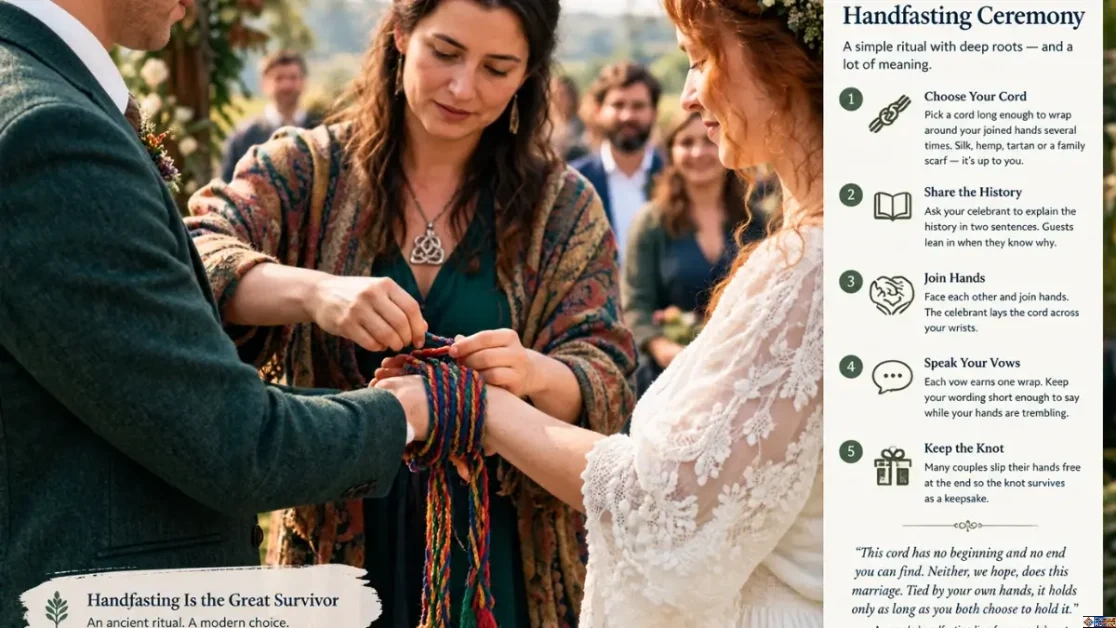
Traditional Wedding Ceremony Rituals Non Religious Couples Still Love
The phrase “tying the knot” is often tied to handfasting, though the honest position is “possibly”. Gretna Green’s own history notes that the word “knot” was already describing marriage in Middle English around 1225, so the phrase may be older than the ribbon. It also flags that the famous “trial marriage” of a year and a day traces to the travel writing of Thomas Pennant, and that some argue it was a Hebridean myth. I’d treat the year-and-a-day story as folklore.
What is documented: handfasting meant betrothal, or marriage by mutual declaration before witnesses, across medieval Britain. Scotland kept recognising irregular marriages until the Marriage (Scotland) Act 1939, and the ritual returned to legal use in 2004, when Pagan Federation celebrants were recognised, as our own piece on celtic wedding traditions and customs sets out with its parliamentary references. For the Irish side of that shared heritage, see Irish Wedding Traditions.
Here’s how to run it in about four minutes:
- Choose a cord long enough to wrap around joined hands several times. Silk, hemp, tartan, a family scarf: the material is yours to choose.
- Ask your celebrant to explain the history in two sentences. Guests lean in when they know why.
- Face each other and join hands. The celebrant lays the cord across your wrists.
- Each vow you speak earns one wrap. Keep the wording short enough to say while your hands are trembling.
- Many couples slip their hands free at the end so the knot survives as a keepsake.
A sample line from a celebrant: “This cord has no beginning and no end you can find. Neither, we hope, does this marriage. Tied by your own hands, it holds only as long as you both choose to hold it.”
The body remembers gestures like this in ways a signature never does. Somatic Heritage Practices explores why.
Wildcard: the letter box. Instead of a tied knot, each partner writes a letter for the worst day of the marriage, and you seal both in a box with your witnesses. It’s odd, a little morbid and oddly comforting. One photographer describes a similar sealed box, opened after ten years.
5. Blending Rituals Are Younger Than You Think
Sand, candles, wine, soil. All of them say the same thing: two separate things become one thing you can’t easily un-mix.
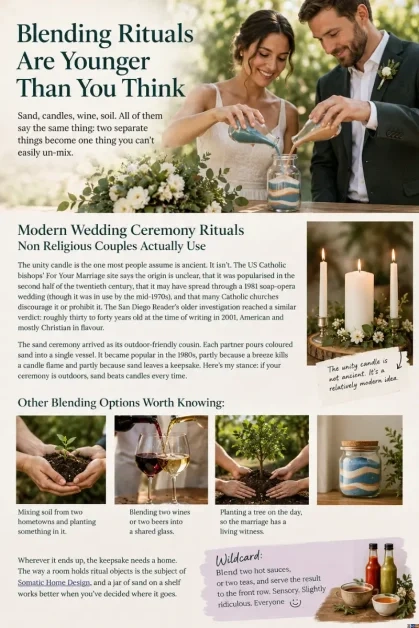
Modern Wedding Ceremony Rituals Non Religious Couples Actually Use
The unity candle is the one most people assume is ancient. It isn’t. The US Catholic bishops’ For Your Marriage site says the origin is unclear, that it was popularised in the second half of the twentieth century, that it may have spread through a 1981 soap-opera wedding (though it was in use by the mid-1970s), and that many Catholic churches discourage it or prohibit it. The San Diego Reader’s older investigation reached a similar verdict: roughly thirty to forty years old at the time of writing in 2001, American and mostly Christian in flavour.
The sand ceremony arrived as its outdoor-friendly cousin. Each partner pours coloured sand into a single vessel. It became popular in the 1980s, partly because a breeze kills a candle flame and partly because sand leaves a keepsake. Here’s my stance: if your ceremony is outdoors, sand beats candles every time.
Other blending options worth knowing:
- Mixing soil from two hometowns and planting something in it.
- Blending two wines or two beers into a shared glass.
- Planting a tree on the day, so the marriage has a living witness.
Wherever it ends up, the keepsake needs a home. The way a room holds ritual objects is the subject of Somatic Home Design, and a jar of sand on a shelf works better when you’ve decided where it goes.
Wildcard: blend two hot sauces, or two teas, and serve the result to the front row. Sensory. Slightly ridiculous. Everyone remembers the taste.
6. Borrowed Rituals Need Manners
The most personal secular ceremonies borrow. That’s fine. But borrowing well means knowing whose it is.
Jumping the broom is the clearest test. It is widely associated with African American weddings, and scholars such as Dianne Stewart describe the dignity it carries there. Historian Tyler D. Parry’s book on its multicultural origins traces it to marginalised communities in the British Isles, among them Romani, rural Welsh and Irish people, before enslaved Americans reshaped it into their own. Both stories are true at once. If you’re not from a community that owns a ritual, name where it came from, don’t rename it, and think hard about whether it’s yours to use.
Living Indigenous traditions call for the same care. Ceremonies belonging to nations such as the Cherokee are practised by people, not preserved in a museum. Read Native American Cherokee Wedding Traditions and Red Clay Tribe Wedding Traditions to understand context, and if you want to include something, ask a member of that community before you decide. Being invited is very different from being inspired.
Some borrowings are easier. Mexican Wedding Traditions includes gestures that families share freely across faith lines, and the bride-focused customs collected in Italian Wedding Traditions for Bride show how a single culture can hold both sacred and playful elements. The rule I use: credit it, keep it short, and check with someone who lives it.
Culture is also a matter of dress. If you plan to carry a heritage into the ceremony through clothing, Modern Cultural Wedding Dresses shows how couples blend traditions without turning them into costume.
7. Your Guests Can Do More Than Watch
The dullest ceremonies treat guests as furniture. The best wedding ceremony rituals non religious couples plan give guests a job.
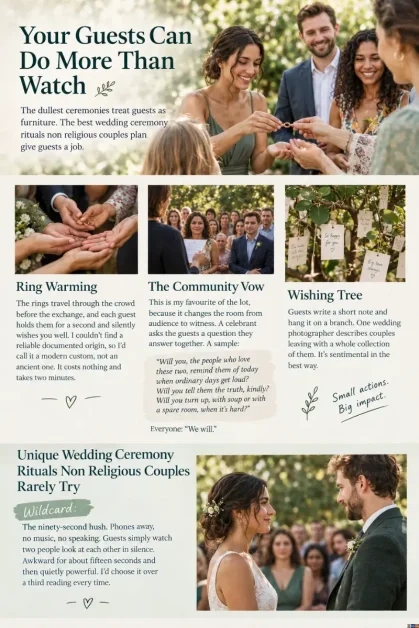
Ring warming. The rings travel through the crowd before the exchange, and each guest holds them for a second and silently wishes you well. I couldn’t find a reliable documented origin, so I’d call it a modern custom, not an ancient one. It costs nothing and takes two minutes.
The community vow. This is my favourite of the lot, because it changes the room from audience to witness. A celebrant asks the guests a question they answer together. A sample:
“Will you, the people who love these two, remind them of today when ordinary days get loud? Will you tell them the truth, kindly? Will you turn up, with soup or with a spare room, when it’s hard?”
Everyone: “We will.”
Wishing tree. Guests write a short note and hang it on a branch. One wedding photographer describes couples leaving with a whole collection of them. It’s sentimental in the best way.
Unique Wedding Ceremony Rituals Non Religious Couples Rarely Try
Wildcard: the ninety-second hush. Phones away, no music, no speaking. Guests simply watch two people look at each other in silence. Awkward for about fifteen seconds and then quietly powerful. I’d choose it over a third reading every time.
8. Catholic and Christian Couples Have Their Own Rules
Some searchers aren’t leaving faith so much as trying to loosen its grip on one day. That’s fair, but the rules differ.
For Catholics, canon law is specific. Canon 1108 says a marriage is valid only if it takes place before the local bishop, a parish priest, or a priest or deacon delegated by them, and before two witnesses. If a Catholic marries in a civil ceremony without a dispensation, the Church does not recognise the union as a valid marriage, according to the Diocese of Scranton’s canonical-form guidance. A bishop can sometimes grant a dispensation, mainly for mixed marriages. So if you are Catholic and want a ceremony with no religious content, speak to your diocese early, not after you’ve booked.
Some Catholic couples do the opposite: keep the Church rite and add older, non-doctrinal rituals such as handfasting, with the priest’s agreement. Ask first.
Other Christian traditions vary widely. Some churches offer a blessing after a civil wedding, and many are relaxed about readings and music. If you’re deciding what to keep, What Are Christian Wedding Traditions traces which customs are truly scriptural and which arrived later.
The interfaith case works well. Humanist celebrants say couples from different backgrounds often choose a humanist ceremony precisely because nobody’s faith wins. Non-religious is not the same as anti-religion. You can nod to a grandmother’s hymn without turning the day into a service.
9. Build Yours in an Afternoon
You don’t need twelve rituals. You need one that fits, and a script that lets it breathe. Good wedding ceremony rituals non religious or not are judged the same way: do they sound like you?
Simple Wedding Ceremony Rituals Non Religious Couples Can Do in Five Minutes
My rule is one ritual per ceremony. Two is a choice. Three is a pageant. Here is a sample running order for a 25-minute ceremony, which sits comfortably inside the range celebrants quote.
- Sort the legal marriage first, in whatever form your part of the UK requires.
- Choose a celebrant who asks you questions for an hour, not one who reads a template.
- Pick your single ritual, using the table below.
- Write your own vows, and keep them shorter than you think.
- Brief anyone with a job (the ring-bearer, the reader, the person handing over the cord).
- Run a ninety-second walkthrough on the morning of the day.
The Ultimate List of Wedding Ceremony Rituals & Traditions, at a Glance
Location changes the feel of a ritual. Mnemonic Landscape Analysis makes the case that places store memory, which is worth remembering when you’re choosing where to stand. And scale doesn’t matter: Crown Family Wedding Traditions shows ritual staged at the most formal extreme, and the same logic of pattern, witness and symbol works at ten guests or a thousand.
If you’d like more inspiration across regions, Cultural Marriage Traditions collects them in one place.
A last thing about proof. The social evidence points one direction, though I’d read it cautiously. Scotland’s humanist ceremonies now outnumber Christian ones in official figures, and a 2019 analysis of Scottish court data reported that only 0.25 per cent of humanist couples divorced in 2017-18 compared with 0.84 per cent of others. Couples who choose humanist weddings may differ in ways that matter, so I wouldn’t call it cause and effect. What it does suggest is that planning a ceremony deliberately, together, seems to do no harm at all.
Somewhere in your ceremony there will be a pause where nobody knows quite what to do with their hands. Put a ritual there.
Frequently Asked Questions
What Is a Non-Religious Wedding Ceremony?
It is a wedding ceremony with no religious content: no prayers, no scripture, no clergy. In its place sit your own vows, readings, music and symbolic acts such as handfasting or a sand blend. It can be humanist, led by a celebrant who shares a non-religious outlook, or a looser secular ceremony led by a friend. It can also be part of a civil marriage, where the registrar handles the legal words and a celebrant handles the meaning. What matters is that the content is yours, and that the legal marriage is arranged properly for wherever you live.
Is a Secular Wedding the Same as a Civil Wedding?
No. A civil wedding is legally binding and led by a registrar using fixed wording. A secular wedding is a broader idea: any ceremony without religion. A secular ceremony can be legally binding where the law allows, as with humanist marriages in Scotland and Northern Ireland, or symbolic only, as in England and Wales at present. Many English and Welsh couples do both: a short civil marriage for the paperwork, then a secular celebration for the emotion. If that’s your plan, ask your register office about notice periods well ahead of the date.
How Long Does a Non-Religious Ceremony Last?
Celebrants usually quote 20 to 40 minutes. Some say up to 30 is normal, one puts the sweet spot near 28, and others offer 15 to 45. A photographer’s account suggests US secular ceremonies run around 20 minutes while French ones can last up to an hour. Length depends on readings, music and how many rituals you add. As a rule, if a guest is checking the time, you’ve run over. The 25-minute running order above is a comfortable middle.
What Does the Officiant Say During a Non-Religious Unity Ritual?
There is no fixed text. A typical structure has three beats: name what is being joined, describe the action as it happens, then close with a promise. For a sand blend it might sound like this: “Two people, two histories, two colours. As they pour, notice how each grain lands differently. Once they’re mixed, nobody could separate them, and neither of them would want to. This is the marriage they’re building.” Keep it under ninety seconds, avoid religious vocabulary if that is the point, and let the action do the talking.
Can We Include a Community Vow for the Guests?
Yes, and it is among the easiest wedding ceremony rituals non religious couples can add to make a ceremony feel shared. Write two or three short promises, ask them as questions, and have guests answer with a single line such as “We will.” Place it right after your own vows so the room’s energy is already high. Give the celebrant a microphone if the crowd is large, and offer a printed card for anyone who prefers to read rather than speak. In a mixed-belief crowd, avoid vows that mention gods or blessings, and stay with promises about presence, honesty and kindness.
Sources and Further Reading
- UK Parliament, Hansard, “Wedding Law Reform: England and Wales” (Commons statement, 16 July 2026): hansard.parliament.uk
- House of Commons Library, “Humanist marriage ceremonies in England and Wales” (SN05864): commonslibrary.parliament.uk
- Law Commission of England and Wales, Celebrating Marriage: A New Weddings Law (July 2022), as summarised in the Commons Library briefing above
- University of Warwick School of Law, “Wedding Law Reform in England and Wales” (Nuffield Foundation-funded research led by Dr Rajnaara Akhtar): warwick.ac.uk
- Bridebook, “Wedding Law Reform UK 2026: What’s Changing?” (trade source, used for consultation dates): bridebook.com
- Humanists UK, “Scotland celebrates 20 years of humanist marriages” (18 June 2025): humanists.uk
- The Courier & Advertiser, reporting National Records of Scotland 2019 marriage data: pressreader.com
- TheHumanist.com, interview with Lynsey Kidd of Humanist Society Scotland: thehumanist.com
- Gretna Green, “The Tradition of Handfasting” (trade and heritage source): gretnagreen.com
- Argyll and Bute Council, “Marriage and Civil Ceremonies: Hand Fasting”: argyll-bute.gov.uk
- Mental Floss, “Tying the knot phrase origin” (popular source, cites BBC): mentalfloss.com
- Parry, Tyler D., Jumping the Broom: The Surprising Multicultural Origins of a Black Wedding Ritual, University of North Carolina Press (2020)
- Blavity, “The origins of jumping the broom” (quotes Dianne Stewart, Emory University): blavity.com
- Aisle Planner, “Wedding Traditions: Jumping the Broom” (popular source for the c. 1700 Welsh records): aisleplanner.com
- For Your Marriage (US Conference of Catholic Bishops), “The Unity Candle”: foryourmarriage.org
- San Diego Reader, “What is the history/origin of the dreaded unity candle?” (2001): sandiegoreader.com
- Young, Hip and Married, “Sand Ceremony” (popular source): younghipandmarried.com
- Diocese of Scranton, “What is Canonical Form?”: dioceseofscranton.org
- Canon 1108, text and commentary: canonlaw.info
- Good To Know, “A Humanist wedding ceremony cuts the risk of divorce by two-thirds” (secondary report of Scottish Courts and Tribunals Service data): goodtoknow.co.uk
- Humanist celebrant FAQs on ceremony length and legal steps: humanist.org.uk, humanist.org.uk, humanist.org.uk
- Kate Rostance Celebrant, “Humanist Weddings Set to Become Legal in England and Wales”: katerostance.com
- Wandermoons, “Secular Ceremony: The Complete Guide + 6 Inspiring Rituals” (wedding photographer’s trade blog): wandermoons.com