By Dr. Helena Voss | Classical Historian & Archaeologist | Author Profile
Blood Spears and Flaming Veils: The Untold Story of Ancient Roman Wedding Traditions
Quick Answer: What Were Ancient Roman Wedding Traditions?
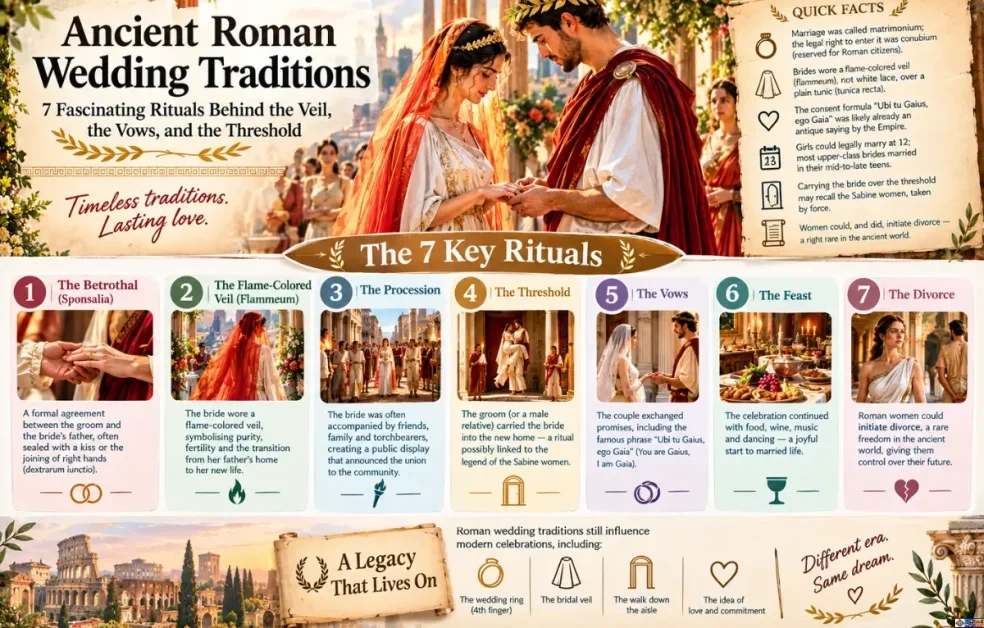
Ancient Roman wedding traditions were elaborate, legally codified rituals spanning multiple days. They included three distinct marriage forms (Confarreatio, Coemptio, and Usus), a dress code centred on a flame-coloured veil called the flammeum, a ceremonial hairstyling ritual using a spear or dagger, a torchlit night procession, the anointing of doorposts, and the groom carrying the bride over the threshold. Many of these customs survive in modern Western weddings in adapted form.
Introduction: The Wedding Playbook Rome Wrote
When a groom carries his bride over the threshold today, most people assume it is purely romantic. It is not. The gesture is roughly 2,000 years old, born from Roman superstition so firmly held that it outlasted the empire itself. That single moment is a thread connecting the 21st century to the marble courtyards of ancient Rome, where ancient Roman wedding traditions were not just celebrations but legally binding civic events, religious rites, and family negotiations rolled into one.
I have spent the better part of two decades studying domestic ritual in the Roman world, and I return to weddings repeatedly. Not because they are quaint — they were anything but — but because they illuminate exactly how Romans understood power, gender, luck, and the divine, all compressed into a single day. The rituals were specific, often strange to modern eyes, and layered with meaning that no participant would have needed explained. Everyone knew what the spear meant. Everyone knew why you threw nuts.
At Culture Mosaic, we write about culture as it actually lives in human behaviour, not as a museum exhibit. The ancient Roman wedding is one of the most instructive places to watch culture in action. These traditions reveal how Romans thought about the gods, about women’s legal status, about luck and malevolence, and about the fragile business of building a new household from scratch.
“The Romans did not just invent the wedding ring. They wrote the ceremonial grammar that still underlies Western matrimony.”
The Three Ways to Say ‘I Do’ — Rome’s Legal Marriage Framework
Rome was a legalistic society. Before the flowers and the feasting came the paperwork, or at least its ancient equivalent. There were three distinct forms of ancient Roman wedding traditions, each carrying different legal implications and each reflecting different social strata.
Confarreatio — The Patrician’s Sacred Bond

Confarreatio was the most archaic and the most exalted form of Roman marriage. It was available only to patricians — Rome’s hereditary aristocracy — and was presided over by the Pontifex Maximus and the Flamen Dialis, two of the most senior religious figures in the Roman state. The ceremony centred on the sharing of a sacred cake called the farreum, made from spelt grain and offered to Jupiter Farreus. Both partners consumed it together in front of ten witnesses, and in doing so they transferred the bride entirely into her husband’s legal household, a status called manus marriage.
The bond formed by Confarreatio was considered effectively insoluble. Dissolving it required an equally complex counter-ritual called diffarreatio, which was so rare it appears only a handful of times in the historical record. Certain priestly offices — notably the Flamen Dialis himself — could only be held by men born of a Confarreatio union, which tells you how deeply this form of marriage was woven into Roman religious infrastructure.
The spelt cake shared between partners is, I think, the clearest single ancestor of the modern wedding cake. The symbolism is identical: communal consumption, witnessed, as the formal enactment of a shared life beginning.
Coemptio — The Ritual of Symbolic Purchase

Coemptio was the most widely used form among the citizen class. The word translates roughly as ‘mutual purchase,’ and while that sounds alarming to modern ears, its legal mechanics were more nuanced. Conducted before five witnesses, the ceremony involved a symbolic exchange — the groom offering a coin to the bride’s family to signify her transfer into his household. It was never a commercial transaction in any meaningful sense; it was a legal formality dressed in ritual clothing.
What made Coemptio important was its flexibility. Unlike Confarreatio, it could apply across class lines, and unlike Usus (below), it was witnessed and formal enough to carry immediate legal weight.
Usus — The Common-Law Option

Usus was Rome’s equivalent of common-law marriage. A man and woman who cohabited for one continuous year became legally married without any ceremony at all. The Twelve Tables — Rome’s foundational law code — even allowed a woman to preserve her legal independence from her husband. If she wanted to avoid the manus transfer that Usus would normally trigger, she could sleep outside the marital home for three consecutive nights every year. Three nights away, and the legal clock reset. It is one of those Roman details that sounds almost modern, because the intention — protecting a woman’s property rights and legal personhood — resonates across two millennia.
For readers interested in how marriage customs reflect broader social structures across cultures, our piece on Marriage Rituals in Different Cultures Anthropology puts the Roman system into a genuinely illuminating global context.
Gearing Up for Battle — Roman Bridal Fashion and Its Hidden Logic

If you imagine a Roman bride in white, you are imagining the wrong century. Roman bridal dress was striking, deliberate, and loaded with protective symbolism. Every element had a function.
The Hasta Caelibaris — Why a Spear Combed the Bride’s Hair
On the morning of the wedding, the Roman bride underwent an elaborate hair ritual. Her hair was divided into precisely six sections — the number associated with Vestal Virgins, Rome’s most sacred female religious office — using a spear called the hasta caelibaris. Ideally, this was a spear that had drawn blood in battle. Failing that, a gladiatorial weapon would serve.
The symbolism was pointed, and I mean that literally. Roman thinkers believed the spear carried martial virtus, a quality we might translate as strength or excellence but which carried connotations of forceful male power. Parting the bride’s hair with it was meant to invest the marriage with that same vigour. It also signalled that this union could only be severed by death — or by iron. The six resulting plaits, wound and pinned, were her ceremonial coiffure for the entire day.
This is one of those ancient Roman wedding traditions that has no modern equivalent at all, and I find that gap revealing. We have sanitised wedding preparation into beauty rituals. The Romans started with a weapon.
The Flammeum — Rome’s Bridal Veil
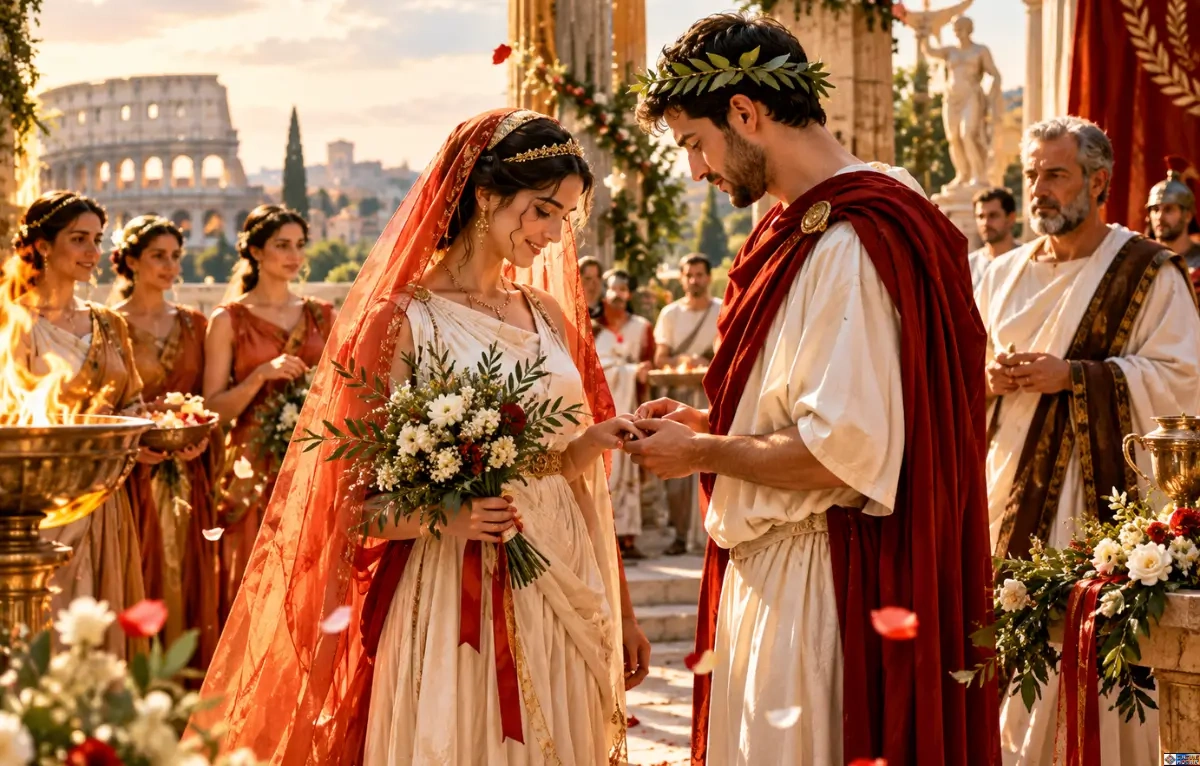
The Roman bridal veil was called the flammeum, from flamma, the Latin for flame. It was saffron yellow or deep orange-red — not white, not ivory — and it was worn draped from the crown of the head down over the face and shoulders. Its purpose was unambiguous: fire repels evil. The veil acted as a spiritual shield, a literal wall of metaphorical flame between the bride and any malevolent spirit, jealous neighbour, or ill-wisher attempting to curse the union through the evil eye.
The flammeum was so closely associated with marriage that the Latin word for a bride, nupta, derives from nubere, meaning ‘to veil.’ The veil was not incidental. It was definitional. The physical presence of the veil was what made the woman a bride.
The modern white veil is a direct descendant of this, though Christianity stripped the fire symbolism and replaced it with purity signalling. The architecture of the gesture — a woman veiled, processed, unveiled by the groom — remained essentially intact across that long transition.
The Tunica Recta and the Knot of Hercules
The bride’s dress was the tunica recta, a straight white robe woven in a single piece without seams. Over it she wore a belt of ewe’s wool tied in the Knot of Hercules — nodus Herculaneus — an interlocking reef-like knot that only the groom was permitted to untie on the wedding night. This was not merely ceremonial coyness. Hercules was the divine protector of marriage and of procreation, and the knot invoked his blessing over the union’s fertility. The act of untying it was ritually charged with the same gravity as any religious observance.
The knot lives on, arguably, in the modern garter tradition — an object worn by the bride, removed by the groom, in a moment that carries both ritual and erotic weight without most participants knowing quite why.
Ancient Roman Wedding Traditions vs. Modern Equivalents
| Roman Tradition | The Ancient Meaning | The Modern Equivalent |
|---|---|---|
|
Eating Spelt Cake (Confarreatio) |
Sacred food shared to seal a religious union before priests. | Cutting the Wedding Cake |
| The Flammeum | A fiery red-yellow veil worn to ward off evil eyes and bad omens. | The Bridal Veil |
| Throwing Nuts to the Crowd | A noisy ritual symbolising the groom’s abandonment of boyhood pleasures. | Tossing Rice, Petals, or Confetti |
| Carrying Over the Threshold | Preventing catastrophic bad luck of the bride tripping on entry. | Carrying the Bride Over the Threshold |
| The Knot of Hercules | A complex sash tied around the bride’s waist, untied only by the groom on the wedding night. | Untying the Garter |
Table 1: Key ancient Roman wedding traditions and their modern-day equivalents.
Reading the Signs — The Role of Auspices and the Auspex
No Roman wedding proceeded without divine approval. Before the ceremony could begin, an auspex — a state-licensed augur — had to observe and interpret natural signs. Most commonly this meant watching the flight patterns of birds. The direction they flew, the species involved, whether they called out or fell silent: all of it was legible to a trained auspex as divine communication.
An unfavourable reading could halt the proceedings entirely. This was not considered odd or pessimistic; it was prudent. Romans understood themselves to be living in continuous relationship with divine powers whose goodwill was neither guaranteed nor permanent. A wedding conducted against the gods’ wishes was not just unlucky — it was potentially invalid.
This is one of the aspects of ancient Roman wedding traditions that most clearly reflects Roman religious sensibility as a whole. The sacred and the civic were not separate domains. A marriage was simultaneously a religious rite, a legal contract, and a social performance. All three dimensions had to be satisfied. The auspex‘s role satisfied the first. The formal witnesses satisfied the second. The procession and feast satisfied the third.
The Pronouncement — ‘Ubi Tu Gaius, Ego Gaia’
At the ceremony’s heart was a spoken exchange, one of the oldest marriage formulas in the Western tradition. The bride said: Ubi tu Gaius, ego Gaia — ‘Where you are Gaius, I am Gaia.’ The names were generic, a deliberate grammatical blank. Every Roman woman became Gaia in that moment; every Roman man became Gaius. The formula dissolved individual identity into conjugal unity with a precision that still strikes me as remarkable.
There was no ring exchange at this point, though Romans did use rings, typically of plain iron and later gold, worn on the fourth finger of the left hand. Roman physicians believed a nerve ran directly from that finger to the heart — the vena amoris. We still use that finger for the same reason.
The Faux Abduction and the Torch-Lit Night Procession
By evening, the ceremony was complete and the deductio began — the procession from the bride’s father’s house to the groom’s home. This was not a quiet walk. It was a public statement, a civic performance, a fertility ritual, and a comic roast rolled into a single noisy event.
The Mock Kidnapping
The procession began with a staged scene: the groom’s party had to physically separate the bride from her mother’s arms. The bride wept or pretended to. This mock abduction was a conscious nod to Rome’s own origin mythology — specifically the Rape of the Sabine Women, in which Rome’s founders seized wives from the neighbouring Sabine tribe. By re-enacting it in miniature, the wedding party acknowledged that marriage involves a rupture, a leaving, a real loss for the natal family even when the marriage is wanted.
It is anthropologically shrewd. The mock distress gave the bride a socially scripted way to express genuine ambivalence about leaving her family without that ambivalence being read as opposition to the match.
Torches, Nuts, and the Song of Talassius
Five torches of white hawthorn led the procession — three carried by boys who also held the bride’s hands, two carried ahead of the group. Guests threw walnuts to children who scrambled for them in the street; the nuts signified the groom’s abandonment of boyhood games and pleasures. The procession’s soundtrack was provided by guests singing the Talassio, a fertility chant whose origins are obscure but whose content was apparently bawdy enough that Roman writers reference it with knowing amusement rather than full transcription.
Flutes played. Onlookers shouted blessings. The whole affair was loud, warm, and deliberately public. A Roman wedding that slipped by unnoticed was a social failure.
This insistence on public, collective participation in private transitions is something worth noting. It connects ancient Roman wedding traditions to a much wider pattern of how human communities use ritual to absorb and legitimise major life changes. Our article on Why is Oral Storytelling Important touches on exactly this — how witnessed, performed narrative binds a community together around shared transitions.
Smearing Fat and Crossing Thresholds — Arriving at the New Home
When the procession reached the groom’s house, the ceremony shifted from public to domestic. The bride performed a series of ritual acts before she could enter, each one precisely calibrated to secure the new household’s prosperity and block any hostile spiritual forces.
Anointing the Doorposts
First, she anointed the doorposts with animal fat and olive oil and draped them with wool garlands. Fat and oil signified abundance — they were expensive, calorie-rich, and associated in Roman thought with divine favour and physical flourishing. The wool garlands referenced the domestic craft that was, culturally, the Roman wife’s primary domain. She was, in that single gesture, claiming the house as her productive space.
I find this moment quietly powerful. Before she has crossed into her new home, she has already marked it. The anointing was her act of territorial inscription. The house began to become hers in that moment, not when the door closed behind her.
Carrying the Bride Over the Threshold
The threshold carry is probably the most enduring of all ancient Roman wedding traditions. It exists in dozens of contemporary cultures with varying degrees of awareness of its Roman origin. The Roman logic was stark: tripping on the threshold of your new home was a ruinous omen. It suggested the house spirits — the Lares — rejected the new arrival. To eliminate the risk entirely, the groom (or in some accounts, designated attendants) simply hoisted the bride off the ground and transported her bodily over the entrance.
Romans were practical about their superstitions. If the threshold was dangerous, you bypassed it. The solution did not require elaborate theology. It required someone willing to lift.
Fire and Water — The First Gifts
Once inside, the groom offered the bride fire and water — a torch and a vessel of water. Fire to light the hearth; water to begin the household’s domestic labour. Both elements were sacred to Vesta, goddess of the hearth and of Rome’s civic continuity. Accepting fire and water was the bride’s formal acknowledgment that she was now mistress of this household’s sacred centre. It was simultaneously practical and deeply ceremonial, which was, in truth, the Roman mode across most of life.
The Wedding Feast and the Day After — Matron of the House
The wedding banquet that followed was equally structured. Guests reclined on couches in the Roman dining mode, with courses organised and timed. The newly married couple shared the first bites publicly, echoing the Confarreatio spelt cake even in non-patrician weddings, because the symbolism of communal eating as a binding act was too culturally potent to restrict to one social class.
The morning after — the day called repotia — was marked by a second, smaller gathering at which the bride received guests in her new household for the first time in her role as domina, mistress of the house. She was no longer a daughter being presented; she was a host. The shift in posture was the point.
If you want to place this within the wider story of how matrimonial culture shapes and is shaped by society, the Cultural Marriage Traditions article on Culture Mosaic is a good companion read — it maps how marriage ceremonies function as cultural technology across very different societies.
Timing Is Everything — Lucky Days, Forbidden Months, and the Roman Calendar
Ancient Roman wedding traditions were deeply entangled with the religious calendar. Romans did not simply pick a date. They navigated a complex grid of auspicious and inauspicious periods, and getting the date wrong was considered as serious a mistake as failing to secure witnesses.
The Forbidden Months
May was considered deeply unlucky for weddings. The Roman month was heavy with festivals for the dead — the Lemuria ran through 9, 11, and 13 May — and marrying while ancestral spirits were understood to be wandering was held to invite their interference. The Latin phrase Mense Maio malae nubunt — ‘those who marry in May fare badly’ — survived long enough to influence European folk custom well into the 20th century.
March was out for similar reasons. The first half of June was inauspicious, reserved for the ritual purification of the Vestal Virgins’ sanctuary. June weddings only became lucky after the Ides, and even then required careful augury. The cluster of preferred dates was genuinely narrow, which meant Roman wedding seasons had a rhythm to them that we have largely lost.
The Role of Juno and Venus
Juno, as patroness of marriage, was invoked at every Roman wedding. Her month, June, gave the modern world its preferred wedding month, though ironically only the second half of June was actually suitable in Roman practice. Venus, as goddess of love and desire, was invoked to ensure the marriage would be affectionate as well as legally sound. Romans understood perfectly well that a contractually valid marriage and an emotionally functional one were not the same thing, and they petitioned separately for each.
What Marriage Meant for Roman Women — Legal Status and Personal Autonomy
No honest account of ancient Roman wedding traditions can sidestep the question of what marriage meant legally for Roman women. The picture is more complicated than either the feminist critique or the nostalgic idealisation allows.
Under manus marriage — the form created by Confarreatio and Coemptio — the bride passed from her father’s legal authority (patria potestas) into her husband’s. She became, in legal terms, like a daughter in his household. Her property merged with his. Her legal personhood was subordinated to his in most civic matters.
But sine manu marriage — increasingly common from the late Republic onward — changed this significantly. Under sine manu, the bride remained under her father’s legal authority and retained her own property rights. She could inherit independently. She could, in principle, divorce and reclaim her dowry. The Usus form’s three-night escape clause was specifically designed to facilitate sine manu status. Roman women of the propertied class in the Imperial period had substantially more legal capacity than is often assumed, and the wedding itself was the moment at which the terms of their legal existence were formally established.
From Rome to the Registry Office — How Ancient Roman Wedding Traditions Survive Today
The survivals are not incidental. They are structural. The reason so many ancient Roman wedding traditions appear in modern Western weddings is that early Christianity adopted and adapted Roman civic and ceremonial forms rather than replacing them wholesale. Marriage became a sacrament, but the ceremonial vocabulary — the veil, the ring, the witnessed exchange of words, the procession, the threshold carry, the communal feast — came largely intact from Rome through the late antique Christian world.
The wedding ring on the left fourth finger is Roman. The bridal veil is Roman. Carrying the bride over the threshold is Roman. The wedding cake as communal shared food is Roman. The June preference for weddings is Roman, and slightly misremembered. The confetti — those thrown walnuts and later grains — is Roman.
What is striking is how much of this survives not as conscious historical homage but as folk memory, transmitted through practice rather than text. Nobody throwing confetti outside a register office is thinking about Roman fertility ritual. But the gesture’s logic — shower the couple with abundance, make noise, witness publicly — is identical to what was happening on a torchlit street in the Campus Martius two thousand years ago.
“Weddings do not change. Costumes change. Theologies change. The human desire to mark a permanent threshold with noise, witnesses, and a touch of magic — that has not moved.”
When Things Went Wrong — Roman Divorce and the Reversibility of Marriage
Roman marriage was not for life in the same legal sense that later Christian marriage would become. Divorce was available to both parties, though its practical ease varied enormously depending on the form of marriage and the period in question. Under manus marriage, the husband held most of the practical power to dissolve the union; under sine manu arrangements, both parties retained more agency.
The earliest Roman divorce recorded in historical sources was reportedly from the 7th century BCE, when Spurius Carvilius Ruga divorced his wife for infertility — and caused a public scandal not because divorce was wrong but because he had dissolved a union contracted by Confarreatio, which essentially required an Act of State to undo.
By the Imperial period, divorce was sufficiently common that moralists were complaining about it bitterly, which tells you it was happening regularly. The Roman satirist Juvenal mocks women who divorce so frequently they have lost count of their husbands. Whether or not he was exaggerating — and he usually was — the very existence of the joke confirms that dissolution of marriage was a socially legible phenomenon rather than a taboo rupture.
What Ancient Roman Wedding Traditions Tell Us About Roman Society
Every ritual encodes a worldview. Ancient Roman wedding traditions are a particularly dense encoding of how Rome understood the relationship between the individual, the family, the state, and the divine.
The requirement for witnesses speaks to Rome’s fundamentally civic understanding of marriage: it was not a private matter but a public, recorded event with legal consequences. The augury speaks to a religious sensibility in which divine approval was not assumed but sought, actively and formally. The multiple rituals around the threshold — anointing, the carry, the reception of fire and water — speak to an animist substrate beneath Roman formal religion, a world in which doorways were genuinely fraught with spiritual danger and had to be managed with care.
The bridal costume — the spear-parted hair, the flaming veil, the Herculean knot — tells us that Roman society understood marriage as a transition demanding protection. The bride was moving from one sphere of spiritual and legal belonging to another, and that transition was dangerous. The rituals were armour.
And the feast, the procession, the noise, the witnesses — these tell us that Romans understood human milestones as fundamentally communal events. You did not get married privately. You got married in public, loudly, with your neighbours watching and your gods informed.
The Long Shadow of the Roman Ceremony
What I find most compelling about ancient Roman wedding traditions is not the strangeness of the details — the spear, the nuts, the anointed doorposts — but how recognisable the emotional architecture remains. Romans were frightened of bad luck on their wedding day. They wanted divine approval. They wanted community witness. They wanted the transition to be marked loudly enough that no one could pretend it hadn’t happened.
Two thousand years on, we still want all of those things. We just do not reach for a blood-stained spear to part the hair anymore. Most of us.
For further reading on how marriage ceremonies across cultures share these deep structural features, see our full collection of Cultural Marriage Traditions and the anthropological overview of Marriage Rituals in Different Cultures Anthropology at Culture Mosaic.
Frequently Asked Questions: Ancient Roman Wedding Traditions
What were the three main types of ancient Roman wedding traditions?
- Confarreatio was the most sacred form, restricted to patricians, involving a shared spelt cake offered to Jupiter and the presence of Rome’s highest priests.
- Coemptio was a symbolic purchase ceremony conducted before five witnesses, used widely across the citizen class and signifying the bride’s transfer into the new household.
- Usus was common-law marriage formed by one year of uninterrupted cohabitation, with a legal provision allowing women to preserve their independence by sleeping away from home three nights annually.
- The choice of marriage type determined the woman’s legal status — either under her husband’s authority (manus) or remaining under her father’s (sine manu).
- By the late Republic, sine manu marriages had become increasingly common, reflecting a broader shift toward greater female legal autonomy in propertied Roman families.
Why did Roman brides wear a red or yellow veil instead of white?
- The flammeum was saffron yellow or deep flame-red because fire was understood in Roman culture as a spiritual shield against malevolent forces and the evil eye.
- The colour was not an aesthetic preference — it was functional. A flame-coloured veil was believed to literally protect the bride from curses and ill-wishing on her most vulnerable ritual day.
- The Latin word for bride, nupta, derives from nubere meaning ‘to veil,’ confirming that the veil itself was definitional of bridal identity, not merely decorative.
- White was not the Roman colour of bridal purity — that association came later, through 19th-century European fashion conventions, most famously Queen Victoria’s 1840 wedding.
- The modern bridal veil preserves the gesture and the architecture of the flammeum while having lost its original fire-protection symbolism entirely.
What was the role of the auspex in ancient Roman wedding traditions?
- The auspex was a state-licensed augur whose job was to read natural signs — principally bird flight and behaviour — to determine whether the gods approved of the marriage.
- Without a favourable omen reading, a Roman wedding could be legitimately postponed, because proceeding against divine will was considered both religiously improper and practically dangerous.
- The auspex‘s role reflected Rome’s fundamentally civic understanding of religion: divine approval was not personal or private but formally sought, witnessed, and recorded.
- The term ‘auspicious’ in modern English derives directly from the auspex‘s practice of watching birds (aves) and then announcing (spectare) what they revealed.
- This element of ancient Roman wedding traditions has no direct modern equivalent, though the general idea — that a wedding requires some form of sanctioned blessing beyond the couple’s own desire — persists in religious ceremony.
Where does the custom of carrying the bride over the threshold come from?
- The threshold carry originates directly from ancient Roman wedding traditions. Romans believed stumbling on the threshold of a new home was a catastrophic omen indicating the household spirits — the Lares — rejected the bride’s entry.
- To eliminate the risk entirely, the groom or attendants physically lifted the bride and transported her across the threshold without her feet touching it.
- The household threshold was considered a liminal zone — neither inside nor outside — and therefore spiritually dangerous during major life transitions.
- The custom survived because it was transmitted through practice rather than text, passing from Roman households through early Christian culture and into European folk custom without requiring any ideological justification.
- Contemporary couples who observe this tradition do so almost entirely without awareness of its Roman origin or the animist logic that generated it.
What did the Knot of Hercules symbolise in a Roman wedding?
- The nodus Herculaneus, or Knot of Hercules, was a complex interlocking knot tied around the bride’s waist over her tunica recta, invoking Hercules as the divine protector of marriage and fertility.
- Only the groom was permitted to untie the knot on the wedding night, making the act of untying it a ritually charged consummation of the legal and spiritual union.
- Hercules was chosen because of his mythological association with virility, protection, and the overcoming of obstacles — qualities Romans considered essential to a successful marriage.
- The knot also symbolised the binding, indissoluble nature of the marital union in its most aspirational form — something as difficult to undo as a Herculean knot.
- The modern garter tradition — an object worn by the bride, removed by the groom in a ritualised public moment — is almost certainly the evolutionary successor to this ancient protective knot, its Roman origins quietly persisting across two thousand years of cultural change.
References
- Gardner, J. F. (1986). Women in Roman Law and Society. Croom Helm.
- Leany, B. (n.d.). Something Borrowed: The Origins of Christian Wedding Rituals. Studia Antiqua. BYU Scholars Archive.
- Mazur, M. (n.d.). Family and Pro-Family Politics in Ancient Rome. Forum Teologiczne. University of Warmia and Mazury.
- Rawson, B. (Ed.) (1986). The Family in Ancient Rome: New Perspectives. Croom Helm.
- Treggiari, S. (1991). Roman Marriage: Iusti Coniuges from the Time of Cicero to the Time of Ulpian. Oxford University Press.
- Wethmar-Lemmer, M. M. (2006). The legal position of Roman women: a dissenting perspective. Fundamina.