
 By Culture Expert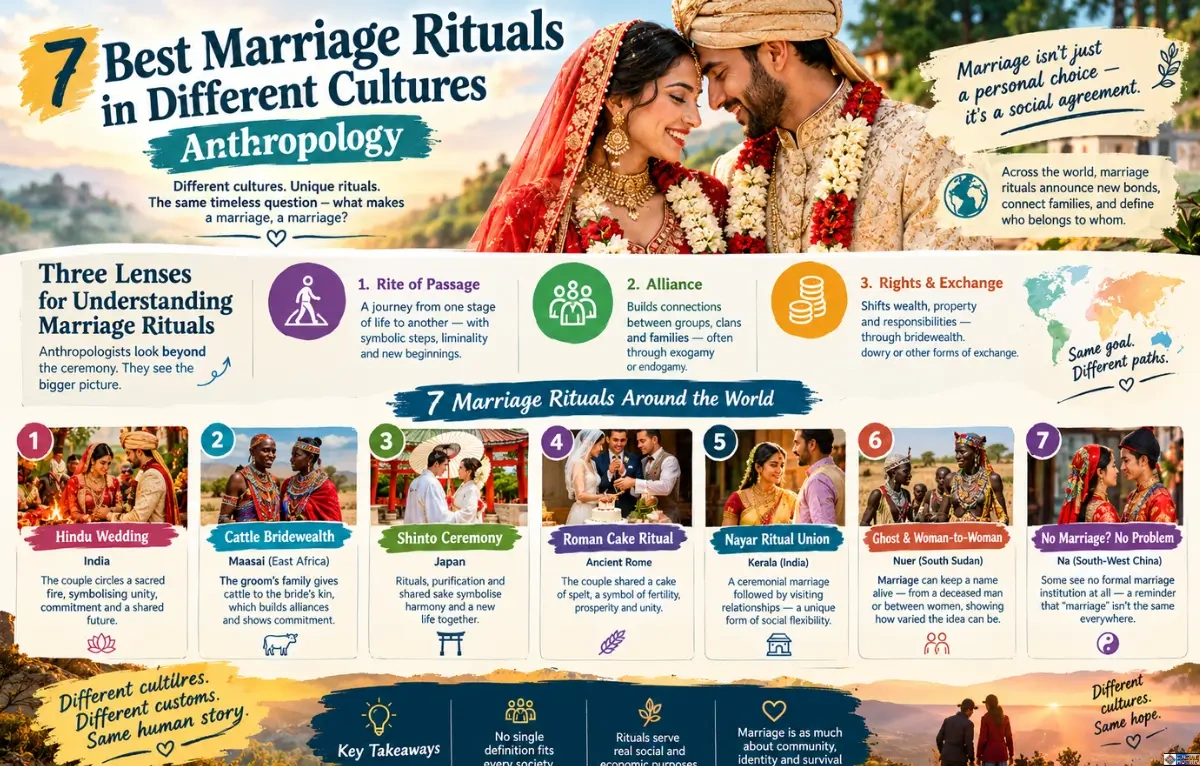
Quick Summary
- Anthropologists read a marriage ritual as public work. It announces a new bond, shifts people and property between families, and tells a community who now belongs to whom.
- No single definition of marriage fits every society. Cattle, cooked grain, a knotted thread and a dead man’s name have all done the job.
- Three ideas explain most ceremonies: rites of passage, alliance between groups, and the exchange of wealth.
- Bridewealth flows from the groom’s side to the bride’s kin. A dowry travels with the bride. Different logic, different economies.
Why Most Wedding Customs Lists Leave You Hungry
You search for marriage rituals and get a slideshow. Lovely photographs. Ten customs, no reasons. Why does a bride circle a fire? Why would a family hand over a herd of cattle? Why did a Roman couple share a cake of spelt?
I think the listicle format flattens all of this. It treats a wedding as decoration. Anthropologists treat it as an answer to a question the community has to settle: who counts as married, who owns what, and whose children are whose?
Call it a wedding, a marriage rite, the nuptials. The question underneath stays the same. This guide gives you the lenses first, then seven ceremonies run through them. If you want the lighter, picture-led version afterwards, I’ve gathered one in Best Wedding Traditions Worldwide, and the wider Culture Mosaic archive goes deeper on individual cultures.
Marriage Rituals in Different Cultures Anthropology: Three Lenses
Rite of passage. In 1909, Arnold van Gennep argued that big life transitions share a three-part shape: separation from the old status, a threshold phase, then incorporation into the new one. Victor Turner later gave that middle phase a name, liminality, the state of being “betwixt and between.” Think of a veiled bride, a procession, a night of seclusion. The couple are neither single nor yet married, and the ritual walks them across.
Alliance. Claude Lévi-Strauss saw marriage as a way groups bind themselves to each other. This is where two terms matter. Exogamy means marrying outside your group, such as a clan or village. Endogamy means marrying within it. Every society draws these lines somewhere, and the wedding is where the line becomes visible.
Rights and exchange. Edmund Leach and, later, Jack Goody and S. J. Tambiah treated marriage as a bundle of rights: over children, property, labour, residence. Who pays whom, and who inherits, shapes the ritual. For a wider survey of how this plays out, see Cultural Marriage Traditions.
Do All Cultures Define Marriage the Same Way?
No. And the cases that break the definition are the best part of the subject.
Leach, writing in 1955, listed the rights marriage might establish: legitimacy for children, sexual access, domestic labour, property claims, alliance between in-laws. His point was blunt. No single item appears in every society’s version. Kathleen Gough pushed this further with the Nayar of Kerala. Girls went through a ritual union (the tali-kettu kalyanam) with a ceremonial husband, and later formed visiting relationships with other men. Gough used the case to argue that a workable definition has to centre on who is recognised as the legitimate parent of a woman’s children.
Then there’s the odd one. Among the Nuer of South Sudan, E. E. Evans-Pritchard recorded two arrangements that surprise nearly every first-time reader. In ghost marriage, a man who died childless could have a wife married in his name, and her children, fathered by a kinsman, belonged to the dead man. In woman-to-woman marriage, a woman without children could pay bridewealth for a wife and be recognised as the “father” of the children. I think the Nuer material is the strongest argument in anthropology against assuming marriage is about two lovers. Sometimes it’s about keeping a name alive.
Another case is the Na of south-west China. Cai Hua argued that they have no institution of marriage at all, and that people don’t recognise a social role of father. Whether you accept his framing or not, it forces you to ask what you thought “marriage” meant.
Bridewealth vs Dowry: What’s the Real Difference?
People mix these up constantly. Goody and Tambiah’s 1973 study Bridewealth and Dowry is still the standard starting point.
| Feature | Bridewealth | Dowry |
|---|---|---|
| Direction of wealth | Groom’s family → bride’s family | Bride’s family → the bride (and the new household) |
| Typical setting (per Goody & Tambiah) | Societies with lineage-based property, common in sub-Saharan Africa | Stratified, plough-farming societies across Eurasia |
| What it does | Compensates a family for losing a daughter’s labour and children; seals the alliance | Works as a premarital share of inheritance; signals and protects status |
| Example | Nuer cattle payments | Historic European and South Asian dowry; southern Italian corredo (trousseau) |
The Italian trousseau is a quieter cousin of the dowry. The household linen, the hand-embroidered pieces, the chest. If you want that thread, Italian Wedding Traditions for Bride picks it up.
One caution. In India, the Dowry Prohibition Act of 1961 made giving and taking dowry illegal, yet the practice has persisted, and demands for it can become coercive. Describing dowry as “tradition” without saying so would be dishonest.
Seven Ceremonies, Seven Facts
1. Hindu weddings: the law counts the seventh step
Searches for Hindu wedding rituals step by step turn up long lists, and I’d stress that sequences vary by region, language and family. A common north Indian pattern runs like this:
- The groom’s party arrives and is formally welcomed.
- Kanyadaan: the bride’s father gives his daughter in marriage.
- The sacred fire (agni) is lit and the couple make offerings.
- Saptapadi: seven steps taken together, each with a vow.
- Regional markers are applied, such as the mangalsutra necklace or sindoor (vermilion).
Fact: Under Section 7 of India’s Hindu Marriage Act 1955, where the customary rites include the Saptapadi, the marriage becomes complete and binding when the seventh step is taken. A ritual gesture carries legal weight. (The Act applies to Hindus, Buddhists, Jains and Sikhs.)
2. Chinese weddings: marriage as a staged negotiation
Classical texts describe six stages, from proposal and exchange of names through betrothal gifts and fixing the date, ending with the groom collecting the bride. Patricia Ebrey’s work on family ritual in imperial China shows how these stages tied households together long before the wedding day. The tea ceremony, where the couple serve tea to elders, remains a familiar part of Chinese weddings.
Fact: The ritual was never a single event. It was a long courtship between families.
3. Ancient Rome: consent mattered more than ceremony
The jurist Gaius, writing in the second century, describes three routes by which a wife came under her husband’s legal control: confarreatio (a religious rite with a cake of spelt), coemptio (a formal symbolic sale) and usus (a year of continuous cohabitation). Susan Treggiari’s study of Roman marriage argues that the essential element was the couple’s intention to be married, not any rite. I covered the customs in Ancient Roman Wedding Traditions and the wedding night in Roman Wedding Night Ritual.
Fact: Rome had elaborate rituals and still treated a marriage as valid through consent.
4. Cherokee: the clan decides who you can marry
Cherokee society was matrilineal and organised into clans, and marrying within your own clan was forbidden. In other words, clan exogamy. Theda Perdue’s history of Cherokee women shows how clan membership, passed down through mothers, shaped household and community life. Practice varies by family and community today, so treat any single “Cherokee ceremony” description with care. The site’s pieces on Native American Cherokee Wedding Traditions and Red Clay Tribe Wedding Traditions go further.
Fact: Before any vow is spoken, kinship has already narrowed the field.
5. The Nuer: cattle as the currency of belonging
Cattle sat at the centre of Nuer life, and bridewealth was paid in cattle, spread across the groom’s relatives and shared among the bride’s. Evans-Pritchard described marriage as a process, not a day. Payments, feasting and the birth of a child all moved the union along.
Fact: The wealth changed hands, but the real transfer was of rights over future children.
6. Celtic and Irish customs: handfasting, and what we actually know
Modern handfasting, with its ribbon binding the couple’s hands, is popular in revival ceremonies. Historians generally see a thinner historical record than the pretty versions suggest. Before England’s Marriage Act of 1753, R. B. Outhwaite’s work on clandestine marriage shows how loosely marriage by exchange of vows was policed. If you’re curious, I’ve written about the broader practices in celtic wedding traditions and customs and Irish Wedding Traditions.
Fact: Part of what we call “ancient” is a modern revival.
7. Mexico: a lasso, thirteen coins and a blended inheritance
Many Mexican Catholic weddings include the lazo, a looped cord or rosary draped around the couple, and the arras, thirteen coins the groom hands to the bride as a pledge to provide. These customs show Spanish Catholic heritage layered over local practice. Mexican Wedding Traditions covers the details.
Fact: Rituals travel, and they change when they land.
Marriage Ritual Meaning: Love, Social Class and Status
Is romantic love a modern invention? Not quite. William Jankowiak and Edward Fischer reviewed ethnographic data from 166 societies in 1992 and found evidence of romantic love in 147 of them. So love isn’t new. What changed, as Stephanie Coontz argues in her history of marriage, is the expectation that love should be the basis for choosing a spouse. That became common in Europe only in the eighteenth century.
Class never left the picture. The cost of the dress, the guest list, the venue. All of it is public evidence of a family’s standing. That’s why Modern Cultural Wedding Dresses is partly a story about heritage and partly about money. Royal weddings take this to its limit, turning a private bond into national theatre, which I explore in Crown Family Wedding Traditions.
Why Do Some Cultures Practise Arranged Marriage?
Families arrange marriages for reasons that aren’t hard to follow: land and property stay in the family, alliances between households get reinforced, and relatives can vet a prospective spouse. Many people in arranged marriages describe the family’s role as a form of support.
There’s a line, though, and I think it matters more than anything else in this debate. Arranged is not forced. In an arranged marriage, both people can say no. In a forced marriage, they can’t. In England and Wales, forcing someone to marry has been a criminal offence since 2014, and the government’s Forced Marriage Unit gives guidance and support. The minimum age to marry in England and Wales rose to 18 in February 2023.
What Weddings Look Like in Britain Now
British marriage law is itself a ritual definition. The Marriage Act 1949 sets out where and how ceremonies may take place. The Marriage (Same Sex Couples) Act 2013 widened who may marry. In 2022 the Law Commission recommended a new framework to give couples more freedom over venue and form. Meanwhile, couples who want something that fits neither a church nor a register office often turn to wedding ceremony rituals non religious, while others keep faith-based customs. For the Christian side, see What Are Christian Wedding Traditions, and for the customs that cross almost every culture, What Traditions Are Common in Weddings.
Rituals live in bodies and places, too. A walk down an aisle, a hand held in a certain way. If that thread interests you, I’ve followed it in Somatic Heritage Practices and Somatic Home Design. And the places where ceremonies happen hold on to them, which is the territory of Mnemonic Landscape Analysis.
So here’s what I keep returning to. Strip away the fire, the cattle, the cake of spelt, and every one of these ceremonies is a community saying out loud, in front of witnesses: this changes things. What’s your family’s version? Tell us in the comments.
Frequently Asked Questions
1. Do all cultures define marriage the same way?
No. Leach showed that no single right, whether sexual access, legitimacy of children or property, appears in every society’s version of marriage. The Nayar tali rite, Nuer ghost marriage and the Na case all strain any universal definition. Most anthropologists use flexible, culture-specific definitions instead.
2. What are the main types of marriage practices globally?
The usual categories are monogamy (one spouse), polygyny (one husband, several wives) and polyandry (one wife, several husbands, which is rare). Marriages can also be endogamous or exogamous, arranged or chosen. In George Murdock’s Ethnographic Atlas, a majority of the societies sampled permitted polygyny in some form, though most marriages even there were monogamous.
3. Why do some cultures practise arranged marriage?
Usually because marriage joins families, not just individuals. Arrangement helps protect property, build alliances and let relatives vet a match. The key distinction is consent: arranged marriages involve both parties’ agreement, while forced marriage does not and is a crime in England and Wales.
4. What is the difference between bridewealth and dowry?
Bridewealth is paid by the groom’s family to the bride’s family, and it is common in lineage-based societies. A dowry travels with the bride as a form of premarital inheritance and is typical of stratified Eurasian societies. Goody and Tambiah’s 1973 study remains the standard reference.
5. What is the meaning of a marriage ritual in anthropology?
It is a public, symbolic act that marks a change in status, creates or confirms alliances between families, and tells the community who holds which rights. Van Gennep’s rites-of-passage model and Turner’s idea of liminality explain why so many weddings involve thresholds, veils, processions and vows.
Sources
- Cai Hua. A Society without Fathers or Husbands: The Na of China. Zone Books, 2001.
- Coontz, Stephanie. Marriage, a History. Viking, 2005.
- Ebrey, Patricia Buckley. Confucianism and Family Rituals in Imperial China. Princeton University Press, 1991.
- Evans-Pritchard, E. E. Kinship and Marriage among the Nuer. Clarendon Press, 1951.
- Gaius. Institutes, Book 1, sections 108–113.
- Goody, Jack, and S. J. Tambiah. Bridewealth and Dowry. Cambridge University Press, 1973.
- Gough, Kathleen. “The Nayars and the Definition of Marriage.” Journal of the Royal Anthropological Institute 89(1), 1959, pp. 23–34.
- Government of India. Hindu Marriage Act, 1955 (Section 7); Dowry Prohibition Act, 1961.
- Jankowiak, William, and Edward Fischer. “A Cross-Cultural Perspective on Romantic Love.” Ethnology 31(2), 1992, pp. 149–155.
- Law Commission. Celebrating Marriage: A New Weddings Law, 2022. lawcom.gov.uk/project/weddings/
- Leach, Edmund. “Polyandry, Inheritance and the Definition of Marriage.” Man, 1955.
- Lévi-Strauss, Claude. The Elementary Structures of Kinship. Beacon Press, 1969.
- Murdock, George P. Ethnographic Atlas. University of Pittsburgh Press, 1967.
- Outhwaite, R. B. Clandestine Marriage in England, 1500–1850. Hambledon Press, 1995.
- Perdue, Theda. Cherokee Women: Gender and Culture Change, 1700–1835. University of Nebraska Press, 1998.
- Treggiari, Susan. Roman Marriage. Clarendon Press, 1991.
- Turner, Victor. The Ritual Process. Aldine, 1969.
- UK Government. Forced Marriage Unit guidance: gov.uk/guidance/forced-marriage
- UK Parliament. Marriage Act 1949; Marriage (Same Sex Couples) Act 2013; Marriage and Civil Partnership (Minimum Age) Act 2022: legislation.gov.uk
- Van Gennep, Arnold. The Rites of Passage (1909). English translation, University of Chicago Press, 1960.