
 By Culture Expert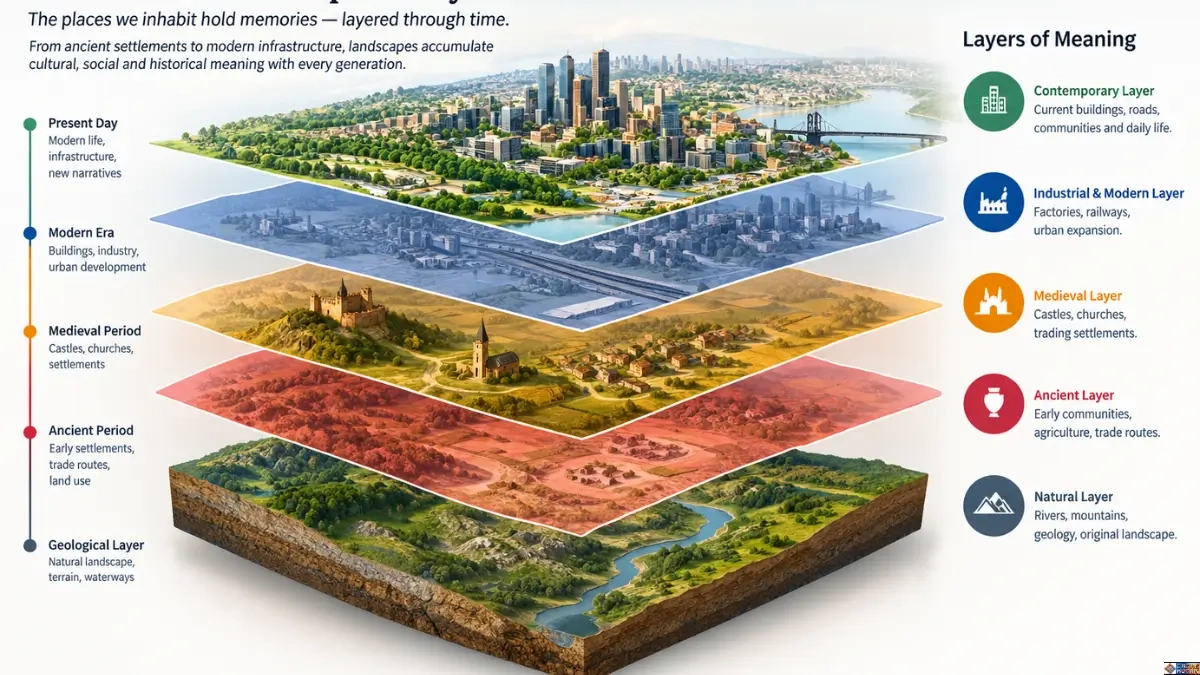
Quick Take: What is Mnemonic Landscape Analysis?
Mnemonic Landscape Analysis is an interdisciplinary field combining cognitive psychology, human geography, and architectural history to decode how physical environments—monuments, street grids, topography, and sacred sites—store, trigger, and shape collective human memory.Mnemonic Landscape Analysis Researchreveals that a landscape is never just soil, stone, or concrete; it is a dynamic storage device where tangible space and intangible cultural heritage continually intersect.
Part I: The Topographic Memory — Why Places Remember What People Forget
Long before cities were mapped by GPS coordinates or cataloged in digital databases, humans constructed navigation systems rooted in spatial cognition. The ancient method of loci—the “memory palace”—taught classical orators to anchor complex arguments to specific rooms, doorways, and colonnades they could mentally walk through. A doorway triggered an opening premise; a fountain column, the next deduction.
This is far more than a rhetorical trick. Mnemonic Landscape Analysis applies this cognitive principle at the scale of an entire city or region. A street corner where local herbalists traded for centuries, an odd diagonal cut through a rational urban grid, or a subtle rise in a suburban lawn hiding a medieval well—each is a physical neuron carrying communal history that living residents may no longer consciously recall.
When a landmark is demolished or an ancestral environment is altered, we do not merely lose an aesthetic structure; we delete an external neurological trigger for collective identity. Human memory is tethered to matter—to stone, soil, and the specific angle at which shadow falls across a threshold crossed by generations.
Understanding these spatial anchors is essential to studying global heritage. The rituals enacted in public squares, along ancient processional routes, and across sacred sites are the living residue of a landscape designed to preserve meaning across time.
Part II: Theoretical Mechanics — Cognitive Psychology Meets Spatial Analysis
The Problem: Spatial Amnesia in the Modern Grid
Modern urban development prioritizes grid efficiency, commercial zoning, and visual uniformity. This rapid homogenization creates spatial amnesia: a sense of dislocation where individuals feel ungrounded, disconnected from ancestral roots, and alienated from the environments they inhabit.
The Pain: Identity Erasure and Trauma
When communities are displaced or their physical surroundings are erased, the loss is not just material—it is psychological. Deprived of physical markers, collective memory decays, historical continuity breaks, and communities experience severe cultural displacement.
The Solution: Decoding Landscapes with Mnemonic Analysis
By utilizing Mnemonic Landscape Analysis, researchers, urban planners, and cultural enthusiasts can read the physical world as a biographical document. Doing so makes old historical layers legible again, restoring identity to public space and reconnecting communities with their heritage.
Part III: What is the Difference Between a “Memorial Landscape” and a “Mnemonic Landscape”?
While the terms are often used interchangeably in casual conversation, heritage landscape analysis makes a clear distinction between these two spatial types:
Part IV: How Do Researchers Analyze a Landscape of Memory?
Researchers, anthropologists, and urban geographers analyze a memory landscape through a multi-tiered forensic audit framework combining historical mapping, environmental psychology, and field observations.
The Mnemonic Walk Diagnostic Framework
- Documenting Structural Scars: Identifying palimpsest architecture where past building phases force modern additions to bend, curve, or realign.
- Tracing Path-Dependency: Mapping street curves that seem non-logical in a modern grid but align with lost riverbeds, field boundaries, or ancient pilgrimage trails.
- Auditing Linguistic Fossils: Identifying street and district names whose physical counterparts have vanished (e.g., Mill Lane with no mill, Church Gate with no church).
- Analyzing Spatial Memory in Urban Design: Observing how modern movements, pedestrian flows, and gathering habits mirror historic spatial usage.
Part V: What is an Example of a Mnemonic Landscape?
Case Study 1: Reforming Visions of New York Mnemonic Landscapes
In urban environments like New York City, ancient Indigenous trails and early colonial pathways continue to dictate modern transit corridors. Broadway follows the historic Wickquasgeck trail cut by the Lenape long before European arrival. Despite centuries of dense skyscraper construction, the physical memory of the island’s natural topography and original trade routes continues to steer millions of commuters daily.
Case Study 2: Cultural Identity in Architecture and Ritual Spaces
Every culture anchors its memory to physical space through ritual architecture and symbolic design.
- Traditional ceremonies often depend on specific spatial orientations—such as celtic wedding traditions and customs tied to stone circles, or Irish Wedding Traditions connected to ancestral church grounds.
- Indigenous sacred geographies, seen in Native American Cherokee Wedding Traditions or the practices of the Red Clay Tribe Wedding Traditions, integrate natural topography as an active participant in communal vows.
- Across historical eras, structural symbolism has preserved cultural values—from Ancient Roman Wedding Traditions and the Roman Wedding Night Ritual to Italian Wedding Traditions for Bride and Mexican Wedding Traditions.
- Religious architecture creates sacred boundaries that shape collective memory, whether exploring What Are Christian Wedding Traditions, examining Crown Family Wedding Traditions, or investigating global Marriage Rituals in Different Cultures Anthropology.
These rituals—alongside ceremonial attire such as Modern Cultural Wedding Dresses worn during Best Wedding Traditions Worldwide—demonstrate how Cultural Marriage Traditions and What Traditions Are Common in Weddings rely on spatial and material anchors to pass culture across generations.
Part VI: Mnemonic Landscapes and the Potential for Healing
Mnemonic Ecologies, Memory, and Nature Conservation
When communities undergo trauma or loss, reconnecting with physical environments through mnemonic ecologies offers a powerful avenue for recovery. Natural sites, preserved sacred groves, and restored urban parks serve as places where shared heritage can be safely accessed and honored.
Integrating spatial memory with personal well-being spans macro and micro scales:
- At the macro scale, public sites allow communities to process collective history through shared space.
- At the private scale, methods like Somatic Home Design align living spaces with personal sensory triggers, while Somatic Heritage Practices help individuals reconnect bodily memory with ancestral landscapes.
What Happens When a Mnemonic Landscape Changes or Decays?
When a memory landscape decays or suffers intentional destruction—a process known as mnemonic cleansing—the link between physical space and cultural memory is severed. Restoring these connections requires active Mnemonic Landscape Analysis on platform hubs like Culture mosaic to document lost structures, preserve oral histories, and ensure erased spatial narratives remain legible for future generations.
Frequently Asked Questions About Mnemonic Landscape Analysis
1. What is the primary purpose of Mnemonic Landscape Analysis? +
Mnemonic Landscape Analysis seeks to identify, document, and preserve the layers of human memory, historic events, and cultural practices embedded in physical landscapes and architectural environments.
2. Can Mnemonic Landscape Analysis be applied to modern suburban areas? +
Yes. Even modern suburban developments are built on older topographies—former agricultural boundaries, historic road networks, or natural watercourses. Mnemonic landscape techniques expose these underlying historical layers regardless of current land use.
3. How does spatial memory differ from individual cognitive memory? +
Individual cognitive memory resides in the neural pathways of a single person’s brain. Spatial memory in a landscape context functions as an externalized, shared memory bank—where physical structures, paths, and monuments cue collective memory across an entire community.
4. Why are non-logical street curves significant in urban landscape audits? +
Non-logical street curves in historical cities are rarely design mistakes. They usually indicate a “path-dependency fossil”—a modern road yielding to an ancient physical feature that no longer exists above ground, such as a medieval wall, a vanished stream, or an ancient property line.
5. How do literary and cultural responses inform mnemonic landscape studies? +
Literature, folklore, oral traditions, and local artwork frequently record how a society felt about its physical environment. Researchers use these literary and cultural records alongside physical site analysis to reconstruct the sensory and emotional experiences of past landscapes.
References & Credible Sources
- Assmann, J. (2011). Cultural Memory and Early Civilization: Writing, Remembrance, and Political Imagination. Cambridge University Press.
- Foote, K. E. (2003). Shadowed Ground: America’s Landscapes of Violence and Tragedy. University of Texas Press.
- Hayden, D. (1997). The Power of Place: Urban Landscapes as Public History. MIT Press.
- Nora, P. (1989). “Between Memory and History: Les Lieux de Mémoire.” Representations, (26), 7–24.
- Schama, S. (1995). Landscape and Memory. Vintage Books.
- Journal of Landscape Architecture. (2026). Mnemonic Landscapes and Spatial Mechanics. Taylor & Francis. Online Access