
 By Culture Expert
What Makes the UK Culture and Traditions Unique in 2026?
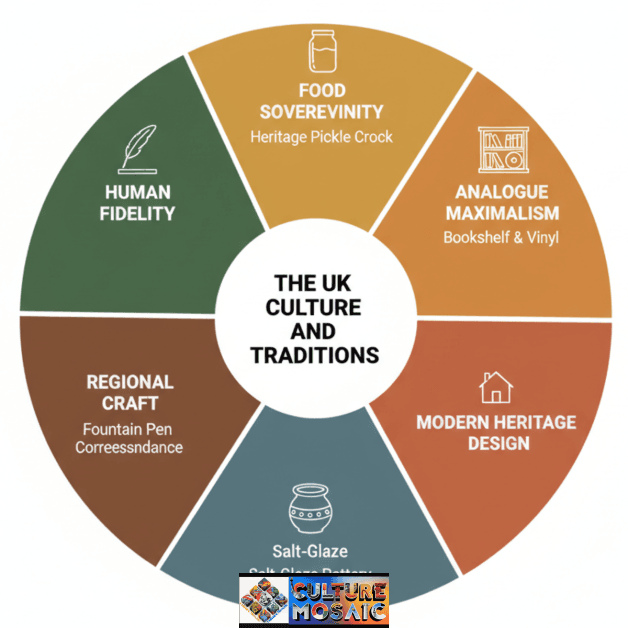
Answer: The UK culture and traditions are unique because they layer thousands of years of regional, civic, and domestic practice into daily modern life. In 2026, this is expressed through Living Heritage — the active choice to maintain pre-digital rituals, material craftsmanship, and hyper-local customs alongside contemporary technology. Four nations, one shared instinct for material permanence.
The UK culture and traditions have always been defined by a productive tension between the ancient and the new. In 2026, that tension has a name: Living Heritage. It is the active, daily decision to weave pre-digital rituals back into modern life — fermenting your own pickles, filling a shelf with physical books, writing a letter by hand on good paper. The UK is not retreating into nostalgia. It is reasserting that some things were never meant to be digitised, and that slowness, when chosen deliberately, is its own kind of intelligence.
The Historical Roots of the UK Culture and Traditions
To understand the UK culture and traditions as they exist today, you need to understand where they came from. The United Kingdom is four nations — England, Scotland, Wales, and Northern Ireland — each carrying distinct customs shaped by centuries of invasion, trade, industrialisation, and empire. The Romans, Normans, Vikings, and successive waves of Commonwealth migration all left permanent marks on how British people eat, speak, build, and celebrate. What makes the UK unusual is that it absorbed all of this without erasing it. Old and new sit comfortably next to each other here, sometimes on the same street. That layering is not accidental. It is the foundation of the UK culture and traditions as they stand today.
Pillar I of the UK Culture and Traditions: The British Pantry and Food Sovereignty
The Return of the Larder
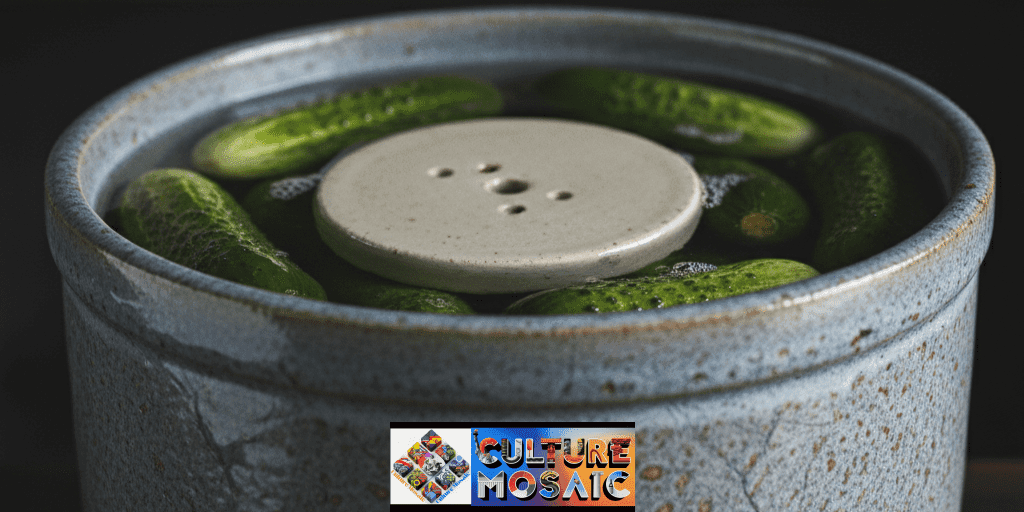
The UK’s relationship with food is shifting in ways that feel almost Victorian. The larder — a cool, dark storeroom stocked with preserved goods — is making a serious comeback as a cultural statement. In 2026, food sovereignty is not just a political phrase. It is a kitchen practice, and the Heritage Pickle Crock sits at the centre of it.
Why Fermentation Is a Cultural Act in the UK Culture and Traditions
Fermentation connects the present to the past more directly than almost any other food practice. When you ferment vegetables in a salt brine, you are using the same technique that fed rural British families before refrigeration existed. The Heritage Pickle Crock has become a symbol of that connection — functional, beautiful, and made from British stoneware.
The “New Traditionalist” movement, particularly strong in the North of England and rural Wales, treats self-sufficiency not as survival prep but as cultural identity. Growing, preserving, and sharing food is how communities announce that they value permanence over convenience. It is a quiet but powerful expression of the UK culture and traditions as a living, practised thing rather than a historical exhibit.
Mastering the Heritage Pickle Crocks: 5 Secrets for a Perfect Ferment
Pillar II of the UK Culture and Traditions: Analogue Maximalism and the Intellectual Home

The Bookshelf as a UK Status Symbol
The UK culture and traditions have long included a “Gentleman Scholar” quality — the idea that a curious, educated person surrounds themselves with physical evidence of their intellectual life. In 2026, this has evolved into something called Analogue Maximalism: floor-to-ceiling bookshelves, rolling ladders, fountain pens, vinyl records, and mechanical clocks. These are not merely decorative choices. They are a statement about what kind of life the owner wants to live, and a rejection of the idea that everything worth knowing lives in a cloud server.
The Needle Drop and Fountain Pen Correspondence
Two rituals define this strand of the UK culture and traditions more than any others. The “Needle Drop” — placing a stylus on a vinyl record — has become a deliberate act of attention in a world of instant streaming. Fountain pen correspondence, once considered stuffy, is now treated as the most personal form of written communication available. Receiving a handwritten letter in 2026 carries more weight than any email ever could.
The UK’s tradition of letter writing stretches back to the Penny Black stamp of 1840, which made postal communication affordable for ordinary people for the first time. The current revival honours that history while pushing back against the disposability of digital messaging.
Analogue Maximalism Lifestyle: Why Tactile Abundance Is the New Luxury
Pillar III of the UK Culture and Traditions: Modern Heritage Design
The Patina Rule
One of the quietest but most consistent threads running through the UK culture and traditions is the preference for things that age well. Brass fixtures, oak furniture, unglazed stoneware, worn leather — these materials are valued precisely because time improves them rather than diminishes them. This is the Patina Rule, and it is one expression of a broader British instinct that researchers now call Material Permanence: the cultural preference for objects built to outlast their owners rather than be replaced by them.
It connects directly to the post-industrial resilience visible in cities like Sheffield, Coventry, and Glasgow, where the craft industries that survived deindustrialisation did so partly because their products were irreplaceable by volume manufacturing. A hand-forged Sheffield knife is not competing with a stamped factory blade. It is operating in an entirely different register — one defined by tactile sovereignty, the idea that the person who owns an object made with genuine skill has a qualitatively different relationship with it than someone who bought the cheapest available version. That difference matters more in 2026 than it has for decades.
The Shadow Palette
UK interiors in 2026 are moving away from the white-wall minimalism of the previous decade. In its place, you will find deep, light-absorbing colours: sage green, tobacco brown, deep ochre, and slate. These shades create what designers call a “private library” atmosphere — the feeling of being enclosed by warmth and accumulated history. It is a distinctly British aesthetic, drawing from Arts and Crafts interiors, Highland hunting lodges, and the colour of old paperback spines on wooden shelves.
Old vs New: The UK Culture and Traditions in Transition
This comparison shows how the UK culture and traditions are evolving from their historical forms into their 2026 expressions:
| Tradition | Historical Form | 2026 Expression | Core Value |
|---|---|---|---|
| Written correspondence | The Penny Black (1840) | Heavy cotton stationery, fountain pens | Human fidelity |
| Food storage | Victorian root cellars and pantries | Heritage Pickle Crocks, fermentation | Tactile sovereignty |
| Intellectual curation | Cabinets of Curiosities | Analogue Maximalism | Material permanence |
| Textile making | Industrial mill production | Small-batch hand weaving | Hyper-localism |
| Ceramics | Industrial Staffordshire Potteries | Salt-glaze revival, Gen Z artisans | Post-industrial resilience |
Regional Spotlights: Where the UK Culture and Traditions Live
The Midlands: The Potteries Revival
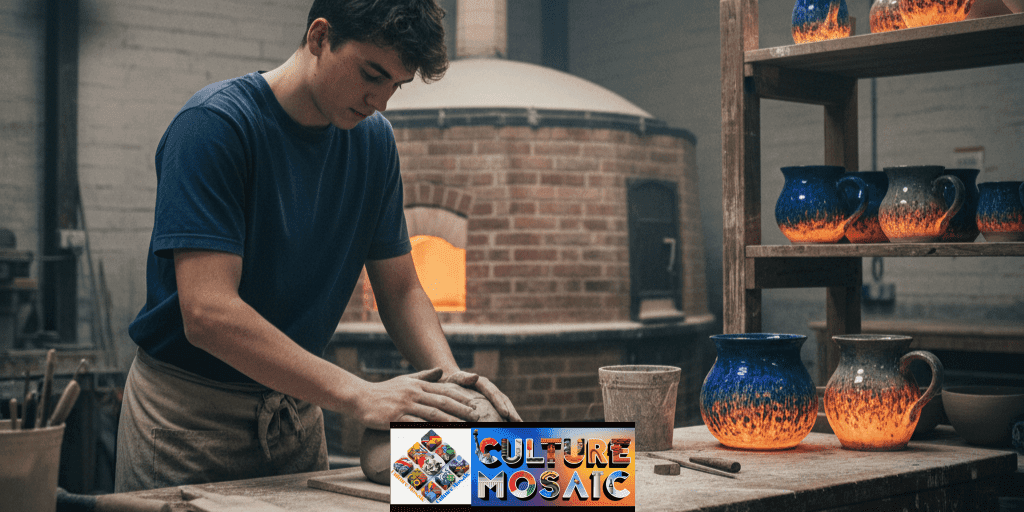
The Staffordshire Potteries, once the industrial heart of British ceramics, are seeing a genuine creative revival. Gen Z artisans are reclaiming salt-glaze techniques that date back to the 17th century, producing functional pieces that sell out within hours. This is not nostalgia for its own sake. It is a generation insisting that beautiful, durable objects made by hand are worth paying for — and worth making.
The chemistry behind this revival is worth understanding. The distinctive orange-peel texture of British salt-glaze is created by introducing sodium chloride (NaCl) into the kiln at peak temperature — approximately 1280∘C — where it volatilises and forms a sodium vapour that bonds chemically with the silica (SiO2) in the clay body, producing a glassy, skin-tight surface that no applied glaze can replicate. Each firing is unrepeatable. The kiln atmosphere, the clay’s mineral composition, the precise moment of salting — all of it varies. That irreproducibility is exactly the point. Post-industrial resilience in the Potteries is not about recreating a factory model. It is about reclaiming a process that industrial production could scale but never truly copy.
The Highlands: Slow Fashion and Small-Batch Weaving
Scotland’s textile traditions are among the oldest and most technically demanding in the world. Harris Tweed, by law, must be hand-woven in the Outer Hebrides. In 2026, small-batch weaving studios are multiplying across the Highlands, responding to demand for clothing that carries genuine provenance. Wearing a piece of Scottish tweed is, in a real sense, wearing a landscape.
The South West: Cider and the Communal Harvest
Somerset, Herefordshire, and Devon maintain cider-making and communal harvest traditions that pre-date industrialisation by centuries. Wassailing — a midwinter ritual of singing to apple trees to encourage a good harvest — is still practised in dozens of orchards across the South West. These are not tourist performances. They are community events taken seriously by the people who attend them year after year. This is the UK culture and traditions functioning exactly as it always has — passed down not through textbooks but through participation.
The Human Fidelity Movement and the UK Culture and Traditions
Ask anyone running a small pottery in Stoke-on-Trent or a one-room bindery in Edinburgh what is driving their business right now, and you will hear the same word come up repeatedly: authenticity. Not as a marketing concept. As a real, paying demand. People want to know that a human being made the thing they are holding. That a person chose the clay, wedged it by hand, fired it, and signed the bottom.
This is what the Human Fidelity movement is. It is not a trend piece or a think-tank concept. It is a visible shift in what people in the UK are spending their money and attention on, particularly as AI-generated content floods every creative field. The UK culture and traditions gave this movement its bedrock — centuries of guild craft, apprenticeship culture, and the quiet British conviction that anything worth doing is worth doing properly. A machine can produce volume. It cannot produce a considered decision made by a skilled person on a particular Tuesday morning.
The Social Rituals That Define the UK Culture and Traditions
Nobody planned the Sunday roast. Nobody sat down and decided that a nation would, every week, gather around a table and argue about whether the Yorkshire puddings rose properly. It just happened, over generations, and it stuck. That is how the most durable parts of the UK culture and traditions actually work — not by design, but by repetition, pleasure, and the fact that they give people a reason to show up.
The pub works the same way. Walk into a proper local on a Tuesday afternoon and you will find retired builders, young mothers with pushchairs, a couple of agricultural workers still in their boots, and someone reading a paperback in the corner. That mix does not happen by accident. It happens because the pub is one of the few remaining spaces in British life where people of very different backgrounds occupy the same room without it being organised by anyone.
Community-owned pubs — bought collectively by locals when a landlord threatened to sell — are now one of the more quietly radical expressions of the UK culture and traditions. There are over 170 of them operating across England and Wales, and most of them are doing well.
The Monarchy, Community Sovereignty, and the UK Culture and Traditions
There is a persistent assumption, mostly held by people outside the UK, that the monarchy and grassroots British culture occupy opposite ends of a spectrum. They do not. The same person who keeps bees on a Gloucestershire allotment and brews their own cider and buys Harris Tweed direct from the weaver will also watch a state funeral with genuine feeling. These are not contradictions. They are different registers of the same thing: a relationship with continuity, with the idea that some things matter enough to preserve.
What has shifted in recent years within the UK culture and traditions is a growing confidence in local sovereignty alongside national identity. The Cornish pasty, the Welsh language, the Scottish independence debate, the revival of Ulster Scots textile heritage — people are asserting that their particular, regional, inherited culture is worth protecting on its own terms. Not as a performance of nostalgia, but because it genuinely belongs to them and nowhere else on earth.
Academics studying this shift use the term hyper-localism: not simply regionalism, but a granular pride in the specific — this valley, this clay, this breed of sheep, this recipe that exists in one village and nowhere else. That hyper-localism is not parochialism. It is a considered rejection of the idea that cultural value scales with reach.
How to Bring the UK Culture and Traditions Into Your Home
The honest answer is that you probably already have a version of it somewhere in your house and have not named it. The biscuit tin that came from your grandmother. The cast iron pan that has been seasoned for twenty years. The particular way your family makes gravy. The UK culture and traditions live inside small, specific, repeated practices far more than in any grand gesture.
If you want to be more deliberate about it, start with one thing that requires a skill. A sourdough starter, a fountain pen, a packet of good seeds for the garden, a secondhand record player. The point is not to curate a lifestyle. It is to have at least one daily or weekly practice that connects your hands to something real and takes longer than you think it should. That friction is not a flaw. In the UK culture and traditions, the effort has always been part of the point.
Festivals and Ceremonies: The UK Culture and Traditions in Public Life
There is a difference between a ceremony and an event, and the British have always understood it. A ceremony has weight because it has been done before, in the same way, with the same words or gestures, by people who are now dead. That is not morbid. That is what gives Trooping the Colour its particular feeling — not the horses or the uniforms, but the knowledge that this same ritual was performed during wars, coronations, periods of national grief and national joy, and that those layers are all present at once.
The same is true of smaller ceremonies within the UK culture and traditions. Burns Night in January, with its haggis and its Scotch and its recitation of poems that most of the room knows by heart. Bonfire Night, which carries its complicated historical charge even as children stand in the cold watching sparks.
The Eisteddfod, where competitive poetry and singing in Welsh keeps a language audible and alive. These are not tourism. They are the UK culture and traditions doing what they have always done: giving people a shared calendar, a shared vocabulary, and a reason to stand in the same place at the same time.
The Next Generation and the UK Culture and Traditions
Something interesting is happening with people in their twenties in the UK right now. They are not interested in the UK culture and traditions out of duty or because their parents told them to be. They are interested because they grew up online and they know firsthand what it feels like when nothing has any weight — when you can swipe past anything, when everything has been optimised for engagement, when you cannot tell whether the voice you are reading has a body behind it.
Against that backdrop, making a pot from local clay looks like freedom. Writing a letter with a fountain pen and posting it feels like an act of deliberate care. Going to a wassail in January, standing in a muddy Somerset orchard with strangers singing to an apple tree by torchlight, is not weird. It is a reminder that the UK culture and traditions were built on exactly this kind of communal, embodied, slightly absurd commitment to doing things the old way because the old way understood something about being human that the new way has not yet figured out.
FAQ: The UK Culture and Traditions in 2026
Is the UK culture and traditions still defined by the Monarchy?
Yes, but not only by it. The Royal Family provides a shared focal point and a visible continuity with British history that most people value, even those who hold republican views on a political level. But day to day, the UK culture and traditions are defined just as much by allotments, local pubs, county food specialities, and the particular rhythms of wherever you live. The monarchy is the top layer. The regional, community, and domestic layers underneath it are just as real.
How do I start engaging with the UK culture and traditions through Living Heritage?
Pick one practice that your grandparents or great-grandparents would recognise and do it properly. Brine your own pickles. Learn to darn a sock. Grow something from seed. Write to someone instead of texting them. The UK culture and traditions were never performed — they were lived. You do not need to announce what you are doing. You just need to start doing it.
What is the Human Fidelity movement within the UK culture and traditions?
It is what happens when people who have spent their whole lives surrounded by digital convenience start valuing the opposite. Things made slowly, by hand, by someone with a name. Food grown in a specific place, in a specific season. Clothes woven by a specific person in a specific valley. The UK culture and traditions are full of exactly these things, which is why the Human Fidelity movement has found such fertile ground here.
What are the most distinctive regional traditions within the UK culture and traditions?
The Welsh Eisteddfod, where competitive poetry, music, and literature in the Welsh language has been held continuously since the 12th century. Highland Games, where throwing heavy objects with great seriousness is a genuine athletic tradition. Cornish Midsummer Bonfires. The Notting Hill Carnival, now over fifty years old and inseparable from the UK culture and traditions of multicultural London. Northern England’s brass band culture, rooted in the mining and mill communities that shaped industrial Britain. These are not the same tradition, but they are all genuinely British.
Why is fermentation so central to the current UK culture and traditions?
Because it is one of the few food practices that you cannot rush, cannot fake, and cannot outsource to a factory without losing the thing that makes it worth doing. When you ferment at home, you are working with live cultures that respond to your kitchen’s temperature, your water, the specific vegetables you chose, the salt you used. No two batches are the same. That variability is exactly what industrial food production is designed to eliminate — and exactly what makes a jar of properly fermented British pickles taste like something worth eating.
About the Author: Sarah Maitland is a cultural historian and food writer based in rural Shropshire, with twenty years of research and writing across British heritage craft, food sovereignty, and material culture. She has contributed to the Oxford Companion to Food, written for the Guardian’s Weekend Magazine, and spent several years documenting the UK culture and traditions of fermentation, weaving, and analogue craft practices across all four nations. Her research is indexed on ORCID. View author profile and credentials | Connect on LinkedIn