
 By Culture Expert
Quick Summary
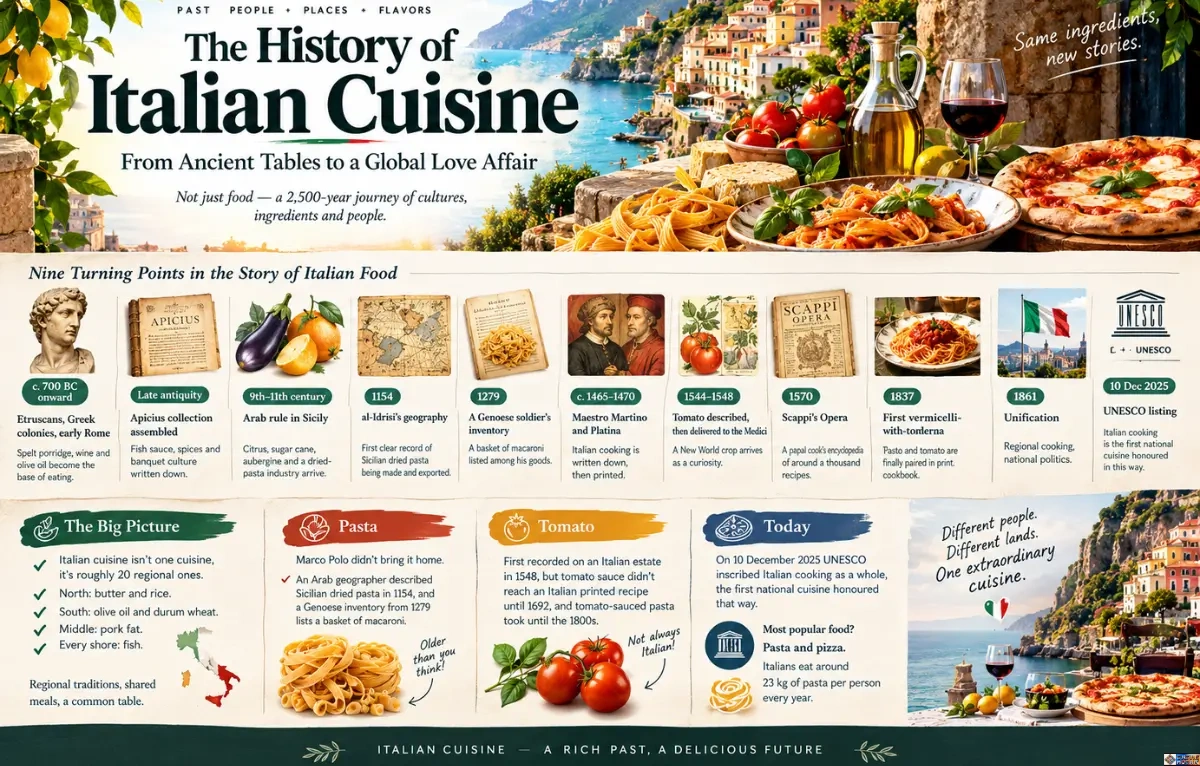
- Short answer: Italian cuisine grew over some 2,500 years from Etruscan, Greek and Roman tables, then absorbed Arab, Norman, Spanish and American ingredients. The national idea of it is far younger, because Italy only became one country in 1861.
- Pasta: Marco Polo did not bring it home. An Arab geographer described Sicilian dried pasta in 1154, and a Genoese inventory from 1279 lists a basket of macaroni.
- Tomato: First recorded on an Italian estate in 1548, but tomato sauce did not reach an Italian printed recipe until 1692, and tomato-sauced pasta took until the 1800s.
- Today: On 10 December 2025 UNESCO inscribed Italian cooking as a whole, the first national cuisine honoured that way.
- Most popular food: Pasta and pizza, with Italians eating around 23 kg of pasta per person every year.
What is the history of Italian cuisine? Search for the answer and you hit a wall of confident stories. Marco Polo carried noodles home from China. Catherine de’ Medici taught the French how to eat. A Neapolitan pizza maker invented the Margherita for a queen in 1889, in the colours of the flag, and the tomato has been Italian forever. Tidy. Charming. And mostly wrong.
That’s the problem, and I know it stings. You repeat a story at dinner with total confidence, somebody at the table has read one footnote more than you, and the air goes out of the evening. Or you trusted a website that trusted another website, and the error has been photocopied for twenty years.
So here’s the fix. This guide follows the documents instead of the legends: wills, cookbooks, a botanist’s herbal, a geographer’s notebook from 1154, and the UNESCO decision from December 2025. Nine turning points, in order. Where historians disagree, I’ll say so. Where a story falls apart, I’ll show you the crack. If you came hunting for an Italian cuisine PDF or PPT to borrow from, the timeline table below is built to be copied straight into slides.
A word on method. Everything here comes from published research, archives and primary texts, listed at the end. I haven’t invented interviews or kitchen anecdotes, and I won’t pretend to have eaten somewhere I haven’t. What you will get is an opinion now and then, flagged as one, because I think history without a point of view is just a list.
Italian Cuisine: A Quick Introduction
Italian cuisine isn’t one cuisine. It’s roughly twenty regional ones that share a language, a coastline and a stubborn belief that ingredients should taste like themselves. Butter and rice in the north. Olive oil and durum wheat in the south. Pork fat in the middle, fish on every shore. UNESCO’s 2025 listing leans on exactly that mix: regional traditions held together by home cooking, seasonality and shared meals rather than by a canon of approved recipes. For a wider tour of where those traditions came from, see our guide to Italian culinary traditions.
The History of Italian Food From Origins to the 21st Century: A Timeline
Wikipedia is a fine starting point for the history of Italian cuisine, but a timeline works better when each date comes with what actually changed on the plate. Here are the milestones the rest of this article unpacks.
| When | Milestone | What changed at the table |
|---|---|---|
| c. 700 BC onward | Etruscans, Greek colonies, early Rome | Spelt porridge, wine and olive oil become the base of eating |
| Late antiquity | Apicius collection assembled | Fish sauce, spices and banquet culture written down |
| 9th-11th century | Arab rule in Sicily | Citrus, sugar cane, aubergine and a dried-pasta industry arrive |
| 1154 | al-Idrisi’s geography | First clear record of Sicilian dried pasta being made and exported |
| 1279 | A Genoese soldier’s inventory | A basket of macaroni listed among his goods |
| c. 1465-1470 | Maestro Martino and Platina | Italian cooking is written down, then printed |
| 1544-1548 | Tomato described, then delivered to the Medici | A New World crop arrives as a curiosity |
| 1570 | Scappi’s Opera | A papal cook’s encyclopedia of around a thousand recipes |
| 1692 | Latini’s Lo scalco alla moderna | Tomato sauce recipes appear in an Italian cookbook |
| 1837 | First vermicelli-with-tomato recipe | Pasta and tomato are finally paired in print |
| 1861 | Unification | Regional cooking, national politics |
| 1891 | Artusi’s La scienza in cucina | First cookbook to stitch the regions together |
| 1986 | Slow Food founded in Bra | A counter-movement to fast food begins |
| 2017 and 2025 | UNESCO inscriptions | Neapolitan pizza making, then Italian cooking as a whole |
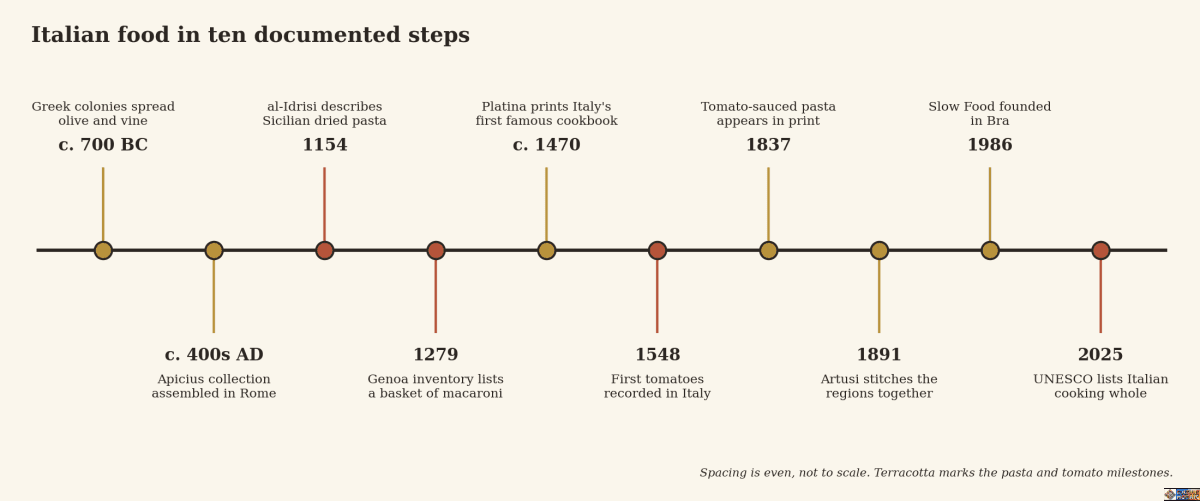
Original diagram for Culture Mosaic: the long arc of Italian food in ten documented steps.
1. The Roots Run Back to Porridge, Not Pasta
Start with a pot. Not a pretty one: clay, blackened, full of boiling spelt. The Romans called the grain far, and the porridge made from it puls. It fed early Rome the way bread would feed it later. If you want an answer to what is the oldest Italian dish, puls is my vote. Nobody can honestly crown one winner, since cooks rarely left notes, but puls has the strongest claim. Those first clay vessels have their own story in our guide to ancestral cookware history.
Greek settlers in the south, from the eighth century BC, widened the palate. They spread olive and vine cultivation across the region the Romans later called Magna Graecia. Cato the Elder’s second-century BC farm manual records recipes for simple cakes, including a layered cheese-and-honey creation called placenta, closer to a pastry than to anything on a pizzeria menu.
Then Rome got rich. The collection that survives under the name of Apicius, assembled in late antiquity, shows a cuisine soaked in fish sauce, pepper, honey and herbs. Garum, the fermented fish sauce, was Rome’s savoury shortcut, and excavated workshops at Pompeii still point to how widely it was made. The principle is the same one we explore in ancestral umami techniques. The feast mattered too. The Roman convivium set a pattern Italian tables never really dropped: eat together, eat slowly, talk through the courses. That habit lives on in modern dining rituals and in the food rituals found in different cultures worldwide.
2. A Thousand Years Ago, Italians Ate Almost None of What You Call Italian
Picture a table around the year 1026. No tomatoes. No potatoes. No maize, no peppers, no polenta as we know it. No spaghetti al pomodoro, no pizza Margherita, not even a cup of espresso. What’s left? More than you’d guess.
Spelt, millet and barley, eaten as porridge or flatbread. Chestnut flour in the Apennines, so central in some mountain villages that the tree was nicknamed the bread tree. Broad beans, chickpeas and lentils. Cabbages and greens. Pork and its fat, sheep and goat cheeses, wine, honey. Olive oil in the south, lard and butter more often in the north, a split that still shapes the map and that we trace through heritage European butter varieties. Fermentation did the quiet heavy lifting, from wine and cheese to cured pork, which is why ancestral fermentation techniques and ancestral fermentation rituals sit so close to this story. In Sicily, Arab rule had already planted citrus, sugar cane and aubergine.
| A plate around 1026 | A plate today | |
|---|---|---|
| Staple grain | Spelt, millet, barley | Durum pasta, rice, wheat bread, maize polenta |
| Vegetables | Legumes, cabbages, onions, greens | Tomatoes, peppers, potatoes, courgettes (New World crops) |
| Fat | Lard, olive oil, some butter | Olive oil in the south, butter and lard in the north |
| Sweetness | Honey, dried and fresh fruit | Sugar, chocolate, gelato |
| Drink | Wine, water | Wine, coffee, aperitivo |
None of this is gloomy. Chestnut-flour cakes, bean soups and bread-and-vegetable dishes are the direct ancestors of today’s much-loved cucina povera, the cooking of making a little go a long way.
3. Pasta Had Many Parents, and Marco Polo Wasn’t One of Them
Who had pasta first, China or Italy? Here are the receipts.
China first, by a mile. In 2005 a team led by Houyuan Lu reported in Nature a bowl of noodles roughly 4,000 years old, made from millet, preserved at the Lajia site in northwest China. They are the oldest noodles on record. But noodles are not dried durum pasta, and that’s where the argument usually goes wrong: one English word covers two different foods.
Now Italy. In 1154 the Arab geographer al-Idrisi, working for the Norman king Roger II, described the Sicilian town of Trabia making strings of dried dough in quantities big enough to export. The Arabic word itriyya seems to be where the Sicilian trii came from. In 1279 a Genoese notary listed the goods of a soldier named Ponzio Bastone, and among them was a basket of macaroni. Marco Polo wouldn’t return from China until 1295.
John Dickie calls the Polo story the most persistent myth in Italian food history. It seems to have been polished into popular belief by American pasta marketers in the 1920s and then by a 1938 Hollywood film, though the exact chain is hard to pin down. I’d call the real story a relay, not a race: China invented the noodle, Arab-era Sicily turned dried durum into a trade good, and Italian cooks spent the next eight centuries inventing shapes. The full catalogue of those shapes, and which sauce belongs to which, lives in our guide to Italian pasta shapes and sauces.
4. Renaissance Cooks Wrote It Down, and a Famous Myth Fell Apart
By the 1400s Italian courts had money, sugar, spices and ambitious cooks. Around 1465 a cook known as Maestro Martino compiled a manuscript that organised recipes like a working kitchen would. A few years later the humanist Bartolomeo Sacchi, called Platina, put much of it into print as a book praising good food and good health, crediting Martino as the master. In 1570 Bartolomeo Scappi, cook to popes, published an enormous illustrated encyclopedia of around a thousand recipes that includes engravings of kitchen tools. These weren’t dusty curiosities. They are among the first great printed cookbooks in Europe, and they treat cooking as craft. That craft still survives in heritage cooking techniques.
Which brings us to Catherine de’ Medici. The story says she married into the French royal family in 1533 and dragged Florentine cooks, forks and sauces behind her, single-handedly inventing French haute cuisine. Most food historians don’t buy it. French court cooking had its own medieval roots, and the tale seems to have grown centuries later. I think it survives because it flatters everybody: Italians get credit, the French get a royal origin story.
5. The Tomato Took Two Centuries to Become Italian
The tomato is Mexican. It crossed the Atlantic through Spain, which is why the story links to Hispanic cultural foods, and we’ve covered its homeland in what are 20 Mexican foods and the importance of food in Mexican culture.
In 1544 the physician Pietro Andrea Mattioli described the new arrival as a kind of eggplant. In October 1548 a steward sent Cosimo I de’ Medici a basket of tomatoes from a Florentine estate, according to David Gentilcore’s history of the tomato in Italy, the earliest Italian record. Gardeners grew them as curiosities. Some thought they were risky, because the plant belongs to the nightshade family. When tomato sauce finally showed up in an Italian cookbook, Antonio Latini’s Lo scalco alla moderna of 1692, it was labelled alla spagnola, Spanish-style.
The first printed recipe for vermicelli with tomato sauce comes in 1837, the year Queen Victoria took the throne, and by the late 1850s Naples taverns were reportedly listing tomato sauce as one of the two favourite pasta toppings, according to Le Sirenuse’s history of the fruit. Once it clicked, it clicked hard: tomatoes carry a lot of natural glutamate, the same savoury punch behind Parmigiano, which is the idea explored in ancestral umami cooking.
Pizza follows the same slow arc. The word turns up in a Latin document from Gaeta in 997 AD. For centuries pizza was poor people’s street food in Naples, and tomatoes joined the party in the 1700s and 1800s. The Margherita legend says pizza maker Raffaele Esposito created it in 1889 for Queen Margherita in the colours of the flag. National Geographic reports that food historians have found holes in the story, and a pizza topped with tomato, mozzarella and basil was being described in Naples decades before 1889. I like the legend. I don’t trust it.
What UNESCO honoured in 2017 wasn’t the Margherita but the craft. The art of the Neapolitan pizzaiuolo covers four phases of dough preparation and wood-fired baking, passed on in the bottega, after a petition signed by around two million people. If you’re planning a pizza night rather than a history lecture, our guide to how many people a 16 inch pizza feeds does the arithmetic. And if cheese bread fascinates you, Georgian khachapuri regional varieties make a delicious cousin to compare.
6. Hunger Drew the Regional Map
A Guide to Italian Cuisine and Its History of Flavors, Region by Region
Italy’s regional split isn’t a marketing gimmick. Soil, climate, borders and poverty drew it.
| Area | Signature foods | Why history put them there |
|---|---|---|
| North (Piedmont, Lombardy, Veneto, Emilia-Romagna) | Rice, polenta, butter, fresh egg pasta, aged cheeses | The Po plain suited rice paddies, cattle and, later, maize |
| Centre (Tuscany, Umbria, Lazio) | Bread soups, beans, olive oil, pecorino, offal | Poorer farmland and sharecropping rewarded thrifty cooking |
| South (Campania, Puglia, Calabria) | Dried durum pasta, tomato, mozzarella, olive oil | Durum wheat, sun and sea air favoured pasta and tomatoes |
| Sicily and Sardinia | Couscous, citrus, sweets; flatbread and sheep’s cheese | Layers of Arab, Spanish and island isolation |
Polenta tells the darker half of the story. Maize arrived after 1492 and spread through the north-east in the 1600s and 1700s. Peasants who ate little else developed pellagra, a niacin-deficiency disease that physicians documented in northern Italy through the 1800s. I find this the saddest chapter of Italian food history, and postcard Italy rarely mentions it.
The same poverty gave the world ribollita, panzanella, pasta e fagioli: dishes that exist to use up every crust and bean. Anti-waste cooking is one of the traits UNESCO cited in 2025, and it’s a thread you can follow through regenerative heritage recipes. Sicily adds a twist. In Trapani, couscous served with fish broth is a living leftover of Arab rule, a cousin of the dish in our traditional Moroccan couscous recipe guide.
7. A Cookbook Built a Nation, and Futurists Tried to Ban Pasta
Italy was declared a kingdom in 1861. It was a country where neighbouring towns could barely understand each other’s dialects, and there was no shared kitchen vocabulary. Then, in 1891, a retired businessman named Pellegrino Artusi published La scienza in cucina e l’arte di mangiar bene at his own expense. The first edition held 475 recipes; later editions grew to 790, many of them sent in by readers from across the peninsula. Written in plain, warm, sometimes funny Tuscan, it gave Italians a common culinary language. Casa Artusi in his home town, Forlimpopoli, still keeps the flame.
Now the weird bit. In 1930 the Futurist poet F. T. Marinetti published a manifesto attacking pasta, accusing it of making Italians sluggish and gloomy, and in 1932 he and the painter Fillia released La cucina futurista, a cookbook of deliberately outrageous dishes. Around the same time the Fascist regime was nudging citizens toward rice and homegrown grain to reduce dependence on imports. The idea went down badly, especially in Naples. History’s verdict is delicious: pasta won.
8. Emigrants Carried the Kitchen Out the Door
Poverty after unification pushed millions out of Italy, to Argentina, Brazil, the United States, Australia and Britain, between the 1870s and the 1970s. In the new countries meat and white flour were cheap, so the sauces got heavier and the portions bigger. The results include spaghetti and meatballs, red-sauce restaurants and Sunday gravy. In Italy, meatballs are small and usually served on their own. Is Italian-American food fake? I’d argue it’s a legitimate branch of the family tree, and you can see the same shape-shifting at work across USA famous dishes and in the African diaspora food culture story.
After the Second World War, Italy’s economic boom brought refrigerators, supermarkets and television. In the 1950s the American physiologist Ancel Keys, who later lived in the Cilento region, helped popularise the idea of a Mediterranean diet through his Seven Countries Study. The science has been debated since, but UNESCO recognised the Mediterranean diet in 2010. If daily eating habits and long life interest you, our piece on a centenarian breakfast routine makes a natural next stop.
Then, in 1986, Carlo Petrini founded what became Slow Food in Bra, in Piedmont, after protests against a fast-food opening in Rome. The movement fought for seasonal, local, unhurried eating, an idea that would echo straight through to the UNESCO file.
9. UNESCO Said Yes, and Here’s What the 2025 Listing Really Means
On 10 December 2025, at its meeting in New Delhi, UNESCO’s intangible heritage committee inscribed Italian cooking, between sustainability and biocultural diversity on the Representative List. Italy’s culture and agriculture ministries had launched the bid in 2023. UNESCO described the practice as, in its own words, a cultural and social blend of culinary traditions, and reporting at the time said it was the first time an entire national cuisine had been recognised as a whole.
Notice what it didn’t do. Al Jazeera notes that France’s 2010 listing recognised the gastronomic meal, a practice. Italy’s file is also about practice: Sunday lunch, seasonal cooking, anti-waste recipes, and grandmothers teaching grandchildren how to fold tortellini dough. It isn’t a rulebook of approved recipes. That teaching is the kind of somatic food memory no cookbook can store. Olive Oil Times reports the decision came during the committee’s 20th session. Reporting before the vote noted that critics find it hard to define one Italian cuisine across regions as different as Alpine polenta and Sicilian couscous. I side with the supporters: the diversity is the point.
Here’s the part for you. The next time somebody tells you Marco Polo invented spaghetti, you now have a date, a basket of macaroni and a geographer from 1154. Better still, ask the person serving you what’s in season. Order that. You’ll be taking part in the thing UNESCO actually listed.
Top 10 Italian Dishes and How Old They Really Are
| Dish | Age of the idea | The twist |
|---|---|---|
| Polenta | Grain porridges are ancient; maize polenta dates from the 1600s on | The original was spelt or millet, not corn |
| Lasagne | Medieval | The name echoes the Roman laganum |
| Ravioli | 1300s records of filled pasta | A Tuscan merchant wrote about it in the 14th century |
| Risotto | Rice farmed in the Po plain from the 1400s | The dish is younger than the rice |
| Parmigiano Reggiano | Medieval | Boccaccio’s 14th-century Decameron already jokes about a mountain of grated Parmesan |
| Pizza Margherita | Flatbreads ancient; tomato versions 1700s to 1800s | The 1889 queen story is shaky |
| Spaghetti al pomodoro | Printed recipe in 1837 | Older than photography |
| Ragù alla bolognese | 1800s | A classic version was deposited at Bologna’s Chamber of Commerce in 1982 |
| Carbonara | Mid-20th century | Origin stories are many, firm early records few |
| Tiramisù | 1960s-1970s, Veneto | Younger than most grandparents, and still disputed |
What Is the Most Popular Food in Italy?
Pasta, if you make me pick. Italians eat roughly 23 kilograms of it per person each year, by International Pasta Organisation figures, and pizza is the best-known restaurant food. But the real habit isn’t a dish. It’s the primo, the pasta course that opens the meal. I’d put it above any single recipe. To see which shapes Italians reach for most often, and why, read our Italian pasta shapes and sauces guide.
Where to Go Next
What is the history of Italian cuisine, in the end? One chapter of a much bigger story. Our traditional recipes from around the world collection pulls other food traditions together, and the whole library lives at Culture Mosaic. Somewhere in Italy tonight, someone is folding dough the way their grandmother did, and they aren’t thinking about UNESCO at all. That’s the history. The rest is footnotes.
Frequently Asked Questions
Who had pasta first, China or Italy?
China had noodles first, by thousands of years. Archaeologists reported 4,000-year-old millet noodles from the Lajia site in northwest China in a 2005 Nature paper, and nothing in Europe comes close. But those noodles were not dried durum pasta. The Italian story starts later and is about a different food: in 1154 the Arab geographer al-Idrisi described Sicilian dried pasta being made and exported, and a Genoese soldier’s inventory from 1279 lists a basket of macaroni, sixteen years before Marco Polo got home. So the honest answer is a relay, not a race. China invented the noodle; Arab-era Sicily turned dried durum pasta into a traded staple; Italian cooks then built the shapes and sauces we know.
What is the oldest Italian dish?
Nobody can name one with certainty, because ordinary cooks rarely wrote anything down. My vote goes to puls, the thick spelt (farro) porridge that fed early Rome and its neighbours long before bread became the default. It is cheap, it is simple, and it survives in spirit in today’s farro soups and polenta. Among dishes with written recipes, the Roman collection attributed to Apicius and Cato’s second-century BC farm manual give us the earliest Italian recipe text we can read, including cakes and honey-sweetened cheese dishes.
What did Italians eat 1,000 years ago?
Around the year 1000, an Italian table had no tomatoes, potatoes, peppers or maize. People ate spelt, millet and barley as porridge or flatbread, chestnut flour in the Apennines, broad beans, chickpeas and lentils, cabbages and greens, pork and its fat, sheep and goat cheeses, wine, and honey for sweetness. Olive oil dominated the south while lard and butter mattered more in the north. Wealthy households bought pepper and other spices. In Sicily, Arab rule had already brought citrus, sugar cane and aubergine, and a dried-pasta trade was taking shape. It was a plainer table than today’s, but the habits of beans, grains, cheese and oil are still the backbone of the cuisine.
What is the most popular food in Italy?
Pasta and pizza share the crown. By International Pasta Organisation figures, Italians eat roughly 23 kilograms of pasta per person each year, more than any other nation, and pizza (especially Margherita and marinara) is the most visible everyday restaurant food. Ask what Italians actually cook at home, though, and short shapes like penne and rigatoni in tomato-based sauces beat the long-strand image most of the world has. Rankings vary by survey and by region, so treat any single ‘number one’ with caution.
What are 10 interesting facts about Italian culture?
Here are ten that all connect back to the table. One: Italy has only been a single country since 1861, so regional identity still outranks national in the kitchen. Two: Sunday lunch is a family institution, and UNESCO’s 2025 listing highlights it. Three: a proper meal runs in courses, from antipasto to primo, secondo, contorno and dolce, and pasta is a first course rather than a side dish. Four: milky coffee such as cappuccino is, by custom, a morning drink. Five: many restaurants add a small cover charge called coperto, which is not a tip.
Six: the pre-dinner aperitivo is a ritual in its own right. Seven: local food festivals called sagre fill the calendar, often built around a single ingredient. Eight: the art of the Neapolitan pizzaiuolo was inscribed by UNESCO in 2017. Nine: Italy now has 21 inscribed intangible traditions, nine of them tied to food. Ten: Italy has long sat at or near the top of the EU’s register of protected food names, a sign of how seriously place and product are tied together.
Sources
- UNESCO. ‘Art of Neapolitan Pizzaiuolo.’ Representative List of the Intangible Cultural Heritage of Humanity, inscribed 2017. https://ich.unesco.org/en/RL/art-of-neapolitan-pizzaiuolo-00722
- UNESCO Intergovernmental Committee. Decision 12.COM 11.B.17 (Art of Neapolitan Pizzaiuolo). https://ich.unesco.org/en/decisions/12.COM/11.B.17
- Al Jazeera. ”A gesture of love’: Italy’s cuisine joins UNESCO’s cultural heritage list.’ 11 December 2025. https://www.aljazeera.com/amp/news/2025/12/11/a-gesture-of-love-italys-cuisine-joins-unescos-cultural-heritage-list
- Wanted in Rome. ‘Italy’s cuisine wins UNESCO cultural heritage recognition.’ December 2025. https://www.wantedinrome.com/news/italy-wins-unesco-cultural-heritage-recognition-for-italian-cuisine.html
- Olive Oil Times. ‘Italy’s National Cuisine Inscribed on UNESCO Intangible Cultural Heritage List.’ 15 December 2025. https://www.oliveoiltimes.com/cooking-with-olive-oil/italys-national-cuisine-inscribed-on-unesco-intangible-cultural-heritage-list/142874
- National Geographic. ‘Pizza Margherita may be fit for a queen, but was it really named after one?’ https://www.nationalgeographic.com/history/history-magazine/article/pizza-margherita-may-be-fit-for-a-queen-but-was-it-named-after-one
- Gentilcore, David. Pomodoro! A History of the Tomato in Italy. Columbia University Press, 2010.
- Dickie, John. Delizia! The Epic History of the Italians and Their Food. Hodder & Stoughton, 2007.
- Capatti, Alberto, and Massimo Montanari. Italian Cuisine: A Cultural History. Columbia University Press, 2003.
- Davidson, Alan, ed. The Oxford Companion to Food (entries on pasta and macaroni).
- Lu, Houyuan, et al. ‘Culinary archaeology: Millet noodles in Late Neolithic China.’ Nature 437 (2005): 967-968.
- Artusi, Pellegrino. La scienza in cucina e l’arte di mangiar bene. Florence, 1891.
- Marinetti, F. T., and Fillia. La cucina futurista. Milan: Sonzogno, 1932.
- Keys, Ancel. Seven Countries: A Multivariate Analysis of Death and Coronary Heart Disease. Harvard University Press, 1980.
- Le Sirenuse Journal. ‘Pomodoro, una passione.’ https://sirenuse.it/en/journal/le-sirenuse/pomodoro-una-passione/
- Thairath Online. ‘UNESCO Registers Italian Cuisine Including Preparation and Consumption as Intangible Cultural Heritage.’ 11 December 2025. https://en.thairath.co.th/news/foreign/2901109
- The Florentine. ‘Italian cuisine could become UNESCO Heritage.’ 11 November 2025. https://www.theflorentine.net/?p=101583
- Slow Food International. History and mission. https://www.slowfood.com/
- UNESCO. ‘Mediterranean diet.’ Representative List of the Intangible Cultural Heritage of Humanity (inscribed 2010, extended 2013).