
 By Culture Expert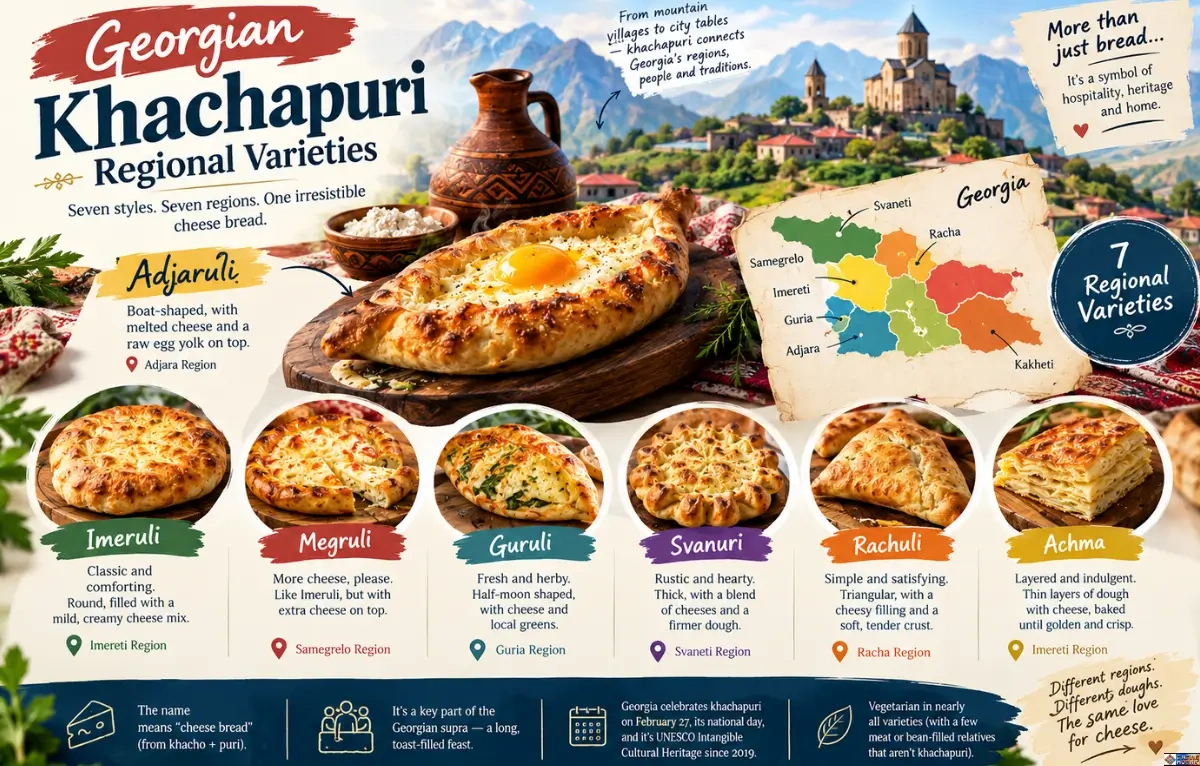
Quick Summary
- This guide to Georgian Khachapuri regional varieties covers the seven styles worth knowing, how each one is cooked and eaten, and where the confusion around them usually comes from.
- Khachapuri is Georgia’s national cheese bread, and it changes shape, dough, and cheese almost every time you cross a regional border.
- The word itself breaks down simply: khacho (curd) plus puri (bread). Cheese bread. No mystery there.
- The seven khachapuri styles worth knowing by name are Imeruli, Megruli, Adjaruli, Guruli, Svanuri, Rachuli, and Achma, each tied to a specific Georgian region.
- Adjaruli, the boat-shaped one with a raw egg yolk on top, is the version most visitors meet first. It is not, strictly speaking, the “classic” one. That title belongs to Imeruli.
- Georgia takes this bread seriously enough to have given it its own national holiday, February 27, and formal Intangible Cultural Heritage status in 2019.
- Nearly every regional variety is vegetarian. A handful of relatives, like the bean-filled lobiani or meat-filled kubdari, are not khachapuri at all, even though they get lumped in by mistake.
Georgian Khachapuri Regional Varieties: The Problem With Ordering Khachapuri Blind
Here is what usually happens. Someone lands in Tbilisi, sits down at a restaurant, and sees six or seven kinds of khachapuri on the menu with names that all sound roughly the same to an unfamiliar ear. Imeruli. Megruli. Acharuli. Guruli. They order the one with the picture, or the one the server points at, and they miss the version that would have actually suited what they wanted to eat that night.
I understand the hesitation. Menus abroad rarely explain themselves, and nobody wants to be the table that orders wrong in front of a Georgian host. That’s a real, small anxiety, and it’s worth taking seriously instead of waving it off with a generic “just try everything.” You have a limited number of meals on a trip, or a limited number of tries before a dinner party goes sideways. Choosing badly costs you something.
So here is the fix: a regional map of khachapuri, in plain language, built from Georgian culinary sources and government heritage records rather than a single restaurant menu. It’s the kind of regional food breakdown we do often at Culture Mosaic — read this once and you will never stare blankly at a Georgian bread list again.
What Does “Khachapuri” Actually Mean?
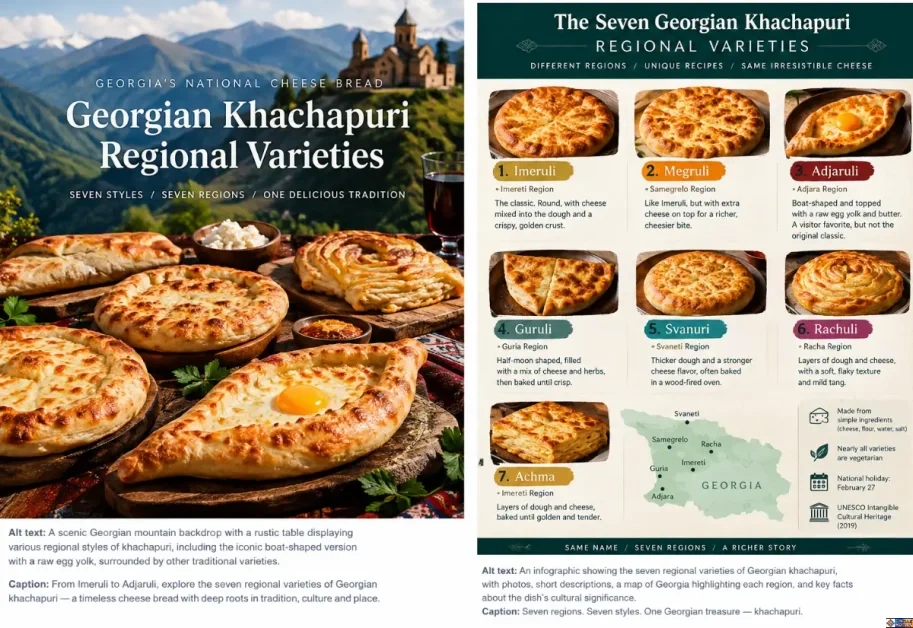
Straightforward answer first. Khachapuri comes from two Georgian words: khacho, meaning curd or cottage cheese, and puri, meaning bread. Put them together and you get exactly what’s on the plate — cheese bread, no more and no less poetic than that. The Georgian script renders it ხაჭაპური, and Georgians pronounce it roughly “khach-ah-POO-ree,” with a hard, aspirated first syllable that non-native speakers tend to soften more than they should.
I like that the name doesn’t try to dress itself up. So much regional cuisine gets buried under flowery restaurant-menu language. Khachapuri just tells you what it is and lets the cheese do the talking.
Georgian Supra Tradition: Where Khachapuri Actually Lives
You cannot understand khachapuri by eating it alone at a hotel breakfast bar. It belongs at a supra — the long, toast-driven Georgian feast run by a tamada, or toastmaster, who steers the table through hours of speeches about love, ancestors, and whatever the occasion happens to be. A supra can run three hours for a casual gathering and stretch past five for a wedding. Bread never leaves the table for the whole stretch, and khachapuri is almost always part of that bread course, refilled the moment a plate looks close to empty.
This matters more than it sounds like it should. A supra is built on the idea that an empty table is a kind of embarrassment for the host, so dishes keep arriving in a sequence that has nothing to do with Western courses — starters, mains, and desserts don’t really exist here. Khachapuri shows up early and keeps reappearing, because it’s cheap enough to make in quantity and beloved enough that nobody complains about seeing it twice. Culture Mosaic has covered these kinds of layered, ritualized dining rituals across other cuisines, and the Georgian supra is one of the more elaborate examples on record — a full culinary and social choreography with khachapuri as one of its steadiest fixtures.
If you want the fuller picture of how communal eating gets structured around a shared table, our piece on the commensal architecture of shared vessels walks through why cultures build entire social systems around exactly this kind of arrangement.
Caucasus Food Heritage: Why the Regions Split So Sharply
Georgia is a small country by land area, but its geography is brutal in the best possible way for food culture. The Greater and Lesser Caucasus mountains box in narrow valleys, and each one developed its own cheese, its own dough habits, and its own baking method largely in isolation for centuries. That’s the honest explanation for why a bread as simple as cheese-stuffed dough ends up with, by some counts, more than fifty documented regional names.
The Georgian government has since caught up with what home cooks always knew: this is heritage worth protecting on paper. On January 22, 2019, “The Khachapuri Tradition in Georgia” was added to the country’s national Intangible Cultural Heritage registry, an official acknowledgment that regional khachapuri-making counts as cultural practice, not just a recipe. Georgia’s wider food and wine heritage backs this up — the traditional qvevri clay-vessel winemaking method earned UNESCO Representative List status in 2013, and Georgian polyphonic singing, often performed at the same feasts where khachapuri is served, holds UNESCO status too.
The aged, slightly sour cheeses that anchor most khachapuri varieties — Imeretian cheese and sulguni chief among them — carry a depth of flavor that comes from real fermentation and aging, not shortcuts. Culture Mosaic’s piece on ancestral umami techniques gets into how curd-based, aged dairy builds that savory backbone across different food cultures, and Georgian cheese is a strong regional case study for it.
The Seven Regional Khachapuri Types You Need to Know
Georgian food writers and the Gastronomic Association of Georgia have documented dozens of localized khachapuri names, but seven regional styles cover the ground that matters for anyone trying to actually understand this bread. Here they are, region by region.
1. Imeruli Khachapuri — The Everyday Classic
Region: Imereti, western Georgia
Imeruli is the one Georgians eat on a random Tuesday. Round, flat, fully closed — the cheese sits sealed inside the dough rather than exposed on top, which keeps the whole thing portable and unfussy. The filling is traditionally Imeretian cheese, a fresh, slightly crumbly, mildly tangy curd cheese named for the region itself, sometimes blended with sulguni for stretch. Bakers traditionally cook it on a flat griddle called a ketsi rather than in a Western-style oven, which gives the bottom crust a light crispness while the top stays soft.
Ask a Georgian which khachapuri is “real” khachapuri, and most will point here first. It’s the version served in family kitchens, roadside bakeries, and school cafeterias alike — inexpensive, familiar, and reliably good.
2. Megruli Khachapuri — The Cheese-Maximalist’s Choice
Region: Samegrelo, western Georgia
Take an Imeruli and don’t stop at “cheese inside.” Megruli (sometimes anglicized as Megrelian or, in older texts, Mingrelian) keeps the enclosed filling but adds a second, generous layer of grated sulguni scattered across the top before baking. That top layer melts, bubbles, and browns into a golden, slightly caramelized crust that Imeruli simply doesn’t have. If Imeruli is the disciplined older sibling, Megruli is the one who never met a cheese ratio it didn’t want to raise.
This is genuinely the clearest answer to “what’s the difference between Imeruli and Megruli?” — Imeruli keeps its cheese inside only; Megruli puts cheese both inside and on top. Everything else about the dough and shape stays close to identical.
3. Adjaruli Khachapuri — The Boat Everyone Photographs
Region: Adjara, Black Sea coast
This is the one on every postcard and every Instagram feed out of Batumi. Adjaruli khachapuri, often anglicized as Adjarian khachapuri on English-language menus, is shaped into an open boat, its edges pinched and twisted upward, then filled with a molten mixture of sulguni and Imeretian cheese. Straight out of the oven, the baker cracks a raw egg yolk into the center and drops in a knob of butter, and the residual heat of the cheese finishes cooking the egg just enough to turn it into a rich, glossy sauce rather than a fully set topping.
Adjaruli khachapuri recipe basics, if you want to try it at home: make a soft, slightly enriched yeast dough, shape it into an oval with raised, twisted edges, fill the center generously with a blend of shredded sulguni and crumbled Imeretian (or a mozzarella-feta substitute outside Georgia), bake until the crust browns and the cheese bubbles, then crack in one egg yolk and a pat of butter in the final minute or two of residual heat, not a full bake.
The eating method matters as much as the recipe: the accepted technique is to tear a strip of bread from the edge, use it to scoop and stir the egg and cheese together in the center, then keep dunking. It is not meant to be cut and plated like a pizza slice.
4. Guruli Khachapuri — The Christmas Crescent
Region: Guria, western Georgia
Fold an Imeruli-style filling into a crescent shape and tuck halved hard-boiled eggs in alongside the cheese, and you get Guruli. Gurians traditionally bake this one for Orthodox Christmas, and in the rest of Georgia it’s sometimes just called “Gurian pie” for that seasonal association. The hard-boiled egg is the giveaway detail that separates it visually from every other closed-dough version.
5. Svanuri Khachapuri — The Mountain Version With Green Onion
Region: Svaneti, high mountain Georgia
Svaneti sits high enough in the Caucasus that its food developed its own dialect, almost literally. Svanuri khachapuri (also called lemzira locally) folds green onion into the cheese filling and uses a cheese blend with a higher fat content than the lowland versions, built to sustain people through cold mountain winters. It’s baked into a circular, sealed shape similar to Imeruli, but the onion changes the flavor enough that it’s unmistakable on the first bite.
6. Rachuli Khachapuri — The Rectangle
Region: Racha, western Georgia
Sometimes called bachulebi, Rachuli khachapuri swaps the round shape almost every other regional variety shares for a rectangle. The dough and cheese filling stay close to the Imeruli formula; the shape is really the defining trait here, along with a reputation among Georgian food writers for being harder to find outside its home region, which makes it something of a specialty item even within Georgia.
7. Achma — The Lasagna-Adjacent Outlier
Region: Abkhazia, and popular in western Georgia more broadly
Achma stretches the definition of “khachapuri” further than any other entry on this list, and some purists argue it doesn’t belong on the list at all, since there’s no enclosed dough pocket in the traditional sense. Thin sheets of dough are boiled first, layered with cheese and melted butter the way you’d build a lasagna, then baked as a whole dish rather than shaped into an individual portion. It’s rich, heavy, and worth the argument over classification.
Best Georgian Khachapuri Regional Varieties at a Glance
| Type | Region | Shape | Cheese | Defining Detail |
| Imeruli | Imereti | Round, closed | Imeretian, sometimes with sulguni | Cheese sealed fully inside |
| Megruli | Samegrelo | Round, closed | Imeretian inside, sulguni on top | Extra melted cheese layer on top |
| Adjaruli | Adjara | Open boat | Sulguni and Imeretian blend | Raw egg yolk and butter added post-bake |
| Guruli | Guria | Crescent | Imeretian, with hard-boiled egg | Made traditionally for Orthodox Christmas |
| Svanuri | Svaneti | Round, closed | High-fat blend with green onion | Green onion folded into filling |
| Rachuli | Racha | Rectangle | Imeretian-style | Rectangular shape, regional rarity |
| Achma | Abkhazia | Layered dish | Cheese between boiled dough sheets | Lasagna-style construction, no dough pocket |
Beyond these seven, Georgian food researchers have logged dozens more localized names — Ossetian khachapuri with potato folded into the cheese, the flaky, puff-pastry Penovani khachapuri from Samtskhe-Javakheti, Svanetian variants with slightly different fat ratios from village to village. Some Tbilisi restaurants now market elaborately garnished, multi-cheese versions under names like “royal khachapuri,” a modern menu invention rather than a historic regional style, built to look impressive rather than to represent a specific valley’s tradition. If you’re after the best Georgian khachapuri regional varieties to actually chase down on a trip, the seven above are the ones with real regional roots behind them.
How Georgians Cook It: Hearth, Ketsi, and Oven
The cooking method is almost as regionally specific as the shape. Imeruli and Svanuri versions traditionally cook on a ketsi, a flat clay or cast-iron griddle set directly over an open flame, which gives a fast, high-heat sear that a conventional oven struggles to replicate. Adjaruli and Megruli, with their raw egg and heavier cheese loads, need the more even, controllable heat of an oven to set the crust without scorching the top before the center finishes. Achma takes a completely different path, boiling its dough sheets before baking, closer to pasta technique than bread technique.
These aren’t arbitrary choices. Culture Mosaic’s coverage of heritage cooking techniques across different food traditions makes a similar point again and again: the cooking method almost always exists because of what the ingredients demand, not because someone picked it for style. A ketsi griddle exists because it’s what mountain kitchens without deep ovens could build and maintain. The method is the recipe’s memory of its own limitations.
The Dough Science: Why Matsoni Matters
Traditional khachapuri dough leans on matsoni, a tangy fermented milk product close to yogurt, worked into the flour alongside yeast or on its own as a mild leavening agent. That fermentation does double duty: it softens the gluten structure for a more tender, pliable dough, and it adds a faint sourness that plays against the richness of the cheese instead of just padding it out. This is the same principle behind the biochemistry of salt-glaze fermentation that shows up across so many aged and cultured foods — a controlled fermentation process changing texture and flavor in ways that raw ingredients alone can’t manage.
Sulguni and Imeretian cheese go through their own version of this. Both are cultured, brined, aged dairy products, closer in family to fresh mozzarella than to a hard aged cheddar, but built through the same basic curd-and-culture logic that shows up in ancestral fermentation rituals worldwide. Georgia’s version of it is distinct enough that Georgian cheese rarely tastes quite right when substituted with feta or mozzarella outside the country, no matter how close the texture comes.
Imeruli Khachapuri Recipe: The Basics Worth Learning First
If you search for a khachapuri imeruli recipe, you’ll find dozens of slightly different versions — but they all share the same bones. If you’re only going to learn one khachapuri recipe, learn Imeruli. It’s the forgiving one, and every other regional variety is really a variation on this base.
- Make a soft, enriched dough with flour, a little sugar, yeast, matsoni or plain yogurt, milk, and a touch of butter. Let it rise until doubled.
- Mix your cheese filling: Imeretian cheese (or a mozzarella-feta blend as a substitute) worked with a small amount of egg to bind it and help it melt evenly.
- Divide the dough, roll each portion into a round, place the cheese filling in the center, then gather the edges up and pinch them closed at the top like a purse.
- Flip the sealed dough seam-side down and gently flatten it back into a round disk, being careful not to tear the seal.
- Cook on a hot, dry griddle or in a very hot oven until the outside is golden and the cheese inside has fully melted, roughly 12 to 15 minutes depending on your heat source.
- Brush the finished bread lightly with butter and serve it hot. Khachapuri loses most of its charm once it cools.
Is Khachapuri Vegetarian?
Mostly, yes. Imeruli, Megruli, Adjaruli, Svanuri, Rachuli, and Achma are all vegetarian by default, built from dough, cheese, butter, and sometimes egg. Guruli’s hard-boiled egg keeps it vegetarian too, just not vegan. The confusion tends to come from close relatives that share a family resemblance but aren’t technically khachapuri at all — lobiani, filled with spiced beans, and kubdari, filled with spiced meat, use the same dough tradition but a completely different filling, and Georgian cooks are fairly firm that neither one counts as khachapuri once meat or beans replace the cheese.
None of the standard khachapuri varieties work for a strict vegan diet, since cheese, egg, and often butter are structural to the dish rather than optional garnish.
Does Khachapuri Have Its Own National Holiday?
Yes, and it’s not a token gesture. February 27 is National Khachapuri Day in Georgia, established by the Gastronomic Association of Georgia to mark the dish’s role as a symbol of the country’s food culture and to support culinary tourism around it. The date sits alongside the more formal January 22, 2019 inscription of “The Khachapuri Tradition in Georgia” onto the national Intangible Cultural Heritage registry, which places khachapuri-making in the same protected category as other recognized Georgian practices.
There’s a lighter piece of evidence for how seriously Georgia takes this bread: economists at the International School of Economics at Tbilisi State University track a “Khachapuri Index,” modeled on The Economist’s Big Mac Index, that measures the cost of a standard Imeretian khachapuri’s ingredients — flour, cheese, yeast, milk, eggs, and butter — as a real-time inflation gauge. When cheese prices spike, the Khachapuri Index moves, and Georgian economic journalists report on it the same way outlets elsewhere report fuel prices. Few countries have built a functioning economic indicator out of a single regional dish. Georgia has.
Which Regional Variety Should You Actually Try First?
I’ll take a position instead of hedging: start with Imeruli, not Adjaruli. Adjaruli gets all the photographs because the boat shape and runny egg yolk are dramatic on camera, and it’s genuinely good. But it’s also the richest, heaviest entry point, and if it’s your very first khachapuri, it can flatten your palate for everything more subtle that comes after. Imeruli shows you the actual foundation — the dough, the specific tang of Imeretian cheese, the balance the whole family of breads is built around — before you add sulguni layers, raw egg, or hard-boiled egg on top of it.
If you’re already comfortable with Imeruli and want a genuine outside-the-box pick, seek out Rachuli. It rarely makes it onto tourist-facing menus, it’s a legitimate regional specialty rather than a restaurant invention, and ordering it tends to surprise Georgian hosts in a good way, since most visitors have never heard of it.
Georgian Khachapuri Regional Varieties: A Note on Food Memory
There’s a reason Georgians rarely eat khachapuri quickly or standing up. The bread is meant to be torn by hand, the cheese pulled into long, stretching strings, the whole process slowed down by heat and texture. Culture Mosaic’s writing on somatic seasoning touches on exactly this kind of sensory-first eating, where texture and temperature do as much work as flavor. Khachapuri rewards that kind of attention. Eaten fast and cold, it’s forgettable.
Eaten hot, torn by hand, dunked or pulled apart at a slow supra table, it becomes the kind of dish people talk about years later — which is really what somatic food memory is built from in the first place: not just what a dish tastes like, but the full physical experience around eating it.
Food rituals like this aren’t unique to Georgia, of course. Culture Mosaic has traced similar patterns in food rituals in different cultures and across a wider set of traditional recipes from around the world — the specifics change, but the underlying instinct to slow a meal down around bread and shared dishes shows up again and again. If preserving that kind of instinct interests you, our collection of regenerative heritage recipes is a reasonable next stop.
Frequently Asked Questions
What does “Khachapuri” actually mean?
Khachapuri comes from two Georgian words: khacho, meaning curd or cottage cheese, and puri, meaning bread. Together they simply mean “cheese bread,” which is a literal description of the dish rather than a metaphorical or historical name.
What is the difference between Imeruli and Megruli?
Imeruli khachapuri seals its cheese filling entirely inside the dough, with nothing on top. Megruli uses the same base filling but adds a second, generous layer of grated sulguni on top of the dough before baking, which melts into a golden, slightly caramelized crust that Imeruli doesn’t have.
How do you eat the boat-shaped Adjaruli Khachapuri?
Tear a piece of the bread crust from the edge and use it to stir the raw egg yolk and butter into the melted cheese in the center until it forms a rich, unified sauce. Continue tearing off pieces of bread to scoop and dunk. It isn’t meant to be sliced and eaten with a knife and fork the way you’d eat a pizza.
Is Khachapuri vegetarian?
Yes, in nearly every regional case. Imeruli, Megruli, Adjaruli, Guruli, Svanuri, Rachuli, and Achma all rely on cheese, dough, egg, and butter rather than meat. The dish is not vegan, since cheese, butter, and often egg are essential rather than optional. Meat- or bean-filled relatives like kubdari and lobiani exist but are not technically khachapuri.
Does Khachapuri have its own national holiday?
Yes. Georgia observes National Khachapuri Day every February 27, an initiative from the Gastronomic Association of Georgia. It sits alongside the dish’s formal January 2019 inscription onto Georgia’s national Intangible Cultural Heritage registry, which recognizes khachapuri-making as a protected cultural tradition rather than just a recipe.
Sources
- National Agency for Cultural Heritage Preservation of Georgia / List of Intangible Cultural Heritage elements in Georgia — Khachapuri Tradition inscription, January 22, 2019.
- Gastronomic Association of Georgia — National Khachapuri Day, February 27, and related Intangible Cultural Heritage research findings.
- International School of Economics at Tbilisi State University (ISET) — Khachapuri Index methodology and reporting.
- UNESCO Representative List of the Intangible Cultural Heritage of Humanity — Traditional Qvevri Wine-Making Method (2013) and Georgian Polyphonic Singing.
Regional khachapuri classification and preparation details cross-referenced across Georgian culinary sources, including georgia-tours.eu’s regional khachapuri guide.Culture Mosaic — culturemosaic.co.uk — Contact: culturemosaic.co.uk/contact-us/