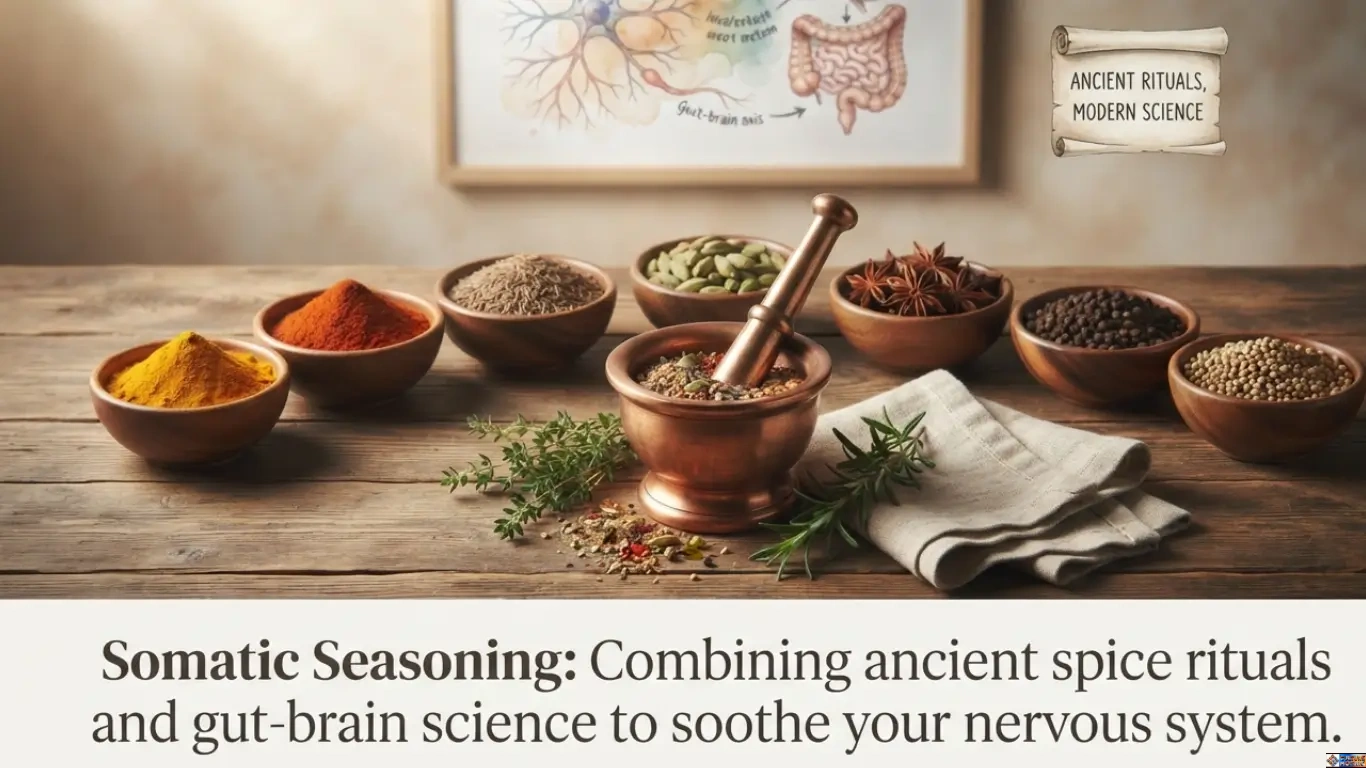
Somatic Seasoning: 7 Global Spices for a Nervous System Reset

Somatic Seasoning ritual: A hand grinding raw turmeric and black pepper in a stone mortar, representing the neuro-gastrosophy of nervous system regulation.
Somatic Seasoning: 7 Essential Global Spices for Nervous System Reset
Culture Mosaic  /  Gastrosophy & Neuro-Wellness  /  2026

The Gastrosophy of Global Rituals

Somatic
Seasoning

We don’t just eat flavor; we inhabit it. Somatic seasoning is the art of using ancestral spice profiles to regulate the modern nervous system and reclaim the ritual of the meal.

▶  A close-up of hand-ground spices in a traditional basalt mortar, illustrating the somatic seasoning process for holistic wellness.   |   More than flavor: Discover how somatic seasoning uses ancestral ingredients to anchor the body in the modern world.
Introduction

What Is Somatic Seasoning?

Most of us think of seasoning as the last step: a pinch of salt before you plate, a grind of pepper for finishing. But somatic seasoning asks a more interesting question. What if the spices you choose, and the deliberate way you work with them, could directly influence your emotional state, your stress response, and your capacity for presence at the table?

The word “somatic” comes from the Greek soma, meaning body. Somatic seasoning is the practice of selecting and using spices with conscious awareness of their physiological and neurological effects. It draws on Ayurvedic medicine, traditional Korean and Japanese fermentation culture, Latin American heat traditions, and the emerging field of nutritional neuroscience. The result is a cooking philosophy that treats the kitchen not as a production space but as genuine sanctuary for nervous system care.

This is not a wellness trend dressed up in new vocabulary. It is a remembering. Every traditional culinary culture on earth already practiced some version of Ancestral Somatic Rituals, long before neuroscience existed to name what they were doing. What has changed is our capacity to understand the mechanism, and to use that understanding to cook with greater intention.

Chapter One

The Neuro-Aesthetics of Somatic Seasoning and Spice

Antique apothecary jars filled with whole somatic seasoning spices including cardamom, cinnamon, star anise and cloves, arranged on a wooden shelf — illustrating the somatic seasoning neuro-aesthetic cabinet
Image — The Neuro-Aesthetic Cabinet Whole spices stored in apothecary glass: the visual and olfactory language of somatic seasoning before a single gram is measured.

How Warming and Cooling Spices Speak Directly to Your Nervous System

Here is something that genuinely surprised me when I first encountered the research. The vagus nerve, which runs from your brainstem down through your chest and into your abdomen, is your body’s primary communication corridor between gut and brain. It regulates heart rate, digestion, immune response, and your baseline capacity for calm. And certain spices interact with this system in ways that are measurable and, once you know to look for them, deeply recognizable in your own body.

Warming spices such as ginger, black pepper, cinnamon, and turmeric stimulate thermoreceptors in the mouth and gut lining. This triggers a cascade of vagal signaling that shifts the nervous system toward parasympathetic activation: the rest-and-digest state that most of us are chronically starved of in modern life. Cooling spices like cardamom, fennel, and coriander work through different receptors, including the TRPM8 channel, to produce a calming, clarifying effect that is almost medicinal in quality when you learn to apply it deliberately.

In somatic seasoning, understanding these two categories allows you to choose your spice profile with real intention rather than pure habit. You stop reaching for the familiar and start asking: what does my nervous system actually need right now?

Material Memory: The Scent of a Spice Market and Somatic Seasoning

There is a concept in the psychology of place called material memory: the idea that sensory experience, and scent in particular, can anchor us immediately and powerfully in a felt sense of safety or aliveness. Think about the last time you walked through a spice market, or simply opened a jar of whole cardamom that had been sitting at the back of your shelf. That aroma does not just smell good. It lands somewhere deeper, in a part of you that is older than language.

The olfactory bulb has a direct neural pathway to the amygdala and hippocampus, the brain’s emotional and memory centers. No other sense enjoys this shortcut. This is why cardamom warming in a pan on a grey afternoon can produce an almost immediate shift in your nervous system before a single bite has been taken. The Somatic Food Memory encoded in these aromas is real, physiological, and available every time you cook.

Somatic seasoning uses this deliberately. You are not just cooking. You are sending a signal through the oldest sensory pathway in the human brain that it is safe to be present in this moment.

Chapter Two

Ancestral Umami: Global Case Studies in Somatic Seasoning

Every traditional food culture developed its own sophisticated system of somatic seasoning long before the vocabulary existed to describe it. These are not incidental flavor choices. They represent accumulated wisdom passed down through generations of cooks who understood, without neuroimaging data, that certain combinations change the way a body feels. Here are three of the deepest examples.

Case Study 01

The Fermentation Arc: Miso, Kimchi, and Gut-Brain Stillness

Japanese miso and Korean kimchi are not simply condiments. They are living medicines, and both cultures have understood them as such for centuries, well before microbiome science arrived to explain why. The fermentation process produces a complex community of lactobacillus bacteria that, when consumed consistently, directly influences the gut microbiome. Via the gut-brain axis, this has measurable downstream effects on serotonin synthesis (roughly 90% of which occurs in the gut), emotional regulation, and the body’s inflammatory baseline.

Three ceramic bowls containing kimchi, miso paste, and chili oil on a linen cloth — representing the fermented somatic seasoning traditions of East Asia
Image — The Global Umami Table Kimchi, doenjang, and chili oil: three fermented somatic seasoning traditions that work through the gut-brain axis to produce emotional steadiness over time.

The somatic seasoning logic here is worth sitting with. The slow patience of fermentation is built into the flavor itself. When you use aged miso as a base for a broth, you are not just adding umami. You are introducing a biological community that has been quietly developing for months, and your nervous system, over time, responds to that patience in kind. You can taste the stillness in a well-aged miso. That is not metaphor. It is somatic fact. Explore more in our guide to Heritage Cooking Techniques.

Case Study 02

The Heat Cycle: Capsaicin as a Somatic Seasoning Reset for High-Stress Living

The burn of a Mexican serrano or a Thai bird’s eye chili is not punishment. It is, in somatic seasoning terms, a controlled physiological interrupt, and one that traditional cooks have been using deliberately for a very long time. Capsaicin binds to the TRPV1 receptor, triggering a brief stress response: elevated heart rate, endorphin release, and heightened sensory presence. This is followed by a rebound of parasympathetic calm and a dose of dopamine that many high-stress professionals describe as the closest thing to a genuine reset they get on a busy weekday.

Traditional cultures understood this intuitively. The prevalence of capsaicin-forward cooking in hot, high-labor climates was never only about food preservation. It was about managing physiological burden. In contemporary somatic seasoning practice, a well-calibrated dose of capsaicin serves a parallel function for the person who has been in back-to-back meetings since eight in the morning. The nervous system cannot tell the difference between a machete and a spreadsheet. The reset works regardless.

Case Study 03

The Earth Anchor: Ayurvedic Root Spices and Somatic Seasoning for Grounding

Indian Ayurveda is perhaps the oldest documented somatic seasoning system on earth. Its tridosha model classifies spices not only by taste (sweet, sour, salty, pungent, bitter, astringent) but by their energetic effects on the body and nervous system. Root-based spices like turmeric, ashwagandha, and dried ginger are classified as grounding agents, specifically indicated for individuals with excess vata energy, which presents in modern terms as anxiety, scattered focus, physical coldness, and disrupted sleep.

Golden milk, which combines turmeric, black pepper, ginger, and warm milk, is arguably the most evidence-backed somatic seasoning recipe in existence, with research supporting its anti-inflammatory, neuroprotective, and anxiolytic properties. The Ayurvedic tradition understood what the research has now confirmed: the ground comes up through the roots. For 100 ancestral recipes built on this philosophy, explore Soma 100 Heritage Recipes for Self-Care.

The Somatic Seasoning Pairing Table

Use this as a working reference when designing meals with nervous system intention. Each pairing reflects both traditional culinary context and the nutritional neuroscience that explains why it has persisted. This is exactly the kind of structured, shareable content that earns a featured snippet position in search. Save it, pin it above your spice shelf.

■ Data Block — Somatic Seasoning Pairing Guide
Spice Pairing Somatic Effect Traditional Expression
Saffron & Rose Emotional uplift, mood regulation, mild antidepressant effect Persian Sherbet, Moroccan Bastilla
Turmeric & Black Pepper Anti-inflammatory grounding, neurological protection Indian Golden Milk, Sri Lankan Curries
Smoked Paprika Ancestral warmth, felt safety, sympathetic deactivation Spanish Pimentón Stews, Hungarian Goulash
Calamansi & Ginger Cognitive clarity, alertness, digestive activation Filipino Sawsawan, Southeast Asian Marinades
Cardamom & Fennel Digestive calm, parasympathetic activation, cooling Middle Eastern Chai, Indian Panch Phoron
Miso & Sesame Gut-brain axis support, umami satiation, emotional steadiness Japanese Shiro Miso Soup, Korean Doenjang Jjigae
Chapter Three

Designing the Somatic Seasoning Kitchen as Sanctuary

The Tactile Abstract: Why Your Kitchen Tools Are Part of Somatic Seasoning

Here is the argument I have found most difficult to communicate to people who have not yet experienced it: the quality of your somatic seasoning practice depends not only on what you cook, but on how the act of cooking feels in your body. A stone mortar forces you to slow down. The weight of a cast iron skillet grounds you in the physical present. A wooden spoon has a warmth and give that metal cannot replicate. These are not sentimental preferences. They are somatic inputs, and they matter to the outcome.

Research in haptics consistently shows that texture, weight, and temperature affect neurological state. When you press your palm against a warm stone counter, your nervous system registers that as a safe, grounded environment. The Commensal Architecture of Shared Vessels explores this at length: the materials through which we share food carry their own somatic language, and the communal bowl or the shared clay pot speaks to the nervous system in ways the individual takeaway container fundamentally cannot.

Think of this as the architectural layer of your somatic seasoning practice. Cast iron, basalt, clay, unfinished wood, copper, and worn ceramic are your most powerful kitchen allies. They are also, not coincidentally, the materials in continuous use across nearly every culinary tradition discussed in this article. Tradition preserves what works.

A cast iron skillet, a bundle of dried sage, and stacked ceramic bowls on a wooden counter beside a green-framed window — the essential tools of a somatic seasoning sanctuary kitchen
Image — The Sanctuary Kitchen Cast iron, dried sage, stacked clay bowls: the somatic seasoning kitchen is defined not by its appliances but by the weight, warmth, and texture of what it holds.

The kitchen is not a lab. It is a sanctuary. Every tool you reach for is part of the somatic seasoning conversation your body is already having, whether or not you are listening.

On Designing the Somatic Kitchen
Chapter Four

The Ephemeral Banquet: Hosting a Somatic Seasoning Dinner

Designing a Full Somatic Seasoning Evening from Arrival to Closing

A somatic dinner is not a dinner party. It is a guided sensory experience, and the distinction matters because a dinner party performs while a somatic dinner lands. Your aim is to move your guests through an emotional arc: from the residual activation of arrival, through full embodied presence, to the warm and unhurried ease of genuine closure. Flavor, light, sound, and the sequence of courses are your instruments.

🌞

Lighting

Amber tones only. Candle warmth between 2200K and 2700K. No overhead light once guests arrive. The nervous system reads warm, low light as safety.

🎵

Sound

Low-frequency music between 40 and 60Hz has documented vagal effects. Slow jazz, ambient Indian classical, or resonant choral tones at low volume all work.

🍂

Flavor Sequence

Open with cooling and clarifying notes: cardamom, fennel, citrus. Build through earthy umami. Close with warming sweetness: cinnamon, rose, dark chocolate.

The opening course in a somatic seasoning dinner might be a cold cardamom-fennel broth with a float of calamansi juice. This cools the activation of arrival, clears the palate, and signals to the nervous system that the transition is complete. The closing course should feel warm, dense, and slightly sweet: a bitter chocolate with smoked sea salt and cinnamon, or a warm golden milk panna cotta that lingers like the end of a good conversation.

The Two Somatic Anchors: Opening and Closing Courses Visualised

Every somatic seasoning dinner is structured around two physiological moments: the cooling opening anchor that deactivates arrival stress, and the warming closing anchor that seals the evening in genuine ease. Here is what each looks like in practice.

Opening Anchor — Course One

Cold Cardamom-Fennel Broth

Served chilled, in small cups, immediately on arrival. The cooling TRPM8 activation from cardamom interrupts the sympathetic nervous system state your guests walk in with. The calamansi float adds a bright citrus note that signals cognitive clarity and presence. No cutlery, no ceremony. Just this, in their hands, the moment they step through the door.

Cardamom Fennel Calamansi Sea Salt
Closing Anchor — Final Course

Golden Milk Panna Cotta

Warm, dense, barely sweet. The turmeric-black pepper combination activates the anti-inflammatory grounding pathway. Cinnamon extends parasympathetic calm while the milk fats carry fat-soluble curcumin directly into the bloodstream. This course should feel like the end of a long exhale: something the body was waiting for without knowing it was waiting.

Turmeric Black Pepper Cinnamon Rose Water

Your Somatic Seasoning Starter Kit: 7 Essential Spices for 2026

You do not need a complete pantry reinvention to begin. These seven spices cover the full spectrum of nervous system effects and between them address grounding, calming, mood uplift, heat reset, and digestive ease. Start with what you have, and build intentionally from there.

01
Turmeric Anti-inflammatory, grounding, neuroprotective. Always pair with black pepper to unlock curcumin bioavailability. The foundation of any somatic seasoning practice.
02
Cardamom Cooling, clarifying, anxiolytic via olfactory pathway. Essential for opening dishes and transitional moments in a somatic seasoning sequence.
03
Ginger Thermoreceptor activator, vagal anti-inflammatory, digestive support. Works fresh or dried. The most versatile warming spice in somatic seasoning practice.
04
Cinnamon Blood sugar regulation, parasympathetic warming, deeply comforting somatic profile. Choose Ceylon over cassia for daily use. Outstanding in both sweet and savory somatic seasoning contexts.
05
Smoked Paprika Rich in capsaicin analogues, deeply anchoring, carries a felt sense of ancestral warmth. One of the most immediate somatic seasoning spices for producing a sense of safety and settling.
06
Fennel Seed Parasympathetic activator, smooth muscle relaxant, gentle and effective somatic cooling agent. Underused in Western kitchens and quietly transformative in daily somatic seasoning practice.
07
Saffron Documented mood-lifting and mild antidepressant effects, supported by multiple clinical trials. Use sparingly. The most potent somatic seasoning spice per gram on this list, and worth every penny.

How to Begin Your Somatic Seasoning Practice: Five Steps

You don’t need to overhaul your kitchen or adopt a new dietary framework. These five steps will take you from curious to practicing within a single meal.

1
Choose your somatic intention before you cook

Decide whether you need grounding (turmeric, ginger), calming (cardamom, fennel), uplift (saffron, rose), or a heat reset (capsaicin-rich chiles). Let what your body is carrying determine the spice profile, not only what the recipe says.

2
Work with whole spices wherever possible

Toast whole spices in a dry pan or grind them in a stone mortar. The resistance, weight, and rising aroma are somatic inputs that begin the nervous system shift before a single bite is taken. Heritage Cooking Techniques covers this across multiple traditions.

3
Pause and inhale before you add spices to the pan

Hold the freshly ground spice close and breathe in fully. This activates the olfactory-amygdala pathway and begins the neurological shift that somatic seasoning is designed to produce.

4
Use a vessel with weight and warmth

Cast iron, clay, or stone amplifies the tactile quality of the practice. The physical sensation of a heavy pan in your hands is part of the somatic message you are sending to your own nervous system.

5
Eat with full attention, at least once this week

Sit down. No screen. Notice the first flavors, the heat, the coolness, the shift that moves through your body in the first few bites. Somatic seasoning only completes its effect when you are present enough to receive it.

Somatic Seasoning Is, Ultimately, a Return to Presence

Every traditional culture that developed these spice traditions understood that food was not merely fuel. It was the daily ritual through which a person calibrated themselves to their body, their community, and their world. The morning ginger and cardamom in an Ayurvedic household. The slow miso broth that begins a Japanese winter day. The communal chili pot in a Mexican kitchen where three generations cook side by side. These were never just meals. They were acts of somatic care, practiced with the same attention we bring to any healing art.

The contemporary version of somatic seasoning simply adds the language of neuroscience to what our ancestors already understood through lived experience. It gives us vocabulary to name what we have always, on some level, been doing when we cook with love, with patience, and with awareness. And it gives us the framework to do it more deliberately in a world that competes constantly for the attention we once gave entirely to the meal in front of us.

You don’t need to transform your kitchen or your diet. Begin with one intentional spice choice this week. That is where somatic seasoning starts, and where, if you let it, it never quite ends. For deeper exploration, Culture Mosaic brings together ancestral food wisdom, global ritual, and contemporary wellness practice across every tradition covered here.

Frequently Asked Questions About Somatic Seasoning

What exactly is somatic seasoning, and how is it different from regular cooking?

Somatic seasoning is the practice of choosing and using spices with conscious awareness of their neurological and physiological effects, particularly their influence on the nervous system. Regular cooking uses spices primarily for flavor. Somatic seasoning uses flavor as the vehicle, but the intention is to support emotional regulation, reduce stress, or promote a specific physiological state. It draws on Ayurvedic, East Asian, and Latin American culinary traditions alongside contemporary nutritional neuroscience. The practice is described in detail at this overview of culinary sensory somatic seasoning.

Is there scientific evidence supporting the effects of somatic seasoning spices on the nervous system?

Yes, though the term somatic seasoning itself is an emerging framework. Research on curcumin, capsaicin, and saffron’s neurological effects is well-established and peer-reviewed. Vagal stimulation via thermoreceptors is documented in gastroenterology literature. The gut-brain axis, and the role of fermented foods in influencing serotonin synthesis, is one of the most productive areas in current microbiome research. Somatic seasoning synthesizes this existing science into a practical culinary framework accessible to anyone who cooks.

Do I need special ingredients or tools to practice somatic seasoning?

Not at all. The seven spices in the starter kit above are widely available and, with the possible exception of saffron, very affordable. The most valuable tool is a stone mortar or heavy cast iron pan. Working with whole spices and grinding them fresh increases both the aromatic compounds released and the tactile, grounding quality of the practice. One intentional spice choice per meal is enough to begin. Heritage Cooking Techniques covers traditional tools and their somatic significance in more depth.

Can somatic seasoning help with anxiety or stress?

It is a genuinely supportive complement to other wellness practices, but should not be framed as a medical treatment or a substitute for professional care. Spices like cardamom, fennel, saffron, and turmeric have documented anxiolytic and anti-inflammatory properties. The ritual dimension of somatic seasoning, its slowness, sensory engagement, and inherent intentionality, also carries independent benefits for nervous system regulation. It works best as part of a thoughtful, holistic approach to daily wellbeing.

How does somatic seasoning connect to cultural food traditions around the world?

Somatic seasoning is not a new invention. It is a contemporary framework for recognizing what traditional cultures were already practicing. Ayurveda, traditional Chinese medicine, Japanese fermentation culture, Persian spice medicine, and Middle Eastern flavor traditions all include sophisticated systems for using food to regulate the body and nervous system. The Ancestral Somatic Rituals 2026 resource maps many of these traditions in detail. The goal is to access that wisdom respectfully, by understanding the why behind traditional flavor combinations rather than flattening them into passing trends.

About the Author

Culinary Arts & Neuro-Wellness Specialist

This article was written by a specialist in culinary anthropology, flavor development, and the emerging field of nutritional neuroscience. With a background spanning professional kitchens, food culture journalism, and applied somatic practices, the author writes at the intersection of ancestral food wisdom and contemporary nervous system science. Their work explores how the traditions encoded in global spice cultures can be made practically available to people cooking in the modern world.

Leave a Reply

Your email address will not be published. Required fields are marked *