
 By Culture Expert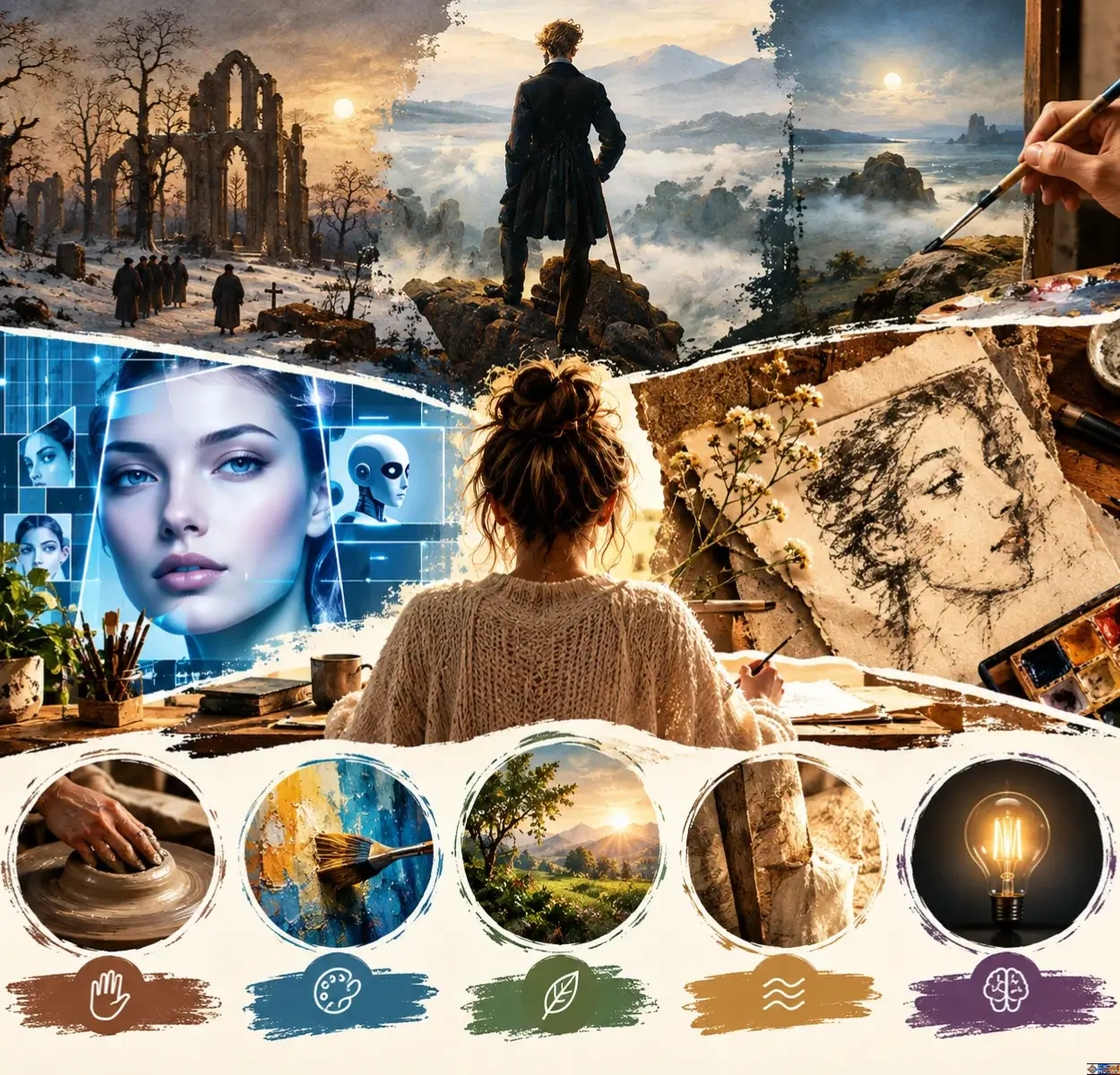
Quick Summary
The Art of Human Distillation is the practice of boiling an experience down to the few marks that carry its feeling, and leaving those marks visibly human. Caspar David Friedrich did it in oil paint in 1810. In 2026, designers are doing it again, this time as a reply to AI-polished sameness.
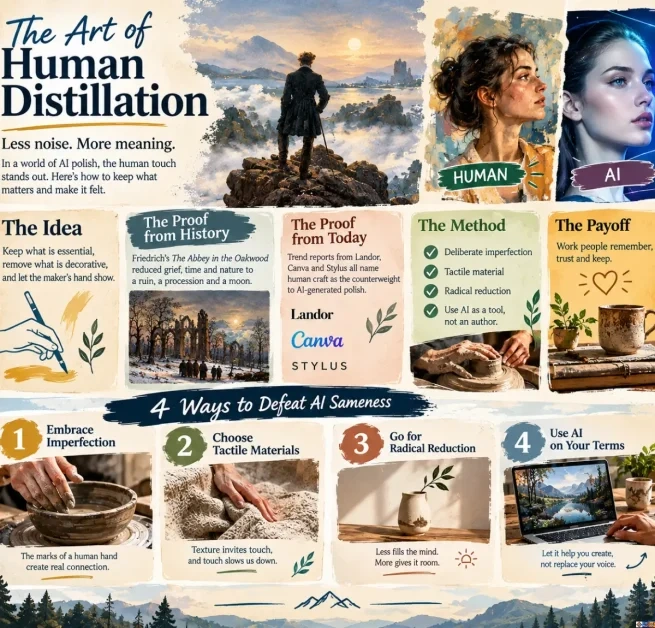
- The idea: keep what is essential, remove what is decorative, and let the maker’s hand show.
- The proof from history: Friedrich’s The Abbey in the Oakwood reduces grief, time and nature to a ruin, a procession and a moon.
- The proof from today: trend reports from Landor, Canva and Stylus all name human craft as the counterweight to AI-generated polish.
- The method: deliberate imperfection, tactile material, radical reduction, and AI used as a tool you direct rather than an author you obey.
- The payoff: work people remember, trust and keep.
This piece grows out of the themes explored at Culture mosaic, including its own take on The Art of Human Distillation.
A note on method: everything below is drawn from published sources listed at the end. I did not run interviews or surveys of my own, so there are no invented testimonials. Where I quote a trend report, I name it.
The Problem: Everything Looks Finished, Nothing Feels Alive
Scroll any feed and you will see it: flawless gradients, perfect symmetry, faces with no pores, layouts with no friction. Generative tools made polish free, and when polish is free, it stops meaning anything.
If that leaves you flat, you are not imagining it. A recent trend roundup puts it bluntly: when anyone can generate a flawless image in seconds, flawlessness stops signalling quality and starts signalling that a machine made it (Design Cloud). Landor’s Graham Sykes describes the response as “Anti-AI Crafting”, with designers putting their hands back on the work, literally (Creative Bloq).
The pain is real on both sides of the screen. Independent creators feel pushed to publish faster than they can think. Brands feel the pull of cheap automated output while sensing that their audience can tell. Viewers feel something harder to name: they are being shown everything and told nothing.
The way out is not nostalgia. It is a discipline with a long history, and a painter from Greifswald practised it better than almost anyone.
Caspar David Friedrich: The Soul of Nature, Distilled
Caspar David Friedrich (1774–1840) is widely called the most important German painter of the Romantic period. Ars Mundi describes him as introverted, close to nature and religious, someone who saw nature as a mirror of human feeling (Ars Mundi). His own rule, in the wording The Art Story gives, was this: “The painter should not paint merely what he sees in front of him, but also what he sees within himself” (The Art Story).
That sentence is human distillation in one line. Look outward, then filter through the inner life, then keep only what survives.
The Abbey in the Oakwood (1809–10)
Painted in Dresden, The Abbey in the Oakwood is an oil on canvas of 110 × 171 cm. A ruined Gothic abbey stands at the centre. Monks carry a coffin toward its gate in a snowy field, an open grave nearby, while bare oaks reach into the last light (Daily Art). The ruin is based on studies of Eldena Abbey, but the oaks and the funeral were Friedrich’s own additions (Dickinson College).
Count what is in the picture: a building, a procession, a tree line, a moon. No crowd, no story spelled out. Yet grief, time and the stubbornness of nature are all there. At Friedrich’s request it was hung beneath The Monk by the Sea, and the Prussian king bought both after the 1810 exhibition. They hang side by side today in Berlin’s Alte Nationalgalerie (Daily Art).
There is also a craft lesson. When the Staatliche Museen zu Berlin restored both paintings between 2013 and 2016, infrared reflectography revealed Friedrich’s underdrawings and the layers he built up by hand (Staatliche Museen zu Berlin). The simplicity is not emptiness. It is the visible result of decisions.
Wanderer above the Sea of Fog (c. 1818)
The Hamburger Kunsthalle holds Friedrich’s most famous Rückenfigur, the figure seen from behind. We cannot see his face, so we borrow his place on the rock. The German History Docs entry notes that this device lets the figure act as a doorway into the picture while remaining an “inscrutable other” (German History in Documents and Images). Leaving space for the viewer is the design move that 2026 brands are rediscovering.
For related reading on art, fame and expression, see Who Is the Most Famous Artist? and Art Therapy Power of Artistic Expressions.
What Human Distillation Means in 2026 Design
Human distillation has three steps: gather real experience, reduce it to what carries feeling, and leave the hand visible. Friedrich gathered Eldena’s ruins and a winter landscape, reduced them to a handful of forms, and left brushwork you can study two centuries later.
The 2026 trend cycle follows the same logic. Canva’s Design Trends Report named 2026 the year of “Imperfect by Design”, based on platform search activity and a survey of 1,000 creators (Design Cloud summary). A brand-trends roundup reports that 73% of consumers say they can spot AI-generated content and view it as less credible, though that is a secondary, self-reported figure and worth treating cautiously (Big Eye Agency). Stylus reported in July 2026 on a “surge of defiant, human-made creativity”, including slow, material-led installations at 3 Days of Design (Stylus).
Polished-by-default versus human-distilled
| Dimension | Polished-by-default (AI-slick) | Human-distilled |
|---|---|---|
| Starting point | A prompt or template | A lived observation or material |
| Surface | Frictionless, uniform | Texture, visible seams, trace of the hand |
| Flaws | Accidental or hidden | Chosen and kept where they carry meaning |
| Reduction | Removes detail to look clean | Removes detail to sharpen feeling |
| Viewer’s role | Consumer | Co-author: space is left to complete it |
| Production speed | Seconds | Slow enough to make decisions |
| What it signals | “A machine made this” | “Someone cared about this” |
The cultural thread runs wider than visuals. Explore it through Tactile Abstract Art Techniques, Tactile Minimalism Art Techniques and The Haptic Resonance of Raw Materials.
How to Practise Human Distillation: Four Methods
1. Keep flaws that carry meaning, without looking sloppy
The test is intent. A wobble in a hand-drawn line reads as human; a misaligned button reads as broken. Keep imperfection in the expressive layer (illustration, texture, type character, collage) and keep the functional layer (navigation, contrast, spacing) exact. Fragmented Collage with Visible Seams shows how seams can be a feature when the structure around them is sound.
2. Make digital things feel tactile
A website or app can feel tactile through grain, paper-like backgrounds, scanned materials, considered motion and sound. Craft details matter: Big Eye’s roundup cites hand-stamped logos and handwritten roast dates on coffee bags as “human labor signals” (Big Eye Agency). For the sensory side of this, read Haptic Sculpting Rituals, Neuro-Aesthetic Wall Art and Somatic Art Documentation.
3. Practise radical reduction, including for sustainability
Ask of every element: does it carry feeling or function? If not, remove it. Fewer materials, fewer print runs, fewer assets and fewer page weights are also the lowest-impact choices, which is why reduction and eco-friendly design travel together. Colour is one of the strongest reduction tools; see The Psychology of Color in Design. For living-material approaches, browse Biophilic Folk Art Aesthetics, The Bio-Art Beginner’s Lab, Mindful Bio-Art Projects and 5 Bio-Art Mistakes.
4. Use AI as a partner, not an author
Human distillation does not require rejecting AI. Landor’s Sykes says AI remains a tool while human-driven craft becomes the antidote to its slick visual language (Creative Bloq). A workable rule: let AI speed up exploration, then make the final decisions, edits and materials by hand. If you could not defend every choice in the finished piece, you have not distilled it yet.
A short checklist before publishing:
- Can I say in one sentence what this piece feels like?
- What did I remove, and why?
- Where can a viewer see a human decision?
- Would the piece survive without its trendiest effect?
Brands and Creators: Cost Versus Premium Value
Automation wins on cost per asset. Human distillation wins on what an asset is worth. The practical balance many teams are reaching for is to automate the invisible work (resizing, versioning, drafts) and invest human time where the audience actually looks: the hero image, the identity, the packaging, the first ten seconds.
There is evidence brands are moving this way. Idle Gaze notes a pro-human-craft counter-movement among luggage, camera and fashion brands, including a full-page New York Times spread from Away declaring “the world is not AI-generated” (Idle Gaze). Waxy.org links to reporting that restaurants are leaning into handmade, DIY aesthetics as AI imagery grows (Waxy.org, July 2026).
For independent creators, algorithms reward volume, but audiences remember distinctiveness. Slowness becomes your signature: show process, publish fewer and better pieces, and document the making. Somatic Art Documentation is a good starting point for recording the human side of your work.
The broader shift is from hyper-personalised feeds toward shared, universal experience. Friedrich’s wanderer works because anyone can stand on that rock. Universal feeling, specifically rendered, outlasts a thousand tailored variants.
Where This Goes Next, and Why to Start Now
Expect three shifts. Provenance becomes a feature: visible process, named makers and material honesty will be marketed the way “organic” once was. Hybrid workflows become normal: Stylus notes research showing AI’s power as a design collaborator, even as many artists reject it as a replacement (Stylus). Reduction becomes a value: less to make, less to ship, less to forget.
The window matters. Right now, human-made work still stands out. As more studios adopt the look of craft, the real differentiator will be the substance behind it: a genuine point of view, distilled.
You do not need a studio to begin. Pick one project this week. Write the one-sentence feeling. Remove half of what is on the page. Then make one element by hand and leave the trace visible. Friedrich needed only a ruin, a procession and a moon.
Frequently Asked Questions
1. What is “The Art of Human Distillation”?
It is the practice of concentrating real human experience (memory, struggle, heritage, feeling) into a refined form, whether a painting, a brand identity or a website. The word “distillation” is a metaphor: remove what dilutes, keep what carries the essence. Friedrich’s Abbey in the Oakwood is a historical model, and the 2026 return to craft is a contemporary one.
2. What did Caspar David Friedrich contribute to this idea?
Friedrich argued that a painter should paint not only what he sees in front of him but also what he sees within himself (The Art Story). His paintings, such as The Abbey in the Oakwood (1809–10, Alte Nationalgalerie) and Wanderer above the Sea of Fog (c. 1818, Hamburger Kunsthalle), use very few elements to carry large emotions.
3. Does human distillation mean rejecting AI?
No. It means keeping humans in charge of meaning. AI can speed up exploration and production, but the choices about what to keep, what to cut and what to leave imperfect stay with a person. Landor’s Graham Sykes frames craft as the antidote to AI’s hyper-slick look while still embracing AI as a tool (Creative Bloq).
4. How can I add imperfection without looking unprofessional?
Put imperfection in expressive elements (illustration, texture, handwriting, collage) and keep functional elements (layout, contrast, navigation) precise. Make every flaw intentional and consistent, so it reads as a style rather than an error. Examples to study: Fragmented Collage with Visible Seams and Tactile Abstract Art Techniques.
5. How can small creators compete with high-volume algorithms?
Don’t match volume; match meaning. Publish fewer, more distinctive pieces, show your process, and use human signals such as hand marks, material and voice. Audiences and brands are visibly shifting toward handmade cues, as the Idle Gaze and Stylus reporting above shows. Learn from Art Therapy Power of Artistic Expressions how making itself can carry emotional weight.
Sources
- The Abbey in the Oakwood, Daily Art
- The Monk Has Returned, Staatliche Museen zu Berlin (Alte Nationalgalerie)
- Restoration of Monk by the Sea and Abbey in the Oakwood, Staatliche Museen zu Berlin
- Abtei im Eichwald, Dickinson College
- Caspar David Friedrich, The Art Story
- Caspar David Friedrich, Ars Mundi
- Wanderer above a Sea of Fog, German History in Documents and Images
- Hamburger Kunsthalle online collection, HK-5161
- Texture, warmth and tactile rebellion: graphic design trends for 2026, Creative Bloq
- Graphic Design Trends 2026, Design Cloud
- 2026 Design Trends: Impact on Consumer Brands, Big Eye Agency
- Defiant creativity in the age of AI, Stylus, 16 July 2026
- Idle Gaze 052: The AI rebellion, handmade
- Restaurants are leaning into handmade/DIY aesthetics, Waxy.org, July 2026
 Dr. Julian Thorne