
 By Marcus J. Holloway
Quick Summary: The best zero waste home ideas follow the 5 Rs (refuse, reduce, reuse, recycle, rot) applied one room at a time. Start in the kitchen, because food is the heaviest thing most of us bin. Swap the daily disposables, compost or use your weekly food caddy, and check your council’s rules, which changed across England on 31 March 2026. Most of it costs nothing. The rest pays for itself.
Why Zero Waste Home Ideas Start With Your Bin
You lift the lid and there it is. Yoghurt pots, a limp bag of salad, three layers of film around something that was already in a tin. It feels like a small failure, repeated daily. These zero waste home ideas are written for ordinary households, not influencers.
Let me say it plainly: that feeling is not a character flaw. Most packaging decisions were made long before the food reached you. But the bin is also the one place in a home where you can see consumption laid out as a pile, and that makes it a good place to start. Zero waste home ideas work because they turn guilt into a short list of jobs.
The scale is real. WRAP, the UK’s waste-reduction charity, puts household food waste at 6.4 million tonnes in 2022, roughly 95kg a person. Its earlier estimate was that about 4.5 million tonnes of the household total could have been eaten, worth around £14 billion. That is the sort of number you cannot shrug off, and it is also the easiest slice to shrink.
The 5 Rs of Zero Waste Living Behind the Best Zero Waste Home Ideas
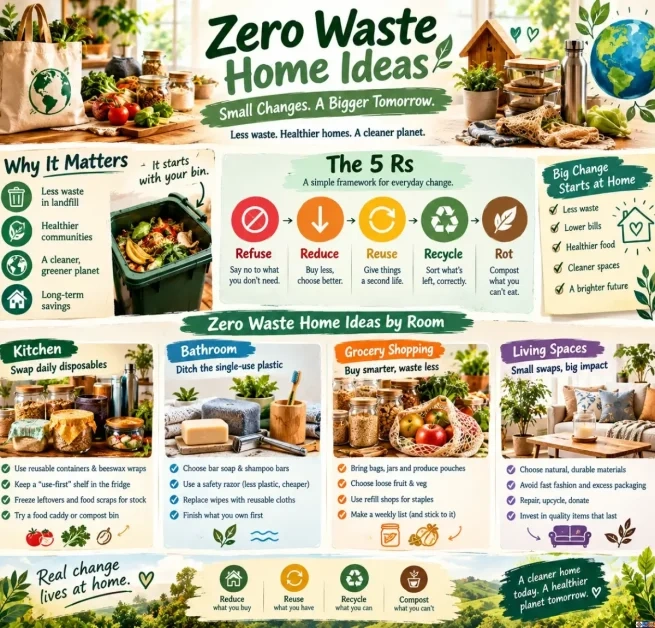
If you remember one framework, make it this. Bea Johnson popularised it in her book, Zero Waste Home, and I think the ranking matters more than the words.
Notice that recycling is fourth. Councils are better at it than they were, but the cleanest item is still the one you never bought.
Zero Waste Home Ideas by Room
The Kitchen: Where Most Zero Waste Home Ideas Begin
Start here. A kitchen bin is heavy, wet and smelly, which is exactly why it matters. Three swaps do most of the work.
- Replace cling film and foil with lidded containers, plates over bowls, or beeswax wraps. Cling film is the one I would drop first. It is rarely recyclable at kerbside and almost always avoidable.
- Keep a “use-first” shelf in the fridge. Whatever sits there gets cooked next. It costs nothing and it beats any gadget.
- Freeze the ends: onion skins, carrot tops, celery leaves, a chicken carcass. When the bag is full, make stock.
Wildcard: Simmer a pan of brown onion skins for twenty minutes and you get a warm amber dye. It will tint linen, wool or cotton napkins. Odd, yes. But it turns something you would bin into something you would keep. If you are rethinking the kitchen wholesale, see What is Considered Kitchenware? for what truly earns its drawer space.
The Bathroom: Small Room, Surprisingly Plastic
Bathrooms hide more single-use plastic than almost any other room: bottles, pumps, wipes, cotton buds, disposable razors. The fix is dull and effective. A bar of soap replaces body wash. A shampoo bar replaces a bottle. A safety razor replaces a pack of plastic ones every few months, and the blades are cheap. Of all the zero waste home ideas I would recommend, bathroom swaps are the gentlest place to start. Finish what you own first. A half-used bottle thrown out for a “greener” bar is its own kind of waste.
Wipes deserve a mention. Even those labelled flushable cause blockages, and the safest bin for them is the general waste bin. A washable cloth and warm water is gentler on skin and on the drains.
Grocery Shopping and Refills
Shopping is where reduce becomes real. Take bags, jars and a few produce pouches. Buy loose fruit and veg when it is no dearer. Look for refill shops for oats, pasta, rice and cleaning liquids, and check whether your local market sells unwrapped produce. The best zero waste home ideas for the shop floor are dull ones, and a weekly list on the fridge door does more for waste than a whole shelf of reusable tubs.
Wildcard: Before you buy a tool you will use twice a year, such as a pasta machine, a drill or a carpet cleaner, see if a “library of things” or a neighbour has one. Borrowing is the most overlooked zero waste product there is.
Composting and Food Waste: Zero Waste Home Ideas After the England Changes
Here is the news that makes this the right year to act. From 31 March 2026, every council in England must offer households a weekly food waste collection, unless a transitional arrangement applies, under the government’s Simpler Recycling reforms. GOV.UK says households now have a maximum of four straightforward collections: food and garden waste, paper and card, dry recyclables like glass and plastic, and general rubbish. Film packaging such as plastic bags is due to be added to kerbside plastic by 31 March 2027, according to the government’s consultation response.
Some councils have secured delays, so check yours at GOV.UK’s Find your local council service before assuming anything. Where it is running, food collected this way is typically sent to anaerobic digestion, where microbes break it down in a sealed vessel without air. Erewash Borough Council explains the process on its food waste page.
If you have a garden or even a balcony, home composting is the next rung. Browns (cardboard, dry leaves) balance greens (peelings, tea bags). Keep it damp, not wet. For flats with no outdoor space, Kitchen Scraps Management for Balcony-Free Apartments covers the realistic options, from caddies to bokashi. And if you simply want to grow a greener interior, How to Create a Biophilic Home shows how plants and natural materials can share a small room.
Zero Waste Home Ideas DIY: Reusable Products You Can Make
DIY is the quiet hero of the zero waste home ideas DIY crowd, because it uses what is already in the house. These zero waste home ideas DIY projects cost pennies.
- Cleaning cloths: cut worn cotton T-shirts and towels into squares. They go in the wash, not the bin.
- All-purpose spray: a half-and-half mix of white vinegar and water, with citrus peel steeped in the vinegar for a fortnight. Do not use it on natural stone, and never mix vinegar with bleach.
- Beeswax wraps: cotton offcuts, beeswax pellets and an oven on low. Wrapped food, no film.
- Mending kit: needles, thread and a darning mushroom beat replacing socks. Repair is the most underrated reuse skill there is.
When you are filling a room, buy secondhand first. A pre-loved piece with decent bones lasts longer than most flat-pack. Modern Heritage Living Room is a good primer on mixing older furniture with a current look without it feeling like a museum.
Energy Efficiency: Zero Waste Home Ideas for the Waste You Cannot See
Waste is not only what lands in the bin. A draughty window throws away heat all winter. Switching to LED bulbs, draught-proofing doors, using a lower wash temperature and fully loading machines are the low-barrier moves. The Energy Saving Trust is the independent place to check what suits your property before you spend. Daylight helps too: Functional Biophilic Decor for Circadian Health looks at arranging a room around natural light, which can cut how long you reach for the switch.
Zero Waste Products Worth Buying (and Skipping)
Here is where I get opinionated. The best zero waste home ideas rarely involve a purchase, and the greenest product is the one you already have. When you must buy, pick the swap that replaces something you use every day.
That last row is the one I would argue about at a dinner party. A starter kit is marketing for a movement that began with doing without.
Zero Waste Projects for Schools and Neighbourhoods: Zero Waste Project Ideas
Home habits scale up, and that is the civic angle I care about most. The same zero waste home ideas translate neatly to a classroom or a street. A school can run a litter and waste audit, set up a swap shop for uniforms, start a lunchtime composting club or a repair day. Keep Britain Tidy’s Eco-Schools programme gives schools a structure to build on. On the street, a refill point, a repair café or a community fridge changes what a whole block throws away.
Space shapes behaviour. Buildings that invite sharing make waste reduction feel normal, an idea explored in Socially Restorative Architecture and in Adaptive Biophilic Urbanism, which looks at how cities can weave nature and community into everyday routines. Calm interiors help too; Somatic Interior Design Principles explains why a home that feels settled tempts us to buy less.
Zero Waste Home Book: Where to Read Next
If you want the original blueprint, read Bea Johnson’s Zero Waste Home (Scribner, 2013). Her 5 Rs shaped how a generation talks about the topic. I would treat her system as a starting point, not a rulebook. Her household and yours differ, and the mood in the later chapters can feel stricter than most families will tolerate. For more zero waste home ideas alongside heritage, design and civic stories, browse the rest of Culture Mosaic.
You may also meet lists called 75 Ways to Create a Low-Waste Home. They are fine for inspiration. But seventy-five small ideas done once are worth less than three done every week.
Examples of Zero-Waste Lifestyles
“Zero waste” is a direction, not a finish line. Zero waste home ideas look different in each of three shapes that show up again and again.
- The purist: loose shopping, a jar of rubbish a year, a strict routine.
- The good-enough household: swaps the loudest offenders, composts, accepts the odd plastic wrapper.
- The community-first household: shares tools, uses repair days, and treats neighbourhood systems as the real lever.
I think the second one is the most realistic and, frankly, the most likely to last.
Your Next Step: A Seven-Day Starter
Zero waste home ideas stick when you schedule them. Day one, find your food waste caddy or set up a scrap container. Day two, plan three dinners. Day three, cut an old T-shirt into cloths. Day four, bin the cling film and use a lid. Day five, carry a bottle. Day six, look up your nearest refill shop or repair day. Day seven, look in the bin and see what is still in there. That is next week’s job.
Zero Waste Home Ideas: Frequently Asked Questions
1. What are the 5 R’s of zero waste living?
Refuse, reduce, reuse, recycle, rot are the 5 Rs behind most zero waste home ideas. Bea Johnson set the order out in her book Zero Waste Home, and the order is the point. Refuse what you don’t need (free pens, flyers, bags). Reduce what you do need. Reuse before you buy new. Recycle only what is left. Rot, meaning compost, handles the food scraps. Recycling sits fourth because it is the weakest of the five: it still takes energy and still loses material.
2. What are some zero waste home ideas I can start today?
The easiest zero waste home ideas use what you already own. Carry a bag and a bottle. Put a lidded container on the counter for food scraps. Cut worn-out T-shirts into cloths and retire the kitchen roll. Plan three dinners before you shop and freeze what you will not eat in time. None of it costs a penny, and the food habits alone tackle the largest slice of most household bins.
3. What are some ideas for zero-waste products?
The ones that replace a daily disposable: a refillable water bottle, a bar of soap or shampoo, a safety razor, washable cloths, a stainless steel or glass food container, and a bamboo or reusable-head toothbrush. Buy them only when the disposable version runs out. A reusable item you replace early can cost the planet more than the plastic it was meant to beat.
4. Can you give me some examples of zero-waste lifestyles?
Three common shapes. The purist keeps a year of rubbish in one jar and shops almost entirely loose. The good-enough household swaps the big offenders, composts or uses the food caddy, and accepts some plastic. The community-first household shares tools, joins a repair café or refill scheme, and treats neighbourhood systems as the real lever. Most people end up somewhere in the middle, and that is fine.
5. Is a zero waste home affordable on a normal budget?
Yes, zero waste home ideas are affordable if you go slowly. The cheapest moves are behavioural: planning meals, using leftovers, mending, borrowing. Many reusable swaps pay back over months because you stop rebuying the disposable. Where I would hold back is the matching-jar aesthetic. A tidy shelf of identical glass is lovely, but old jam jars do the same job for free.
Sources
- GOV.UK (31 March 2026), Simpler household recycling rules come into force across England. https://www.gov.uk/government/news/simpler-household-recycling-rules-come-into-force-across-england
- GOV.UK, Find your local council. https://www.gov.uk/find-local-council
- ENDS Report, Government announces plans for “long overdue” waste collection reforms (film packaging and 2027 dates). https://www.endsreport.com/article/1844775/government-announces-plans-long-overdue-waste-collection-reforms
- WRAP, UK food surplus and waste key facts (2022 household figure: 6.4 million tonnes). Editor to confirm the live primary page on wrap.ngo. https://www.wrap.ngo/
- WRAP Food Waste Action Week 2023 announcement, as reported by Resource Media (edible waste estimate; campaign reach and behaviour-change figures). https://www.resourcemedia.eco/article/wrap-announces-food-waste-action-week-2023
- Love Food Hate Waste (WRAP), practical food-waste guidance. https://lovefoodhatewaste.com/
- Erewash Borough Council, Food Waste Collections (anaerobic digestion explained). https://www.erewash.gov.uk/bins-and-recycling/food-waste/food-waste-collections
- Energy Saving Trust, independent home energy advice. https://energysavingtrust.org.uk/
- Keep Britain Tidy, Eco-Schools England. https://www.keepbritaintidy.org/
- Johnson, Bea (2013), Zero Waste Home: The Ultimate Guide to Simplifying Your Life by Reducing Your Waste. Scribner.
 Culture Expert