
 By Dr. Julian Thorne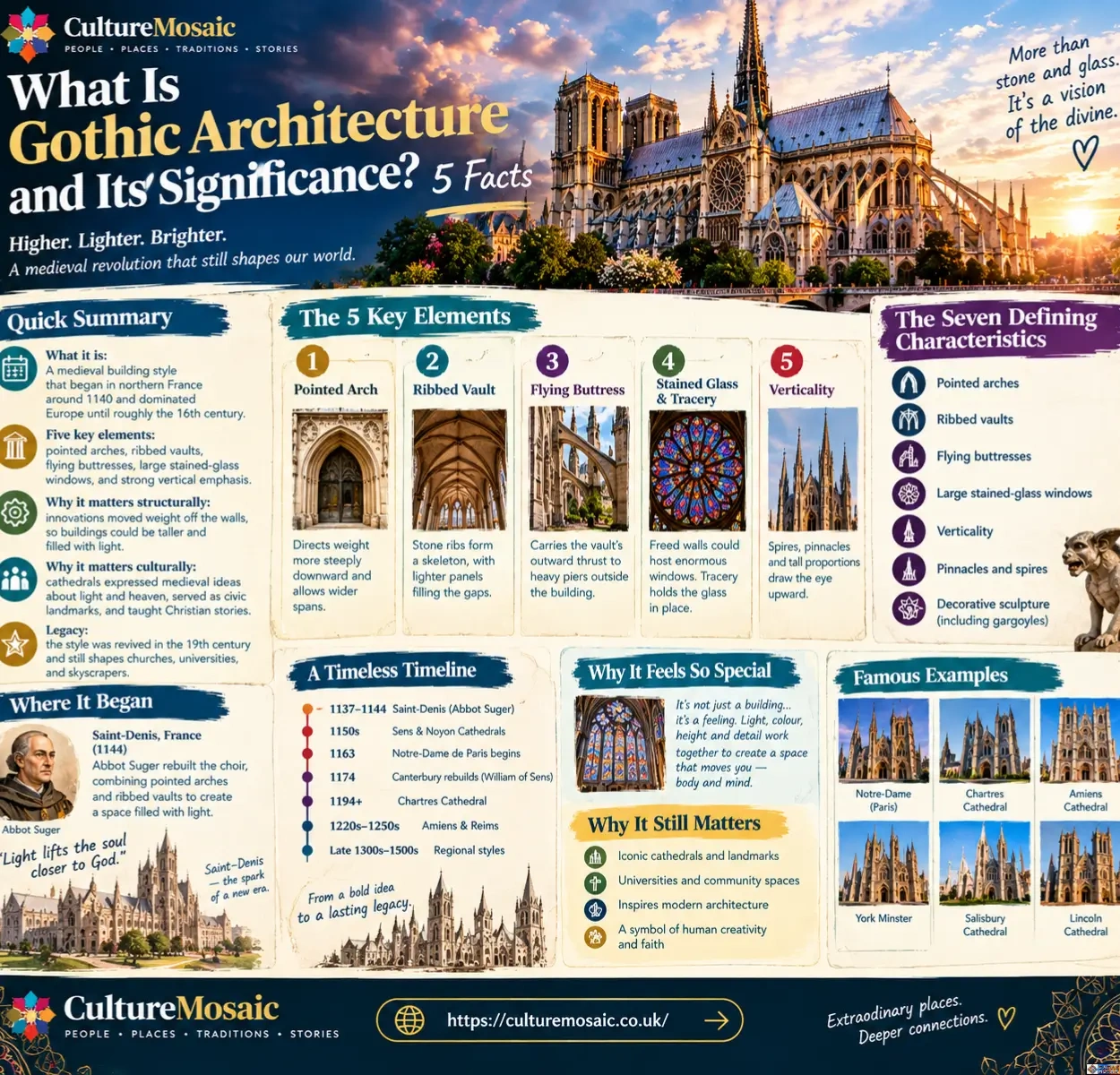
Quick Summary
- What it is: Gothic architecture is a style of building that began in northern France around 1140 and dominated Europe until roughly the 16th century.
- Five key elements: pointed arches, ribbed vaults, flying buttresses, large stained-glass windows, and strong vertical emphasis.
- Why it matters structurally: these innovations moved weight off the walls, so buildings could be taller and filled with light.
- Why it matters culturally: cathedrals expressed medieval ideas about light and heaven, served as civic landmarks, and taught Christian stories visually.
- Legacy: the style was revived in the 19th century and still shapes churches, universities, and skyscrapers.
The Problem: Why Do Gothic Buildings Feel So Hard to “Read”?
Stand beneath a great cathedral and you feel something before you understand anything. The ceiling is lost in shadow, and colored light falls across the floor from windows too high to see clearly. It’s overwhelming, and many visitors leave unsure what they were looking at or why it was built that way.
That feeling is understandable. Gothic buildings are packed with technical vocabulary (ribbed vault, tracery, clerestory) that can feel like a barrier. But the story underneath is simple: builders wanted more height and more light, and they invented the engineering to get both. Once you know that, every cathedral becomes readable.
What Is Gothic Architecture?
So, what best describes Gothic architecture? It is a medieval building style defined by structural skeletons of pointed arches, ribbed vaults, and external supports that let walls become screens of glass. For a fuller definition, see What Defines Gothic Architecture? and What Is Gothic Art and Architecture?.
The name is ironic. “Gothic” was originally an insult: Renaissance writers in Italy used it for medieval buildings they considered barbaric, as if made by the Goths. The label stuck even though it has nothing to do with the Goths. Today it carries no insult at all.
Early Gothic Architecture: Where It All Began
When and where did it start? Most historians point to the abbey church of Saint-Denis, just north of Paris. Abbot Suger rebuilt its choir, consecrated in 1144, combining pointed arches and ribbed vaults to create a space filled with light. (For more, see How Did Gothic Architecture Begin?)
Suger wrote about his project himself in De Administratione, a primary source and one of the best windows into his thinking. He saw light as spiritual, a way for the human mind to rise toward God through beautiful physical things.
Nothing came from nowhere, though. Romanesque builders, including those at Durham Cathedral in England, had already experimented with ribbed vaults decades earlier. Gothic was an evolution that came together at Saint-Denis. Compare the two styles in Gothic vs. Romanesque Architecture.
Gothic Architecture Characteristics: The Five Key Elements
What are the five key elements of Gothic architecture? Here they are, with what each one did.
1. The Pointed Arch
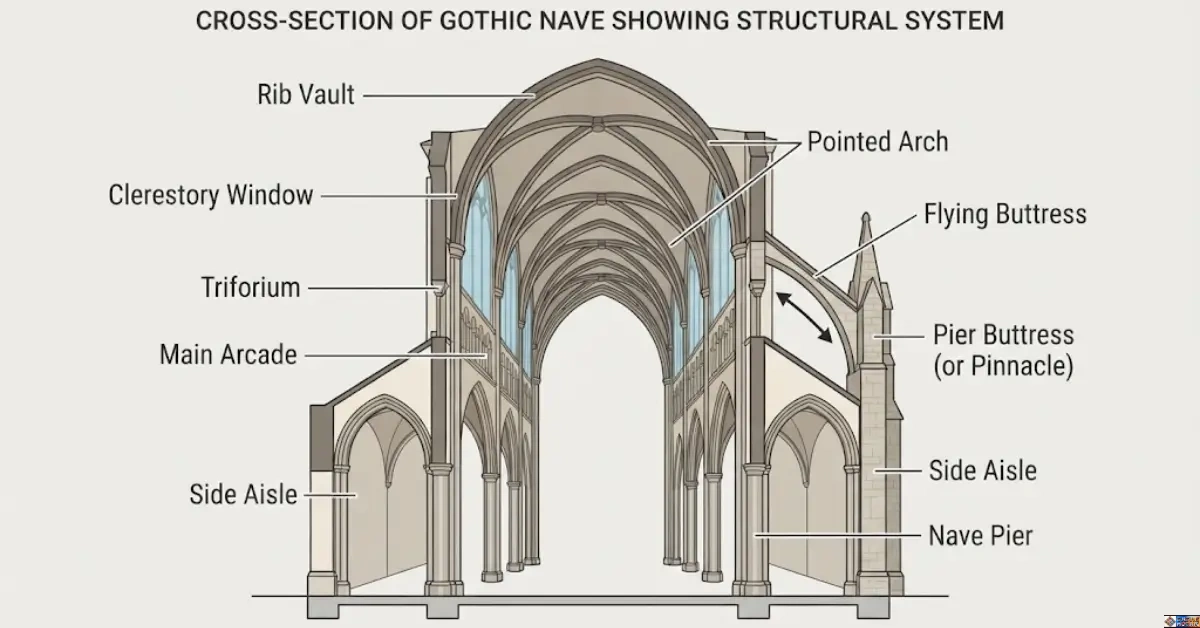
Unlike the round Romanesque arch, a pointed arch directs weight more steeply downward and can span openings of different widths while keeping the same height. This flexibility made complex vaulting possible.
2. The Ribbed Vault
Stone ribs form a skeleton that carries the roof’s load, with lighter stone panels filling the gaps. See the regional variations in English Gothic vaulting types.
3. The Flying Buttress
These arched external supports carry the vault’s outward thrust to heavy piers outside the building. Walls no longer had to be thick and solid. Learn more at Flying Buttress Definition in Art.
4. Stained Glass and Tracery
With walls freed from load-bearing, builders opened them to enormous windows. Stone tracery, the delicate patterned framework, holds the glass in place. Rose windows are the most famous result.
5. Verticality
Spires, pinnacles, and tall narrow proportions all draw the eye upward. Height was also a statement of ambition and civic pride.
The Seven Defining Characteristics
If you want seven defining characteristics, add two more to the list above: pinnacles and spires, and decorative sculpture (including gargoyles, which also worked as rainwater spouts). Explore more in Gothic architecture key features and Gothic architecture elements.
Gothic Architecture Characteristics and Time Period
Gothic architecture spans roughly 1140 to the early 1500s, varying by region.
Gothic Architecture Characteristics and Time Period
Spanning roughly from 1140 to the early 1500s, explore how architectural traits and structural innovations evolved across France and England.
| Phase / Region | Approximate Dates | Notable Traits | Example |
|---|---|---|---|
| Early Gothic (France) | c. 1140–1200 | First pointed arches and ribbed vaults | Saint-Denis |
| High Gothic (France) | c. 1194–1250 | Greater height, larger windows | Chartres, Reims |
| Rayonnant (France) | c. 1240–1350 | Delicate, radiating tracery | Sainte-Chapelle |
| Early English (England) | c. 1180–1250 | Lancet (narrow pointed) windows | Salisbury Cathedral |
| Decorated (England) | c. 1250–1350 | Elaborate curved tracery | Exeter Cathedral |
| Perpendicular (England) | c. 1350–1550 | Strong vertical lines, fan vaults | King’s College Chapel, Cambridge |
For the English sequence in detail, read English Gothic Architecture Characteristics.
Famous Gothic Architecture: Examples Worth Knowing
What are some famous examples of Gothic architecture?
- Notre-Dame de Paris (begun 1163): damaged by the fire of April 2019, it reopened to the public in December 2024 after extensive restoration.
- Chartres Cathedral: rebuilt after a 1194 fire, it preserves a remarkable body of medieval stained glass.
- Sainte-Chapelle, Paris (consecrated 1248): often described as a jewel box of glass, commissioned by Louis IX to house relics.
- Salisbury Cathedral: built mostly in the 13th century in a unified style, with the tallest church spire in Britain.
- Canterbury Cathedral: its choir was rebuilt after a fire in 1174 by the French architect William of Sens, an example of ideas traveling across the Channel.
- Westminster Abbey: rebuilt from 1245 under Henry III, with strong French influence.
- King’s College Chapel, Cambridge: a famous fan vault, built between 1446 and 1515.
- Cologne Cathedral: begun in 1248 and not completed until 1880, a reminder of how long these projects could take.
Beauvais Cathedral shows the limits of ambition. Its choir vault, at roughly 48 meters, collapsed in 1284 and had to be rebuilt. Medieval builders were pushing the edge of what stone could do, and sometimes they fell over it.
The Meaning Behind the Stone: Light, Faith, and “Bibles in Stone”
The Philosophy of Light
Suger and his contemporaries were influenced by writings attributed to Pseudo-Dionysius, which described divine light as flowing down through creation. A glowing church interior was a physical echo of that idea, the “new light” (lux nova) often associated with Gothic design.
A caution: the famous argument that Gothic architecture was a direct expression of scholastic philosophy comes largely from Erwin Panofsky (1951). It’s influential but debated, and some scholars argue the connections are looser than he claimed. Readers value that honesty.
Teaching Without Books
You’ll often see cathedrals called “Bibles in stone.” It’s a simplification, but it rests on a real idea: Pope Gregory the Great (c. 600) wrote that images serve those who cannot read. Sculpture portals and stained-glass narratives did present biblical stories, saints’ lives, and moral lessons to people with little access to books. For the theology, see How Did Gothic Architecture Reinforce Christianity and English Gothic architecture symbolism.
Cathedrals as Civic Projects
Cathedrals weren’t only religious. They represented the pride, wealth, and competition of towns and bishops, and employed generations of masons, glaziers, carpenters, and carvers. Many were built over decades, even centuries, by people who would never see them finished.
Gothic Architecture and Its Significance Today
Why does it still matter?
- Engineering heritage: the skeleton-and-skin logic of Gothic building anticipates later structural thinking, where frames carry loads and walls become lighter.
- The Gothic Revival: in the 18th and 19th centuries, Britain led a revival, including the Houses of Parliament (rebuilt after the 1834 fire, designed by Charles Barry with A. W. N. Pugin). Pugin’s Contrasts (1836) and John Ruskin’s essay “The Nature of Gothic” (1853) shaped how the Victorians thought about craftsmanship and beauty.
- Modern Gothic architecture: the style appears in universities, churches, and even skyscrapers, such as Cass Gilbert’s Woolworth Building (1913) in New York, nicknamed the “Cathedral of Commerce.”
- Living heritage: many Gothic cathedrals are UNESCO World Heritage Sites and continue as places of worship, tourism, and community.
Gothic vs. Romanesque: Quick Comparison
| Feature | Romanesque | Gothic |
|---|---|---|
| Arch shape | Round | Pointed |
| Walls | Thick, heavy | Thinner, supported externally |
| Windows | Small | Large, filled with stained glass |
| Interior feel | Solid, sheltered | Tall, luminous |
| Support system | Massive piers and walls | Ribs, piers, flying buttresses |
Frequently Asked Questions
1. What is Gothic architecture in simple terms?
It’s a medieval building style that used pointed arches, ribbed vaults, and flying buttresses to create tall, bright interiors with large stained-glass windows. It began in France around 1140 and spread across Europe.
2. What are the five key elements of Gothic architecture?
Pointed arches, ribbed vaults, flying buttresses, stained-glass windows with tracery, and a strong emphasis on height. Together they allowed lighter walls and much taller buildings.
3. Why did Gothic cathedrals have flying buttresses?
Tall stone vaults push outward as well as down. Flying buttresses carry that sideways force across to external piers, so the walls could be opened up for glass instead of staying thick and solid.
4. When was the Gothic period?
Roughly from the mid-12th century to the early 16th century, though timing varies by country. England, for example, is usually divided into Early English, Decorated, and Perpendicular phases.
5. How did Gothic architecture influence later styles?
It inspired the Gothic Revival in the 18th and 19th centuries, which shaped churches, civic buildings, and universities worldwide. Its structural ideas, using a frame to carry the load, also echo in later engineering.
Where to Go Next
If this made you curious, the best next step is simple: visit a Gothic building near you, look up, and try to name what you see. Then keep exploring at Culture mosaic, or read a short, authoritative introduction to the style on Gothic Architecture and Its Significance at Khan Academy.
Sources and Further Reading
Primary sources
- Abbot Suger, De Administratione and De Consecratione (12th century), on the rebuilding of Saint-Denis. Translated by Erwin Panofsky, Abbot Suger on the Abbey Church of St.-Denis and Its Art Treasures (Princeton University Press).
- Gregory the Great, letters to Serenus of Marseille (c. 600), on images and the unlettered.
Scholarly works
- Jean Bony, French Gothic Architecture of the 12th and 13th Centuries (University of California Press, 1983).
- Paul Frankl, Gothic Architecture (Yale University Press, revised edition 2000).
- Otto von Simson, The Gothic Cathedral (Princeton University Press, 1956).
- Erwin Panofsky, Gothic Architecture and Scholasticism (1951).
- John Ruskin, The Stones of Venice, vol. II, “The Nature of Gothic” (1853).
- A. W. N. Pugin, Contrasts (1836).
Museums, institutions, and reference
- Khan Academy, “Gothic architecture: an introduction” (linked above).
- The Metropolitan Museum of Art, Heilbrunn Timeline of Art History, entries on Gothic architecture.
- UNESCO World Heritage Centre, listings for Chartres, Reims, Notre-Dame (Paris), and Cologne.
- Historic England, guidance on medieval church architecture and the Houses of Parliament.
- Encyclopaedia Britannica, “Gothic architecture.”