
 By Culture Expert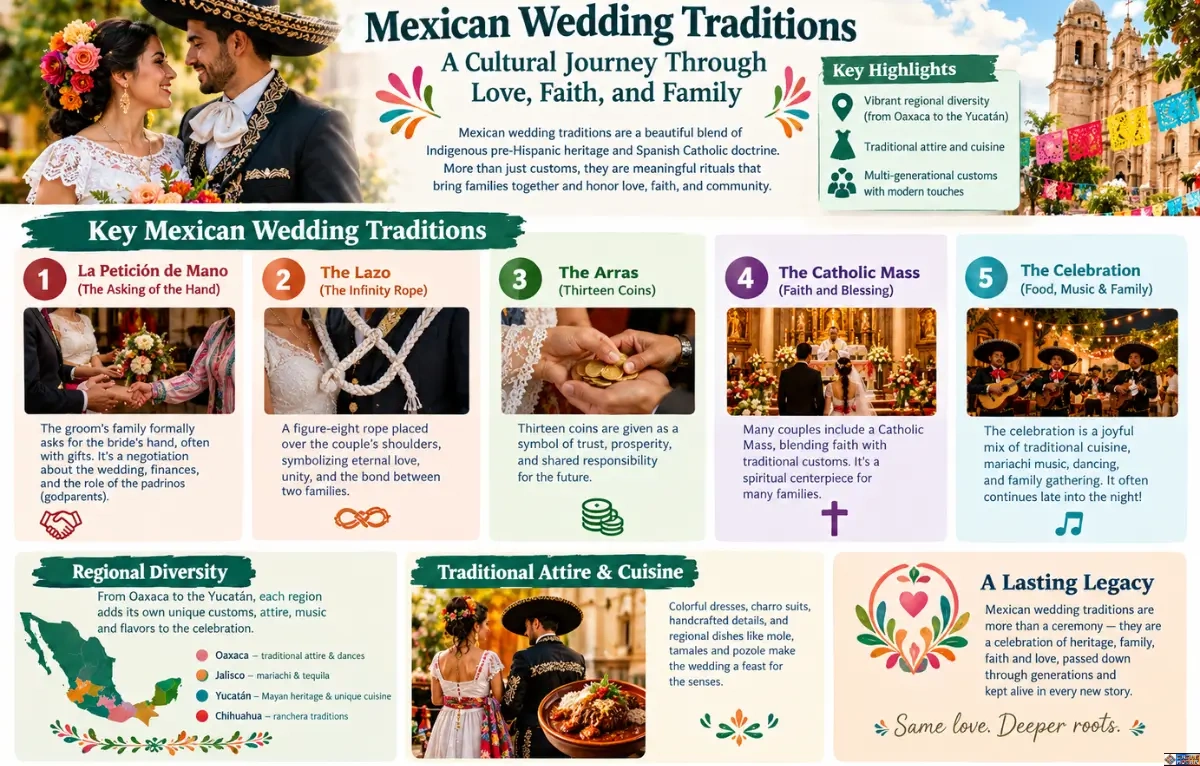
Summary of Mexican Wedding Traditions
Mexican wedding traditions are a rich synthesis of Indigenous pre-Hispanic heritage and Spanish Catholic doctrine. Rather than being purely decorative, these customs—such as la petición de mano (formal marriage proposals and shared community financial planning via padrinos), the lazo (a figure-eight rope symbolizing infinity), and the arras (thirteen coins representing trust and prosperity)—serve active communal and spiritual roles.
Key Highlights: The text illuminates the vast regional diversity across Mexico (from Oaxaca to the Yucatán), details vibrant traditional attire and cuisine, and illustrates how modern couples continue to honor multi-generational customs alongside contemporary additions.
What Are Mexican Wedding Traditions?
I’ve sat through enough Mexican weddings now, some as a guest, some as a researcher with a notebook I tried to keep out of sight, that I stopped thinking of them as simple “customs” a while back. They’re closer to inherited choreography. Everyone in the room, from the abuela in the front pew to the cousin who’s had two tequilas before the vows even start, knows their part. These aren’t a single script, either. They shift from state to state, from a ranch outside Guadalajara to a courtyard in Mérida, but certain threads run through nearly all of them: family, faith, and a stubborn refusal to let the party end early.
What strikes me most, every single time, is how little of it is decorative. The lasso draped over a couple’s shoulders isn’t just pretty rope. The thirteen coins passed hand to hand aren’t just coins. Mexican wedding traditions carry weight because someone, generations back, decided that love needed witnesses and objects to hold it accountable. That’s what I want to walk through here: not just what happens at these weddings, but why.
I should say up front that I’m not neutral on this. I think a lot of modern weddings, in the US especially, have been sanded down into something photogenic but hollow. What I love about these ceremonies is the opposite instinct. A coin isn’t a prop here. A godparent isn’t a title on a program. Everything in this framework is asked to do actual work, and that’s rare enough now that it’s worth slowing down for.
The Historical Roots of Mexican Wedding Traditions
Mexican wedding traditions didn’t spring from one source. They’re a merger, sometimes an uneasy one, between Indigenous ritual and Spanish Catholic doctrine, forced together starting in the 1500s and reshaped by nearly five centuries of local invention.
Before the conquest, Aztec, Maya, and other Indigenous nations across what’s now Mexico had their own marriage rites, and some were far more elaborate than what survives today. Aztec ceremonies, for one, involved tying the groom’s cloak to the bride’s blouse, a physical knot representing a marital bond. That single image is almost certainly the ancestor of the lasso ritual still used at weddings today.
Then came the Spanish, and with them Catholic sacrament, confession, dowries, and a rigid church calendar dictating when marriages could and couldn’t happen. Rather than erase Indigenous practice, the two traditions tangled together over time. You can see the seam if you look closely: a Catholic Mass on one hand, a coin ceremony with clear pre-Columbian echoes on the other.
I find that layering more interesting than either tradition standing alone. If you want to see how other cultures handled this same collision of empire and ritual, I’ve written more broadly about cultural marriage traditions elsewhere on the site.
There’s a detail most articles skip that I think matters: the Catholic Church, in the earliest colonial decades, actively discouraged mixed unions between Spaniards and Indigenous people, even while missionaries pushed Indigenous converts toward Catholic marriage rites. That contradiction shaped a lot of what came next.
Communities absorbed the church’s ceremony while quietly keeping older customs alive at home, sometimes in the same week, sometimes at the same event. By the 1700s, a fused version, part Mass, part inherited ritual, had become the norm across most of central and southern Mexico, and it’s essentially the template still used today.
Pre-Wedding Customs: La Petición de Mano
Long before anyone sends invitations, there’s a step a lot of outsiders don’t know about: la petición de mano, or “the asking of the hand.” Traditionally, the groom’s parents visit the bride’s family, formally, sometimes bearing gifts, and ask for her hand in marriage. It’s not a suggestion. It’s a negotiation dressed up as courtesy, and in some rural communities it still works that way, with real discussion about where the couple will live, how the wedding will be paid for, and who the padrinos and madrinas, or godparents, will be.
Padrinos aren’t just an honorary title, either. They’re assigned specific financial and ceremonial duties: one couple might pay for the flowers, another for the lazo, another for the arras. It spreads the cost of the wedding across an entire extended family, which, frankly, strikes me as more practical than a lot of Western wedding customs I’ve covered.
I remember sitting in a kitchen in Michoacán while a mother-in-law-to-be explained, half in Spanish and half in gestures, exactly which cousin would be paying for the band and which would be covering the flowers. There was coffee going cold on the table and a rooster making noise somewhere outside, and nobody seemed rushed at all. That unhurried, communal negotiation is as much a part of the tradition as anything that happens at the altar.
The Ceremony: Lazo and Arras Rituals
This is where Mexican wedding traditions get visually distinctive, and where most photographers linger.
The lazo is a decorative rope, sometimes a rosary, sometimes ribbon, occasionally a literal loop of flowers, draped in a figure-eight around the shoulders of the bride and groom partway through the Mass. It’s usually placed by the padrinos de lazo once the couple has exchanged vows, and it stays there for the rest of the ceremony. The shape matters. A figure eight has no beginning and no end, which is exactly the point: infinity, unbroken.
Then there’s the arras, thirteen gold or gold-plated coins the groom presents to the bride, usually cupped in his hands and poured into hers. Thirteen isn’t arbitrary. In Catholic tradition it represents Christ and his twelve apostles, though I’ve also heard older relatives explain it as a promise: the groom trusting his wife with the household’s wealth, and by extension, its future. Whatever the coins mean to a given family, the ritual itself has stayed remarkably steady for centuries.
The coins themselves are usually kept afterward, tucked into a small decorative box or purse called an arras box, and plenty of families pass that same set down to their children when it’s their turn to marry. I’ve handled a few of these boxes during interviews, and there’s something almost startling about holding coins that have sat in three or four generations’ worth of hands. They’re worn smooth at the edges in a way new coins never are.
Traditional Wedding Attire and Its Symbolism
Attire in Mexican wedding traditions carries more meaning than a lot of visitors realize, and it’s rarely just about looking good for photos.
Brides in more traditional or rural ceremonies sometimes wear regional dress instead of a white gown, especially in Oaxaca or the Yucatán, where embroidered huipiles in bright colors and floral patterns are worn with pride rather than treated as a folkloric costume. Even brides who choose a Western-style white dress often add a rebozo, a woven shawl passed down through female relatives, sometimes across three or four generations.
Grooms, meanwhile, frequently wear a charro suit: fitted trousers, an embroidered short jacket, and sometimes a wide-brimmed sombrero, all rooted in the dress of Mexican horsemen and landowners from the 1800s. It’s sharp, it’s formal, and it says something specific about heritage that a rented tuxedo simply doesn’t.
Color choices matter more than outsiders tend to assume, too. Deep reds and golds show up constantly in accessories, sashes, and floral arrangements, largely because they’re read as colors of prosperity and passion rather than mourning or caution, the way certain colors are read elsewhere.
I’ve noticed brides in Puebla lean toward embroidered florals with sharp, saturated color, while ceremonies in more Europeanized cities like Mexico City often stick closer to a conventional white-and-ivory palette. Neither approach is more “authentic” than the other, whatever some purists might argue.
Reception Traditions: Mariachi, Money Dances, and Toasts
If the ceremony is solemn, the reception is the opposite. Loud, warm, occasionally chaotic in the best way.
Mariachi bands are close to mandatory. Live horns and violins carry the couple from the church steps to the reception hall, and they’ll often keep playing well past midnight. Somewhere in the middle of the night comes la víbora del mar, “the serpent of the sea,” a money dance where guests pin cash to the bride’s dress or dance with the groom in exchange for a donation, often forming a snaking line around the room. It’s part fundraiser, part game, and usually the rowdiest ten minutes of the whole event.
The first dance carries its own small ritual too. In a lot of receptions, the bride dances first with her father before the groom cuts in, and the band will often slow things down deliberately for that handoff. Toasts, meanwhile, usually start with the padrino de honor rather than a best man in the American sense, and it’s not unusual for four or five people to speak before the meal is served. Nobody seems to mind the length. If anything, a short toast list would look like nobody cared enough to talk.
Traditional Mexican Wedding Food and Drink
Food at a Mexican wedding is regional first, formal second. A wedding in Jalisco might serve birria, slow-cooked and smoky, while a coastal wedding leans on ceviche and fresh seafood. Mole, in one of its many varieties, shows up often enough that I’d call it close to a staple at formal Mexican celebrations generally, not just weddings.
Then there’s the wedding cake, frequently paired with, or replaced by, a champurrado or hot chocolate station for guests who want something warmer once the dancing starts. Tequila and mezcal toasts round out the night, usually offered by the padrinos rather than poured freely at every table.
Late-night food service is its own small tradition on top of the main meal. It’s common for a second, lighter course, tacos, pozole, or tamales, to appear around midnight once the dancing has worn people down and the first round of alcohol has settled. I’ve always thought this is the smartest part of the whole event. Nobody goes home hungry, and nobody has to leave the party early just to eat.
Regional Variations in Mexican Wedding Traditions
Mexico is not one culture wearing a single wedding dress, and treating it that way flattens something real. Wedding customs in Oaxaca lean heavily on Indigenous textile traditions and community-style celebration. In the Yucatán, Maya heritage shapes both the language used in blessings and the food served afterward. Northern states like Sonora and Chihuahua, with their ranching history, tend toward charro attire and country-style receptions with live banda music instead of mariachi.
Even the lazo and arras rituals, common as they are, aren’t universal. Some coastal and northern families skip them entirely in favor of simpler civil ceremonies, especially among younger, more urban couples.
Chiapas offers a different variation again, with some Indigenous Tzotzil and Tzeltal communities incorporating candle-lighting rituals and extended blessing ceremonies conducted partly in Indigenous languages rather than Spanish. Veracruz weddings, meanwhile, lean into son jarocho music and coastal seafood spreads that would look completely out of place at a highland ceremony in the same country. I think this is the part that gets lost when people talk about “Mexican culture” as one thing. It never has been.
Mexican Wedding Traditions Compared to Other Cultures
Cross-cultural comparison is where this gets genuinely interesting to me, and it’s part of why I keep circling back to this topic. Coin and cloth rituals aren’t unique to Mexico. Ancient Roman wedding traditions used their own version of symbolic joining, sometimes centuries before the Aztec cloak-tying ritual took shape, and the Roman wedding night ritual carried its own thresholds and blessings that Mexican ceremonies never adopted.
The red clay tribe wedding traditions of the Himba in Namibia use ochre and cattle instead of coins and cloth, but the underlying logic, binding two families through shared material wealth, isn’t so different. Italian wedding traditions for the bride include their own coin customs, and I’d argue the crown family wedding traditions found in Orthodox ceremonies do something remarkably close to what the lazo does: crowning a union rather than simply blessing it.
If you like falling down this kind of rabbit hole, and I do, I’ve put together a broader look at the best wedding traditions worldwide, a deeper anthropological read on marriage rituals in different cultures anthropology, and a shorter piece asking what wedding traditions around the world actually have in common once the regional decoration gets stripped away. For an outside perspective on this exact topic, Brides magazine’s own overview of Mexican wedding traditions is worth a look too.
Modern Mexican Weddings: Old Meets New
Younger couples aren’t abandoning these traditions so much as editing them. I’ve seen brides pair a designer gown with a hand-embroidered rebozo from her grandmother’s village. I’ve seen grooms skip the charro suit for a modern tuxedo but keep the arras ceremony because their mother insisted, and honestly, because they wanted it too, once pressed.
What doesn’t change, in my experience, is the underlying instinct: that a wedding is a family event before it’s a personal one, and that ritual objects, whether coins, cloth, or a wide-brimmed hat, do work that words alone can’t.
I’ll also say this, and it’s a slightly odd note to end a history section on: the wedding hashtag has become its own strange little tradition. Couples now coin a phrase blending both surnames, print it on napkins, project it on a wall behind the dance floor. It’s new, it’s a little corny, and I still think it fits. These families have always found ways to mark a union with something visible. A hashtag is just the newest version of a coin.
The Evolution of Mexican Wedding Celebrations
In recent years, Mexican weddings have increasingly embraced a “hybrid” approach that bridges ancestral heritage with modern lifestyle values. Contemporary couples are increasingly blending high-end couture with localized artisanal craftsmanship—such as pairing sustainable, ethically sourced designer gowns with bespoke, hand-woven rebozos or authentic embroidered textiles passed down through generations. Furthermore, as destination weddings and multicultural unions become more frequent, modern planners are integrating bilingual ceremonies, digital keepsake registries, and eco-friendly reception practices, proving that these centuries-old rituals remain remarkably adaptable while keeping family, faith, and community at their core.
Frequently Asked Questions About Mexican Wedding Traditions
What is the lasso ritual in a Mexican wedding?
The lasso, or lazo, is a decorative rope, rosary, or ribbon draped in a figure-eight shape around the shoulders of the bride and groom during the ceremony, usually placed by the padrinos de lazo right after the vows. It symbolizes the couple’s union as unbreakable, echoing pre-Columbian cloth-binding rituals that predate Spanish colonization by centuries.
What are the 13 coins in a Mexican wedding?
The thirteen coins, called arras, are typically gold or gold-plated and presented by the groom to the bride during the ceremony. In Catholic symbolism they represent Christ and the twelve apostles, though many families read them as a pledge of trust, with the groom placing the household’s future prosperity in his wife’s hands.
Why do guests pin money on the bride at a Mexican wedding?
This custom, part of la víbora del mar, is a reception tradition where guests dance with the bride or groom in exchange for pinning cash to their clothing or contributing to a shared pot. It works as both entertainment and a practical way for the community to help fund the couple’s new life together.
What do Mexican brides wear if not a white dress?
While white gowns are common, especially in urban and modern ceremonies, many brides in Oaxaca, the Yucatán, and other regions wear embroidered huipiles or add a rebozo, a woven shawl often inherited from mothers or grandmothers, over a Western-style dress. The choice usually reflects regional heritage as much as personal taste.
How long do traditional Mexican wedding celebrations last?
Celebrations commonly run well past midnight, sometimes into the early morning, with mariachi or banda music, multiple food courses, and the money dance all stretching the reception far beyond a typical few-hour event. Some rural celebrations continue across two full days.