
 By Culture Expert
Quick Summary
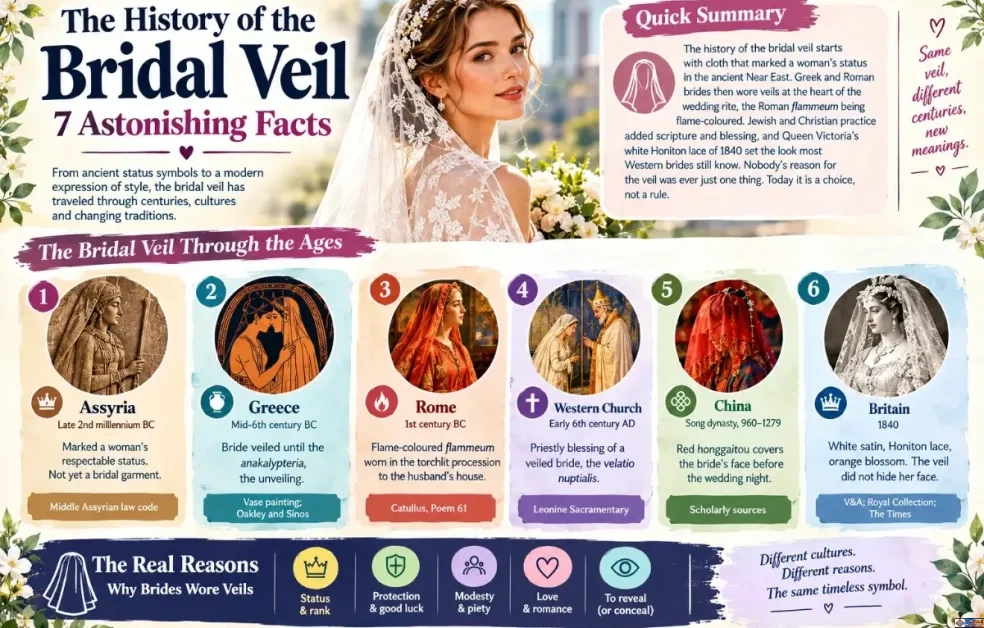
The history of the bridal veil starts with cloth that marked a woman’s status in the ancient Near East. Greek and Roman brides then wore veils at the heart of the wedding rite, the Roman flammeum being flame-coloured. Jewish and Christian practice added scripture and blessing, and Queen Victoria’s white Honiton lace of 1840 set the look most Western brides still know. Nobody’s reason for the veil was ever just one thing. Today it is a choice, not a rule.
Ask five websites why brides wear veils and you will get five confident answers. Evil spirits. Modesty. A father handing over his daughter. A groom who needed to check what he was getting. They can’t all be right, and a couple of them barely appear in the record at all.
That is maddening if you are planning a ceremony and want to know what you are actually choosing. It is just as maddening if you simply love a good origin story and keep tripping over the same recycled one. I understand the frustration. The history of the bridal veil has collected so much blog-post folklore that the real evidence gets buried underneath it.
So here is what this piece does. It follows the veil through sources you can point to: a Greek vase, a Latin wedding hymn, two scenes in Genesis, a royal wedding reported in the newspapers. Where the story turns into guesswork, I say so. I think the true version is stranger than the folklore, and better. Here at Culture Mosaic, that is the whole job.
One honest note before we start. I have not run an original survey or conducted interviews for this article, and I won’t dress up someone’s shop blog as research. Every factual claim traces to a museum, a scripture text, a scholarly article or a period newspaper report, all listed at the end.
What Is a Wedding Veil?
A wedding veil is a length of fabric, tulle, lace or silk, worn on the head and sometimes drawn over the face during a wedding. That is the dictionary part. The historical part is messier. Across more than three thousand years the same object has stood for status, luck, piety, obedience, romance and, lately, plain good taste.
Hold that thought. Every section below is really one question asked in a different century: what is this cloth for?
The History of the Bridal Veil Timeline at a Glance
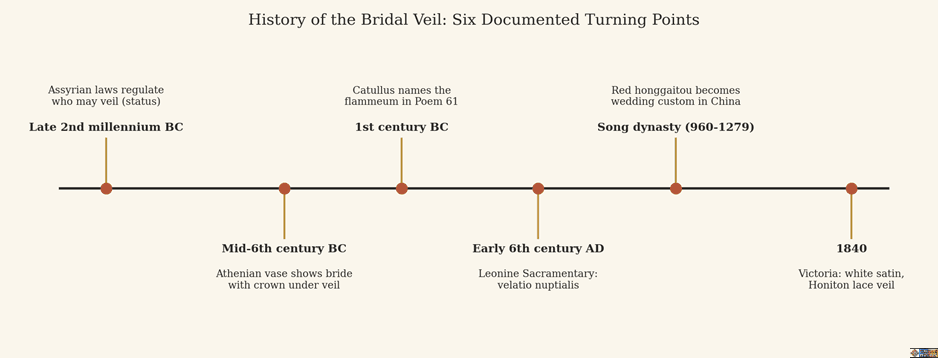
Original diagram by Culture Mosaic. Dates follow the sources listed at the end.
| When | Where | What the veil did | Where the evidence sits |
|---|---|---|---|
| Late 2nd millennium BC | Assyria | Marked a woman’s respectable status. Not yet a bridal garment. | Middle Assyrian law code |
| Mid-6th century BC | Athens | Bride veiled until the anakalypteria, the unveiling. | Vase painting; Oakley and Sinos |
| 1st century BC | Rome | Flame-coloured flammeum worn in the torchlit procession to the husband’s house. | Catullus, Poem 61 |
| Early 6th century AD | Western Church | Priestly blessing of a veiled bride, the velatio nuptialis. | Leonine Sacramentary |
| Song dynasty, 960–1279 | China | Red honggaitou covers the bride’s face before the wedding night. | Scholarship summarised in the Honggaitou entry |
| 1840 | Britain | White satin, Honiton lace, orange blossom. The veil did not hide her face. | V&A; Royal Collection; The Times |
1. Where Did the Tradition of a Bridal Veil Come From? A Status Symbol First
Start with the least romantic fact in the whole story. The oldest written rules about veiling that I know of are not about brides at all. The Middle Assyrian laws, from the late second millennium BC, regulate who may veil and who may not. A respectable woman was expected to. A prostitute was forbidden to, under harsh penalty.
Veiling, then, was a public statement. Rank. Respectability. Whose household you belonged to.
That matters for our question. Popular articles love to say the bridal veil “began in Mesopotamia” as a wedding custom. I can’t find a source that supports that wording. What the evidence shows is a world where a covered head already meant something before anybody sewed it into a wedding. Marriage was the moment a woman’s status changed, so it is no shock that the cloth of status migrated to the day status changed.
The honest answer to the origin of the bridal veil is this: the veil is older than the bridal veil. The history of the bridal veil proper begins where the first clearly bridal examples turn up, in Greece and Rome.
2. Bridal Veils in Ancient Rome and Greece: Flame, Cloud and Unveiling
Greece: the unveiling is the ritual
In Athens the moment of unveiling gave the ritual its name, anakalypteria. Archaeology Odyssey describes a mid-sixth-century BC vase by the Amasis Painter in which the bride holds the crown she wore beneath her veil before it was removed. Classicists still argue over exactly when in the day the unveiling fell, but the vase scenes suggest she kept the veil on until the last possible moment.
Not every Greek bride veiled, either. A study in the Classical Quarterly notes that the Spartan wedding gave the veil no role. So the Greek bridal veil was local, not universal. Worth remembering whenever someone announces what “brides in ancient Greece” did.
Rome: the flammeum
Rome gave the veil its best costume. The flammeum, named for its flame colour, a deep yellow-orange, was the signature garment of the Roman bride. She wore it in the torchlit procession from her father’s house to her husband’s, the deductio. According to scholarship summarised by the New Liturgical Movement, that veil and that procession marked her passage from betrothal to wedlock.
Romans also connected it to the veil of the Flaminica Dialis, the priestess-wife who could never divorce her husband, which made it a good omen for lifelong fidelity. And there is a pun I love. The verb nubere, “to marry”, sits close to nubes, “cloud”. The bride was “clouded over”. Catullus mentions the flammeum in his wedding hymn, Poem 61, so we are not relying on gossip. A poet of the first century BC treated it as standard wedding kit.
What about the famous claim that the flame colour scared off evil spirits? It is everywhere. Marie Claire UK ran it as a “creepy” truth. I’d call it a popular theory, not a documented Roman belief. The ancient evidence I can point to stresses omen, fidelity and modesty. Spirits may well have been in the mix. I just can’t show it. If you want the wider Roman picture, our guide to Ancient Roman Wedding Traditions covers the rites, and what happened once the veil came off that evening is in the Roman Wedding Night Ritual piece.
3. Wedding Veil Meaning in the Bible: Rebekah, Leah and the Bedeken
Genesis gives us two veil scenes, and Jewish custom still acts both of them out.
First, Rebekah. Spotting Isaac across a field, she “took her veil and covered herself” (Genesis 24:65). The two had never met. This was a match arranged at a distance, and her veil is the shy, practical gesture of a woman about to meet her husband.
Second, Leah. Jacob served seven years for Rachel, then woke up married to her sister, because the bride delivered to him was veiled (Genesis 29:23-25). Put the two stories together and you get the bedeken, Yiddish for “veiling”, in which the groom lowers the veil over the bride’s face before the chuppah. The National Jewish Outreach Program reads the first story as the reason for veiling and the second as the reason the groom does it: he is confirming he has the right bride. A Jewish Theological Seminary commentary offers a gentler reading, that the veil signals a bride keeps her own identity even inside the union.
So what does the Bible actually say about a bride wearing a veil? It describes veiled brides. It never issues a wedding rule. Everything after that, in Jewish and Christian practice alike, is interpretation, and good interpretation, but interpretation.
4. Wedding Veil Meaning in Catholic Tradition: From Flammeum to Blessing
Here the scholars disagree, and I enjoy that.
Tertullian, writing around the turn of the third century, mentions the flammeum and the wedding torch as marks of a properly conducted marriage. By the early sixth century, the Leonine Sacramentary names a rite, the velatio nuptialis, the veiling for marriage, in which a priest blessed the veiled bride.
Did that Christian veiling grow out of the pagan flammeum? Kenneth Stevenson sees a “Christianizing” of the old custom. Philip Reynolds argues the Christian veil, applied by the priest with a blessing, was a separate thing. I lean toward Reynolds’s caution. A shared ancestry is plausible, but a straight line has not been proven, and I would rather say that than tell you a tidy story.
What about today? As far as I know, the current Catholic marriage rite does not require a bridal veil, so what you meet in practice is parish custom and family habit. A Catholic Review feature from Baltimore, for example, describes a father lifting his daughter’s blusher at the altar. Spain’s lace mantilla is another strand, and it echoes through Spanish-influenced customs such as those in Mexican Wedding Traditions. Italian Wedding Traditions for Bride shows how another Catholic country frames the bride’s day. For the wider Christian picture, see What Are Christian Wedding Traditions. If you are marrying in a church, ask your priest. Parishes differ.
5. The History of the Wedding Veil Tradition: How Queen Victoria Rewrote It
The history of the bridal veil has many chapters, but for most Western brides the veil’s look comes from one morning: 10 February 1840.
The Victoria and Albert Museum explains that Victoria chose white satin and a large piece of handmade Honiton lace, partly because skilled lacemakers were being squeezed by machine-made textiles. White was the best colour to show the lace off. The Textile Research Centre in Leiden, writing about the Royal Collection’s dress, notes that more than 200 people worked on the lace under the supervision of Jane Bidney, Lacemaker in Ordinary to the Queen. The veil matched the flounce of the dress. Victoria wore a wreath of orange blossom, a symbol of fertility and virtue, instead of a tiara.
Now the detail I find most striking. The Times reported that the lace veil was thrown over her wreath, but not so as to hide her face. The most famous bridal veil in British history was a flourish, not a screen. That should make us cautious about calling the face-covering blusher the “original” form. At one of the best-documented weddings in history, it wasn’t there.
A Romantic Frame of Mind
The V&A traces what happened next. Fashion plates, adverts, valentine cards and sheet music sold the image of the white dress and lace veil as a model of romantic propriety and purity. If a bride was marrying for the first time and could afford it, white became the norm. That is the romantic frame the veil still sits in. Royal weddings have kept rewriting the script ever since, as Crown Family Wedding Traditions explores, and the story of why the dress itself turned white is picked up in Modern Cultural Wedding Dresses.
6. Veils Around the World: The White Tulle Version Is One Chapter
The history of the bridal veil outside Europe is longer and more varied than the Western white veil suggests, which is a very recent chapter. Here are four traditions side by side, using only what the sources let me say.
| Tradition | Name | Colour | What it signals | Source |
|---|---|---|---|---|
| Athens | Anakalypteria (the unveiling) | Not specified in sources | Passage from maiden to wife; the unveiling closes the rite | Archaeology Odyssey; Oakley and Sinos |
| Rome | Flammeum | Flame yellow-orange | Transition to wedlock; omen of lasting fidelity | NLM summary; Catullus 61 |
| Jewish custom | Bedeken | Not specified in sources | Groom confirms the right bride; bride’s own identity | NJOP; JTSA |
| Han Chinese | Honggaitou | Red | Good luck and joy; covers the bride before the wedding night | Honggaitou entry (Song-dynasty custom) |
| Victorian Britain | Lace veil | White | Romantic propriety and purity | V&A; Royal Collection |
The Chinese honggaitou deserves a moment. Veils have been used in China since the Han dynasty, and the custom of the red bridal covering can be traced to the Song. In traditional Chinese culture red means luck and celebration, while white is tied to mourning, which is a useful reminder that “bridal white” is a regional habit.
Plenty of cultures also put the symbolism somewhere other than the head. Celtic ceremonies, for instance, lean on the hands and cords of handfasting, as in celtic wedding traditions and customs and Irish Wedding Traditions. Cherokee-rooted ceremonies use their own objects and rites, which you can read about in Native American Cherokee Wedding Traditions and Red Clay Tribe Wedding Traditions. For a global sweep, try Best Wedding Traditions Worldwide, and for the anthropology behind why rituals like these recur, Marriage Rituals in Different Cultures Anthropology.
Veil Myths, Weighed Against the Evidence
| The claim | What the sources support | My verdict |
|---|---|---|
| The flame colour scared off evil spirits | Ancient evidence points to omen, fidelity and modesty. The spirits version is a modern popular retelling. | Plausible folk belief. Not documented. |
| The bridal veil began in Mesopotamia | The Assyrian laws regulate veiling by status. They do not describe a wedding garment. | Misleading. Veiling began there; the bridal veil did not. |
| Queen Victoria invented the bridal veil | Veils were centuries old. Victoria popularised white and Honiton lace. | False. She changed the look, not the custom. |
| The Bible requires a bride to wear a veil | Genesis describes veiled brides. It sets no wedding rule. | False. It is precedent, not command. |
7. Who Lifts the Veil at a Wedding, and Do You Need One at All?
Who lifts the veil at a wedding?
Two conventions dominate modern Western weddings. The bride’s father, or whoever escorts her, lifts the veil as he gives her away at the altar. Or the veil stays down until the end, and the groom lifts it just before the kiss. Both are etiquette, not ancient law. I will say this for the second one: it rhymes with the Greek unveiling that closed the rite, and with the Jewish bedeken where the groom is the one handling the cloth.
What is the rule of wedding veils?
There isn’t one. No statute, no scripture, no church law that I know of. What exists is convention. Veil length has traditionally tracked the formality of the occasion, the blusher goes up or stays down depending on the couple, and plenty of brides take the veil off after the photographs so they can actually dance.
Why do some brides not wear a veil?
For all sorts of reasons. It does not suit the dress. It tangles in a breeze. The “handover” symbolism sits wrong with a couple who see marriage as a partnership. The V&A itself suggests the symbolism of the white wedding look may have shifted again for contemporary brides, and I think that is healthy. If you are building a ceremony without a religious script, our guide to wedding ceremony rituals non religious is full of ideas that carry meaning without a single yard of tulle.
If you do want meaning in your look, here are four ideas. Three are conventional, and one is not.
- Keep a blusher, and choose who lifts it. Father, mother, partner, best friend. The choice is the symbol.
- Wear heirloom lace. Victoria kept re-using her wedding lace for decades.
- Skip the veil for a comb, flowers or a wreath. Victoria’s own orange-blossom wreath did a lot of the work.
- The wildcard: go flammeum. A flame-orange scarf or wrap, worn in the Roman way for the walk to the reception. Nobody will confuse it with a mass-market veil, and you can tell guests exactly why.
What Does a Veil Symbolize, and What Is the Purpose of a Veil?
Ask the Romans and the veil is an omen. Ask Genesis and it is a shy gesture, then a trick. Ask the Church and it is a blessing. Ask Victoria’s lacemakers in Devon and it is a livelihood. Ask a modern bride and it might be a tradition she loves or a fuss she doesn’t.
What strikes me is that the history of the bridal veil is a history of reinvention. The veil survives precisely because it never meant one thing. A cloth that can carry status, luck, modesty and romance will outlast any single reason someone invents for it.
If you are planning a ceremony, or just can’t stop being curious, the next stop is What Traditions Are Common in Weddings, and then Cultural Marriage Traditions for how other communities answer the same question: what should we wear, and what does it say about us? Pick one thread and pull. I suspect you will end up somewhere you didn’t plan to go.
Frequently Asked Questions About the History of the Bridal Veil
Why do brides wear veils?
There is no single reason, and that is the honest answer. In the ancient Near East veiling marked a woman’s respectable status. Greek and Roman brides wore veils as part of the wedding rite, and the Roman flammeum was linked with omen and lasting fidelity. Jewish and Christian traditions added scripture and blessing, and Queen Victoria’s 1840 lace veil made the white veil the Western default. Many modern brides wear one simply because they love the tradition.
What does the Bible say about a bride wearing a veil?
The Bible describes veiled brides but does not command the practice. In Genesis 24:65 Rebekah covers herself with a veil when she first sees Isaac. In Genesis 29:23-25 Jacob marries the veiled Leah instead of Rachel. Jewish custom builds on these scenes in the bedeken, where the groom lowers the veil over the bride before the ceremony. Christian meaning has been layered on later, but neither verse sets a wedding rule.
Who lifts the veil at a wedding?
Two customs are common today. Either the bride’s father, or whoever escorts her, lifts the veil as he gives her away at the altar, or the veil stays down until the end of the ceremony and the groom lifts it before the kiss. Some couples choose a parent, a friend or the bride herself. These are modern etiquette conventions rather than ancient laws, so choose whichever fits the meaning you want.
Why do some brides not wear a veil?
Reasons vary. Some feel a veil clashes with the dress or hairstyle. Others dislike the symbolism of being handed from one household to another. Some simply find it impractical for dancing or windy venues. Since no law, scripture or church rule requires a veil, brides often choose a flower crown, comb, hat or nothing at all. The V&A suggests the meaning of the white wedding look may have changed again for contemporary brides.
What is the rule of wedding veils?
There is no formal rule. What exists is convention: veil length has traditionally followed the formality of the wedding, a blusher can be worn up or down, and some brides remove the veil after photographs. Religious traditions such as the Jewish bedeken may involve a specific veiling moment, but secular and most church weddings leave the decision to the couple.
Sources and Further Reading
1. Genesis 24:60-67 and 29:16-30. Hebrew Bible; text via Sefaria and standard English translations.
2. Catullus, Poem 61 (Epithalamium for Manlius and Junia), mentioning the flammeum. Latin primary source.
3. Victoria and Albert Museum. “The Victoria connection.” https://www.vam.ac.uk/articles/the-victoria-connection
4. Victoria and Albert Museum. Honiton lace wedding veil, object record O1223045, which quotes The Times on Queen Victoria’s veil, 1840. https://api.vam.ac.uk/v2/object/O1223045
5. Royal Collection Trust. Queen Victoria’s wedding dress (RCIN 71975), discussed by the Textile Research Centre, Leiden: “Lovely in white” https://www.trc-leiden.nl/trc/index.php/en/blog/1051-lovely-in-white
6. Textile Research Centre, Leiden. “Queen Victoria’s Wedding Lace,” quoting The Western Times, 15 February 1840. https://trc-leiden.nl/trc-needles/individual-textiles-and-textile-types/secular-ceremonies-and-rituals/queen-victorias-wedding-lace
7. Oakley, J. H. and Sinos, R. H. The Wedding in Ancient Athens. University of Wisconsin Press, 1993.
8. Biblical Archaeology Society. “Tying the Knot: Marriage in Ancient Greece.” Archaeology Odyssey 7:5, September/October 2004. https://old.biblicalarchaeology.org/node/118114
9. Cairns, D. “Off with her AIDOS: Herodotus 1.8.3-4.” The Classical Quarterly (Cambridge University Press), discussing the Athenian and Spartan veil. https://www.cambridge.org/core/journals/classical-quarterly/article/abs/off-with-her-herodotus-1834/281ED37291DE37AE6AD5CD18CB34F73F
10. New Liturgical Movement. “A History of the Care-Cloth,” discussing the flammeum, Tertullian, the Leonine Sacramentary and the Stevenson and Reynolds positions. https://www.newliturgicalmovement.org/2023/09/care-cloths-mystagogical-value-of.html
11. Reynolds, P. L. Marriage in the Western Church. Brill, 1994.
12. Jewish Theological Seminary. “Rebecca’s Veil of Independence.” https://www.jtsa.edu/torah/rebeccas-veil-of-independence/
13. National Jewish Outreach Program (NJOP). “Placing a Veil.” https://njop.org/placing-a-veil/
14. Catholic Review (Archdiocese of Baltimore). “Blusher is symbolic for bride.” https://www.archbalt.org/blusher-is-symbolic-for-bride/
15. Wikipedia. “Veil” (Middle Assyrian law and Roman flammeum summaries; tertiary source, used as a pointer to the primary law code). https://en.wikipedia.org/wiki/Veil
16. Wikipedia. “Honggaitou” (Han and Song dynasty history; tertiary source). https://en.wikipedia.org/wiki/Honggaitou
17. Marie Claire UK. “So This Is Why Brides Really Wear Veils On Their Wedding Day.” Cited only as an example of the popular evil-spirits claim. https://www.marieclaire.co.uk/news/fashion-news/why-brides-wear-veils-on-their-wedding-day-12263
18. Brides. “Wedding Traditions Debunked: The Veil.” https://www.brides.com/story/wedding-traditions-debunked-the-veil