
 By Culture Expert

Overview Quick Summary
It is 11:47 p.m. The laptop is shut. Your head is not.
Tomorrow’s meeting replays. The email you never answered replays. Even the laundry draped over the chair gets a turn. The day ended on the calendar and carried on inside your skull. I’d call that the quiet tax of modern life, and midnight reset rituals are the cheapest way I know to stop paying it.
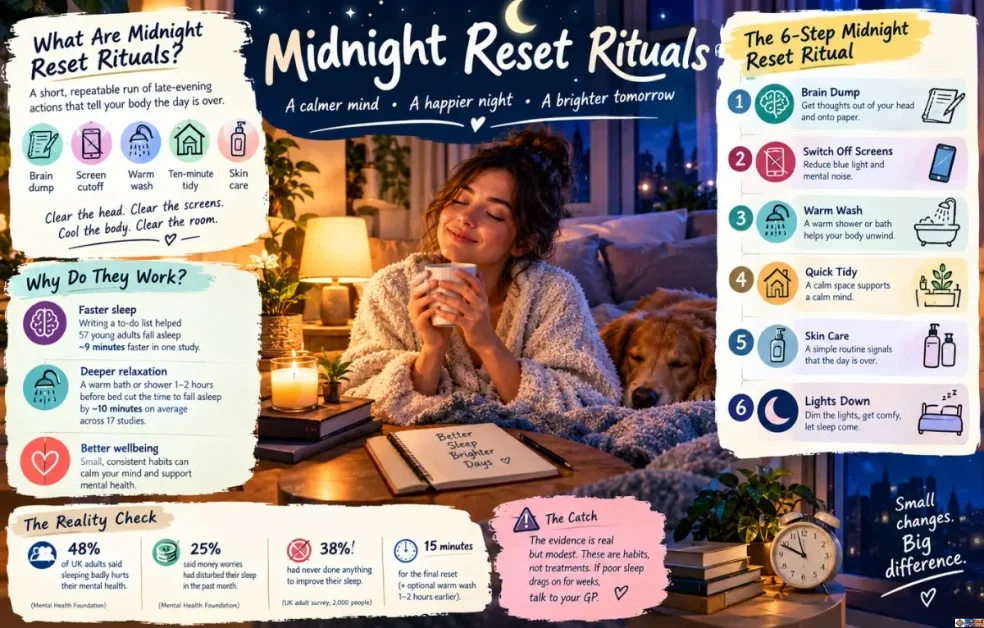
You are far from alone. In the Mental Health Foundation’s surveys, nearly half of UK adults (48%) said sleeping badly hurts their mental health, and a quarter said money worries had disturbed their sleep in the past month.[1] Meanwhile a separate survey of 2,000 UK adults found 38% had never done anything to improve their sleep.[2]
So here is the promise. No miracle, no spend. Just what the research actually says about midnight reset rituals, where the traditions behind them come from, and a plan short enough that you’ll still be doing it in March. Six truths sit at the heart of it, numbered below.
What Are Midnight Reset Rituals, Really?
A midnight reset ritual is a deliberate sequence you perform between “I’m finished” and “I’m asleep”. Clear the head. Clear the screens. Cool the body. Clear the room. That’s the whole idea. It isn’t a skincare haul, and it isn’t an aesthetic.
“Midnight” is a mood, not a time. If you work nights, your midnight might arrive at 7 a.m. The point is the sequence, not the hour. And I’ll take a stand here: literal midnight is too late for most people. If you start your reset at 12:00, you are already borrowing sleep from tomorrow.
Plenty of writers have mapped out midnight reset rituals under friendlier names. One UK supplement brand calls its version a “Rest Ritual” and covers mind, body and bedroom.[3] It is a decent outline, but the company sells the products it mentions, so I read it as a sketch, not as proof. The proof for midnight reset rituals comes later in this piece.
Why Your Brain Refuses to Power Down
Nights are loud in a particular way. The distractions of the day fall away and whatever you’ve been avoiding walks in and sits on the end of the bed.
Work makes it worse. In the same Mental Health Foundation research, 37% of working adults said their job (workload, colleagues, fear of losing it) reduces how much control they feel they have over their sleep.[1] When your desk is a laptop on the sofa, the boundary between “office” and “pillow” dissolves entirely. There’s more on that blurred-edge lifestyle in Digital Nomad Culture, and the sleep cost is the part nobody puts in the brochure.
The pain is real, then. The fix, midnight reset rituals, is smaller than you’d think.
The History of Nocturnal Reset Customs
Before electric light, the night had a shape. The historian Roger Ekirch, drawing on diaries, court papers, medical texts and prayer books, argued in a 2001 article in the American Historical Review that many people in early modern Britain slept in two stretches, a “first sleep” and a “second sleep”, with a waking interval between them.[4] The first reference he found sits in a 1697 court record from a travelling assize. People used the gap to pray, talk, eat, even take medicine.[5]
Ekirch also found that by the early nineteenth century the first sleep had begun to swallow the second.[5] He ties that shift to brighter evenings and changing attitudes towards sleep.[4]
A caution, because I don’t trust tidy stories about the past. Other historians have since questioned how universal segmented sleep really was.[6] I find Ekirch’s evidence striking, but “everyone slept in two halves” is a stronger claim than the records can carry. What survives the argument is gentler: the hours around bedtime were once full of small, deliberate customs, and ours are mostly full of a phone, which is why midnight reset rituals feel like a rediscovery rather than an invention.
For wider context on how societies shape the dark hours, see Modern Culture, which looks at how everyday habits spread and stick.
Cultural Midnight Reset Rituals Around the World
Almost every culture has midnight reset rituals of its own, whatever name it uses. These traditional evening wind-down rituals differ in belief and share a structure: a fixed order, a change of state, a clear ending.
In Japan, the evening bath carries more than hygiene. One academic account describes it as a threshold: you wash off the “outside” world and enter the “inside” one.[7] The public bathhouse itself rose to prominence in the Edo period and doubled as a social hub.[8] In the Jewish tradition, the Talmud records Rabbi Yehoshua ben Levi saying the Shema should be recited at bedtime, and later texts treat the night prayer as the individual’s closing act of the day.[9][10] Some modern teachers frame it as a nightly stocktaking, forgiving others and letting go of the day’s grievances.[11] The Ayurvedic abhyanga appears in the wellness-brand guide mentioned above, so I’m flagging that source’s commercial interest rather than leaning on it.[3]
A word on borrowing midnight reset rituals from other cultures. I’d argue you can take the structure freely and the sacred content only if it’s yours. The bath belongs to everyone. A prayer you don’t believe is a costume. That line gets more room in Cultural Appreciation, and the wider map of customs lives in World Cultural Geography, Global Cultural Mosaic and Culture Unveiled.
Midnight Reset Rituals for Burnout Recovery
Let me be careful here, because this is where wellness writing overpromises.
The World Health Organization describes burnout as a syndrome that results from chronic workplace stress that hasn’t been successfully managed. It is classed as an “occupational phenomenon”, not a medical condition, and it has three dimensions: exhaustion, growing mental distance or cynicism about the job, and reduced professional efficacy.[12]
Midnight reset rituals cannot fix a workload. I want that on the record. What it can do is stop the workload following you to bed. For someone running on fumes, midnight reset rituals are a fence, not a cure: a hard edge between the job and the rest of your life, drawn at the same time every night. If the exhaustion is constant, if you feel numb or dread Monday on Thursday, that is a conversation for your GP or occupational health team, not a bath.
How Night Reset Rituals Help Modern Urban Mental Health
Cities compress everything: commutes, deadlines, screens, small flats. I haven’t found a study that tests a specific ritual against urban mental health outcomes, so I won’t pretend one exists. What exists is the broader link, and it is solid. Poor sleep and poor mental health feed each other, which is why the Mental Health Foundation urges treating sleep as central to mental wellbeing.[1]
Midnight reset rituals help here for a plain reason. They are cheap, they need no garden or spare room, and they work inside a rented one-bed. For the wider social picture of how we live now, Modern Society is the companion read.
Evening Reset Routines for Busy Community Leaders
Councillors, organisers, volunteers, the person who runs the food bank and the residents’ group: the unpaid kind of busy never clocks off. My advice is blunt. In your midnight reset rituals, put the brain dump first and make it ruthless. Every promise, every follow-up, every “I’ll ring them tomorrow” goes on paper before you shower. You can’t lead anyone well on four hours of sleep, and nobody is grateful for a martyr.
1. The 10-3-2-1 Rule: A Countdown, Not a Commandment
You’ll see this rule bolted onto midnight reset rituals everywhere. The shorthand: stop caffeine 10 hours before bed, stop big meals and alcohol 3 hours before, stop work 2 hours before, put screens away 1 hour before, and hit snooze 0 times in the morning.
Where does it come from? Not from a trial. It was popularised by the fitness writer Craig Ballantyne and spread through social media and explainer articles.[13][14] I could not find a study that tests the full rule as a package. The individual pieces, though, line up with mainstream advice. The NHS suggests avoiding phones, tablets and computers for an hour before bed and cutting alcohol and nicotine one to two hours before.[15] Estimates of caffeine’s half-life run from roughly three to seven hours, and it varies from person to person.[13][14]
My view: treat it as a dial, not a law. If you sleep fine with a 2 p.m. coffee, ten hours is theatre. If you lie awake at 1 a.m., it is the first thing I’d test.
2. The Brain Dump: Five Minutes That Beat Lying There Worrying
Of all midnight reset rituals, this is the most useful minute-for-minute habit, and the research is oddly specific.
In a Baylor University sleep-lab study, 57 healthy people aged 18 to 30 spent five minutes writing either a to-do list or a list of tasks they’d already finished before bed. The to-do group fell asleep significantly faster, in roughly 15 to 16 minutes against 25 for the completed-tasks group. The more specific the list, the faster they dropped off.[16][17]
Now the honest bit. The study had no “do nothing” control group, so it can’t prove the to-do list helped rather than the completed list hurting.[18] The participants were healthy young adults, so it’s unclear how far the result stretches to people with insomnia, and the researchers called for larger studies.[16] Still, the NHS gives the same tip: if you worry in bed, list tomorrow’s tasks first.[15] Write short, concrete lines. “Email Priya re: invoice” beats “sort admin”.
3. The Warm Shower Trick: Why Heat Makes You Sleepy
It sounds backwards. Heat, then sleep? The trick is the cool-down. About an hour or two before your usual bedtime your core temperature starts to fall, and warm water appears to nudge that process along by stimulating the body’s thermoregulatory system.[21]
A meta-analysis led by Shahab Haghayegh at the University of Texas at Austin pooled 17 studies drawn from more than 5,300 records. Bathing in water of roughly 40 to 42°C (104 to 109°F) one to two hours before bed improved sleep quality and shortened the time to fall asleep by about ten minutes on average.[19][20] Ten minutes in the water was enough. Timing mattered: a bath only 15 minutes before bed was too soon to get the same effect, and a cold shower works against you by warming the body afterwards.[21]
Among midnight reset rituals, this is the one I like most: it asks for nothing but a bathroom. If the hot-water bill worries you, a warm footbath was used in some of the studies too.[22]
4. The Screen Cutoff: Your Phone Is Not Neutral
Picture the glow on a face in a dark room. That small blue-white rectangle is doing more than you’d think.
In an experiment published in PNAS in 2015, 12 adults spent two weeks in a sleep lab reading either a light-emitting e-reader or a printed book before bed. The e-reader readers took nearly ten minutes longer to fall asleep, produced less melatonin, had a later-running body clock and felt less alert the next morning.[23][24] Caveats: the sample was tiny and the reading sessions were long, so I wouldn’t promise anyone a ten-minute gain. But the NHS gives the same direction of travel, an hour screen-free before bed, and it costs nothing to try.[15]
My rule for midnight reset rituals is stricter than the research strictly demands: the phone charges in another room. An alarm clock is a ten-pound problem solved.
5. Reset Your Space Tonight, Not Tomorrow
Is it better to reset your space at night or in the morning? No study I’ve found tests that head-to-head. What does exist is a 2010 study from psychologists Darby Saxbe and Rena Repetti. They asked 60 dual-income spouses to give self-guided tours of their homes and counted words like “cluttered” and “unfinished”. Wives who described a stressful home had flatter daily cortisol curves (a pattern linked to poorer health) and a worse mood across the day, while those who described a restful home showed steeper curves and improving mood.[25]
It is correlational, small and it focuses on wives in dual-income couples, so don’t over-read it. But it fits something I believe: you go to sleep with whatever your eyes last rested on. I’d put the space reset inside midnight reset rituals, at night. Ten minutes. Clear one surface, set out tomorrow’s clothes, close the laptop lid on a tidy table. Then your morning self wakes to a room that is already on your side.
6. The Night Reset Ritual: Why Your Skin Repairs
Skin has its own clock. A review in the Journal of Clinical and Aesthetic Dermatology reports that skin permeability is higher in the evening than in the morning, and that repair of UV-damaged skin cells peaks at night.[26] That is a reason to wash off the day and protect the barrier before bed. It isn’t a reason to buy a shelf of serums.
Keep it small: a gentle cleanse, a plain moisturiser, lukewarm rather than scalding water on the face. And a word of realism. This part of midnight reset rituals is for comfort and the pleasure of a closing gesture. The evidence that a particular product repairs you faster overnight is much thinner than the evidence for the brain dump or the warm wash.
A Midnight Reset Rituals List You Can Actually Finish
Here is the 15-minute version of midnight reset rituals. It answers the question people type most: how long should a reset routine take? Short enough to survive a bad week.
Earlier, one to two hours before bed: a warm shower or bath, about ten minutes.
Three of those are standard. The fourth is the weird one, per my own rule that a list needs a wildcard.
The wildcard: the closing lap. Walk through your home and switch off lights one by one. At each doorway say out loud one thing that’s finished. “Invoice sent.” “Dishes done.” It’s slightly silly, and that’s the point. It echoes the shop-closing shape of the bedtime Shema without borrowing a word of it, and I invented this exact version, so no study backs it. Try it for a week and judge for yourself.
 Marcus J. Holloway