
 By Culture Expert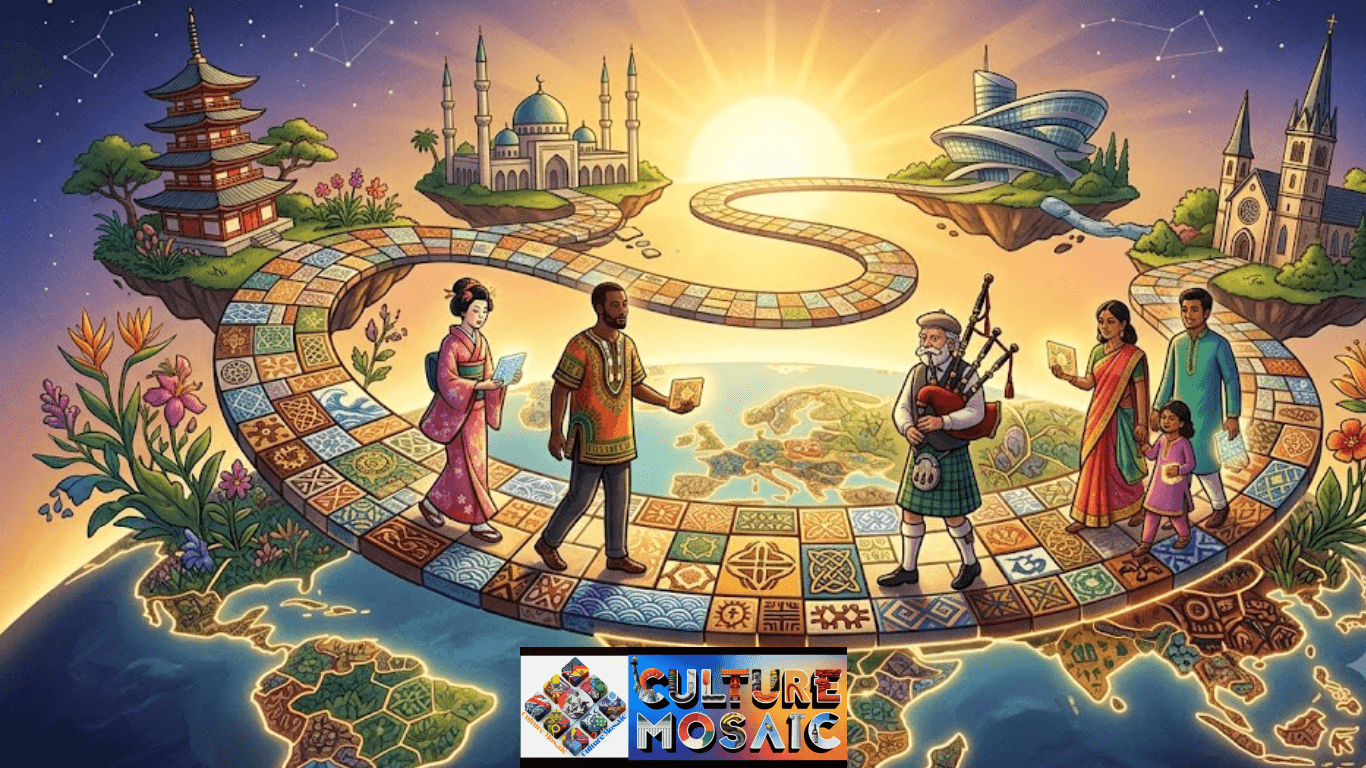
QUICK SUMMARY
Global Cultural Mosaic describes how different cultures sit alongside each other worldwide, each keeping its own shape instead of blending into one flat, uniform culture.
The metaphor comes from Canada, popularized by writer John Murray Gibbon in his 1938 book Canadian Mosaic to reject the American “melting pot” ideal.
Cultural mosaic and cultural pluralism describe closely related concepts: pluralism is the philosophical idea, coined by Horace Kallen in 1915, and mosaic is the visual image that illustrates it.
Tunisia’s Bardo National Museum holds the world’s largest collection of Roman mosaics, serving as a literal manifestation of the metaphor.
Globalization tests the mosaic through language loss and algorithmic homogenization, but active preservation work continues to push back.
Here’s what nobody tells you when you start reading about globalization: everyone assumes the world is heading toward one giant, flattened culture. Same coffee chains. Same music charts. Same handful of phrases translated into forty languages. I’ve heard this fear from students, from journalists, and from my own grandmother, who worried out loud that her traditional recipes would die with her. It’s a real worry. Languages do disappear, and local traditions constantly face pressure.
But that’s not actually what’s happening at the global level. The fear often stems from using the wrong picture. The right picture isn’t a melting pot, where everything dissolves into a single broth. It’s a Global Cultural Mosaic — thousands of distinct pieces, each keeping its own color, shape, and edge, fitted together into something larger. Having spent years studying how communities hold onto identity while trading, migrating, and connecting online, the mosaic metaphor consistently holds up better than any alternative.
This piece walks through what the term actually means, where it came from, how it differs from the “salad bowl” and “melting pot” concepts, and what’s genuinely at stake if the mosaic cracks.
What Is a Global Cultural Mosaic? Meaning, Pronunciation, and Usage
The core meaning of the metaphor is much simpler than academic writing often suggests. Picture a traditional tile mosaic: small, individually colored pieces (tesserae) set side by side to form a complete image. No tile changes its shade to match its neighbor; the overall picture functions precisely because each piece stays distinct.
When applied to societies, it describes a world where different ethnic, linguistic, and religious groups live alongside one another, preserving their unique heritage while contributing to a connected whole.
Pronunciation: “CUL-cher-ul MOH-zay-ik”
In Context: “London’s East End functions as a working cultural mosaic, where Bengali, Caribbean, and Eastern European communities live block by block, each visibly maintaining its identity.”
Notice that the description doesn’t imply blending into a uniform culture. That is the fundamental point: a mosaic remains legible through its distinct pieces.
The Cultural Mosaic Model: Where the Idea Actually Came From
The concept of the cultural mosaic isn’t ancient—it is Canadian, originating less than a century ago.
Travel writer Victoria Hayward first used “mosaic” in 1922 to describe Ukrainian settlements across the Canadian prairies, likening their distinct architecture and church domes to colored tiles across the landscape. Author Kate Foster used the phrase again in 1926. However, Scottish-Canadian writer John Murray Gibbon fully established the term in his 1938 award-winning book Canadian Mosaic: The Making of a Northern Nation. Gibbon explicitly crafted the concept to counter the American “melting pot” doctrine.
While Gibbon’s original text focused almost exclusively on European immigrants—a limitation modern historians rightly point out—the overarching metaphor outgrew its original bounds. By 1971, Canada formally adopted multiculturalism as a governing principle, using the mosaic model as its guiding image.
Cultural Mosaic vs. Salad Bowl vs. Melting Pot
These three terms are frequently conflated, but the distinctions are meaningful:
| Metaphor | Core Mechanism | Resulting Structure |
| Melting Pot | Cultures dissolve and assimilate over time. | A single, uniform outcome where original identities recede. |
| Salad Bowl | Ingredients sit together in the same space. | A casual mix where items remain separate, but without structural cohesion. |
| Cultural Mosaic | Distinct pieces are deliberately fitted together. | A structured, durable whole where individual identities form an intentional larger design. |
While a salad bowl implies loose adjacency, a mosaic implies structural design and permanence. However, maintaining a functional mosaic requires deliberate effort—the civic “mortar” that keeps individual tiles bound together without crushing their unique edges.
Cultural Pluralism: The Idea Underneath the Metaphor
If the mosaic is the visual image, cultural pluralism is the philosophy behind it. The term was coined by philosopher Horace Kallen in his 1915 essay “Democracy versus the Melting-Pot.” Kallen argued that a democratic nation gains strength when it allows distinct cultural identities to thrive rather than enforcing a single national mold.
Writing in the United States decades before Gibbon’s book was published, Kallen established the ideological foundation that later made the mosaic metaphor so resonant.
Global Cultural Mosaic Artwork: Lessons from Real Mosaics
Real physical mosaics offer valuable insights into how the societal metaphor functions. A prime example exists in Tunisia: the Bardo National Museum in Tunis houses the world’s largest collection of Roman mosaics, spanning over 5,000 square meters of preserved tilework.
Walking through those galleries reveals complex scenes—fishermen, harvests, classical mythologies—built entirely from thousands of individually placed, distinct stones. The artwork demonstrates how individual pieces contribute to a broader composition: removing a few tiles leaves a noticeable gap, and removing too many causes the structural image to collapse entirely.
What Counts as an Example of a Global Culture Today?
Modern global culture exists across overlapping layers:
Shared Global Surface: Universal media franchises, international sports like football, and shared digital platforms create a common global framework.
Distinct Cultural Depth: Local traditions maintain their core grammar underneath that shared surface. A wedding in Lagos and a wedding in Seoul may both be shared on the same digital network, but the underlying rituals remain entirely unique.
To explore how these dynamics function across different contexts, see our analysis on Cultural Marriage Traditions.
Food, music, and apparel demonstrate this same balance. On Culture Unveiled, we examine traditional customs that have achieved global visibility without losing their distinct identity. For a detailed look at contemporary shifts, explore our research on Cultural Diversity Trends 2025 and Current Global Cultural Trends 2025.
Unexpected Example: Amateur (“ham”) radio culture represents a global community operating across more than a hundred countries. Radio operators have developed shared etiquette, technical jargon, and communication rituals independent of commercial algorithms or social media platforms.
Challenges to the Mosaic and Preservation Efforts
The pressures facing cultural diversity are real and measurable:
Language Vulnerability: Approximately 44% of the world’s ~7,170 living languages are classified as endangered.
Algorithmic Uniformity: Digital feeds frequently promote standardized aesthetics and media formats worldwide.
Commercial Flattening: High-volume tourism can transform distinct local neighborhoods into standardized commercial areas.
At the same time, preservation efforts remain active and organized. UNESCO’s 2001 Universal Declaration on Cultural Diversity formally framed cultural heritage as vital to humanity. Digital archiving projects, international heritage designations, and community-led language revivals continue to safeguard local traditions.
To see how these dynamics operate within specific national frameworks, read our overviews of UK Culture and Traditions and Cultural in USA. For a broader system-level analysis, our guide on How Cultural Systems Relate to Sustainability outlines how cultural diversity reinforces societal resilience.
For ongoing coverage of these developments, Culture mosaic tracks global shifts, and our dedicated CULTURE MOSAIC hub provides further resources.
Frequently Asked Questions
What is the concept of cultural mosaic?
It is a model of society where distinct ethnic, linguistic, and religious groups coexist while retaining their specific heritage, as opposed to assimilating into a single uniform culture.
What country is famous for mosaics?
Tunisia holds the world’s largest collection of historical Roman mosaics at the Bardo National Museum in Tunis. Italy and Turkey also house significant historical collections.
What is an example of a global culture?
Widely shared sports, international film releases, and common digital communication platforms serve as global cultural layers, operating above distinct local traditions.
What is a synonym for cultural mosaic?
Cultural patchwork, multicultural quilt, and cultural pluralism are closely related terms, though “pluralism” refers to the underlying philosophy rather than the visual metaphor.
Is a country more accurately a melting pot or a cultural mosaic?
It varies by region and policy framework. While some nations historically emphasized assimilation (“melting pot”), others explicitly adopt pluralist frameworks (“cultural mosaic”). Most modern multicultural societies exhibit elements of both.
Sources
UNESCO. Universal Declaration on Cultural Diversity (2001).
The Canadian Encyclopedia. “John Murray Gibbon and the Canadian Mosaic.”
The Pluralism Project, Harvard University. “Cultural Pluralism and Horace Kallen.”
Ethnologue: Languages of the World. SIL International (28th Edition).
Smithsonian Magazine. “The Mosaic Collections of the Bardo National Museum.”