
 By Culture Expert

Quick Summary
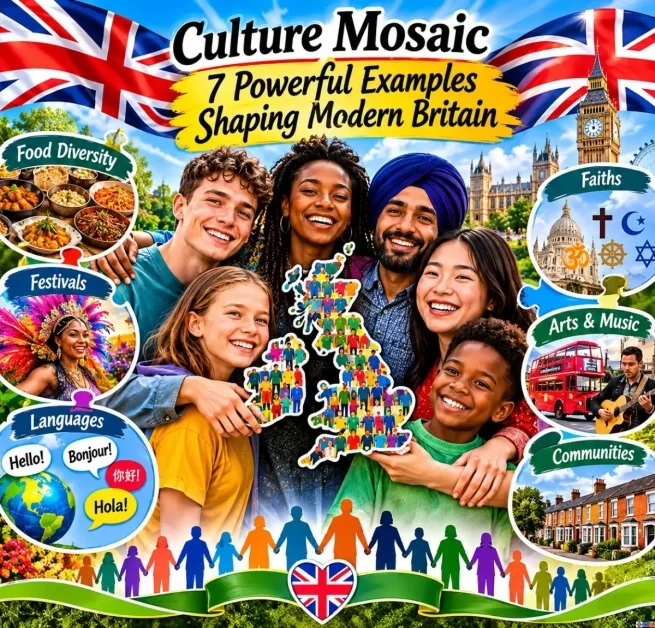
A culture mosaic is a way of seeing a society, a neighbourhood or a workplace as a picture made of many distinct pieces rather than one blended colour. The idea grows out of the cultural mosaic metaphor, most often used for Canada, where communities keep their languages, faiths, foods and customs while sharing one civic life. Britain’s own mosaic is measurable: the 2021 Census recorded 287 detailed ethnic groups in England and Wales, and over a quarter of Londoners report a religion other than Christianity.
This guide explains what a culture mosaic is, how it differs from a melting pot or salad bowl, where Britain’s mosaic shows up, and how to start a project of your own. It follows the thinking behind Culture Mosaic: moving beyond assimilation to honour the unique colours, flavours and perspectives of the UK’s social fabric.
The Problem: When Belonging Costs You Your Story
Most people know the quiet arithmetic of fitting in. You soften an accent at work. You explain a festival that everyone else has never heard of. You learn which parts of your family’s food, dress or faith are “fine” in public and which ones to keep at home. Over years, the pieces you leave at the door can start to feel like pieces of you that nobody wanted.
That pressure has a long history. In Canada, immigrants were expected to assimilate into the mainstream until the 1960s. In Britain, the politician Roy Jenkins argued in the late 1960s that newcomers should not be pushed into a “flattening out” of their cultures, asking instead for equal opportunity alongside cultural diversity.
The cost is not only personal. It is also archival. When histories are not collected on purpose, they thin out. A Goldsmiths, University of London project on the 1948 Windrush arrival had to recreate passenger landing cards because the originals were destroyed by the Home Office in 2010. The National Archives, which holds the Windrush passenger list, is open about the fact that archives are always incomplete.
So the problem has two faces:
- People feel unseen. Diversity is celebrated in a slogan but rarely given room to be specific, messy and personal.
- Communities lose their record. Memories, recipes, songs, objects and rituals vanish when nobody asks for them in time.
The good news is that there is a practical answer. It starts with a better picture of what a diverse society can look like, and then it turns that picture into something a community can actually build.
What Is a Cultural Mosaic in Simple Terms?
A cultural mosaic is a society made of diverse ethnic, linguistic and cultural groups who are encouraged to keep their own identities while living side by side. Picture a tiled picture: every tile keeps its own colour and shape, and the picture only exists because the tiles sit together.
What is a mosaic culture?
People searching for “mosaic culture” usually mean the same thing: a culture whose character comes from many contributing traditions rather than one dominant one. In a mosaic culture, nobody is asked to dissolve into a single standard. Difference is part of the design.
Cultural mosaic example
Canada is the classic case. Britain offers a vivid one too. Notting Hill Carnival grew out of Caribbean traditions in London and now fills the streets each August bank holiday weekend, while the Windrush story shows how one ship’s passengers became a generation that reshaped British life (more on both below).
Cultural mosaic in a sentence
- “The street market was a cultural mosaic: Polish bakeries, Punjabi sweet shops and Caribbean grocers sharing one pavement.”
- “The school’s heritage week turned the building into a cultural mosaic of languages, music and food.”
Cultural mosaic pronunciation
Say it as KUL-cher-ul moh-ZAY-ik. The stress falls on the second syllable of “mosaic”.
Cultural mosaic synonyms and related terms
Cultural pluralism and cultural divergence
Cultural pluralism describes a society where several cultural groups hold onto their own traditions and still share common civic rules. It is the principle underneath the mosaic metaphor.
Cultural divergence is the opposite direction of travel from convergence: over time, groups or regions develop more distinct customs, languages or values. A healthy mosaic expects some divergence. The challenge is keeping the pieces connected while they do.
Why Is Canada Called a Cultural Mosaic?
Canada earned the label through a mix of writing, sociology and law, built up over about seventy years.
- 1920s: an early image. Writer Victoria Hayward described the Canadian Prairies as a mosaic, pointing to onion-domed churches and Swedish and Russian church music brought by newcomers from many parts of Europe.
- 1938: a book gives it a name. John Murray Gibbon published Canadian Mosaic and set it against the American melting pot, which he saw as pushing immigrants to cut ties with their origins.
- 1965: a warning inside the picture. Sociologist John Porter’s The Vertical Mosaic showed that some ethnic groups held far more economic and political power than others.
- Early 1970s: policy. The Trudeau government built multiculturalism policy on the idea of Canada as a mosaic of cultures.
- 1988: law. The Canadian Multiculturalism Act, assented to on 21 July 1988, recognises the freedom of all members of Canadian society to preserve, enhance and share their cultural heritage.
The numbers back up the picture. Statistics Canada reported more than 200 ethnic groups in the 2001 Census and more than 250 in 2016.
Does the mosaic really work?
Not everyone agrees that the distinction is as sharp as the slogans suggest. Journalists Jeffrey Simpson and Andrew Cohen have argued that the whole melting pot versus mosaic contrast is largely an imagined concept, with little measurable proof that one country’s immigrants are more or less assimilated than the other’s. And Porter’s finding is a reminder that a mosaic can still be unequal: pieces can sit side by side and yet not hold equal weight. Any serious Culture Mosaic project should keep both points in view.
Cultural Mosaic vs Melting Pot vs Salad Bowl
The three metaphors answer one question differently: what happens to difference once people live together?
Two honest caveats. First, the mosaic and the salad bowl are close cousins, and many writers use them almost interchangeably; the usual distinction is that a mosaic’s pieces form a deliberate larger design, while a salad’s ingredients are simply mixed together. That distinction is one of emphasis, not a hard rule. Second, as noted above, some commentators doubt that the contrast is as clear in practice as it is in slogans.
Where Britain sits
The 2000 report The Future of Multi-Ethnic Britain, chaired by Bhikhu Parekh for the Runnymede Trust, argued that Britain should develop both as a community of citizens and as a community of communities. It was controversial: the then Home Secretary, Jack Straw, questioned its conclusions within days and stressed “Britishness” as a unifying idea. More than twenty years later, scholars are still using the report as a lens, including a 2024 study in the journal Ethnicities on Polish migrants in Wakefield.
The Culture Mosaic in the UK: What the 2021 Census Shows
Britain’s mosaic is easiest to see in the official numbers. These are Census 2021 figures for England and Wales (Scotland and Northern Ireland publish separately).
Two things stand out. First, the mosaic is not evenly spread: London, Wolverhampton (where 6.5% have Panjabi as a main language), Slough (4.3% Urdu) and Boston in Lincolnshire (5.7% Polish) each show a different pattern. Second, the pieces are connected. ONS reported that nine in ten people across England and Wales still identify with a UK national identity, and the census recorded more than 5 million people whose main language is not English, most of whom speak English well or very well.
Where the mosaic shows up in daily life
- Food and shared tables. Every language and faith in the table above arrives with a kitchen. For a related read on shared eating, see The Commensal Architecture of Shared Vessels.
- Dress and ceremony. Clothing is one of the most visible threads in the mosaic. Explore Traditional Clothing Styles and the long story told in the History of the Bridal Veil.
- Modern lifestyle and taste. Contemporary aesthetics travel across cultures too; see Quiet Luxury Lifestyle Neutral Tones for one angle on it.
- Buildings that hold communities. Faith and civic buildings are where many of these threads meet. Start with Civic Assembly Spaces Architectural History and Gothic Cathedral Architecture Light and Shadow.
- Living history. Technology now lets us study the past without damaging it; see Virtual Unwrapping Egyptian Mummies for an example of heritage meeting digital tools.
Three Documented Stories Behind the Numbers
Statistics tell you the mosaic exists. Stories tell you what it feels like. These three are drawn from published archives and research, not from anecdote.
1. Windrush: one ship, a whole generation
The Empire Windrush docked at Tilbury in Essex on 22 June 1948, almost a month after setting sail from Jamaica. The National Archives describes the ship’s passenger list as one of the iconic documents in its collection, listing more than 1,000 people. The ship later lent its name to everyone who made similar journeys to Britain between 1947 and 1971. The Goldsmiths project Windrush: Arrival 1948 turned the list into recreated landing cards, one per passenger, and invited visitors to leave memories and messages of solidarity on postcards that became part of the exhibition. That is a small, concrete model of what a culture mosaic project looks like.
2. Notting Hill Carnival: culture as an answer to hostility
Carnival’s roots lie partly in the racial tensions of the late 1950s, including the 1958 Notting Hill race riots. Trinidadian-born journalist and activist Claudia Jones organised a Caribbean carnival at St Pancras Town Hall on 30 January 1959, and the event was televised by the BBC. The first outdoor event in Notting Hill followed in 1966, associated with community campaigner Rhaune Laslett and with Russell Henderson’s steel band, whose spontaneous walkabout drew a crowd.
Who deserves the title of founder is still debated by historians and community members, and the Black Cultural Archives and the London Museum both present the story as one of resilience and layered contributions rather than a single origin. A mosaic project should be comfortable with that kind of honest complexity.
3. Polish neighbours in Wakefield: belonging, and its limits
A 2024 peer-reviewed study in Ethnicities by Zinovijus Ciupijus gathered qualitative data in Wakefield after the Brexit vote. It found a high degree of local embeddedness among post-2004 Polish migrants, including friendly relations across ethnic lines and a sense of shared commitment. It also found that inclusion was undermined by patterns of paid work, language difficulties and uncertainty over settled status. Good mosaic work holds both truths: people build real community, and structural barriers still get in the way.
Add your own voices
The strongest version of this article is one that includes your community’s own testimony. This guide does not invent quotes, reviews or poll results. When you collect your own, here are three prompts that work well, with the person’s written consent:
- Which object, dish, song or phrase from your family would you want in a community archive, and why?
- When did you last feel that a part of your heritage was welcomed in a public space?
- What would you want a young person here to know about where your family comes from?
The Culture Mosaic Framework: A Practical Model You Can Use
So far the mosaic has been a metaphor. Here it becomes a working framework.
What it is. A Culture Mosaic is a community-led initiative that collects, preserves and shares the cultural elements of a place or group, in the contributors’ own words and on their own terms.
Core purpose. To make difference visible and valued without flattening it, and to leave a durable record for people who come later.
Who it serves.
- Residents and families, who see their heritage reflected in public life
- Schools, libraries, museums and community centres, which gain living local material
- Employers and organisations, which gain a more honest picture of the people they work with
- Researchers, students and future generations, who inherit a richer archive
How it works: five components
Tone and values
- Inclusivity: every contributor is a co-author, not a case study. No tile is too small.
- Authenticity: people describe their own culture; the project never speaks for them or invents material.
- Curiosity: questions are open and generous, and “I don’t know, tell me” is welcome.
- Respect for consent: people choose what is shared, how, and for how long.
- Honesty about complexity: disagreements, gaps and unequal power are named, not smoothed over.
How to Launch a Culture Mosaic Project, Step by Step
The steps below use a mixed neighbourhood with a library or community centre as the home base. Swap in your own setting, whether that is a street, a school, a faith group, a workplace or a town.
- Name the setting and the question. Decide the boundary (this neighbourhood, this workplace) and one guiding question, such as “What traditions live on this street?”
- Find a hub and a small steering group. A library, community centre or civic hall gives the project a home. For ideas on why shared civic rooms matter, see Civic Assembly Spaces Architectural History. Aim for 5 to 8 people who reflect different parts of the community.
- Check who is actually there. Use the ONS Census maps to see the ethnic, language and religious profile of your local area, so you know which voices to look for.
- Write a consent and ethics sheet. Plain-language forms, the right to withdraw, options for anonymity, and respect for UK data protection rules. Agree who owns the recordings and how they can be reused.
- Invite contributions in more than one way. Offer story sessions, an artifact-and-recipe day, written submissions, phone or audio recording, and translated invitations. Meet people where they already gather, such as places of worship, markets, schools and clubs.
- Audit representation as you go. Compare your contributors with the census profile. If a group is missing, ask trusted community members what would make taking part easier, rather than assuming disinterest. Pay particular attention to older residents, newer arrivals and people who do not speak English as a main language.
- Catalogue and archive. Record who contributed, when, in what language and under what permissions. Use open file formats and keep two copies. For inspiration on digital heritage tools, see Virtual Unwrapping Egyptian Mummies.
- Share the mosaic. Hold an exhibition, publish an online gallery, run a walking tour or compile an anthology. Invite contributors to the launch, and let them speak first.
- Review and keep going. After three to six months, ask contributors what worked, what felt uncomfortable and who is still missing. Add new tiles; the mosaic is never finished.
Quick-start checklist
- Boundary and guiding question written down
- Hub venue confirmed
- Steering group of 5 to 8 people recruited
- Local census profile reviewed
- Consent form drafted in plain language and translated where needed
- First three contributor sessions scheduled
- Storage and backup plan agreed
- Launch event date set
Why Starting This Week Matters
A mosaic can only include the tiles someone thought to collect. The Windrush landing cards that had to be recreated, and the National Archives’ own admission that archives are always incomplete, show how easily records disappear. Memories held by elders, languages spoken at home, recipes kept in the head and festivals that exist only in one hall are the most fragile pieces of all.
You do not need a grant or a committee to begin. This week you could:
- Write down one question and ask one person from a different background than yours to answer it, with their consent.
- Look up your area on the ONS Census maps and note one community you do not yet know well.
- Explore the Culture Mosaic site for ideas, and share your first story or object with your local library or community centre.
Start small, and start with someone who is willing. A single well-told story is already a tile.
Frequently Asked Questions About the Culture Mosaic
1. What is a cultural mosaic in simple terms? ▼
2. Why is Canada called a cultural mosaic? ▼
3. What is the difference between a cultural mosaic, a melting pot and a salad bowl? ▼
4. Can you provide an example of a cultural mosaic in the UK? ▼
5. Does the cultural mosaic model have any downsides? ▼
Sources and Further Reading
Figures are as published at the dates shown and were checked in October 2026.
Government and official statistics
- Office for National Statistics, Ethnic group, England and Wales: Census 2021 (released 29 November 2022)
- Office for National Statistics, Language, England and Wales: Census 2021 (released 29 November 2022)
- Office for National Statistics, Religion, England and Wales: Census 2021
- Office for National Statistics, Census 2021 ethnic group, national identity, language and religion news release
- Office for National Statistics, Census maps
- Welsh Government, Ethnic group, national identity, language and religion in Wales (Census 2021)
- Government of Canada, Canadian Multiculturalism Act (1988)
- Key religion and ethnicity findings as reported by the Associated Press: Census: Christians a minority in England; non-religious grow
Museums, archives and heritage bodies
- The National Archives, An iconic and treasured record: The Empire Windrush passenger list
- The National Archives, Marking the arrival of the Empire Windrush 75 years on
- The National Archives, Carnival: bringing a ‘little bit of heaven’ to Notting Hill
- Goldsmiths, University of London, Windrush: Arrival 1948
- London Museum, Origins of Notting Hill Carnival
- Black Cultural Archives, A History of Notting Hill Carnival (Google Arts & Culture)
Academic and policy sources
- Wikipedia, Cultural mosaic, which cites Gibbon (1938), Porter (1965), Hayward and Statistics Canada
- Gibbon, J. M. (1938). Canadian Mosaic. McClelland & Stewart.
- Porter, J. (1965). The Vertical Mosaic: An Analysis of Social Class and Power in Canada. University of Toronto Press.
- Runnymede Trust, A Community of Communities and Citizens (summary of the Parekh Report) (2000)
- Ciupijus, Z. (2024). Being (un)settled as citizens and community: post-2004 Polish migrants, Brexit and the legacy of the Parekh report. Ethnicities, 25(1). DOI: 10.1177/14687968241247569
- Cambridge University Press, Multiculturalism and Ethnicity Politics (on Roy Jenkins and the Parekh Report)
From Culture Mosaic
- Culture Mosaic home page
- Civic Assembly Spaces Architectural History
- Quiet Luxury Lifestyle Neutral Tones
- History of the Bridal Veil
- Gothic Cathedral Architecture Light and Shadow
- The Commensal Architecture of Shared Vessels
- Traditional Clothing Styles
- Virtual Unwrapping Egyptian Mummies