
 By Culture Expert
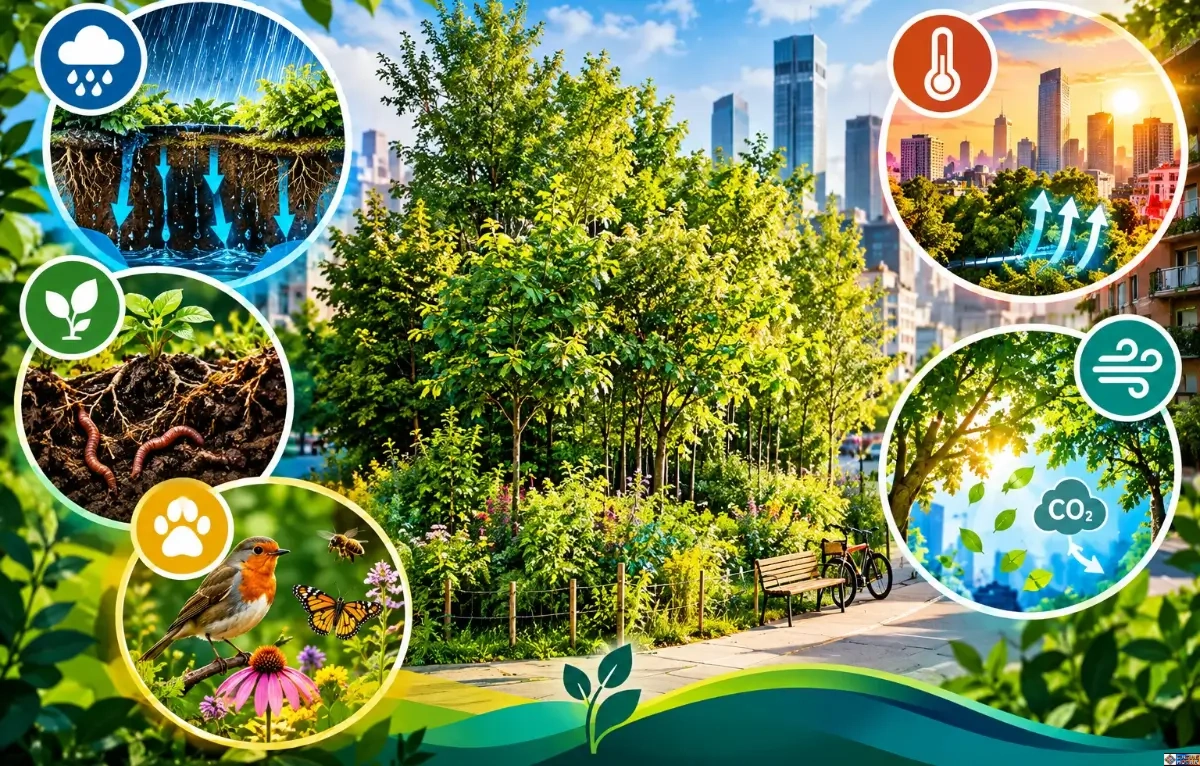
How do micro-forests benefit urban ecosystems?
They turn a tennis-court-sized scrap of compacted ground into dense native woodland that soaks up rain, cools the air beside it, feeds wildlife, and gives neighbours something to look after together. In UK monitoring by Earthwatch Europe, water soaked into the soil 32% faster inside its Tiny Forests than outside them.
The honest caveat: A 2026 review of 51 studies found that much of the method’s reputation rests on thin evidence. They help. They are not a miracle.
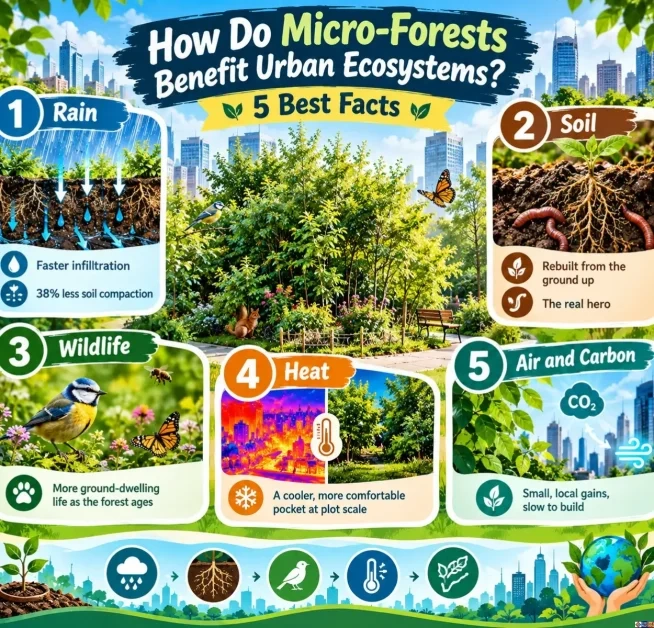
- Rain: Faster infiltration, 38% less soil compaction
- Soil: Rebuilt from the ground up, and arguably the real hero
- Wildlife: More ground-dwelling life as the forest ages
- Heat: A cooler, more comfortable pocket at plot scale
- Air & Carbon: Small, local gains, slow to build
Stand on a July pavement with no tree in sight and you already understand the problem. Tarmac stores heat. Drains swallow rain faster than the ground can. A blackbird hunting for a worm finds only paving.
That is daily life in a dense city, and it is not merely uncomfortable. A Lancet study of 93 European cities linked urban heat islands to around 6,700 premature deaths in 2015, about 4.3% of summer deaths in those cities. Meanwhile, almost every town has small, awkward, leftover plots: the verge nobody mows properly, the corner of a school field, the tarmac strip behind a car park. The question landing in council inboxes and residents’ group chats is simple. Can a micro-forest on one of them do any real good?
I think the answer is yes, with conditions, and this article is my attempt to say exactly which conditions. It leans on monitoring reports, peer-reviewed reviews and published council costs, and it names the weak spots as plainly as the strong ones. Micro-forests also sit inside a bigger idea, cities designed to work with living systems rather than against them. Our guide to Adaptive Biophilic Urbanism maps that wider field, as we do across Culture mosaic.
What Is a Micro-Forest? (And Why Does Everyone Say Miyawaki?)
A micro-forest is a small, deliberately crowded planting of native trees and shrubs, designed to behave like young woodland. You will also see it called a pocket forest, a mini-forest or, in Earthwatch’s branding, a Tiny Forest. Same family. Same idea.
The method comes from Akira Miyawaki, a Japanese botanist who developed it in the 1970s, drawing on the ancient woods around Shinto shrines. In the UK, Earthwatch Europe planted the first Tiny Forest in Witney, Oxfordshire, in 2020, and by 2023 the network had passed 200 forests. The recipe is specific. Roughly 200 square metres, about 25 native species and three trees per square metre, usually around 600 trees in all, planted into soil that has been prepared first. Compare that with a conventional planting, where a few species stand in neat lines.
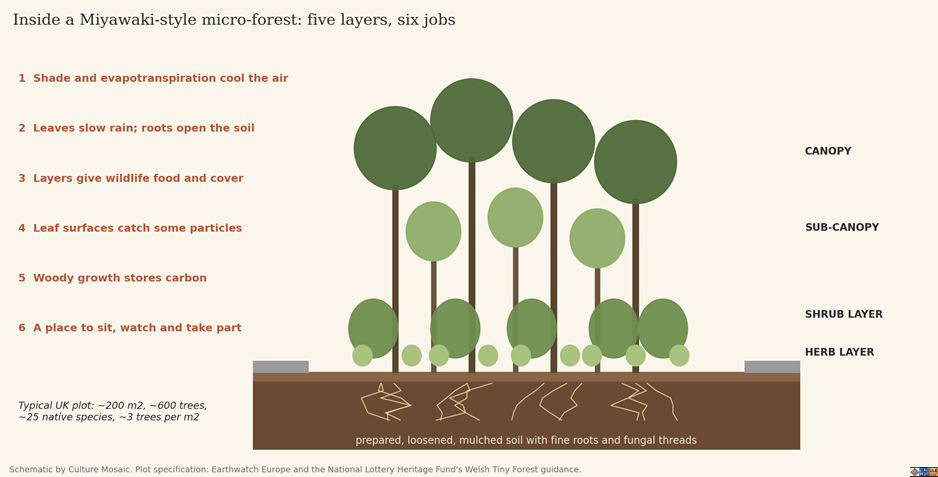
Figure 1. The layered structure of a Miyawaki-style micro-forest and the six jobs it is asked to do. Original illustration.
How Do Micro-Forests Benefit Urban Ecosystems? Five Facts, Ranked by Evidence
Here is the order I trust them in, strongest evidence first. Table 1 is the shortcut. The sections after it show the working.
Table 1. The five benefits at a glance. Evidence labels are an editorial reading of the sources cited in this article.
1. They Drink Rain Before It Floods the Street
Cities shed water. Paving cannot absorb it, and the soil beneath is often squashed so hard that rain skates across the top even where grass grows. A micro-forest attacks the problem twice: the ground is loosened before planting, then roots and leaf litter keep it open.
The best numbers come from Earthwatch’s volunteer monitoring. Across its UK network, water soaked in 32% faster inside Tiny Forests than in the surrounding area, helped by soil that was 38% less compacted.
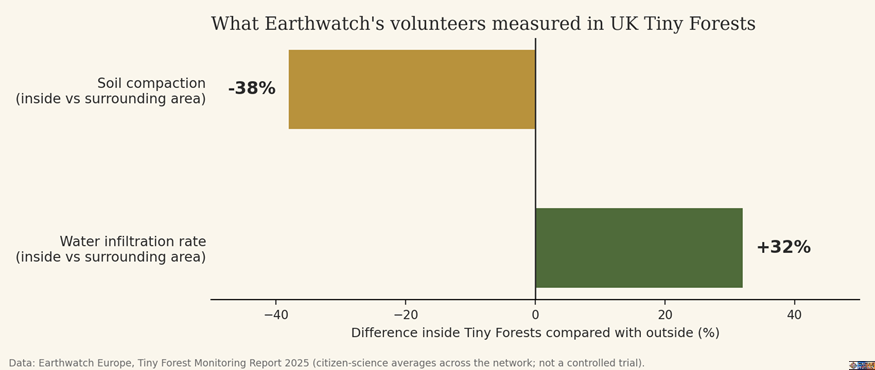
Figure 2. Differences measured inside UK Tiny Forests compared with outside. Source: Earthwatch Europe, Tiny Forest Monitoring Report 2025. Citizen-science averages, not a controlled trial.
Earthwatch’s own modelling expects a plot to handle around 30,000 litres in a single rain event. Spread over 200 square metres, that is a layer of water 15 centimetres deep. Impressive for one plot. Also small. One plot will not rescue a street from a flash flood. For scale, London’s i-Tree survey estimated that the capital’s 8.4 million trees avoid about 3.5 million cubic metres of runoff, valued at £2.8 million a year. That is what many trees add up to. Micro-forests work best as one link in a chain with rain gardens, swales and permeable surfaces.
2. They Rebuild Wrecked Soil
This is the benefit people skip, and I think it is the quiet hero. Urban ground is often rubble, fill and compaction. The method starts by fixing that: digging, loosening, mixing in organic matter, mulching the surface. Only then do the trees go in.
Earthwatch’s monitoring found that the diversity of ground-dwelling invertebrates rises as Tiny Forests age and the soil develops. You will also hear a great deal about fungal networks threading beneath these plots. Mycorrhizal fungi are real and matter in woodland soil. But the Journal of Applied Ecology review found that most claims about the method come from promotional or grey literature rather than controlled studies, and I have not found a controlled measurement of fungal networks in a micro-forest. Plausible, then. Not proven.
There is a sharper point buried in a 2025 systematic review reported by Mongabay India: the fast early growth may owe more to intensive soil preparation, irrigation and maintenance than to the packed planting. If so, soil preparation is not a side dish. It is the meal. You can borrow the lesson at home. Kitchen Scraps Management for Balcony-Free Apartments shows the compost habit that feeds ground like this, and Zero Waste Home Ideas widens it.
3. They Pack Wildlife Into Tiny Spaces
Mow a lawn and you have grass. Plant five layers, from canopy trees down to herbs, and you have food and shelter at every height. Earthwatch’s volunteer surveys found that the number of ground-dweller groups increases as a forest grows and its soil develops.
The headline claim, that a Tiny Forest attracts more than 500 species within a few years, is a modelled expectation. It draws on Dutch monitoring that recorded more than 600 species across seven forests together after four years, according to an Earthwatch factsheet. Read that carefully: seven forests combined, and everything counted, not only rarities. Still a striking result for plots about the size of a tennis court.
The Journal of Applied Ecology review is the cold shower here. It found that biodiversity claims rarely come with controls, so nobody can say how much of the gain belongs to the method and how much to simply planting something. Young woodland is also a different habitat from ancient woodland. A micro-forest adds habitat. It does not replace what an old wood provides.
In a dense city, the payoff for urban biodiversity conservation is connectivity. One plot on its own is an island. A string of plots, gardens and verges is a corridor. That is my argument for planting them in clusters rather than as one-off trophies.
4. They Cool the Air Around Them
Trees cool in two ways. Shade stops the sun heating the surface, and leaves release water vapour that draws heat out of the air, a process called evapotranspiration.
Earthwatch’s 2023 monitoring reported that the average air temperature inside a Tiny Forest was 6°C cooler than outside, even in forests whose trees averaged just 1.3 metres tall. Hold that number loosely. These are volunteer readings, not a controlled experiment. The 2025 report adds that visitors consistently say they feel more comfortable inside the forest than in the open ground around it.
The bigger prize is citywide. The Lancet analysis estimated that raising tree cover to 30% in those 93 cities could have prevented about a third of heat-island deaths, some 2,644 in 2015, while average tree cover across European cities sat near 15%. No single micro-forest gets a city to 30%. Hundreds of them, plus street trees and parks, might help. My view: a micro-forest is a cooling shelter, not an air conditioner, so for urban heat island mitigation at street level, plant it where people actually wait, walk and queue. Bus stops. School gates. Estate entrances.
5. They Clean Air a Little and Store Carbon Slowly
Here the claims run furthest ahead of the evidence, so let me be blunt. Defra’s Air Quality Expert Group concluded that urban vegetation is not a solution to air-quality problems at city scale. Plants help locally. The question is how locally.
A field study from the University of Surrey’s air-quality group measured particulate reductions of 2% to 9% behind a roadside hedge compared with open ground. A separate five-month experiment by Surrey’s Global Centre for Clean Air Research reported reductions of more than 50% behind a beech hedge once it had come into leaf, in a Guildford children’s park, and its lead researcher urged evergreens for year-round performance. Both studies looked at hedges, not micro-forests. The logic should carry over to a dense planted edge, but I have not found anyone who has shown it for micro-forests specifically. The sensible use is a screen between traffic and a playground, school gate or bench, where PM₂.₅ exposure matters most.
Carbon next. Earthwatch estimates its whole network holds about 35,000 kg of above-ground carbon, equal to 128 tonnes of CO₂, roots not counted, and says storage rises steeply as the trees grow. By climate standards that is small. The Journal of Applied Ecology review found only two papers that actually estimated carbon stocks, and they showed no significant long-term difference from other planting methods. Against that, research cited by Mongabay India found five-year-old forests holding nearly four times the carbon of two-year-old ones. Growth is real. Superiority is unproven. I looked for a rigorous head-to-head against mown turf and did not find one, so I will not quote a multiplier.
What Does a Micro-Forest Do for People?
Wellbeing
So how do micro-forests benefit urban ecosystems when the ecosystem includes the people who live in it? Ecology is half the story. In a 2019 study of almost 20,000 people in England, those who spent at least two hours a week in nature had 23% higher odds of reporting high wellbeing and 59% higher odds of reporting good health than people with no nature contact. That is an association, not proof of cause, and nobody tested micro-forests specifically.
But two hours a week is a walkable dose, and a green pocket on your route makes it easier to reach. Indoors you can borrow the same logic with How to Create a Biophilic Home and Functional Biophilic Decor for Circadian Health. For a design practice’s view of how surroundings act on the body, see Somatic Home Design.
Community
This is where micro-forests quietly beat most green infrastructure. Planting day is a social event. MINI’s partnership with Earthwatch reported more than 1,600 volunteers, including schoolchildren, across 14 forests planted between 2021 and 2023. In Bromley, the Friends of Cator Park raised £37,000 and planted about 600 trees and shrubs with volunteers. Afterwards, Earthwatch found that people attending its Discovery Days felt 8% more connected to nature, 5% more connected to their local community and 3% more responsible for their local environment.
Small percentages. But they are the kind that change who turns up to the next meeting. If you are starting that conversation, our guides to Organising a Neighbourhood Mural and urban farming community gardens show how shared projects take root, and Socially Restorative Architecture is a companion read on places that bring people back together.
Money
Forests are undervalued because their benefits never arrive as invoices. London’s i-Tree Eco survey tried to fix that. Its 8.4 million trees deliver at least £133 million of benefits a year, spanning pollution removal, carbon storage, rainwater interception and energy savings. Strikingly, £126.1 million of that is air pollution removal. Note what the figure is and is not: a citywide number for all trees, not for micro-forests.
Micro-forests have their own price tag. Cator Park’s £37,000 included maintenance, which works out at roughly £185 per square metre on a 200-square-metre plot (my arithmetic). A Welsh grant scheme capped each site at £40,000. That is not cheap. Restoration ecologist Karen Holl, who was not involved in the review, called the method “impractical and cost-prohibitive” at scale. At pocket scale I find the cost easier to defend, because you are buying a monitored plot, a school programme and a neighbourhood project as well as trees.
What Are the Downsides of Miyawaki Forests?
The December 2025 Journal of Applied Ecology review gathered 51 pieces of literature on the method. Only 41% gave quantitative assessments. Of those, just 33% had a control and 14% had replication. The two most common claims, growth up to ten times faster and maturity within 20 to 30 years, came out as partially supported and unsupported respectively, according to Mongabay’s report. The authors stress they are not against the method. Their worry is a technique designed for specific conditions being applied everywhere. In Mediterranean-climate ecosystems, for instance, plants tend to cooperate rather than compete, which undercuts a core assumption of dense planting.
Then come the practical downsides. In interviews with 12 UK tree professionals reported in the Arboricultural Journal study, half supported the method for places like schools and small parks, but worries about tree mortality and the cost of saplings, soil preparation and maintenance remained. Trees may need watering for their first two years, and they could grow to 20 metres or more, so siting near buildings and wires matters.
Fairness demands the other side. The same piece notes a Tree Council report finding significantly higher survival rates and better cost-effectiveness for Miyawaki plots than for non-Miyawaki plots. And in Cambridge, Massachusetts, a city forestry official described its three Miyawaki forests as by far the best-received urban forestry programme the city runs. Clark University’s John Rogan calls the method “fashionable” yet says it suits concrete-heavy areas that need greenery. Fashion is not evidence. Neither is it a verdict.
Table 2. Popular claims against the evidence found. Confidence ratings are an editorial judgement, not a statistical measure.
My verdict: plant them, as soil-and-community projects at pocket scale. Do not sell them as climate machines.
Why Are Urban Forests Becoming Common in Major Cities?
Three pressures stack up. Space: a plot the size of a tennis court exists almost everywhere. People: Witney’s first forest was planted by dozens of staff, councillors and volunteers on a single planting day. Policy: heat, flooding and biodiversity targets are pushing governments to act. Wales, for one, committed to creating 100 Coetiroedd Bach, or Tiny Forests, as part of its National Forest. Mongabay India describes the Miyawaki method as the preferred model for urban greening among governments, corporations and citizen groups alike.
Popularity, as the evidence table shows, has run ahead of proof. That does not make the idea wrong. It makes measurement non-negotiable.
How to Start a Micro-Forest Without Wasting Money
Find the ground first. Check ownership, underground utilities and light. Earthwatch sometimes shifts a site slightly to avoid utilities, and mature trees need room.
Budget the aftercare, not only the planting. Watering may be needed for two years. Ask any provider what happens in year three.
Recruit the neighbours before the spade. Clark University research mentioned by WBUR suggests community buy-in is crucial for urban tree survival. A planting day with a school, a friends group and a rota for who waters in August beats a ribbon-cutting every time.
The wildcard: run a pavement thermometer test first. On a hot afternoon, take two cheap thermometers to your candidate site. Put one on sunlit paving and one in the shade of the nearest tree. Photograph both. If the gap does not move your neighbours, you have saved a lot of money. If it does, you have your first data and your first argument.
Not a wildcard, a warning: planting on public land without permission carries consequences. Before you grab a trowel, read our explainer on Moss Graffiti Legal Status; the same questions about permission apply.
The One Thing Planners Should Take Away
Fund the soil and the people, not just the saplings. The strongest evidence in this whole field sits with what lies under the trees and around them: looser ground, faster water, neighbours who turned up. Buy 600 trees without the preparation, the aftercare and the community, and you have bought 600 expensive twigs. Do all three, and “How do micro-forests benefit urban ecosystems?” stops being a theory question and becomes a list of things you can measure, one small plot at a time.
Ask what that plot will look like in 2046. Somebody has to be there to find out.
Frequently Asked Questions
What is a micro-forest, and what does “micro forest” mean?
A micro-forest, also called a pocket forest, mini-forest or Tiny Forest, is a dense planting of native trees and shrubs on a very small plot. In the UK Earthwatch model that means around 200 square metres and roughly 600 trees, planted into prepared soil. “Micro” describes the footprint, not the ambition: the plot is designed to grow into layered woodland. A Miyawaki forest is the same thing built using the method developed by botanist Akira Miyawaki in the 1970s.
What are the downsides of Miyawaki forests?
The biggest is an evidence gap: a Journal of Applied Ecology review of 51 studies found only 41% gave quantitative results, and the claims of ten-times-faster growth and maturity in 20 to 30 years were only partly supported or unsupported. Practical downsides include cost, watering for roughly two years, tree mortality concerns and trees that can reach 20 metres. Results also vary by climate, so a method designed for one setting may not suit another.
Why are urban forests becoming common in the major cities of the world?
Cities face heat, flooding and biodiversity loss, and micro-forests fit into leftover plots, can be planted by volunteers on a single day and build community support. A Lancet study of 93 European cities suggested 30% tree cover could prevent about a third of heat-island deaths, which has pushed tree planting up the agenda. The Miyawaki method has also become a popular, visible model. Popularity has run ahead of proof, so monitoring matters.
What are the economic benefits of forests?
In cities, benefits include pollution removal, carbon storage, rainwater interception and energy savings. London’s i-Tree Eco survey valued its 8.4 million trees at more than £133 million a year, of which £126.1 million was air pollution removal. That is a citywide figure for all trees, not micro-forests. A UK micro-forest costs tens of thousands of pounds, for example £37,000 including maintenance at Cator Park, so its returns are mostly local and social.
Where can I find the research as a PDF, and is there microforest software?
Earthwatch Europe publishes annual Tiny Forest monitoring reports, including a downloadable 2022 PDF and a 2025 summary page, and the Journal of Applied Ecology review is available through its DOI. As for software, the closest genuine tool I know of is i-Tree Eco, which valued London’s urban forest. It models the benefits of existing trees rather than designing micro-forests, and I am not aware of dedicated microforest software.
Sources and Further Reading
- Earthwatch Europe. Tiny Forest Monitoring Report 2025. https://earthwatch.org.uk/report/tiny-forest-monitoring-report-2025/
- Earthwatch Europe. Tiny Forest Monitoring Report 2023. https://earthwatch.org.uk/?p=7488
- Earthwatch Europe. Tiny Forest Monitoring Report 2022 (PDF). https://tinyforest.earthwatch.org.uk/images/documents/Tiny-Forest-Monitorin…
- Earthwatch Europe. Planting a Tiny Forest: how do we prepare? https://earthwatch.org.uk/blog/plan-prepare-plant-repeat-what-do-our-scient…
- Earthwatch Institute. Tiny Forest factsheet (Witney Town Council papers). https://democracy.witney-tc.gov.uk/documents/s1960/Earthwatch%20Institute%2…
- Witney Town Council and Earthwatch. UK’s first-ever Tiny Forest press release. https://www.witney-tc.gov.uk/wp-content/uploads/2021/02/Tiny-Forests_Press-…
- Morales, N. S., Fernández, I. C., Durán, L. and Craven, D. (2026). Tiny forests, huge claims: the evidence gap behind the Miyawaki method for forest restoration. Journal of Applied Ecology, 63(1), e70242. https://doi.org/10.1111/1365-2664.70242
- Mongabay (13 May 2026). Popular Miyawaki reforestation method lacks evidence, study finds. https://news.mongabay.com/2026/05/popular-miyawaki-reforestation-method-lac…
- Mongabay India (July 2026). Cities need tailored restoration, not mass tree planting. https://india.mongabay.com/2026/07/cities-need-tailored-restoration-not-mas…
- WBUR (10 June 2026). Tiny forests are a growing trend in Massachusetts. https://www.wbur.org/news/2026/06/10/massachusetts-tiny-forests-miyawaki
- Inverse. ‘Tiny Forests’ are taking off in cities everywhere, but can they thrive? (reporting an Arboricultural Journal study). https://www.inverse.com/science/tiny-forests-are-taking-off-in-cities-every…
- Miyawaki, A. (1999). Creative ecology: restoration of native forests by native trees. Plant Biotechnology, 16(1), 15-25. https://doi.org/10.5511/plantbiotechnology.16.15
- IFLScience. Miyawaki Method: the Japanese system claiming a forest 10 times faster. https://iflscience.com/miyawaki-method-this-japanese-system-from-the-1970s-…
- Iungman, T. et al. (2023). Cooling cities through urban green infrastructure: a health impact assessment of European cities. The Lancet. ISGlobal press release. https://www.isglobal.org/en/-/4-of-summer-mortality-is-attributable-to-urba…
- Giving Compass. How urban trees could help mitigate heat-related deaths (average European tree cover). https://givingcompass.org/article/how-urban-trees-could-help-mitigate-heat-…
- Air Quality Expert Group for Defra (2018). Impacts of Vegetation on Urban Air Pollution. https://uk-air.defra.gov.uk/assets/documents/reports/cat09/1807251306_18050…
- REF 2021 impact case study quoting the Clean Air Strategy on AQEG’s conclusion. https://results2021.ref.ac.uk/impact/a03c6ba4-aa74-426b-99c3-30ef7c4edec8/pdf
- Abhijith, K. V. and Kumar, P. (2020). Quantifying particulate matter reduction and their deposition on the leaves of green infrastructure. https://agris.fao.org/search/ar/records/65df489a4c5aef494fe17119
- Air Quality News (2019). A hedge could cut air pollution by 50% (Surrey GCARE). https://airqualitynews.com/2019/11/22/a-hedge-could-cut-air-pollution-by-50
- White, M. P. et al. (2019). Spending at least 120 minutes a week in nature is associated with good health and wellbeing. Scientific Reports, 9, 7730. https://doi.org/10.1038/s41598-019-44097-3
- Physician’s Weekly (HealthDay). Summary of White et al. (2019). https://www.physiciansweekly.com/?p=109382
- Forest Research. i-Tree Eco London. https://www.forestresearch.gov.uk/research/i-tree-eco/i-tree-eco-projects/i…
- i-Tree. Valuing London’s Urban Forest project profile. https://www.itreetools.org/support/resources-overview/project-profiles/valu…
- National Lottery Heritage Fund. Coetiroedd Bach: Tiny Forests in Wales (rounds 1 and 2). https://heritagefund.org.uk/programmes/coetiroedd-bach-tiny-forests-wales-r…
- London Borough of Bromley. Tiny Forest planted in Cator Park. https://www.bromley.gov.uk/news/article/660/tiny-forest-planted-in-cator-park
- MINI UK / BMW Group. Tiny Forest partnership with Earthwatch. https://www.press.bmwgroup.com/united-kingdom/article/attachment/T0451094EN…
 Marcus J. Holloway