
 By Culture Expert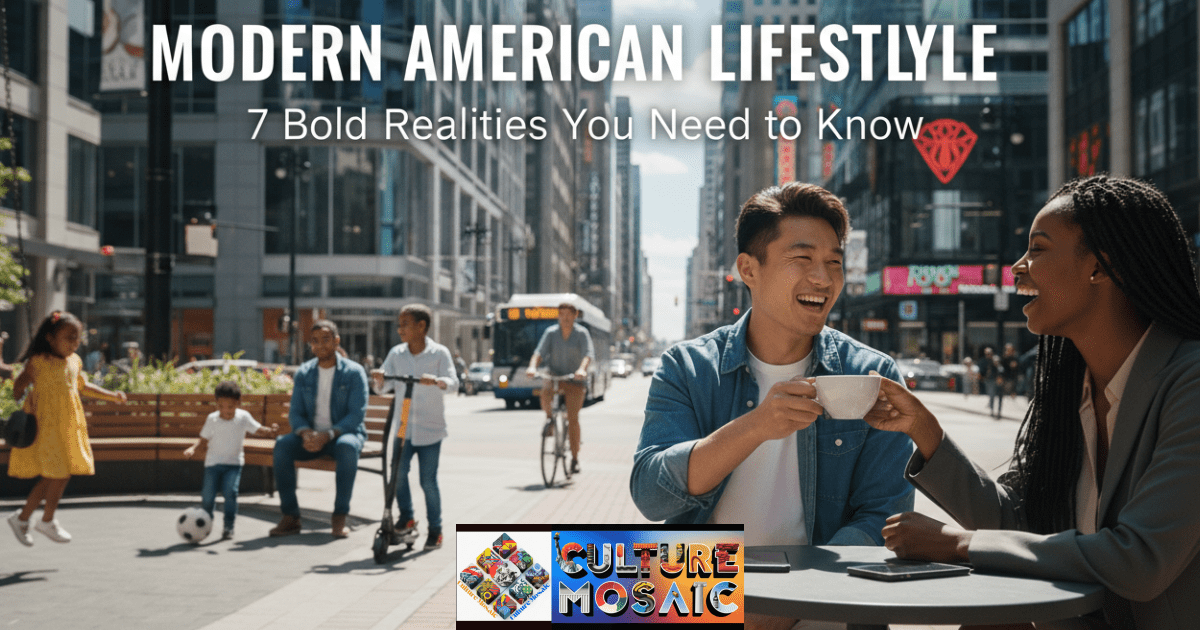

Street-level joy in an American city — the texture of contemporary life captured in a single moment. © Culture Mosaic
7 Powerful Truths About the Modern American Lifestyle
A cultural anthropologist’s field notes on how Americans eat, work, connect, grieve, hustle, and occasionally exhale in the mid-2020s.
Here’s the honest thing about studying the modern American lifestyle: it defies the single narrative. People love to say “Americans are stressed” or “Americans are lonely,” and those things are true. But they’re also laughing at outdoor cafés on Tuesday afternoons, coaching their kid’s soccer team, and building community gardens in parking lots that used to hold nothing but concrete and exhaust fumes. The picture is messier and more interesting than any single headline suggests.
I’ve been studying contemporary American society for twenty-two years. I’ve sat in truck-stop diners in rural Ohio and coworking spaces in Austin. I’ve watched the shifts. Some of what I’ve seen reassures me. Some of it keeps me up at night. All of it is worth understanding clearly, without the oversimplification.
The Modern American Lifestyle Is Not One Thing
The first mistake most observers make is treating the modern American lifestyle as monolithic. It isn’t. A 28-year-old software engineer in Seattle and a 55-year-old warehouse supervisor in Akron both live in America, but they inhabit almost entirely different daily realities, different rhythms, different anxieties, different pleasures. What they share, though, are certain structural pressures: time scarcity, digital saturation, and the persistent feeling that something important is just slightly out of reach.
How Modern American Lifestyle Differs by Geography
Coastal cities run fast and expensive. The interior runs quieter but not necessarily slower. What I’ve found in rural and small-town America is not backwardness; it’s a different calculus of what a good life looks like. Longer commutes, yes. But also longer tables. Family dinners that actually happen. The trade-offs are real in both directions, and neither geography has it figured out.
Work Has Rewired the Modern American Lifestyle
The single biggest structural shift in the modern American lifestyle over the last decade is what happened to work. Remote work didn’t just move the office home; it dissolved the boundary between professional and personal time. The laptop sits open at 9 PM. The Slack notification arrives on Saturday morning. People are working more hours, not fewer, and calling it “flexibility.”
The gig economy layer compounds this. Millions of Americans now patch together income from multiple streams, which creates a peculiar kind of financial anxiety: you’re always earning, but you’re never quite secure. It’s a hustle culture that sells freedom but delivers fragmentation.
The Side Hustle as a Modern American Lifestyle Default
Side hustles aren’t new. Americans have always worked hard. But what’s changed is the cultural framing: the side hustle is now a personality, an aspiration, a badge. I find this worth scrutinizing. When overwork becomes identity, the cost is invisible until it isn’t, and then it shows up in burnout statistics, in therapists’ waiting lists, in the quiet resignation of people in their 30s who aren’t sure what they actually enjoy anymore.
Technology and the Modern American Lifestyle
Technology is both the connective tissue and the irritant of the modern American lifestyle. Smartphones are now an extension of the nervous system. The average American checks their phone over 140 times per day. That number sounds alarming until you realize how many of those check-ins are genuinely useful: navigating, banking, connecting with family, managing a chronic condition.
Social Media’s Complicated Role in Modern American Lifestyle
Social media promised connection and delivered something murkier. I’ve watched it create genuine community for isolated people, for LGBTQ+ teenagers in small towns, for caregivers of rare diseases who found each other across state lines. I’ve also watched it deepen political polarization and create a performative layer over everyday life that exhausts people even as they can’t stop engaging. The relationship is not simple. It never was.
Home Design Reflects Modern American Lifestyle Priorities
The home has become the site of extraordinary investment, financially and emotionally, in the modern American lifestyle. After years of pandemic living, Americans started treating their physical environments as a genuine priority, not just a backdrop. Concepts like Somatic Interior Design Principles are gaining real traction because people are connecting the quality of their physical space to their mental and physiological state. That’s not trend-chasing. That’s a legitimate insight.
Modern American Lifestyle and the Demand for Smarter Living Spaces
The apartment as sanctuary. Millions of Americans now think seriously about Circadian Lighting for Small Modern Apartments and how light exposure shapes mood, sleep, and productivity. They’re thinking about Spatial Decoupling for Home, the idea that different parts of a home should serve psychologically distinct functions. Work shouldn’t happen where you sleep. Rest shouldn’t happen where you eat. These aren’t luxury concerns. They’re structural responses to lives that have blurred every boundary.
The Modern Heritage Living Room trend also tells you something telling about American ambivalence: people want the warmth of the past but the function of the present. Heirlooms next to smart speakers. Old wood next to LED strips. It’s not contradiction; it’s an attempt to hold onto something stable in a landscape that keeps shifting.
Food and the Modern American Lifestyle
Food culture in America right now is one of the most revealing windows into broader social shifts. The modern American lifestyle has produced a food paradox: never have Americans had access to more diverse, high-quality ingredients, and yet convenience food dominates the actual dinner table for most households. Time pressure wins over aspiration most nights of the week.
Sustainability Enters the Modern American Lifestyle Kitchen
Something interesting is happening in the sustainability space, though. Kitchen Scraps Management is becoming a genuine household practice, not just a niche concern. Americans are composting, fermenting, and rethinking food waste in numbers that would have seemed implausible fifteen years ago. It’s partial, it’s imperfect, and it coexists with drive-throughs and DoorDash. But it’s real.
The Wellness Turn in the Modern American Lifestyle
The modern American lifestyle has absorbed wellness as a core value, sometimes genuinely and sometimes as a commercial performance. Americans spend over $480 billion annually on wellness products and services. Some of that spending reflects real need: mental health awareness has genuinely expanded, therapy has lost much of its stigma, and conversations about Nervous System Regulation at Home are entering mainstream discourse in ways that would have sounded clinical and obscure a decade ago.
Mental Health Is Central to the Modern American Lifestyle Conversation
Gen Z has destigmatized therapy faster than any previous generation. That’s not a small thing. The willingness to say “I’m not doing well” and seek help is a real cultural shift, and I think it’s one of the more encouraging developments in contemporary American life. The shortfall is access: therapy is expensive, waits are long, and rural communities are chronically underserved. The conversation has changed faster than the infrastructure.
Social Connections in the Modern American Lifestyle
Loneliness is a documented crisis in the modern American lifestyle. The U.S. Surgeon General declared it an epidemic. The average American has fewer close friends than they did thirty years ago. The causes are structural: longer work hours, car-dependent suburban design, the replacement of third places (churches, bowling alleys, union halls) with private digital spaces where connection is algorithmically managed and ultimately thin.
Community Reinvention and the Modern American Lifestyle
And yet. I keep watching Americans invent community in unexpected places. Running clubs that fill the role of the old church social. Neighborhood mutual aid networks that formed during COVID and never disbanded. Group chats that, however imperfect, maintain genuine relationships across distance. The hunger for belonging is strong. Americans are resourceful. They find ways.
Leisure and the Modern American Lifestyle
Americans are famously bad at rest. The modern American lifestyle treats busyness as status and vacation as vaguely suspect. But the post-pandemic period produced what I’d call a leisure re-evaluation. People who spent two years unable to travel, eat out, or gather, came back to leisure with more intentionality. Not everyone. But enough to register as a shift.
How the Modern American Lifestyle Is Rethinking Free Time
Outdoor recreation has surged. National park visits hit record numbers. Pickleball, of all things, became the fastest-growing sport in the country. These aren’t trivial data points. They suggest Americans are actively seeking embodied, low-tech, face-to-face experience as a counterweight to the screen-saturated workday. The body wants to move. The social animal wants contact. The modern American lifestyle is currently negotiating that tension in real time.
What the Modern American Lifestyle Tells Us About American Values
If you ask Americans what they value, they’ll say family, freedom, and community. If you watch how they actually spend their time and money, the picture is more complicated. But I don’t think that’s hypocrisy, exactly. I think it’s the gap between aspiration and structure. The structures of American life, economic pressure, car dependency, healthcare anxiety, housing costs, push people away from their stated values constantly.
The modern American lifestyle is a daily negotiation between who people want to be and what their circumstances allow. Understanding that gap, rather than judging it, is what cultural anthropology is actually for. Americans aren’t failing to live well. They’re working hard under real constraints, finding joy in the margins, and doing what humans do: adapting.
Frequently Asked Questions About the Modern American Lifestyle
The modern American lifestyle in the mid-2020s is shaped by four converging forces: digital saturation, blurred work-life boundaries, a serious wellness turn, and a renewed hunger for genuine community. It’s not one thing. It varies sharply by region, income, and generation, but the shared pressures of time scarcity and economic uncertainty cut across most demographics.
Remote work shifted the office into the home but didn’t deliver the work-life balance many expected. For millions of Americans, it increased employer access to personal time. The upside is real flexibility for some workers. The downside is a structural erosion of recovery time that shows up in burnout data across industries.
Yes, and the data is consistent. Declining close friendships, reduced participation in community institutions, and social media’s replacement of face-to-face interaction have all contributed. The U.S. Surgeon General formally identified loneliness as a public health crisis. The encouraging counter-trend is that Americans are actively building new forms of community to fill that gap.
Wellness spending is enormous, and mental health conversations have genuinely expanded. Americans are thinking more seriously about sleep, nutrition, and stress than previous generations. The gap is access: quality mental health support remains expensive and unevenly distributed, meaning wellness culture often benefits those who are already relatively secure.
Post-pandemic, the home became the site of significant psychological investment. Americans are thinking about how their physical environments affect mood, sleep, and cognition. Concepts like spatial function, light quality, and sensory design have moved from niche to mainstream because people now understand, viscerally, that their environment shapes their inner state.
 Marcus J. Holloway