
 By Culture Expert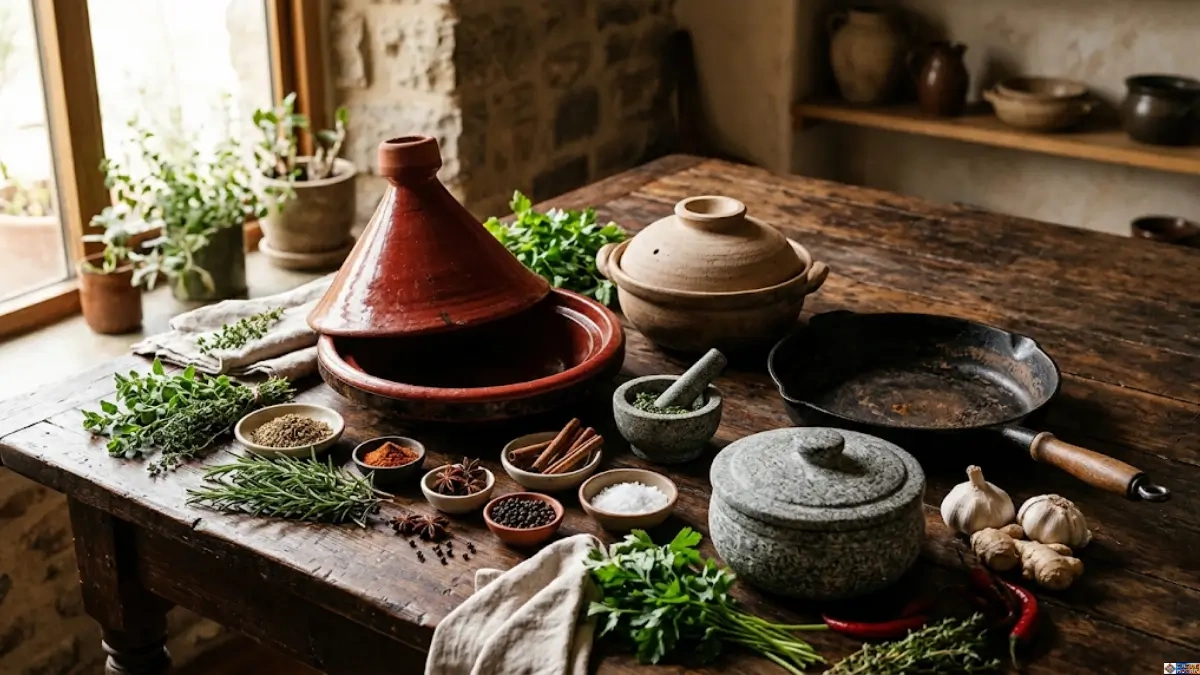
Quick Summary
- The oldest confirmed cooking pottery comes from Jōmon-period Japan, used to stew fish roughly 15,000 years ago — long before farming existed anywhere.
- Cast iron cookware traces to China’s Han Dynasty (around 200 BC), and the wok grew directly out of that tradition.
- Soapstone and clay each interact with food differently: clay buffers acidity and holds gentle, even heat; cast iron sears hot and adds trace iron; soapstone stores heat like a battery.
- Rounded and pointed pot bottoms weren’t primitive design — they were built for open fires and sand hearths, and only went flat once the kitchen stove arrived.
- Clay pot cooking is having a real comeback among home cooks chasing non-toxic, mineral-rich alternatives to Teflon.
The Problem: We’ve Forgotten What Our Pots Are Actually Doing
Here’s what nags at me every time I watch someone unbox a shiny new non-stick pan. We’ve spent decades optimising cookware for speed and easy cleanup, and almost none of it for flavour, nutrition, or longevity. Most kitchens today run on aluminium and coated steel — light, cheap, disposable in five years. Convenient, sure. But convenience has a cost nobody put on the label.
I’ve spent years digging through archaeological reports and food-science journals on ancestral cookware history, and the pattern is hard to miss: every material our ancestors chose — clay, soapstone, cast iron, copper — was chosen because of what it did to the food, not just how it looked on a shelf. When you understand that logic, cooking stops being a chore and starts being chemistry you can taste.
That’s the empathy part out of the way. Now let’s get into the solution: understanding what actually worked, for thousands of years, and why some of it is worth bringing back into your kitchen.
What Is Ancestral Cookware, and Why Does Its History Matter?
Ancestral cookware means any cooking vessel developed before industrial manufacturing standardised what a “pot” should look like — fired clay, carved stone, hammered copper, cast iron, hollowed gourds, even animal-skin bags heated with hot rocks. None of it was arbitrary. Every ancient cook was, whether they knew it or not, running a materials-science experiment three times a day.
This matters because the history of cookware is really the history of how humans learned to make food safer, more digestible, and more flavourful without any of the tools we take for granted — no thermometers, no non-stick coatings, no gas rings. What they had was trial, error, and an intimate knowledge of local stone and clay.
When Did Humans First Boil Water — and How Did They Cook Before Pots?
Long before anyone had a vessel that could sit directly over flame, cooks used a method called stone-boiling: heat rocks in a fire until they’re glowing, then drop them into a water-filled pit, gourd, or hide bag. The stones transfer their heat to the liquid, and with enough of them, you get a rolling boil without ever putting the container itself on the fire. It’s slow, it’s inefficient, and it’s genuinely clever.
Fired clay changed everything. Chemical residue analysis on Jōmon vessels from Japan — among the oldest confirmed cooking pottery on Earth — shows fat traces from freshwater and marine fish dating back roughly 15,000 years, to the tail end of the last Ice Age. Researchers at the University of York, publishing in Nature, found this cooking predates agriculture by thousands of years. Pottery, in other words, came before farming. Hunter-gatherers were stewing fish in clay pots while agriculture was still millennia away.
A Rough Timeline of Ancestral Cookware History
Why Did Ancestral Pots Have Rounded or Pointed Bottoms?
If you’ve ever handled a genuinely old clay pot, the flat bottom is the thing that’s missing. Early cookware was almost always round-bellied or pointed, and it wasn’t a design flaw. Fires were built on the ground or in shallow pits, not on a flat stovetop, so a rounded base could nestle directly into embers or be propped on stones, exposing far more surface area to heat than a flat bottom ever could. A pointed or globular base also stood up to thermal shock better, because heat spread around the curve instead of concentrating on one flat plane, which is exactly where clay likes to crack.
Why Did Traditional Cookware Lose Its Legs?
Cast iron cauldrons and “spider” pans came with legs and hooks for a reason nobody needs anymore: the open hearth. Before the mid-1800s, cooking happened in a fireplace, not on a stovetop, so pots needed legs to stand in the coals or hooks to hang from a crane. Once the enclosed kitchen range and cast-iron stove became standard household fixtures, a pot with legs was just an obstacle. Flat-bottomed skillets and pans followed almost immediately, and cookware design has been chasing the shape of the heat source ever since — first the open flame, now the induction coil.
Earthenware Culinary History: Clay Pots Across Continents
Clay cookery isn’t one story; it’s dozens, running in parallel with almost no contact between them. In West Africa, unglazed clay pots are still the backbone of daily cooking, prized because the porous walls let a stew breathe as it simmers. Across the Mediterranean and Middle East, clay cazuelas and tagines built up a reputation for turning tough, cheap cuts into something worth serving to guests.
I’ve written before about how to cook a traditional Moroccan tagine, and the cone-shaped lid isn’t decorative. It condenses steam and drips moisture straight back onto the meat, which is a genuinely elegant piece of low-tech engineering.
Clay also shows up as the quiet engine behind flavour development. Fermentation crocks — unglazed on purpose — let a controlled amount of air exchange happen through the clay wall itself, which matters enormously for traditional sauerkraut fermentation and the wider world of ancestral fermentation techniques. I go deeper into the biochemistry of salt-glaze fermentation elsewhere on the site, but the short version is that the glaze controls oxygen exposure in a way plastic and glass simply don’t replicate — a pattern that shows up again and again across ancestral fermentation rituals worldwide.
Then there’s the couscoussier, the two-tiered steaming pot that turns dried semolina into something soft and fluffy without ever touching direct water — a technique I’ve documented in the traditional Moroccan couscous recipe. Steam cooking through clay is gentler than boiling, and it shows in the texture.
Soapstone Cooking Origins: The Arctic’s Ingenious Answer
In the Arctic, clay wasn’t a realistic option — there was rarely enough fuel to fire it properly, and the climate made ceramics brittle and unreliable. Soapstone, or steatite, solved a completely different problem. It’s soft enough to carve with basic stone tools yet dense enough to store an enormous amount of heat, and unlike clay, it won’t crack under sudden temperature swings.
Inuit and other circumpolar peoples carved soapstone into qulliq oil lamps and cooking vessels that could simmer for hours on a small, steady flame — no forest of firewood required, just seal or whale oil and patience. It’s one of the cleverest material adaptations in the entire history of cookware, purpose-built for an environment with almost none of the resources everyone else took for granted.
Traditional Cooking Vessel Materials Compared
The clay-versus-cast-iron debate isn’t really about which is “better” — it’s about what you’re trying to do to the food. Acidic tomato sauces pull measurable iron out of a cast-iron pan, which is a genuine nutritional upside for anyone managing iron intake, but that same reactivity can leave a faint metallic edge on delicate sauces. Clay does the opposite: it stays chemically quiet, which is exactly why it’s the vessel of choice across so many heritage cooking techniques built around long, slow extraction of flavour — stocks, confits, bean pots, and the kind of ancestral umami cooking that depends on gentle, uninterrupted simmering rather than a hard boil.
Seasoning Cast Iron: A Tradition Worth Keeping Alive
Seasoning cast iron — building up a layer of polymerised oil across the surface — isn’t a modern trick. Chinese cooks were doing something functionally identical to their wok surfaces well over a thousand years before “seasoning” became a hashtag. The wok itself grew out of Han Dynasty cast-iron casting, first used for drying grain before it became the stir-fry vessel we’d recognise today, and its thin walls demanded a well-seasoned surface to keep food from sticking over blistering heat.
There’s something almost physical about the ritual of seasoning a pan — the smell of hot oil, the slight sheen building layer by layer, the sense that you’re maintaining a tool rather than just using one. I’d call it somatic seasoning, honestly: a bodily, repetitive act that ties a cook to generations of the exact same motion. That kind of muscle memory around cookware is part of what I mean by somatic food memory — the way certain smells and textures in the kitchen carry meaning your conscious mind never quite articulates.
How Did the Invention of Pots Alter Human Evolution?
This is where the story stops being just about kitchens. Cooking softens food, breaks down tough plant fibres, and denatures proteins so they’re easier to digest — which means the body spends less energy extracting calories from a meal. Some anthropologists argue this freed-up energy budget helped support the larger, more energy-hungry human brain. Pottery specifically extended what cooking could achieve: boiling and stewing unlock nutrients that roasting over an open flame simply can’t reach, and it makes tough or fibrous, previously inedible foods safe and palatable. A pot, in other words, isn’t just kitchen equipment. It’s part of the reason we look the way we do.
Vessels also reorganised how people ate together. A single pot simmering over a shared fire turns a meal into something communal by necessity — everyone eats from the same source, at the same time, often with the same utensils. I’ve written about that shift as the commensal architecture of shared vessels, and it connects directly to the wider study of dining rituals and food rituals in different cultures around the world — table manners, seating order, who eats first, all of it traces back to the fact that early cooking vessels forced people to eat together or not at all.
Traditional Clay Pot Cooking Benefits: Why Modern Cooks Are Going Back
Sales of unglazed clay cookware — Spanish cazuelas, Indian handis, Moroccan tagines, Japanese donabe — have climbed steadily as cooks look for alternatives to Teflon and other synthetic non-stick coatings. I think the appeal is straightforward once you’ve used one properly: clay cooks gently, it doesn’t leach anything troubling into food, and it genuinely does change texture in long-cooked dishes, giving grains and legumes a softness that’s hard to replicate in stainless steel.
There’s also a slower argument worth making, and it’s less about chemistry than about attention. A clay pot punishes you for rushing — crank the heat too fast and it can crack, walk away too long and the bottom scorches. That built-in demand for patience is, in my view, most of what people mean when they talk about “slow food.” It’s not really about time on the clock. It’s about a vessel that won’t let you cheat. If you want to see the principle in action, browse through some regenerative heritage recipes built entirely around clay-pot patience, or our broader collection of traditional recipes from around the world.
Frequently Asked Questions
What is the oldest known cooking vessel in the world?
The oldest confirmed cooking pottery comes from the Jōmon culture of Japan. Chemical residue analysis on vessels roughly 15,000 years old shows they were used to cook freshwater and marine fish, predating the invention of agriculture by thousands of years.
How did humans boil water before pots were invented?
Through stone-boiling: heating rocks in a fire until glowing, then dropping them into a water-filled pit, hide bag, or gourd. The hot stones transferred enough heat to bring the liquid to a boil without the container ever touching the flame directly.
Why did ancestral pots have rounded or pointed bottoms instead of flat ones?
Because early cooking happened over open fires or in embers, not on flat stovetops. A rounded or pointed base could nestle directly into hot coals, exposing more surface area to heat and handling thermal stress better than a flat bottom would.
Is cooking in clay pots actually healthier than cast iron or non-stick pans?
It depends what you’re optimising for. Clay is chemically inert and doesn’t react with acidic ingredients, while cast iron actively adds small amounts of dietary iron to food, particularly acidic sauces. Both are safer than synthetic non-stick coatings, but they behave very differently in the pot.
Why did traditional cookware lose its legs and handles over time?
Legs and hanging hooks were built for open hearths and fireplace cooking. Once the enclosed cast-iron kitchen stove and, later, the flat stovetop became standard in the 1800s, a pot with legs became impractical, and flat-bottomed cookware quickly replaced it.
Sources
- Craig, O. E. et al. “Earliest evidence for the use of pottery.” Nature, 2013 — analysis of Jōmon vessel residues.
Wiley Online Library / Archaeometry — ancestral cookware and material culture research
- Stockholm University, Archaeological Research Laboratory — research on Incipient Jōmon period pottery use.
- Smithsonian Institution — collections and research on ancient cookware and foodways.
- The British Museum — collections records on Han Dynasty ironwork and East Asian cast-iron vessels.