
 By Culture Expert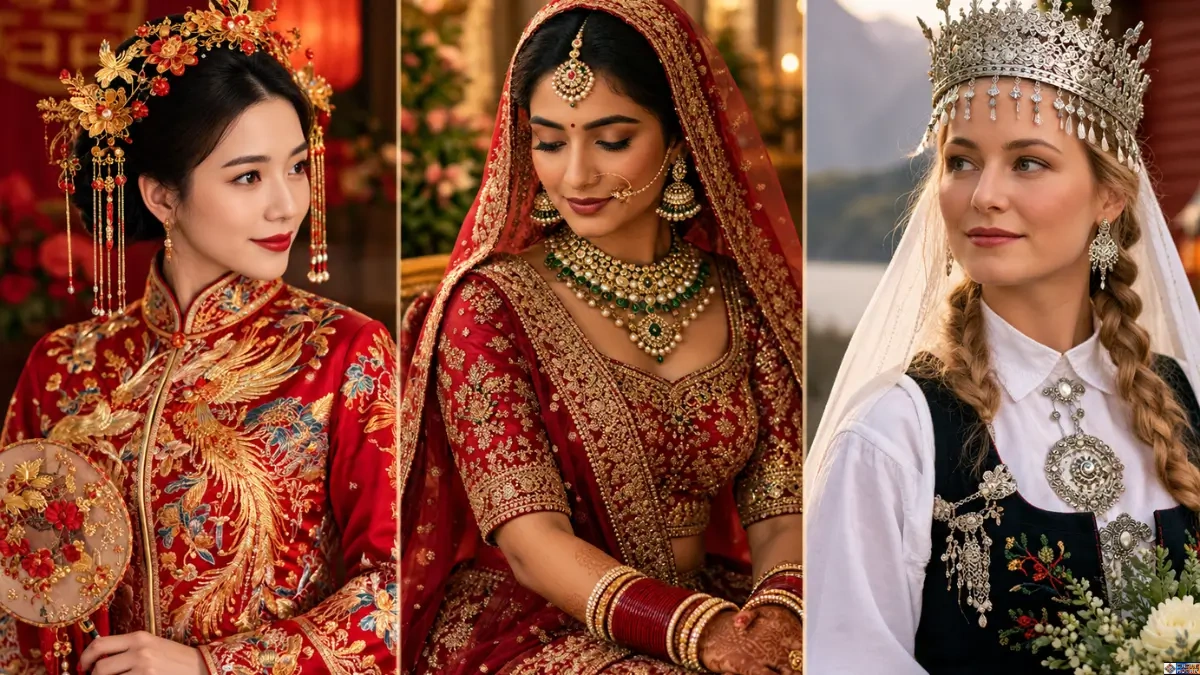
Global bridal wear traditions are the colours, cloths, headpieces and rituals that cultures use to dress a marriage. Every garment answers three questions: who is she, where is she from, and what is this day for?
- ▪ Red leads in China and much of South Asia, where it stands for luck and protection.
- ▪ White is ceremonial in Japan and Ethiopia, and only became Britain’s default after Queen Victoria’s 1840 wedding.
- ▪ Silver crowns in Norway, embroidered thobes in Palestine and aso oke in Nigeria show how a single dress can carry region, status and family in its stitches.
- ▪ Many traditional ensembles are re-worn, borrowed or rented. The one-wear white gown is the outlier.
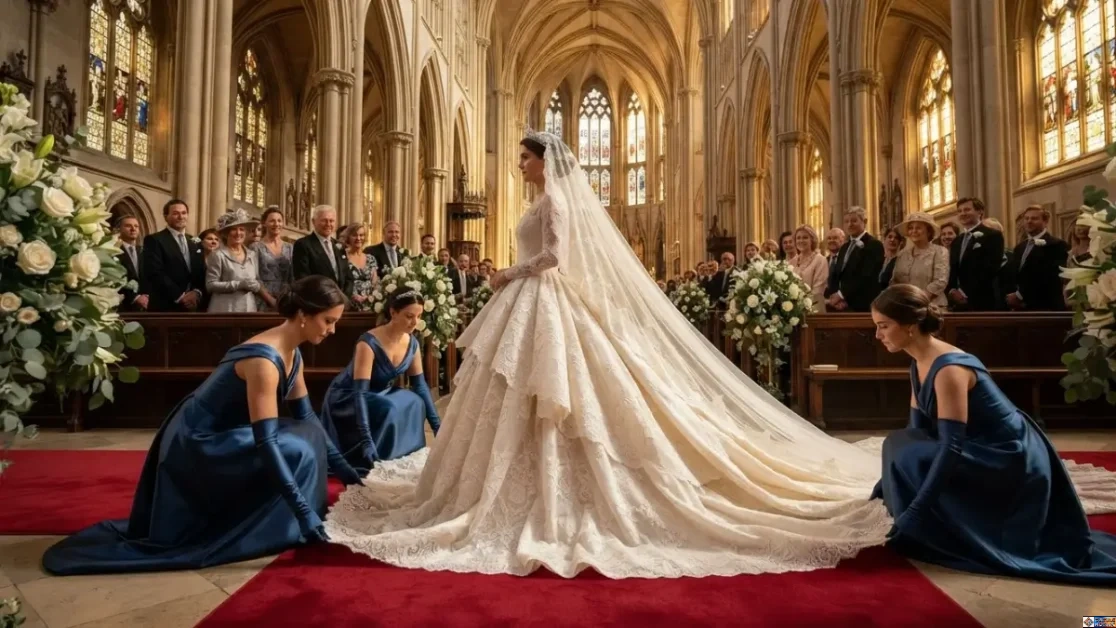
Queen Victoria married Prince Albert on 10 February 1840 in a satin gown trimmed with Honiton lace, and the Royal Collection Trust says she chose that lace to revive a struggling Devon industry. Britain has been copying her ever since. Much of the rest of the world never did.
That’s the problem. Most of us in the UK absorb one bridal template and quietly file every other tradition under “costume”. Then a Nikah invitation lands, or a cousin marries in Seoul, or you scroll a gallery of crimson and gold and can’t say what any of it means. It’s a strange feeling. You can see the craftsmanship and still miss the message. And missing the message is exactly how people pair the wrong colour with the wrong ceremony, or describe a centuries-old garment as fancy dress.
I think the cure is to read a garment like a sentence. Who made it? What is it woven from? Which piece does the bride wear, and which does her family give her? What does it promise? This guide reads nine global bridal wear traditions that way, leaning on museum catalogues, UNESCO records and government publications rather than folklore. Where a claim rests on a trade source or a popular explanation, I say so.
For a designer’s view from Istanbul, Mediha Cambaz has written her own tour of Global bridal wear traditions. What follows is UK-based and citation-led, and it’s written for brides, guests and anyone who has wondered why one wedding looks nothing like another. It also sits inside a longer conversation at Culture mosaic about how heritage dress survives, and the archive’s wider essay on Culture and Fashion is a good place to start if you want the big picture first.
What Are Global Bridal Wear Traditions?
Global bridal wear traditions are the customs that decide what a bride wears, what it’s made from, who gives it, and what it means. That covers dresses, obviously. It also covers robes, crowns, veils, cheek paint, beads, bangles and sashes. Some of it is centuries old. Some of it, like Britain’s white gown, is comparatively new.
Traditional global wedding attire tends to do four jobs, and once you spot them, unfamiliar garments stop looking unfamiliar:
- Protect. Colours, jingling metal or stitched symbols meant to guard the bride.
- Announce. Region, family, marital or economic status written into the cloth.
- Transition. The moment a bride moves from one household or life stage to another.
- Last. Cloth built to be re-worn, rented, passed down or reused.
Each of the nine sections below is tagged with the jobs its garment does. If you’d like a shorter primer on regional dress first, the archive’s guide to Traditional Clothing Styles and its explainer What is Heritage Fashion are useful starting points.
1. Britain: Why the White Wedding Dress Is the Newest Tradition Here
Start at home, because home is where the assumption lives.
The Victoria and Albert Museum’s account is careful. Queen Victoria helped popularise white in 1840, it says, but earlier royal brides had worn white too, usually woven or heavily embroidered with gold or silver. Her dress was plain by comparison. Meanwhile widows, older brides and less well-off women often chose practical coloured gowns that then did duty as Sunday best for years. Hold on to that last detail. It matters later.
The Royal Collection Trust adds the commercial angle. Fashion at the time favoured Brussels lace, yet Victoria commissioned Honiton, reviving a flagging trade in Devon, and the flounce came out again for family weddings in 1858 and 1893. So even the most famous white dress in British history was partly re-worn. The White House Historical Association offers a useful correction to the popular story: her gown was not the sole origin of the white wedding dress. It popularised a look that already existed.
My view? The white dress is a lovely tradition and a young one. Treating it as the default “traditional” option is the biggest reason British readers misread everybody else’s. If you want the fuller timeline, the archive lays it out in Why Wedding Dresses Are White and in Traditional Wedding Dress Cultural Meaning.
Jobs this garment does: Announce, Last.
2. China: How the Red Chinese Wedding Dress Balances Yin and Yang
A Chinese wedding dress rarely tries to be one garment. It’s an ensemble, and the Metropolitan Museum of Art explains the logic in one clean idea: yin and yang. A bride, as the female (yin) partner, traditionally wore an even number of garments. Her groom, yang, wore an odd number. Numbers as tailoring. I find that wonderful.
The colour is red. The V&A’s catalogue entry for a pair of Hong Kong-made bridal shoes names the classic set: hong gua, or “red gown”, a matching jacket and skirt. The shoes carry a dragon and a phoenix chasing a pearl, worked in padded metallic thread so the design lifts off the satin. The museum notes that the dragon stands for the male and the phoenix for the female, side by side as a picture of balance. It also records that brides once embroidered their own shoes to prove their skill, until ready-made pieces sent by the groom’s family, often borrowed or rented, took over.
The Met makes a second point that quietly upends Western habits. Unlike a Western bridal gown, a Chinese wedding ensemble was usually meant to be worn again, for milestone birthdays and other celebrations. Its own example swaps the classic phoenix for ears of grain and cranes for longevity, stitched in heavy gold thread.
Here’s the modern twist, and the reason this tradition hasn’t faded. The V&A observes that white wedding dresses are popular today, but traditional bridal ensembles are still worn for the rituals in front of parents and ancestors and at the banquet. Singapore Brides, a wedding publication, lists a tea-ceremony kua among the outfits in a June 2026 guide that puts the average bride at five outfits. So the red dress didn’t lose to white. It simply got a different scene in the day. White for the aisle and the cameras, heritage for the family. That’s the pattern I’d bet on across most Asian bridal traditions, and it’s one reason global bridal wear traditions keep surviving alongside the white dress.
The stitched symbols deserve more room than I can give them here. The archive’s breakdown of cultural wedding dress motifs covers the dragons, peonies and pomegranates one by one.
Jobs this garment does: Protect, Last.
3. Japan: White First, Then Colour
Japan is where the white-versus-red argument dissolves, because the bride wears both.
The Government of Japan’s Highlighting Japan magazine (July 2024) describes the classic bridal look as shiromuku: a white kimono, white obi and white accessories, chosen because white is regarded there as sacred and pure. Web Japan, run by the Ministry of Foreign Affairs, dates the shiromuku to the Muromachi period (1333 to 1568) and lists the full white set: the uchikake outer robe, the kakeshita worn beneath it, the obi, the wataboshi hood, the tsunokakushi headband and the sandals. Then comes the change of colour. The coloured iro-uchikake is decorated with cranes and tortoiseshells for long life and prosperity, and the hikifurisode, with its trailing hem, became formal wear for women of samurai lineage in the late Edo period.
Highlighting Japan treats the hood and headband as the Japanese counterpart to the Western veil, and it mentions a small thing that stays with me: tucked into the robe is the kaiken, a short protective sword. Samurai-class women carried one around the 17th century, and it entered bridal dress as an accessory from the 19th. A weapon as a wedding accessory. History doesn’t get more stitched-in than that.
Why white, then colour? The popular explanation is that the bride arrives as a blank cloth, is “dyed” in her new family’s colours, and changes into colour to show it. Treat that as a popular reading rather than a documented rule. The government sources I’ve used call the white pure and sacred, and don’t spell out the dye metaphor. I like the idea. I can’t trace it to a primary text.
Jobs this garment does: Transition, Protect.
4. South Korea: The Hwarot, Red and Blue in Balance
Korean bridal robes stayed close to the palace. The hwarot (also spelled hwalot) has been culturally significant as a female wedding garment since the early Choson dynasty, according to a study in the Clothing and Textiles Research Journal by Laura K. Kidd and Younsoo Lee. They found it evolved from Chinese costume styles yet stayed distinct from everyday hanbok, and that its silhouette, colour and motifs carry symbolism that has barely shifted. Their neat conclusion: surface details can change, individuality can slip in, and the robe still reads as itself.
Colour is the code. In a 2013 lecture for the Society for Asian Art, scholar Minjee Kim set out the scheme using robes and reproductions from museum collections. Red is yang and blue is yin. A pair of mandarin ducks means eternal love and happy marriage, peonies mean nobility, pomegranates mean fertility, and coloured stripes on the cuffs are meant to block disease and bring spiritual power. Among global bridal wear traditions, few are read as closely as this robe. It’s a lecture handout, not a peer-reviewed paper, but it comes from a specialist working with named objects.
Two details fascinate me. First, the jokduri, the small black crown, and the red cheek dots called yeonji gonji. One bride who married in Korea describes on an intercultural-marriage blog how the dots are believed to protect against evil spirits, and admits that her dots were red stickers and the whole look was uncomfortable on a hot day. That’s a personal account, not scholarship, but it’s honest about how these things feel.
Second, a footnote in Kidd and Lee’s paper says one of the authors, after a Western ceremony, changed into a hwalot and gave her in-laws a formal, deep bow. That’s the p’yebaek, in which the bride presents food to her new in-laws, and it shows how a bride today can hold two wardrobes in one wedding.
Jobs this garment does: Protect, Transition.
5. India and Pakistan: Red Is the Headline, the Weave Is the Story
Of all the global bridal wear traditions in this guide, South Asia’s may be the most regional. Ask most of us for a South Asian bride and we picture red. Fair enough. Red saris and lehengas are the classics. But regional custom breaks that picture apart.
According to the Indian sari label Tilfi’s guide to the bridal sari, which is a trade source, South Indian brides traditionally chose pure silk Kanjeevaram saris in maroon and deep reds with gold zari temple borders. A Malayali bride wore the Kasavu sari in cream and gold. An Assamese bride wore a cream Mekhla Chador in muga silk, gifted by the groom’s family. A Parsi bride wore an embroidered white sari called Gara. A Maharashtrian bride wore a yellow-and-green Paithani draped in the nauvari style. Cream, white, yellow, green. All bridal. All correct.
The lesson: there is no single “Indian wedding dress”. There’s a map. And where a fibre comes from matters, which is the thread the archive follows in Geographic Fingerprinting of Heritage Fibers.
Pakistani bridal wear runs on the same reds, in lehengas, sharara sets and heavy embroidery. UK retailers Rania Zara and Zara Shahjahan, both trade sources, describe British brides choosing red for ceremony and reception while cream-and-gold looks gain ground, and the second points to a revival of hand techniques such as vasli, marori threadwork and tilla embroidery. The Asian wedding photography studio Royal Bindi adds the religious layer: Hindu brides typically wear a sari or lehenga, while Sikh brides may choose a salwar kameez or lehenga. Where these ensembles get mixed most inventively is in Britain itself, and the archive tracks that fusion in Modern Cultural Wedding Dresses.
Jobs this garment does: Announce, Transition, Last.
6. Nigeria: Aso Oke, Coral and the Colour of the Day
Nigeria makes the strongest case that a wedding outfit can belong to a whole room, not just a bride, and it’s where global bridal wear traditions turn most openly social.
The Knot’s guide to Nigerian bridal wear, built on interviews with Nigerian planners and designers, sorts the traditions by ethnic identity: George fabric and coral beads for Igbo brides, aso oke for Yoruba brides, and modest silk or lace gowns for Hausa-Fulani brides. The Yoruba set is a buba blouse, an iro wrapper, a gele head tie and an ipele shoulder sash, all cut from aso oke, the handwoven cloth, with the groom in an agbada and fila cap.
Nigeria’s TheCable Lifestyle adds the coral beads and a decorative hand fan. Coral, per The Knot’s experts, signals royalty and fertility. On colour, they say there are no strict rules, though red often reads as love and strength and gold and champagne as royalty and celebration. An Igbo bride may change into a second outfit before the palm-wine ceremony.
Then there’s aso-ebi, “family clothes”. A chosen fabric goes out to relatives, friends and the wedding party, and everyone has their own outfit made from the same cloth. Guests who don’t receive it may follow a “colour of the day”, and planner Feyisola Ogunfemi explains that at a traditional introduction the two families often wear different colours until they’re formally joined. I think aso-ebi is the most social piece of bridal clothing on this list. If you’re invited as a guest to any wedding with a colour brief, the wider etiquette is in multicultural wedding attire.
Jobs this garment does: Announce, Transition.
7. Palestine: A Wedding Dress Written in Thread
Few global bridal wear traditions are documented as carefully as this one, so UNESCO’s record is the best place to begin. The art of embroidery in Palestine was inscribed on the Representative List of the Intangible Cultural Heritage of Humanity in December 2021. UNESCO describes the thob, the loose dress, embroidered across chest, sleeves and cuffs with birds, trees and flowers in silk thread on wool, linen or cotton. The choice of colours and designs signals a woman’s regional identity and her marital and economic status, and the Committee’s decision notes the practice is featured at weddings.
What strikes me is how much information one garment holds. A Palestinian thobe is closer to an identity card written in thread than to a costume. UNESCO adds that the skill passes from mothers and grandmothers to daughters, and through formal training. A 2023 V&A blog describes a partnership with the Palestinian Museum built around a collection of 80 thobes, bought after a crowdfunding campaign in 2020, which tells you how seriously conservators take the cloth.
Jobs this garment does: Announce, Last.
8. Norway: The Silver Crown That Rings
If you want protection stitched, or rather hammered, into a wedding outfit, look north.
Vesterheim, the National Norwegian-American Museum, holds a silver, gold-washed bridal crown from around 1740 with rayed solar disks stamped around the base and cut-out suns forming the points. Its curators explain that solar symbols on Norwegian crowns link the woman’s head to the heavens and attract the sun’s fertilising rays, and small birds on the crown carry the same heavenly meaning. For more on the older symbols that keep resurfacing in dress, see the archive’s Ancient Ethnic Heritage Symbols. Many crowns also carry dangling pendants, and the Museum of International Folk Art in Santa Fe catalogues a later example by Bergen silversmith Magnus Aase with red stones, bowl-shaped dangles and seven brocaded ribbon streamers.
The pendants make music. Tradition, as reported by a UK jeweller and by Transparent Language, says the sound wards off evil spirits while the bride dances. Ingebretsen’s, a Scandinavian retailer in Minneapolis, tells the crown’s longer story: it entered use at the end of the Middle Ages, echoing the Virgin Mary’s crown, and stood for purity. Pregnant or widowed women were not allowed to wear it. Some crowns were so heavy they were sewn into the bride’s hair, and many belonged to the church and were rented out, typically for a single daler before 1875. That’s a retailer’s account and the only source I found for the rental detail, so weigh it accordingly.
Picture the weight and the chime. I can’t think of a bridal accessory I’d want to hear more.
Jobs this garment does: Protect, Announce, Last.
9. Ethiopia and Eritrea: When White Isn’t a Western Colour
Here is my favourite corrective to the idea that white means Western.
The habesha kemis is a long dress of handwoven cotton called shemma, woven by specialist weavers, usually white, and finished with tibeb embroidery along the waistband and edges. A light shawl, the netela, often goes over the shoulders. A fashion blog on Ethiopian cloth reports that a single dress can take up to three weeks to finish, and that placement varies by region: Shewa versions may embroider the hem, cuffs and waist, while Gondar versions put embroidery on the back of the hem only. It’s worn at ceremonies and special occasions, so it isn’t a bridal garment alone. Modern designers now work with dyed cotton and new silhouettes.
I’d offer this as a useful thought experiment. Here, white cotton and coloured thread say “celebration” and “our region”. Nobody needs Queen Victoria to explain it.
Jobs this garment does: Announce, Last.
Global Bridal Wear Traditions List: Which 10 Countries at a Glance?
Which 10 countries have the most traditional wedding dresses? Nobody keeps an official league table, and “most” depends on how you count. What I can give you is a global bridal wear traditions list of ten places with well-documented bridal dress traditions, drawn from the sources above. It’s a sample, not a ranking.
If a wedding is on your calendar this season, five minutes with this table can save you an awkward mistake.
Wedding Dress Colors in Different Cultures: A Quick Chart
Traditional wedding dress colors never map neatly to one meaning, and global bridal wear traditions rarely treat any single colour the same way. In this ten-country sample, red leads in four (China, South Korea, India and Pakistan), white or cream leads in three (Britain, Japan’s opening ceremony and Ethiopia and Eritrea), silver and gold lead in one (Norway), and two vary by region or family (Nigeria and Palestine). That’s a snapshot of this guide’s examples, not a global survey.
Traditional wedding dress colours at a glance[cite: 2]
Ten bridal traditions, their signature colours and what each palette signals[cite: 2]
Original chart: signature colours across ten bridal traditions. Swatches are indicative.
Notice how “red” is popular but never identical. In China it’s luck and yin-yang balance, in Korea it’s the yang half of a pair, and in Nigeria planners describe it as love and strength. Same colour. Different sentence.
Symbolism in Traditional Wedding Garments: The Four Jobs Compared
Reading across nine global bridal wear traditions, I kept seeing the same four jobs. Here’s where each shows up, based on the sources above.
The white gown, as Britain wears it, is brilliant at “Announce” and rarely does “Last”. That single difference explains a lot about why it feels so different from the others.
Wedding Dress Traditions and Superstitions of Different Cultures: A Fact Check
Global bridal wear traditions attract myths, and three claims travel across the internet more often than any others. Here’s how they hold up.
”White has always meant purity.” Not quite. The V&A ties Victoria’s white to fashion and to the lace trade, and notes that coloured gowns were common. Japan treats white as sacred and pure, yet changes into colour later in the ceremony. In Ethiopia and Eritrea white cotton is simply the fabric of formal occasions. Purity does appear in some traditions, such as Norway’s crown, but it’s one thread of many.
”Traditional means frozen.” The evidence says otherwise. Kidd and Lee’s study found that surface details can change while the robe’s cultural meaning stays intact, and Highlighting Japan notes that wearing a colourful kimono under the white one has become fashionable. Traditions stay alive because people adjust them.
”Red means the same thing everywhere.” As the chart shows, it doesn’t. Popular, yes. Identical, no.
As for the superstitions themselves, the documented ones are wonderfully specific: jingling crown pendants against evil spirits in Norway, cheek dots in Korea, protective cuff stripes on the hwarot, and a short sword in the folds of a Japanese robe. Whether any bride believes them literally is another matter. As a stylist, I’d say they work the way a lucky charm does, by making the day feel guarded.
Why Is the One-Wear White Gown the Odd One Out?
Line up the evidence. The Met says Chinese ensembles were meant to be worn again. The V&A says ready-made Chinese wedding clothes were often borrowed or rented. Norwegian church crowns were rented out. Victorian brides in coloured gowns wore them as Sunday best. UNESCO says Palestinian embroidery skills pass from mothers to daughters. In that company, the single-wear white gown starts to look like the eccentric one.
I don’t say that to shame anyone in white. I say it because it changes the question. Instead of “which tradition should I copy?”, try “which of these can I keep using?”. If you’d rather not buy at all, Where Can I Rent Wedding Dresses walks through the routes, and the wider case for cloth that lasts sits in Regenerative Textile Traditions.
How Do You Borrow From Cultural Wedding Dress Traditions Respectfully?
Anyone borrowing from global bridal wear traditions should start with a simple rule: it’s somebody’s inheritance, not a mood board. If you have family or community ties to a tradition, it’s yours to wear. If you don’t, take a lighter route, ask, and credit the makers. Here are three routes that work in a UK wedding, plus one weird one.
Change the second outfit. Singapore Brides puts the average 2026 bride at five outfits, and the South China Morning Post reports that multiple dresses, common in Asia, are catching on in the West. London boutique founder Caroline Burstein of Browns Bride says comfort and movement are the main reasons her brides want a second look. That’s your opening: keep the white gown for the ceremony, then wear a heritage piece for the party. I’ve laid out the current silhouettes in What Wedding Dresses Are in Style and the season’s palette in Colour of the Season 2026. For where the wider industry is heading, see Latest Trends in Bridal Wear and Fashion 2026.
Stitch one motif, skip the costume. A small protective symbol inside a hem or along a sash says more than a full borrowed outfit, and it’s easier to do well.
Wear an heirloom textile. A family sari as a sash, a grandmother’s embroidered cloth at the veil’s edge. It keeps the “Last” job alive.
Budget shapes all of this, of course. How Much Are Wedding Dresses UK? gives realistic price bands, and Affordable Wedding Dresses Europe looks at cheaper routes across the Channel. And if your taste runs toward a shape none of these traditions would recognise, that’s fine too. Plus Size Wedding Dresses and Best Sexy Wedding Dresses cover cuts and confidence without asking you to choose between heritage and self-expression.
The weird one. Borrow the logic of the Norwegian pendants. Sound as protection. Sew a few small silver charms into the bouquet ribbon or the shoe lining so you chime faintly when you dance, and tell the story if anyone asks. It’s a nod to an idea, not a copy of a crown, and it costs pennies.
Frequently Asked Questions
1. What are some common bridal traditions?
Most global bridal wear traditions fall into four groups. Colour: red in China and much of South Asia, white in Britain and, in different ways, in Japan and Ethiopia. Head coverings: veils, hoods, crowns and wreaths. Protective details: jingling metal in Norway, cheek dots in Korea, protective cuff stripes on Korean robes and a short sword in Japan. And change: many brides wear more than one outfit, moving from a ceremonial garment to a celebratory one, as in Japan’s white-then-colour sequence or Chinese tea-ceremony outfits. Another common thread is family involvement, from Nigerian aso-ebi to gifts of cloth from the groom’s family in Assam.
2. Which 10 countries have the most traditional wedding dresses?
There’s no official ranking, so “most” is a judgement call. Ten places with especially well-documented bridal traditions are Britain, China, Japan, South Korea, India, Pakistan, Nigeria, Palestine, Norway, and Ethiopia and Eritrea. Each has a named garment and a body of museum, government or UNESCO documentation behind it: the white satin-and-lace gown popularised in Britain in 1840, China’s red hong gua, Japan’s shiromuku, Korea’s hwarot, India’s regional saris, Pakistan’s lehenga and sharara sets, Nigeria’s aso oke ensembles, Palestine’s embroidered thobe, Norway’s silver bridal crown and the Ethiopian and Eritrean habesha kemis. See the comparison table above for colours and meanings.
3. What are 10 of the world’s most unusual wedding traditions?
Ten unusual bridal-wear customs from this guide include a short protective sword (kaiken) tucked into a Japanese bridal robe, and a Japanese headband said to veil the bride’s “horns” of jealousy (noted as a popular explanation reported by a Kyoto kimono rental shop rather than a documented rule). Other customs feature jingling spoon-shaped pendants on Norwegian crowns to scare away spirits, crowns so heavy they were sewn into the bride’s hair, and a Chinese bride wearing an even number of garments to match her groom’s odd number.
Additional customs span red dots on a Korean bride’s cheeks, protective coloured stripes on Korean cuffs, and Nigerian aso-ebi where guests wear cloth chosen by the couple. The list also highlights Palestinian embroidery that signals a woman’s region and marital status, alongside Queen Victoria’s twelve bridesmaids who similarly wore white.
4. What do wedding dress colours mean in different cultures?
Meaning depends on the tradition. Red is linked with luck and yin-yang balance in China, with the yang half of a pair in Korea, and with love and strength in Nigerian planners’ accounts. White is described as sacred and pure in Japan, as formal-occasion cotton in Ethiopia and Eritrea, and as post-1840 fashion in Britain. Gold signals royalty and celebration in Nigerian planners’ accounts, and metallic thread runs through Chinese, Indian and Norwegian bridal pieces. Cream and gold appear in Kerala, cream in Assam, and white for Parsi brides. The safest rule is to ask what the colour means to the family whose wedding it is.
5. Can I wear another culture’s wedding dress?
Sometimes, with care. Global bridal wear traditions belong first to the families who keep them. If you’re invited into the tradition by family, a partner or a community, wearing the garment is usually welcome, and asking which pieces carry meaning is a good habit. If you have no connection, consider lighter routes: a single motif, a heirloom textile, or a second outfit inspired by a tradition and credited to it. Buy from makers within the community where you can. As a guest, follow the couple’s colour or dress brief, such as a Nigerian aso-ebi or a “colour of the day”, instead of improvising. Treat the garment as an inheritance, not a costume.
A white dress asks a bride to look like a beginning. A hwarot, a hong gua, or a thobe asks her to carry a whole family. I know which sentence I’d rather wear.
Sources and Further Reading
- Royal Collection Trust, “Queen Victoria’s wedding dress, 1840” (RCIN 71975): col.rct.uk
- History of Royal Women, “The Wedding Gown of Queen Victoria and Its Inspiration to Future Brides” (quotes the Royal Collection Trust on the lace flounce reused in 1858 and 1893): historyofroyalwomen.com
- Victoria and Albert Museum, collection record O78857 (Victorian wedding dress and social class notes): collections.vam.ac.uk
- White House Historical Association, “Queen Victoria’s Wedding Dress, 1840”: whitehousehistory.org
- The Metropolitan Museum of Art, “Jacket and Skirt for Wedding” (China): metmuseum.org
- Victoria and Albert Museum, collection record O167373 (embroidered bridal shoes, hong gua): api.vam.ac.uk
- Singapore Brides, “One is never enough: all the outfits you’ll wear for your wedding” (June 2026, trade publication): singaporebrides.com
- Government of Japan, Highlighting Japan vol. 194, July 2024, “Japanese Wedding Attire”: gov-online.go.jp
- Web Japan (Ministry of Foreign Affairs of Japan), “Wedding Kimonos”: web-japan.org
- Kidd, L. K. and Lee, Y. (2002), “The Style Characteristics of the Hwalot, with a Focus on One Robe from the Collection of the Honolulu Academy of Arts”, Clothing and Textiles Research Journal 20(1), 1-14: journals.sagepub.com
- Kim, M. (2013), “Structure, Colors, and Symbolism of Korean Bridal Robes: Hwalot and Wonsam”, Society for Asian Art lecture handout: societyforasianart.org
- My Korean Husband, “Jokduri and yeonji gonji” (personal account, non-academic): mykoreanhusband.com
- Tilfi, “The Indian Bridal Saree” (trade source): tilfi.com
- Rania Zara, “Pakistani Wedding Dresses Trends UK Brides Are Loving Right Now” (trade source): raniazara.co.uk
- Zara Shahjahan UK, “Pakistani Bridal Dresses in the UK” (trade source): uk.zarashahjahan.com
- Royal Bindi, “What to Expect at an Asian Wedding in the UK”: royalbindi.co.uk
- The Knot, “Nigerian Bridal Wear”: theknot.com and “Nigerian Wedding Attire”: theknot.com
- TheCable Lifestyle, Nigerian traditional wedding outfits by tribe: lifestyle.thecable.ng
- UNESCO, “The art of embroidery in Palestine, practices, skills, knowledge and rituals” (2021): ich.unesco.org and Decision 16.COM 8.B.30: ich.unesco.org
- Victoria and Albert Museum, “Palestinian Museum x V&A partnership” (2023): vam.ac.uk
- Vesterheim Norwegian-American Museum, Brudekrone (bridal crown), c. 1740: onlineexhibits.vesterheim.org
- Museum of International Folk Art, Brudekrone by Magnus Aase: collection.moifa.org
- Ingebretsen’s, “Bridal Crown History from Norway” (retailer, trade source): ingebretsens-blog.com
- Robert Gatward Jewellers, “The Wedding Traditions of Norway”: luxe.robertgatwardjewellers.co.uk
- Transparent Language, “Norwegian Wedding Preparation”: blogs.transparent.com
- Made In Ethiopia blog, “The Habesha Kemis, It’s Details & Compliments” (fashion blog): tdsblog.com
- Yumeyakata Kyoto Kimono Rental, “Wedding Attires” (rental shop, trade source; tsunokakushi explanation): en-kyoto.yumeyakata.com
- South China Morning Post, “Multiple wedding dresses for Meghan, Jennifer Lopez, Britney Spears”: scmp.com
- Newswise, “Wedding in white: Queen Victoria set the white wedding trend in 1840” (twelve bridesmaids in white): newswise.com