
 By Dr. Marcus Hale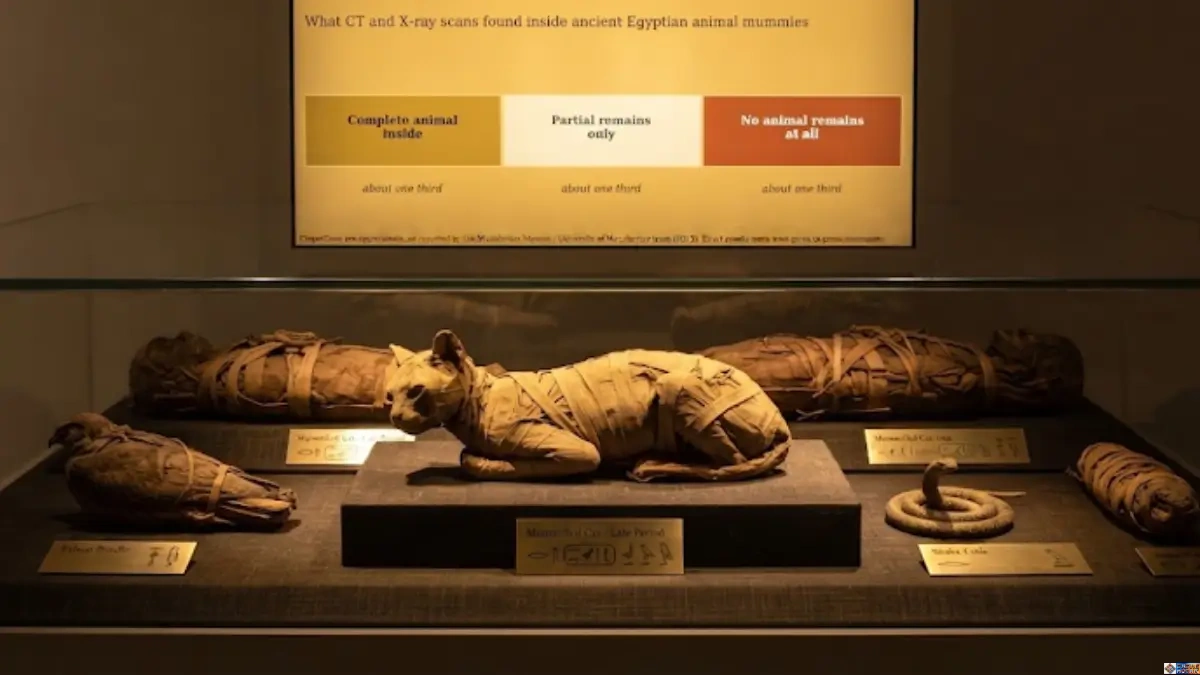
Quick Summary
- Ancient Egyptian animal mummies were not novelty items. Most were votive offerings, bought by pilgrims and buried by priests as a kind of prayer made physical, the way a candle works in a church today.
- Egyptologists sort them into four groups: sacred animals worshipped as a living god’s incarnation, beloved pets buried with their owners, food provisions for the afterlife, and votive offerings, which vastly outnumber the rest.
- Modern CT and micro-CT scans, run without ever unwrapping the linen, have found that roughly a third of scanned mummies hold no animal remains at all, just packing material.
- The scale was staggering: an estimated 70 million animal mummies were produced across Egypt, including nearly 8 million dogs buried in a single catacomb at Saqqara.
- Genuine animal mummies are not for sale anywhere legal. Egyptian law has banned the export of antiquities since 1983, and any dealer offering you a real one is either lying or committing a crime.
We Got the Story Backwards
Ask most people what they picture when they hear “Egyptian mummy” and you get gold masks, cursed tombs, Boris Karloff shuffling through a movie set. Pharaohs. Always pharaohs.
Here’s the part that gets left out of that picture: there are more mummified animals in Egypt than mummified people. Vastly more. Cats, dogs, ibises, crocodiles, snakes, shrews, even bulls the size of a small car, wrapped and buried by the million across dozens of sites. Some estimates put the total number of animal mummies produced at around 70 million.
That’s not a rounding error. That’s an industry.
I understand the instinct to skip past this and go straight to Tutankhamun. Golden coffins photograph well. But if you actually want to understand how ordinary Egyptians related to their gods, day to day, animal mummies get you there faster than any royal tomb ever will. This wasn’t reserved for kings. A farmer with a few coins to spare could walk up to a temple, buy a mummified cat, and hand it to a priest as a gift to the goddess Bastet. It was devotion you could hold in your hands.
So let’s do this properly: why they made them, how, what the science has found hiding inside the wrappings, and what happens if you go looking to buy one yourself.
Why Did Ancient Egyptians Mummify Animals?
Four separate motives, and mixing them up is where most popular accounts go wrong.
Sacred animals. A small number of animals were treated, in life, as the living incarnation of a god. The Apis Bull at Memphis is the clearest example: a bull selected by priests through a set of physical markings, housed in luxury, worshipped while alive, and mummified with full royal-grade ceremony when it died of natural causes. These animals lived like a god because, to the Egyptians, they were one.
Pets. Ordinary household animals, buried alongside their owners so the bond continued into the afterlife. Cats and dogs mummified this way turn up in private tombs next to their humans, not in the mass temple catacombs.
Food for the afterlife. Joints of meat, poultry, and fish were mummified and packed into tombs as provisions, the same logic behind every other object in a burial: you’ll need it where you’re going.
Votive offerings. By far the largest category, and the one that produced those staggering numbers. A pilgrim purchased a mummified animal associated with a particular god, dedicated it in a ritual, and left it in that god’s catacomb as a permanent, physical prayer. Buy a cat for Bastet, an ibis for Thoth, a falcon for Horus. It functioned exactly like lighting a candle in a cathedral, except the Egyptians were playing a longer game than a few minutes of flame.
For a wider sense of how religion sat inside ordinary daily routines rather than as a separate Sunday activity, I’ve written more on what was everyday life in ancient Egypt, where household shrines and small acts of devotion come up again and again.
Were Ancient Egyptian Animal Mummies Pets?
Some were. Most weren’t. Here’s the distinction laid out side by side, because conflating “sacred animal,” “pet,” and “votive offering” is the single most common mistake I see in casual writing on this topic.
Notice how small that “pet” row actually is next to “votive offering.” The mummified-cat-as-beloved-companion story is real, but it’s a rounding error compared with the industrial religious economy built around votive animals. Most animal mummies never had an owner at all — they were manufactured for sale.
What Types of Animals Were Mummified?
Nearly anything with fur, feathers, or scales that could be tied to a god. The British Museum’s own ongoing research project, Divine Creatures: Animal Mummies in Ancient Egypt, works from a collection of roughly 500 examples that includes cats, crocodiles, bulls, ibises, snakes, shrews, and fish, alongside the wooden and bronze coffins built to house them.
Dogs deserve special mention here. Excavations at the Anubieion catacomb near Saqqara, led by Paul Nicholson of Cardiff University, uncovered a network of tunnels that once held an estimated eight million mummified dogs, along with jackals, foxes, cats, and mongooses swept in alongside them. Most were very young puppies, likely bred specifically for this purpose and separated from their mothers within days of birth. It’s an uncomfortable fact to sit with, and I won’t pretend otherwise.
How Were Egyptian Animal Mummies Made?
For decades, the assumption among Egyptologists was that animal mummification was the cheap, sloppy cousin of human embalming — coarse linen, a dip in resin, done. Chemistry proved that assumption wrong.
A landmark 2004 study in Nature, led by chemist Richard Evershed’s team at the University of Bristol working with tissue samples from cat, hawk, and ibis mummies, found embalming mixtures every bit as sophisticated as those used on wealthy human burials of the same era: animal and plant fats, beeswax, sugar gum, petroleum bitumen, and resin from conifers and the pistacia tree, sometimes traded in from hundreds of miles away. Reverence, not corner-cutting, shaped the recipe.
The basic steps mirrored human mummification at a smaller scale: the body was dried using natron salt, treated with these resin-and-fat mixtures to seal out moisture and pests, then wrapped in layers of linen, often in elaborate geometric patterns for higher-status offerings. Wealthier votive mummies got a wooden or bronze coffin shaped like the animal itself. Cheaper ones got a rough bundle and a shared pit.
I’ve laid out the fuller preservation chemistry, including the natron-drying process shared with human burials, in Ancient Egyptian Mummies Preservation Techniques.
The Industrial Scale Nobody Expects
Here’s where the numbers stop feeling abstract. In 1888, a farmer plowing a field near Beni Hasan broke into a vast cat cemetery attached to a temple of the lioness goddess Pakhet. Estimates of what he’d found range from 80,000 to over 300,000 mummified cats. Rather than being studied, most of it was shovelled up, shipped to Liverpool, and in February 1890, roughly 180,000 mummified cats weighing around 19.5 tons were auctioned off — for fertiliser.
Read that again. Sacred animals, worshipped as gifts to a goddess for over a thousand years, ground into farm feed by Victorian entrepreneurs who saw a cheap source of nitrogen and nothing else. A handful of specimens survived only because a few museums, including what is now National Museums Liverpool, bought samples off the auction lot before the rest went into the fields.
That single event tells you something the temple ruins can’t: the sheer scale of animal mummification meant these weren’t precious, individually mourned objects to everyone who encountered them. To the pilgrims who bought them, they were sacred. To a plundered nineteenth-century field, they were commodity. Both things were true at once, a hundred years apart.
For more on how burial practice more broadly shifted across dynasties and social classes, see Ancient Egyptian burial customs.
What Do CT Scans Reveal Inside Animal Mummies?
This is where the science gets genuinely surprising, and where I think the field has made its biggest leap in the past decade.
In the largest project of its kind, researchers at the University of Manchester and Manchester Museum ran CT scans and X-rays on more than 800 animal mummies. Dr. Lidija McKnight, who led the work, told the BBC the results held real surprises. Roughly a third of the mummies contained a complete, well-preserved animal. Another third held only partial remains. The final third contained no animal material whatsoever — just mud, reeds, sticks, and organic scraps like eggshells and feathers that had been lying around the embalmers’ workshop floor.
What CT and X-ray scans found inside 800+ ancient Egyptian animal mummies[cite: 1]
Proportions are approximate, as reported by the Manchester Museum / University of Manchester team (2015). Exact counts were not given in press summaries.[cite: 1]
Original chart based on Manchester Museum / University of Manchester scan results (2015).
Was this a mass con? McKnight and her colleagues don’t think so. Their theory is more interesting than fraud: demand for votive mummies, driven by millions of pilgrims over more than a thousand years, likely outstripped the supply of animals available to embalm. A partial mummy, or one padded out with material from the workshop where a real animal had once been prepared, may still have carried genuine ritual weight for buyers who never checked what was inside anyway. In an era before X-rays, nobody could.
A separate 2020 study out of Swansea University pushed the science further, using micro-CT scanning — a technique roughly a hundred times more detailed than a hospital scanner — on a cat, a bird, and a snake from the Egypt Centre’s collection. Engineering professor Richard Johnston and Egyptologist Carolyn Graves-Brown found the cat was a kitten under five months old with a broken neck, likely killed deliberately during the mummification process.
The snake, a juvenile Egyptian cobra, showed signs of dehydration and a fractured spine consistent with being seized by the tail and whipped against the ground. Its mouth had been forced open and packed with natron, matching descriptions of the “opening of the mouth” ceremony performed on human dead so they could see and breathe again in the afterlife.
Graves-Brown put it plainly at the time: like us, the ancient Egyptians used and sometimes abused animals. I’d rather sit with that discomfort than paper over it, because it’s exactly the kind of nuance dry academic summaries tend to flatten out.
What Is the Oldest Animal Mummy Ever Found?
Long before the Apis Bull, before Bastet’s cat temples, before any of the industrial-scale catacombs, Egyptians were already burying animals with care.
At Hierakonpolis, an elite predynastic cemetery dating to roughly 3600–3500 BCE, archaeologists working in the site’s HK6 sector have uncovered an extraordinary menagerie: elephants, hippopotamuses, baboons, wildcats, and dogs, some showing healed fractures that could only have occurred in captivity. One elephant, buried beneath what may be the earliest known elaborate funerary superstructure in Egypt, appears to have been kept and fed for years before its death. Slightly later, predynastic burials at Tarkhan included donkeys and ducks, each given its own small coffin.
Whether deliberate mummification, as opposed to simple burial in absorbent desert sand, was intended at this early date is still debated. But the impulse — treating a beloved or symbolically important animal’s remains with the same care given to a human — clearly predates the pharaohs by centuries.
What Did Mummification Smell Like?
Genuinely better than you’d expect, if the human mummies studied so far are any guide, and the chemistry behind animal embalming used many of the same ingredients.
A 2025 study published in the Journal of the American Chemical Society, led by Cecilia Bembibre of UCL’s Institute for Sustainable Heritage and chemist Matija Strlič, used chemical analysis alongside a trained panel of human sniffers to characterise the scent of nine human mummies at the Egyptian Museum in Cairo, some as old as 5,000 years. The dominant notes were woody, spicy, and sweet, likely from the pine and juniper resins used in embalming. “We were surprised at the pleasantness of them,” Bembibre said.
The animal-mummy chemistry, drawn from the same resin-and-beeswax palette identified in the Bristol study above, points toward a similar experience: pine, pistacia resin, and a faint sweetness from beeswax rather than decay. Ancient Egyptians associated pleasant scent directly with purity and the presence of the divine, and foul odour with corruption — so getting the smell right mattered as much, spiritually, as getting the wrapping pattern right.
Are Ancient Egyptian Animal Mummies for Sale?
If you’ve searched for “ancient Egyptian animal mummies for sale,” here’s the direct answer: no, not legally, and you don’t want the ones that claim to be genuine anyway.
Egypt’s Law 117 of 1983 bans the export of any antiquity from the country outright, with no personal-export permit route for private buyers. Anything genuinely ancient that surfaces on the open market almost certainly left Egypt illegally, decades ago or more recently, and international auction houses have faced very public disputes over exactly this kind of provenance question in recent years. Buying one doesn’t just risk your money on a possible fake — it risks funding the ongoing looting of active archaeological sites.
What is legitimately for sale, and worth owning if the topic genuinely interests you, are museum-licensed replicas, scholarly facsimiles, and the wooden or ceramic coffin styles reproduced by education-focused makers. Several UK museums, including the ones holding real specimens discussed throughout this piece, sell exactly this kind of item in their own shops. That’s the version of “bringing a piece of ancient Egypt home” that doesn’t come with a customs seizure attached.
What Animal Mummies Tell Us About Ancient Egypt
Step back from the individual facts and a bigger picture emerges: animal mummies are, in a very real sense, a census of Egyptian belief conducted in linen and resin. They tell us which gods mattered enough to ordinary people that a farmer would spend real money on a votive offering. They tell us how badly demand for religious devotion could outstrip supply, prompting workshops to pad bundles with mud and feathers rather than turn pilgrims away.
They tell us, uncomfortably, that animals bred purely for religious sacrifice were sometimes killed in ways we’d now call cruel, and that ancient Egyptians were capable of both genuine tenderness toward their pets and industrial-scale exploitation of the same species, sometimes within the same generation.
That tension between reverence and mass production runs through nearly everything the Egyptians built, actually — it’s there in how they thought about death and identity more broadly, including the way a single tomb’s imagery can spark centuries of scholarly disagreement about who its occupants really were to each other; I’ve touched on that question, among others, in what was everyday life in ancient Egypt.
If a single royal death can still generate genuine mystery three thousand years later, imagine how much remains unresolved about the tens of millions of animals nobody bothered naming. For more on how that kind of long-running historical puzzle plays out with far higher stakes, how did King Tut die and why walks through one of Egyptology’s most stubborn cold cases, and secrets of the mummy’s tomb covers the myths that grew up around opening royal burials at all.
And if you’re wondering how any of this fits into the broader definition of what a “mummy” actually is across cultures and eras, not just Egypt, what is mummy in history is the place to start, while where were ancient Egyptian mummies first buried and how old are most Egyptian mummies fill in the earlier chronology this piece builds on.
Frequently Asked Questions
Why did ancient Egyptians mummify animals?
Mainly as votive offerings — a pilgrim would buy a mummified animal linked to a specific god and dedicate it as a physical prayer, similar to lighting a candle in a church today. Beyond that, a small number of animals were mummified because they were worshipped as a living god’s incarnation (the Apis Bull), others were beloved pets buried with their owners, and still others were food provisions meant to sustain the deceased in the afterlife.
Were ancient Egyptian animal mummies pets?
Some were, but pets make up a small fraction of the total. The overwhelming majority were votive offerings, manufactured and sold specifically for pilgrims to dedicate to a god, with no individual owner at all. Pet mummies do exist and turn up in private tombs alongside their human companions, but they’re the exception rather than the rule.
What types of animals were mummified?
Cats (linked to Bastet), dogs and jackals (Anubis), ibises and baboons (Thoth), falcons and hawks (Horus and Re), crocodiles (Sobek), and bulls (the Apis cult) make up the major categories, alongside snakes, shrews, and fish. The British Museum’s own collection of roughly 500 animal mummies spans most of this range.
What is the oldest animal mummy ever found?
The earliest deliberate animal burials come from the predynastic elite cemetery at Hierakonpolis, dating to roughly 3600–3500 BCE, where elephants, hippos, baboons, and dogs were interred with clear signs of care, some showing healed injuries from captivity. Whether these count as true mummification or simply careful burial in preserving desert sand is still debated, but they predate the pharaohs and any organised mummification industry by centuries.
What did mummification smell like?
Better than popular culture suggests. A 2025 chemical and sensory study of nine human mummies at the Egyptian Museum in Cairo found dominant notes of wood, spice, and sweetness rather than decay, largely from pine and juniper embalming resins. Animal mummies were embalmed with a very similar palette of resins, fats, and beeswax, so the experience was likely comparable — pleasant rather than unpleasant, which mattered to Egyptians who associated good scent with purity and the divine.
Sources
British Museum, “Divine creatures: animal mummies in ancient Egypt,” research project overview, britishmuseum.org.
Buckley, S.A., Clark, K.A., and Evershed, R.P., “Complex organic chemical balms of Pharaonic animal mummies,” Nature, vol. 431 (2004), pp. 294–299; University of Bristol press release, bristol.ac.uk.
McKnight, L., University of Manchester and Manchester Museum, CT-scan survey of 800+ animal mummies (2015), reported via BBC News and Smithsonian Magazine.
Nicholson, P.T., et al., “The Sacred Animal Necropolis at North Saqqara: the Falcon Complex and Catacomb,” Antiquity, vol. 89, no. 345 (2015); reporting via NPR, National Geographic, and Live Science.
Farrell, N.E., Johnston, R., Graves-Brown, C., et al., “Evidence of diet, deification, and death within ancient Egyptian mummified animals,” Scientific Reports, vol. 10 (2020), Swansea University.
Adams, B., “Discovery of a Predynastic elephant burial at Hierakonpolis, Egypt,” Archaeology International, vol. 2 (1998), UCL Petrie Museum; Hierakonpolis Expedition field reports.
Bembibre, C., Strlič, M., et al., “Odour analysis of ancient Egyptian mummified bodies,” Journal of the American Chemical Society (2025); UCL Institute for Sustainable Heritage.
Elliott, C., “Cats, Commerce, and Cemeteries: The Mummified Felines of Beni Hasan,” Antiquity (2023); National Museums Liverpool object records.
Egypt, Law No. 117 of 1983 on the Protection of Antiquities; Egyptian Ministry of Tourism and Antiquities.
Ikram, S. (ed.), Divine Creatures: Animal Mummies in Ancient Egypt, American University in Cairo Press (2005/2015 revised edition).
Want more deep dives into the ancient world? Explore more history features at Culture Mosaic.