
 By Dr. Marcus Hale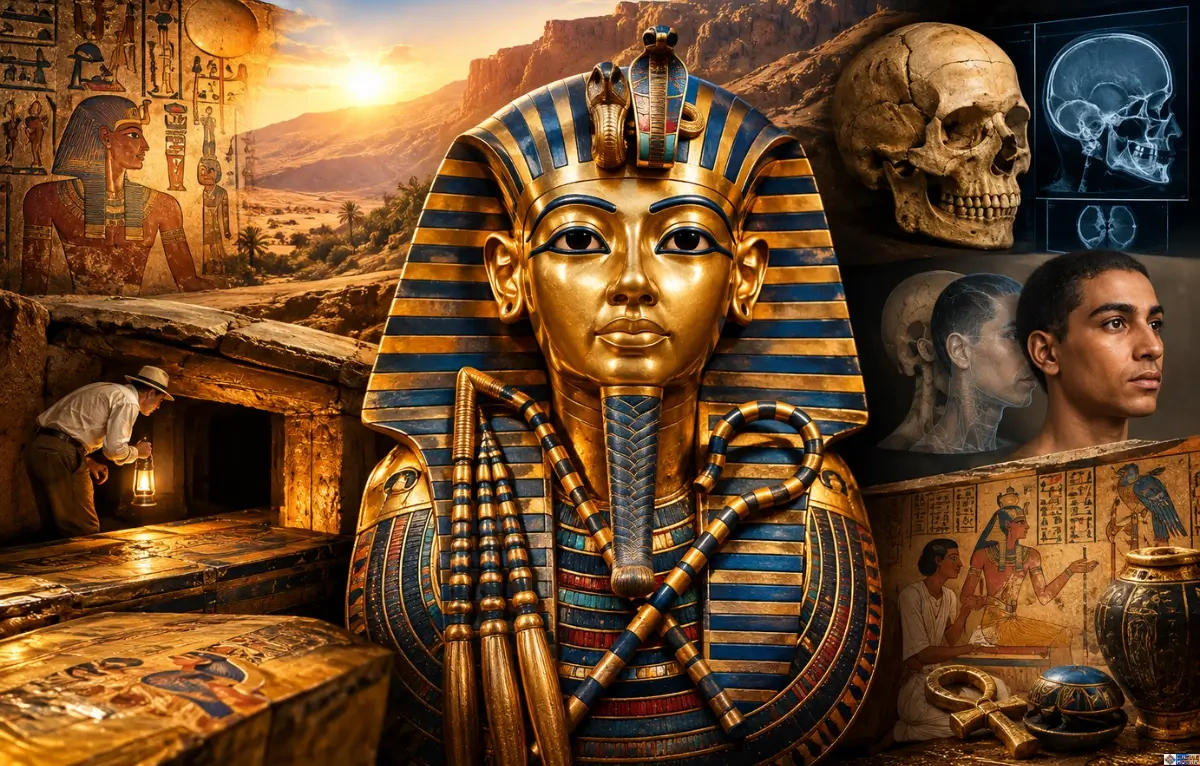
Quick Summary: How Did King Tut Die and Why?
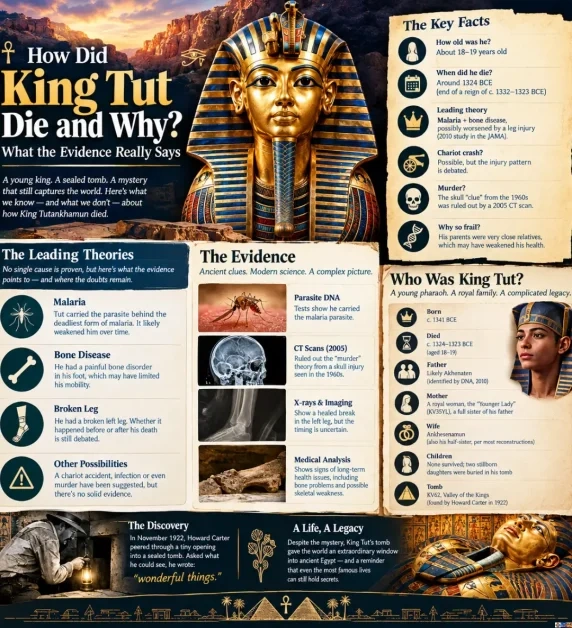
The short answer: nobody can name one proven cause, but the best-supported modern explanation is a perfect storm. Tutankhamun died around 1324 BCE, aged about 18 or 19. He had a painful bone disorder in his foot, he had a broken left leg (its timing is still debated), and he carried the parasite behind the deadliest form of malaria. Together, these probably overwhelmed a body already weakened by inherited health problems. Murder is possible, but no evidence has ever proved it.
- How old was he? About 18 to 19 years old.
- When? Around 1324 BCE, near the end of a reign of roughly nine to ten years (c. 1332–1323 BCE).
- Leading theory: malaria plus bone disease, possibly worsened by a leg injury (a 2010 study in the Journal of the American Medical Association).
- Chariot crash? Possible, but the injury pattern is debated.
- Murder? The skull “clue” from the 1960s was ruled out by a 2005 CT scan.
- Why so frail? His parents were very close relatives, which may have weakened his health.
If you have ever read three headlines about Tut and come away with three different answers (“murdered!”, “killed by malaria!”, “thrown from a chariot!”), you are not alone. The honest reason is that the evidence is 3,300 years old, fragile and sometimes damaged by the very people who found it. This article sorts what is solid from what is speculation, so you can decide for yourself.
It begins with a moment most people know. In November 1922, Howard Carter peered through a tiny opening into a sealed tomb in the Valley of the Kings. Asked whether he could see anything, he recorded his answer as “wonderful things.” What he did not know was that the tomb’s occupant would become one of history’s great medical mysteries.
Who Was Tutankhamun? Birth, Parents and What King Tut Looked Like
Tutankhamun was a king of Egypt’s 18th Dynasty who took the throne as a child, around 1332 BCE, and died while still a teenager. He was born around 1341 BCE during one of the strangest chapters in Egyptian history, the Amarna period, when his father tried to replace the old gods with the worship of a single sun disc, the Aten. His birth name, Tutankhaten, meant “living image of the Aten.” Once the court returned to the traditional gods, he became Tutankhamun, “living image of Amun.”
To picture his world, it helps to know what everyday life in ancient Egypt was like: a society of farmers, scribes and priests, where the pharaoh stood between ordinary people and the gods. A child on that throne was surrounded by powerful advisers, and historians still debate how much real power he held.
King Tut’s parents
For decades, Tut’s parentage was guesswork. In 2010, a team led by Egyptologist Zahi Hawass and geneticist Carsten Pusch published DNA results from Tut and ten other royal mummies in JAMA. They concluded that Tut’s father was the mummy from tomb KV55, probably Akhenaten, and that his mother was a woman from tomb KV35 who was a full sibling of that man. This overturned the popular idea that the famous queen Nefertiti was his mother. Ancient DNA is difficult to work with in hot climates, and some researchers have questioned how firm these identifications are, so treat the names as strong hypotheses rather than settled fact.
What did King Tut look like?
In 2005, three independent teams (Egyptian, French and American) built facial reconstructions from CT scans of his skull. All three showed a slim young man with a long head, a soft chin and a noticeable overbite, features shared by several relatives in his family. He stood about 1.67 metres (5 ft 6 in) tall. The famous golden mask is an idealised divine portrait, not a photograph, though it is thought to resemble him.
The Medical Evidence: What CT Scans and DNA Reveal About Tut’s Death
Tut’s body has been examined four times: by anatomist Douglas Derry in 1925, by an X-ray team in 1968, by a CT scan in 2005, and by DNA testing in 2008–2010. Each round overturned something the last one suggested. Here is what the most recent science says.
1. A broken left leg
The 2005 CT scan, carried out in Egypt with Hawass’s team, found a clean break in Tut’s left thigh bone, just above the knee. It also revealed that embalming resin had seeped into the break, which suggests it happened before mummification rather than being damage done by later handling. That has been read as evidence of an injury shortly before death, though other specialists question the timing and whether it caused death at all. This is the finding behind headlines such as “King Tutankhamun ‘died from a broken leg and malaria’.”
2. Malaria, the likely second blow
In the 2010 JAMA study, researchers found DNA from Plasmodium falciparum, the parasite behind the most dangerous form of malaria, in Tut and in three other mummies from his family. Malaria was common in the Nile valley, so this is not surprising. The authors concluded that the bone disease combined with a malaria infection was the most likely cause of death, and stressed that none of Tut’s conditions alone would have been fatal. A broken leg, if it happened shortly before death, could have made things worse.
3. A painful bone disease in his foot
The CT scans also showed that part of the bone in Tut’s left foot had died, consistent with a condition called Köhler disease II, in which the blood supply to a foot bone fails. The study also reported a clubfoot. It would have made walking painful. That fits what the tomb itself says: Carter’s team found around 130 walking sticks, some of them worn with use.
4. No sign of a fatal blow to the head
The 1968 X-ray showed loose fragments inside Tut’s skull, and for decades many people took this as evidence of murder. The 2005 CT scan found that these fragments were not from a wound before death. There was no sign of healing or a fracture line, and the damage is more consistent with the mummy’s removal and handling in 1925 and with the embalmers’ work. The skull was not the cause.
How certain is all this?
Be cautious. The malaria evidence rests on small fragments of ancient DNA, which can be contaminated or degraded, and some scientists have urged caution about the malaria and family-relationship conclusions. Embalming resin and 100 years of handling also make bones harder to read. The result is a plausible reconstruction, not a signed death certificate.
To understand why the mummy is in such a delicate state, see ancient Egyptian mummies preservation techniques and our guide on how old most Egyptian mummies are.
Was Tutankhamun Murdered? Accident vs Murder Theories
A teenage king, a sudden death and a powerful adviser who took the throne next: it is no surprise that people suspect foul play. Here is how the two main stories hold up.
The murder theory
The case rests on two ideas. First, the 1968 skull X-ray, which seemed to show a head injury. As explained above, the 2005 CT scan undercut this. Second, motive. After Tut died with no surviving heir, the throne passed to Ay, an elderly official who had served as a senior adviser. The Egyptologist Bob Brier made a case for Ay as a suspect in his 1998 book The Murder of Tutankhamen. Ay is shown performing the “Opening of the Mouth” ritual on Tut’s mummy in the tomb painting, a role normally reserved for a royal heir, which some read as a power grab. But a motive is not evidence. No weapon, wound or confession points to anyone, and a king with a broken leg and a malaria infection did not need a murderer to die.
The accident theory
A broken thigh bone suggests a fall, and a young king who loved hunting is easy to picture falling from a chariot. In 2013, a television documentary (Tutankhamun: The Mystery of the Burnt Mummy) put forward a version of this idea, suggesting that crush injuries to the chest and pelvis fit a chariot crash. This was a documentary hypothesis, not a peer-reviewed study, and other specialists note that the missing ribs and chest wall could have been damaged during embalming or by modern handling. Others ask whether a young man with a painful foot could drive a chariot at all, though ancient reliefs show kings shooting arrows from chariots, and the tomb held several of them.
So what do experts conclude?
Most current specialists favour a natural-causes explanation (disease plus injury) over murder. The honest position is that an accident cannot be excluded, murder cannot be disproved, and neither can be proved. The cause of the leg fracture, and whether it came before or after his final illness, remains the biggest open question.
To see how the tomb itself was prepared for the journey into the afterlife, read about ancient Egyptian burial customs and where ancient Egyptian mummies were first buried.
The Role of Inbreeding: Why Was Tut So Frail?
This is the “why” behind the “how.” Royal marriage between close relatives was common in the Egyptian royal family, and the 2010 DNA study suggested that Tut’s own parents were full siblings. His wife, Ankhesenamun, is generally believed to have been his half-sister. If that picture is right, Tut inherited two copies of any harmful gene his family carried, which raises the risk of inherited conditions and may weaken the immune system.
The researchers linked this family background to several of Tut’s health problems: the bone disease in his foot, a possible mild cleft palate and a curved spine reported in some assessments. They also suggested it left him less able to fight infections such as malaria. That is the logic behind the popular claim that “inbreeding killed King Tut.”
A few cautions keep the story honest:
- It was deliberate. Royal sibling marriage was tied to religious ideas about the divine family, including the gods Isis and Osiris, not to ignorance.
- It is not proof. Genetic risk is a probability, not a verdict. Many royal families in history married close kin and produced healthy heirs.
- The data are thin. The family relationships come from ancient DNA, and some geneticists think the conclusions are stated more firmly than the evidence allows.
- Other ideas were rejected. Earlier suggestions that Tut had Marfan syndrome or a feminised body were not supported by the 2010 study.
In short, inbreeding probably did not kill Tut directly, but it may have loaded the dice against him.
Theories Compared: What Is Strongest, What Is Weakest?
No single theory explains everything, but they are not equally strong. This table shows how the leading ideas compare on the evidence.
The best summary is that the “killer” was probably a chain of events, not a single cause.
King Tut’s Wife, Children and What Happened After He Died
How many wives did King Tut have?
Only one is known: Ankhesenamun, a daughter of Akhenaten and probably his half-sister. They married as teenagers, and artwork from the tomb, such as the golden throne, shows the couple in tender poses.
Did King Tut have kids?
No child survived. Two tiny mummified fetuses were found in his tomb, in the same style of burial as the king. DNA testing reported in 2010 suggested they were Tut’s daughters, one stillborn at about five to six months of pregnancy and the other near full term. Losing both children is a quiet human tragedy behind the golden treasure, and it left the throne without an heir.
What happened to King Tut’s wife when he died?
Her fate is unknown, but one dramatic story survives in Hittite records. A widowed Egyptian queen, named in the texts as “Dahamunzu,” wrote to the Hittite king Suppiluliuma I asking for one of his sons as a husband, saying she had no son of her own. Many historians believe this was Ankhesenamun, though some think it could be another queen. A Hittite prince was sent but died on the road, and the Hittites later blamed Egyptians for his death. In Egypt, Ay became king, and a ring survives with the names of Ay and Ankhesenamun together. After that, she disappears from the record.
Ay ruled only a few years. His successor Horemheb then worked to erase the memory of Akhenaten, and Tut, from the king lists. For about 3,200 years Tut was a footnote, until Carter’s discovery made him a household name.
To see how the tomb’s contents fit into the wider world of burial and the afterlife, explore secrets of the mummy’s tomb.
Why Is King Tut So Famous, and How Old Would He Be Today?
Why is King Tut so famous?
Ironically, because he was a minor king. Most royal tombs in the Valley of the Kings were robbed in antiquity. Tut’s was buried and then hidden by debris from later construction, so Carter found it largely intact in 1922 with more than 5,000 objects, including the gold mask, a gilded throne, chariots and jewellery. Add the newspaper-driven “curse” stories after his patron Lord Carnarvon died in 1923, and the world’s imagination was caught. Touring exhibitions in the 1970s made him a global icon. Today the Grand Egyptian Museum near the Giza pyramids is the home of his collection, so check the museum’s official site for current visiting details.
How old would King Tut be if he were alive today?
He was born around 1341 BCE, so he would be roughly 3,360 years old today (the exact figure is uncertain, because his birth date is itself an estimate).
The takeaway
King Tut’s death is not a closed case, and that is what makes it fascinating. Each new scan or DNA test sharpens the picture, and some conclusions may change again. What we can say with confidence is that he was a young man in pain, with a broken leg and probably a serious infection, who died too soon and left a story that has outlived every pharaoh who ruled longer than he did.
If this story caught your imagination, don’t stop here. The best way to understand Tut is to see him in his world:
- Culture Mosaic home
- How Did King Tut Die and Why
- What Is Mummy in History?
- Ancient Egyptian animal mummies
- Ancient Egyptian burial customs
- Secrets of the Mummy’s Tomb
Frequently Asked Questions About King Tut’s Death
1. How did Tutankhamun die?
The best-supported explanation is a combination: severe malaria, a bone disorder in his foot and a broken left leg, probably worsening each other in a body weakened by inherited health problems. The evidence comes from CT scans (2005) and DNA analysis (2010). Because ancient DNA is fragile and the mummy has been damaged over time, it remains a reasoned reconstruction rather than a certainty.
2. Was Tutankhamun murdered?
There is no proof. The famous skull fragments seen in a 1968 X-ray were not shown by the 2005 CT scan to be a fatal wound. Suspicion falls on Ay, who became king next, but that is motive without evidence. Most scientists now favour natural causes, possibly with an accident, but cannot completely rule out foul play.
3. Was King Tut deformed?
He was not the grotesque figure of some older theories, but he did have real health problems. Scans showed bone death in his left foot, possibly a clubfoot, which would have made walking painful, and the tomb contained about 130 walking sticks. He may also have had a mild cleft palate and a curved spine, though these are less certain. Theories of Marfan syndrome were not supported.
4. How old was King Tut when he died, and when was he born?
He died aged about 18 or 19 around 1324 BCE, after ruling for roughly nine to ten years from about age eight or nine. Counting back, he was born around 1341 BCE. All of these dates are estimates, as Egyptian chronology has a margin of error of a few years.
5. Did a curse kill the people who opened Tut’s tomb?
No. Lord Carnarvon died in 1923 of blood poisoning after an infected insect bite, which fuelled the legend. A 2002 study in the British Medical Journal compared the lifespans of Westerners present at the tomb’s opening with those who were not and found no evidence of any “curse” effect. Howard Carter himself lived until 1939.
Sources and Further Reading
Peer-reviewed studies (abstracts checked for this article)
- Hawass Z, Gad YZ, Ismail S, et al. “Ancestry and Pathology in King Tutankhamun’s Family.” JAMA 2010;303(7):638–647. doi:10.1001/jama.2010.121
- Nelson MR. “The mummy’s curse: historical cohort study.” BMJ 2002;325:1482–1484. PubMed record · full text
Books and primary-source scholarship (cited from standard references; please verify page details before publishing)
- Carter H, Mace AC. The Tomb of Tut.Ankh.Amen (3 vols, 1923–1933), the excavator’s own account.
- Reeves N. The Complete Tutankhamun. Thames & Hudson, 1990.
- Hawass Z, Saleem SN. Scanning the Pharaohs: CT Imaging of the New Kingdom Royal Mummies. American University in Cairo Press, 2016 (the 2005 CT scan and related work).
- Brier B. The Murder of Tutankhamen. Putnam, 1998 (the case for murder).
- Güterbock HG. “The Deeds of Suppiluliuma as Told by His Son, Mursili II.” Journal of Cuneiform Studies 10 (1956), for the Hittite account of the widowed Egyptian queen.
Museums
- The Grand Egyptian Museum (Giza) holds the Tutankhamun collection; check its official website for current opening and ticket details.
 Marcus J. Holloway