
 By Marcus J. Holloway

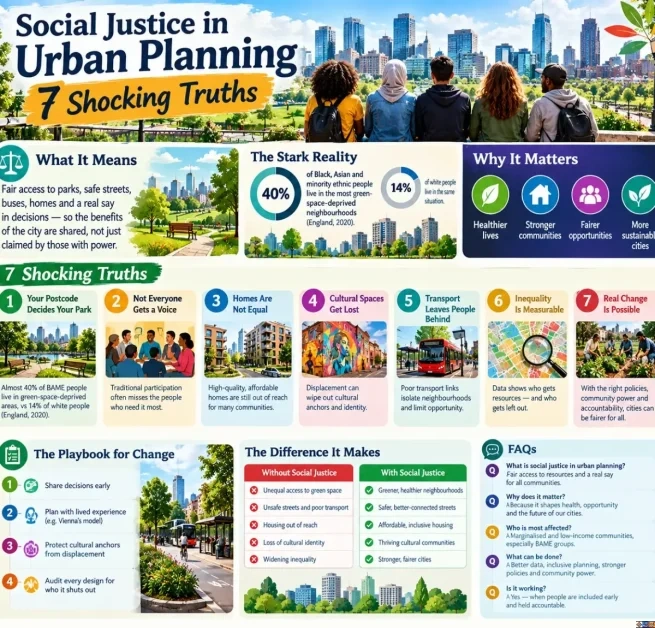
Social justice in urban planning means deciding who gets parks, safe streets, buses, homes, and a real say—then designing so the answer is not simply “whoever already has power.”
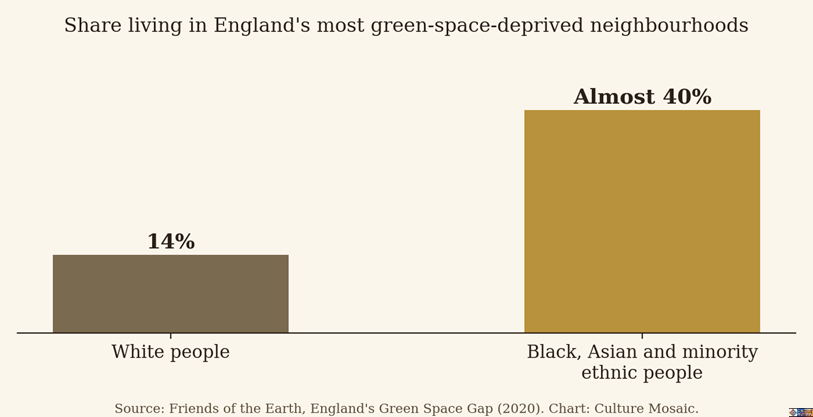
Disparity in Data: In England, almost 40% of Black, Asian, and minority ethnic people live in the most green-space-deprived neighbourhoods, against 14% of white people (Friends of the Earth, 2020).
- Share decisions early with local residents.
- Plan with lived experience (as Vienna successfully demonstrated).
- Protect cultural anchors from gentrification and displacement.
- Audit every design for who it shuts out.
Picture a concrete bench. Slanted edges. No gaps for litter or bags. A coating that repels paint, and a weight of roughly two tonnes. You can sit on it, and that is about all. Camden Council put these benches on its streets in 2012, and the design has since become shorthand for a question planners rarely say out loud: who is this place actually for?
That question sits at the centre of social justice in urban planning. Ask it of your own street. Who gets a park within a five-minute walk? Who waits for the bus that never comes? Whose shopfront turns into hoarding when the cranes arrive? I think most of us already sense the answers, and I think that sense is where the anger comes from. Powerless is the word. But it is also a pattern, which means it can be measured, and anything measurable can be changed.
A May 2026 brief on Social Justice in Urban Planning and local governance, from the Driving Urban Transitions (DUT) Partnership, draws on seven projects and lands on a blunt point: traditional participation often fails to include the people who need it most. This guide takes that seriously. I will name the problem, show you what it looks like in England and beyond, then set out fixes with real results behind them. No fairy tales. A couple of these stories are messier than the headlines.
One note on method. I have not run my own interviews or surveys for this piece, and I will not pretend otherwise. Every figure comes from a named source in the list at the end. The comparisons and the opinions are mine.
What Is Social Justice in Urban Planning?
Social justice in urban planning is the idea that the benefits and burdens of city-making should be shared fairly, and that the people affected should help decide. Parks, buses, pavements, housing, clean air, a market where your language is spoken. Who gets them. Who pays for them. Who is moved aside to make room. That is the whole subject.
Scholars give it a few names. Edward Soja called it spatial justice: fairness in where resources and harms land on the map. Susan Fainstein’s The Just City boils the test down to equity, diversity and democracy. My plain-English version asks three things of any plan. Does it spread resources fairly? Does it keep room for difference, including cultural difference? Did the people most affected have real power over it? Equitable urban design is never a finished state. It is a habit.
This is Civic Engagement at street level, and it is as old as the first public assemblies. If you like the long view, Modern civic spaces ancient assemblies traces that line from ancient meeting places to modern ones. If you prefer the personal view, Understanding Civic Duty asks what we owe each other when we share a place.
1. Your Postcode Still Decides Your Park
Start with grass. Friends of the Earth’s 2020 mapping of England found that almost 40% of Black, Asian and minority ethnic people live in the most green-space-deprived neighbourhoods. For white people the figure is 14%. Read that twice.
The worst-rated neighbourhoods, graded “E,” have under nine square metres of public green space per person, very little garden space, and larger green spaces more than five minutes’ walk away for at least three-quarters of residents. Around 11 million people lived in E-rated areas, with another 7.7 million in D-rated ones. The Health Foundation’s evidence hub tells the same story from another angle: 28% of people in the most deprived neighbourhoods live in the 10% of neighbourhoods with the least green-space access. Social justice in urban planning starts with a map like this. Two caveats, because honesty matters here. The data is England-only and dates from 2020, and the authors say it measures quantity and access, not quality.
That is spatial injustice you can put on a map. I think it is the cleanest definition we have: not a feeling about unfairness, but a heat map of it. Maps only change anything when residents can read them, which is where Civic Literacy earns its keep. And these are Real-World Problems, measured in metres and minutes.
2. Distance Is a Policy Choice (the 5 D’s, Through a Justice Lens)
Planners talk in Ds. Density, diversity and design came from Cervero and Kockelman in 1997. Ewing and Cervero’s 2010 meta-analysis of the built-environment research added destination accessibility and distance to transit. Their headline finding: how easily people can reach jobs, schools and shops had the strongest link with how people travel, and no single factor did the job alone. Combined changes mattered more.
Now flip the lens. A neighbourhood far from jobs and frequent transit is not a lifestyle choice for someone without a car. It is a tax on time, paid daily, mostly by people who can least afford to pay it. Here is how I would translate each D into a fairness question.
The 15-minute city idea packages these Ds neatly, and I have unpicked it, critics included, in What is a 15-minute city concept explanation. My own view: it works when the equity question travels with it, so new amenities do not price out the people they were meant to serve. Where the next bus stop goes is a participation question as much as an engineering one. Citizen Participation Infrastructure Planning covers how residents have shaped those calls.
3. Hostile Architecture Tells You Who Is Unwelcome
Back to the bench. Camden commissioned it, Factory Furniture designed it, and it was built to deter sleeping, skateboarding, graffiti and more. Critics call it hostile architecture. The designers answered that designing in comfort for rough sleepers would amount to giving up on the problem of homelessness, and that feeling uneasy near it is perhaps the right reaction. I side with the critics. Few things expose a gap in social justice in urban planning faster than a seat nobody can use. A seat that only one kind of body can use is not neutral. It is a rule written in concrete.
Hostile design is rarely a villain’s plan. UK design press has noted that councils often reach for it because it is cheap and needs no upkeep. Some places have reversed course. Bournemouth’s council removed the bars from its benches, and an artist-led “Love Bench” event there invited locals to turn the seats into art. Small, yes. But Micro-Civic Interventions like these show that public space can be argued with. For a hands-on route, DIY Placemaking Community Engagement is a good place to start.
4. Gentrification Can Erase Heritage Before You Notice
Seven Sisters Indoor Market in Tottenham, known as Latin Village, is the best-documented UK case I know. Minority Rights Group International reported that almost 56% of people employed in the market were of Latin American or Hispanic background. Grainger held planning consent from July 2012 for a scheme that would demolish the Wards Corner building and replace it with flats and shops. Traders and campaigners fought it for around fifteen years. In early 2021 Grainger abandoned the plan, citing costs and community opposition, and Haringey Council backed the alternative Wards Corner Community Plan, which called for affordable rents for traders and accessible social space.
It is not a clean fairy tale, and I would be doing you a disservice to tell it as one. A review for the council found most traders favoured a version of the scheme that would have relocated them to temporary space, and one London columnist argued the “community victory” story flattens a more tangled reality. Traders disagreed with each other. That is normal. Social justice in urban planning also covers culture, not just concrete. It is also the point: a just process does not guarantee unanimity. It makes disagreement visible and gives the people with most to lose real power over the outcome. The story has kept moving since the reports I found, so check the council’s current updates.
Markets like this run on unwritten rules and relationships, the sort of thing Vernacular Governance Structures explores. Campaigns win attention through story, and Narrative Advocacy is the craft behind that. Culture can go on a wall as well as a petition; see Grassroots Murals UK Civic Engagement and Organising a Neighbourhood Mural for how communities have claimed space with paint.
5. Inclusive City Planning Works When You Count Everyone
Vienna offers my favourite proof that social justice in urban planning is more than theory. In 1991 urban planner Eva Kail curated an exhibition called Who Owns Public Space, following the days of women of different ages and backgrounds, and the city began splitting its mobility data by gender. A pilot in the Mariahilf district, running from 2002, brought better street lighting, wider and barrier-free pavements, more seating, and the removal of obstacles for pushchairs and wheelchairs. Park redesigns followed after the parks department noticed girls’ use dropped off after about age nine, and planners added areas for volleyball and badminton, lighting and seating. Kail says Vienna now applies its gender-sensitive park guidelines to every new or redesigned park, because the city owns and manages them.
Notice the method. Count differently. Listen to the people the data misses. Change the spaces. Notice too the honest footnote: a Vienna University of Technology thesis found the pilot widened planners’ thinking, yet gender aspects often show up only implicitly in later planning, which is a reminder that embedding fairness takes years of effort. Young people are usually the first to tell you a space is failing, which is why a solid Youth Engagement Strategy belongs in any serious plan, and why Diverse Civic Harmony matters when more than one community shares a street.
6. A Seat at the Table Means Power, Not a Survey
Sherry Arnstein’s 1969 “ladder of citizen participation” still stings. Its lower rungs, which she called manipulation and therapy, are about managing people rather than hearing them. Its middle rungs offer information and consultation without any promise of influence. Only the upper rungs give residents real power, and social justice in urban planning lives or dies on that point. I think many consultations still sit on the middle rungs, with a glossy leaflet and a feedback form nobody answers.
The DUT brief suggests three shifts: value local knowledge and lived experience alongside technical expertise, put a skilled facilitator between officials and residents who can translate jargon and stop powerful voices drowning out quiet ones, and broaden the stakeholder table to include grassroots groups and social-justice organisations. That is the shape of real grassroots civic voices in urban development. For the how, Co-design in urban planning and civic engagement walks through methods, and Why Public Consultation Is Important makes the case for doing consultation properly. How Public Feedback Shapes Local Policy shows what good follow-through looks like, and What Is Public Commentary? explains how written responses carry weight.
In the UK, the law gives you more levers than most people use. The Equality Act 2010 places a Public Sector Equality Duty on public bodies to have due regard to eliminating discrimination and advancing equality of opportunity. The Localism Act 2011 created neighbourhood planning, letting communities write plans for their own area. Online tools help too. Hyperlocal Digital Deliberation and digital civic engagement urban planning look at how digital rooms can widen the circle, while Digital Platforms and the Future of Civic Voices is honest about the limits. Ethical Grassroots Advocacy matters because pressure without principles burns trust, and Community Activism Strategies gives you a menu of tactics.
7. Will AI Fix Planning, or Just Speed Up Its Blind Spots?
Every few months someone asks if planners will be replaced. I do not think so, and the profession’s own bodies agree. The RTPI’s chief executive said in 2025, when the UK government announced an AI tool called Extract to speed up planning admin, that AI must support rather than replace planners’ judgement and local discretion. The RTPI’s practice advice flags real risks too, including inaccuracy and security. Fear is common, though. The American Planning Association’s chief foresight officer acknowledged in early 2026 that people worry about being replaced.
AI changes the tools, not the question at the heart of social justice in urban planning. My worry is subtler. An AI trained on past decisions can learn past bias and apply it faster. Faster is not fairer. The sensible use is as a helper: summarising thousands of consultation responses, spotting who did not respond, translating documents. Someone accountable still has to ask who is missing. For where digital participation is heading, see Civic Engagement Trends, From Hashtags to Agency 2026 and 2026 Civic Agency Movement.
Participation Theatre vs Participation That Works
Here is the comparison I wish every council kept on a wall. It is my own synthesis, built on Arnstein’s ladder and the DUT brief, not a published standard.
How to Build Equitable Urban Design: 8 Moves That Work
Social justice in urban planning becomes concrete in small, specific moves. Here are eight, with two wildcards.
Map before you plan. Chart green space, journey times to work and clinics, noise and air quality by neighbourhood. If you cannot see the gaps, you cannot close them.
Pay people to take part. Childcare, interpreters, evening and weekend sessions, a small fee for time. It costs little and changes who turns up.
Count differently. Split data by gender, age, disability and ethnicity, as Vienna did with travel data. Averages hide the people who are struggling.
Wildcard: hand a school class the brief. Give a Year 6 class the same site and ask them to review the council’s drawings. Children notice the missing seat, the long crossing, the corner that feels wrong. Vienna’s park findings suggest teenage girls will tell you things adults never think to ask.
Write displacement protections into approvals. Affordable rents for existing traders, a guaranteed place in the new building, and a community-led option on the table from day one. Seven Sisters shows the cost of leaving this late.
Put a facilitator between experts and residents. Someone whose job is to translate, connect local groups to officials, and make sure the loudest voice does not win by default. That is straight from the DUT brief.
Publish a “you said, we did” ledger. One page. What residents asked for, what changed, what did not and why. It turns a survey into a conversation.
Wildcard: run a bench-by-bench sit test. Take a clipboard and ten minutes to every bench on your high street. Record who could sit, who could lie down, who could stay, and who would be moved on. Post the results. A bench audit makes hostile design embarrassing.
What You Can Do This Month
You do not need a planning degree to practise social justice in urban planning. You need a few hours and a bit of stubbornness. Start by checking you are on the electoral roll: How to Register to Vote in UK has the steps, and Why Is Voting Important in Local Elections? explains why local ballots shape the streets you live on. Next, read your council’s current local plan consultation and send in a response, even a short one. Written comments count, and they are one of the few routes with legal weight.
Then find your neighbourhood forum or residents’ group, or start one with a few neighbours. If you would rather begin online, how to get involved in local civic issues online shows where to look first. Community Advocacy Toolkit and Hyperlocal Advocacy Toolkits give you templates, and Hyperlocal Advocacy Strategies shows how small groups win local arguments. If you want to learn alongside others, 10 Civic Engagement Opportunities lists ways in, and Volunteer for Civic Education Programs points to teaching roles. Bring friends who do not usually join in, because civic participation tools only work if different people use them. Leaders will find more in Civic Leader’s Playbook and Local Civic Engagement Strategies.
Why bother? Because Social Change in Modern Society rarely arrives as one big decision. It piles up through small ones: a bench, a bus stop, a market lease. What is the Value of Civic Participation? makes the case for showing up, and Civic Voice is the habit that keeps decisions honest.
Somewhere right now a council is choosing its next bench.
Frequently Asked Questions
What are the four main principles of social justice?
Frameworks differ, but one widely taught version names four: equity (fair shares, with extra help where needs are greater), access (everyone can reach opportunities and services), participation (people have a real voice in decisions that affect them) and rights (basic human and civil rights are protected). In planning, that translates into questions you can ask of any scheme. Does it direct resources where need is highest? Can a person on a low income, a disabled person or a newly arrived family use it? Did they help shape it? Some lists swap in diversity or fairness, so check which framework your council or course uses.
What are the 5 D’s of urban planning?
They are density, diversity, design, destination accessibility and distance to transit. The first three come from Cervero and Kockelman’s 1997 work, and Ewing and Cervero added the last two in a 2010 meta-analysis of how the built environment affects travel. The key lesson is that destination accessibility, meaning how easily people reach jobs, schools and shops, had the strongest link with travel behaviour, and that combined changes matter more than any single one. For social justice, the Ds become fairness tests: who can reach what, how safely, how affordably.
Will urban planners be replaced by AI?
Unlikely, and the profession’s leaders are clear about it. The RTPI says AI should support, not replace, planners’ professional judgement, while welcoming its use for admin tasks and evidence gathering. Planning involves weighing competing interests, talking to residents and making value calls, which are things software cannot take responsibility for. The real risk is subtler: tools trained on past decisions can repeat past bias at speed. Planners who understand both the technology and the communities they serve will be the ones who benefit.
What are some good examples of social justice in urban planning?
Vienna’s gender mainstreaming is the best-documented: mobility data split by gender, the Mariahilf pilot from 2002, and park guidelines applied to new and redesigned parks. The Seven Sisters campaign in Tottenham shows community pressure and an alternative plan changing what a developer chose to do, though the story is contested and has kept developing. The DUT brief draws on seven DUT projects, including work in Bolzano, Italy. None of these is perfect, and I would be wary of anyone who says otherwise. Each shows a method: count differently, share power early, protect what people value.
How can residents influence planning decisions in the UK?
Several routes exist. You can comment on planning applications through your local council, respond to local plan consultations, and join or start a neighbourhood forum, because the Localism Act 2011 lets communities produce neighbourhood plans. Public bodies also carry a Public Sector Equality Duty under the Equality Act 2010, which gives you grounds to ask how a decision affects different groups. Registering to vote and contacting your councillors matter too. Keep written records of what you submit, and ask for the council’s response in writing.
Sources and Further Reading
- Driving Urban Transitions (DUT) Partnership, Strategies for Increased Social Justice in Urban Planning and Local Governance (de Jonge, Sandberg and Calvo, May 2026) https://dutpartnership.eu/news/strategies-increased-social-justice-urban-planning-and-local-governance
- Friends of the Earth, England’s Green Space Gap (2020) https://policy.friendsoftheearth.uk/insight/englands-green-space-gap
- Friends of the Earth, press release on England’s green space deprivation (E-rated neighbourhood definitions and counts) https://friendsoftheearth.uk/nature/englands-not-so-green-and-pleasant-land-millions-can-only-access-green-space-size-garden
- The Health Foundation, Inequalities in access to green space (evidence hub) https://www.health.org.uk/resources-and-toolkits/data-tools/evidence-hub/inequalities-in-access-to-green-space
- Ewing, R. and Cervero, R. (2010), Travel and the Built Environment: A Meta-Analysis, Journal of the American Planning Association, 76(3), 265–294; summary at Safe Routes Partnership https://saferoutespartnership.org/resources/research/travel-built-environment
- Ewing and Cervero, Five Ds of the Built Environment (University of Utah appendix, citing Cervero and Kockelman 1997) https://ptod.lib.utah.edu/docs/A.pdf
- Design Week, Hostile design is still a problem in our public spaces (October 2019) https://www.designweek.co.uk/issues/14-20-october-2019/hostile-design/
- The Big Issue, Hostile takeover: Who is welcome in our public spaces? https://bigissue.com/latest/hostile-takeover-welcome-public-spaces
- Time Out London, Victory! Tottenham’s Latin Village is saved (March 2021) https://www.timeout.com/london/news/victory-tottenhams-latin-village-is-saved-090321
- OnLondon, Haringey: Work resumes on Seven Sisters regeneration scheme (review of trader views) https://www.onlondon.co.uk/haringey-work-resumes-on-seven-sisters-regeneration-scheme/
- OnLondon, Haringey: Seven Sisters Latin Village traders legal challenge dismissed (planning consent July 2012) https://www.onlondon.co.uk/haringey-seven-sisters-latin-village-traders-legal-challenge-dismissed-by-judge-as-not-realistic/
- OnLondon, Dave Hill: Seven Sisters “Latin Village” realities that don’t fit the “community victory” script https://www.onlondon.co.uk/dave-hill-seven-sisters-latin-village-realities-that-dont-fit-the-community-victory-script/
- Minority Rights Group International, statement on compulsory purchase of Seven Sisters market https://minorityrights.org/compulsory-purchase-of-seven-sisters-market-vital-to-culture-of-londons-latin-american-community-should-not-go-ahead-says-mrg/
- Euradio, Vienna: pioneer city on gender mainstreaming in Europe (interview with Eva Kail) https://euradio.fr/2021/04/12/vienna-pioneer-city-on-gender-mainstreaming-in-europe/
- Centre for Liveable Cities (Singapore), Urban Solutions case study: Vienna gender mainstreaming https://www.clc.gov.sg/docs/default-source/urban-solutions/urb-sol-iss-10-pdfs/case-study-vienna-gender-mainstreaming.pdf
- TU Wien repository, thesis on the Mariahilf gender mainstreaming pilot process https://repositum.tuwien.at/handle/20.500.12708/221795?mode=full
- Royal Town Planning Institute, AI tool for planning must support, not replace planners’ discretion (June 2025) https://www.rtpi.org.uk/news/2025/june/ai-tool-for-planning-must-support-not-replace-planners-discretion/
- Specification Online, RTPI releases best practice advice for planners working with AI (March 2025) https://www.specificationonline.co.uk/articles/2025-03-10/royal-town-planning-institute/rtpi-releases-best-practice-advice-for-planners-working-with-ai
- Lincoln Institute of Land Policy, From AI to the Future of Work: Trends in Planning (February 2026, on the APA 2026 Trend Report) https://www.lincolninst.edu/podcasts/land-matters/from-ai-to-future-work-trends-planning/
- Equality Act 2010, section 149 (Public Sector Equality Duty), legislation.gov.uk https://www.legislation.gov.uk/ukpga/2010/15/section/149
- Localism Act 2011 (neighbourhood planning), legislation.gov.uk https://www.legislation.gov.uk/ukpga/2011/20/contents
- Arnstein, S. R. (1969), A Ladder of Citizen Participation, Journal of the American Institute of Planners, 35(4), 216–224
- Soja, E. W. (2010), Seeking Spatial Justice, University of Minnesota Press
- Fainstein, S. S. (2010), The Just City, Cornell University Press