The Social Fossil: Analyzing Vernacular Governance Structures

A vertical cross-section of an archaeological dig site showing historical layers of stone, ash, and earth, representing the physical buildup of vernacular governance structures over centuries, with a technical glass overlay.
Vernacular Governance Structures: 7 Proven Pillars
The Governance Review Vernacular Governance Structures · Expert Analysis · Vol. IV

Feature Essay · Governance Studies

The Social Fossil:
Analyzing Vernacular Governance Structures

How communities encode power into stone, fire, and landscape — and why frictionless bureaucracy keeps losing to them.

Dr. Arthur Mason, LSE · 5,400 Words · Focus: Vernacular Governance Structures

What Are Vernacular Governance Structures?

There is a kind of governance that never appears in a policy manual. It is not handed down from a ministry or ratified in a legislature. It lives instead in the way a fishing village divides its catch, in the unspoken turn-taking of a town square debate, or in the careful rotation of a communal water channel high in the Andes. These are vernacular governance structures — and they are, in the most literal sense, social blueprints encoded into daily life.

Think of vernacular governance structures as the load-bearing walls of a resilient society. Remove them carelessly — in the way modern bureaucracies sometimes do when they impose standardised systems on communities with radically different histories — and something essential collapses. The building may still stand for a while, but it feels hollow. The walls that once carried weight have been replaced with decorative panels. Every community self-organisation scholar who has studied post-colonial governance displacement has witnessed this precise failure: the vernacular structure disappears, and the social coherence above it quietly collapses within a generation.

Modern governance systems are frequently praised for being frictionless: digital, fast, scalable, efficient. But that frictionlessness is precisely the problem. What political scientists and anthropologists are increasingly documenting is that vernacular governance structures carry a haptic signature that top-down systems cannot replicate. Authentic community power can be felt. It has texture, weight, and smell. It is rooted in what we might call the specific geology of a place — the accumulated history, ecology, and social memory embedded in a particular landscape and held in the bodies of the people who live there. Strip that away, and what you have left is administration, not governance. The distinction between the two is not semantic. It is the difference between a system that communities own and a system that owns them.

The most resilient governance is that which is written in the soil, the stone, and the collective memory of the people who inhabit them.

The Architecture of the Meeting

How Physical Space Shapes the Civic Voice

Before anyone speaks at a community meeting, the room has already made a decision. The arrangement of bodies in space is one of the oldest and least examined instruments of power — and vernacular governance structures have always understood this, even when their architects could not have articulated it in those terms. The spatial logic of vernacular governance is not incidental to how decisions get made. It is the mechanism itself.

Consider the difference between a circle and a long table. In a circle, every participant faces every other. There is no head position, no privileged sight line. The acoustics of a circular arrangement mean that a quiet voice — a hesitant voice, an elder speaking from what would otherwise be the back — carries almost as far as the voice at the centre. This is not accidental. Indigenous councils across North America, West Africa, and Oceania converged independently on circular or near-circular arrangements precisely because the geometry enforces acoustic democracy. When we examine these spatial choices forensically, we are looking at deliberate social architecture — the physical expression of a community’s theory of legitimate power.

Comparative Floor Plan: Circular Vernacular Council vs Linear Bureaucratic Chamber Two architectural floor plans side by side. On the left, eight seats arranged in a circle around a central fire, representing a vernacular Indigenous council with equal sightlines and no dominant head position. Power-flow arrows radiate symmetrically from all directions toward the centre. On the right, twelve seats arranged in two parallel rows along a rectangular table, representing a bureaucratic chamber. A single dominant seat is marked at the narrow head end, with directional arrows showing authority flowing only toward that position. Caption reads: equal sightlines, no head position, acoustic parity for the circular layout versus hierarchical sightlines, single head, unidirectional authority for the linear layout. CIRCULAR VERNACULAR COUNCIL fire Equal sightlines · No head position · Acoustic parity LINEAR BUREAUCRATIC CHAMBER Hierarchical sightlines · Single head · Unidirectional authority Distal seats carry diminished civic weight
Fig. 1 — Comparative Floor Plans: The circular vernacular council distributes power through acoustic parity and equal sightlines. The linear bureaucratic chamber concentrates authority at the head position, with power flowing in a single direction. Physical geometry is governance.

Now place those same people at a long rectangular table. Immediately, a hierarchy emerges. The person at the narrow end commands attention. Side conversations form between neighbours. Those at the far end are physically and psychologically distant from the decision. The table does not just seat people — it organises power. This is why the spatial choices embedded in vernacular governance structures are never trivial. The room is always doing governance work, whether anyone acknowledges it or not.

The Sensory Dimension of Civic Memory

There is something else at work in vernacular governance structures that formal systems rarely capture: the role of the senses in anchoring memory and accountability. The acoustics of a stone hall — its echo and resonance — mean that words spoken there feel heavier, more permanent. The scent of a communal fire, of woodsmoke and shared food, is a profound mnemonic trigger. When a community meets in the same place, with the same sensory context, year after year, those cues become part of the civic record. Embodied memory is not a supplement to governance — in authentic vernacular governance structures, it is often the most durable form of the record itself.

This is what we mean by haptic governance: the idea that legitimate decision-making is not just heard or read, but physically felt and remembered in the body. A vote taken in a cold, rented office building has a different experiential weight than a vote taken in a hall where your grandparents once also voted. The former is a transaction. The latter is an act of civic memory.

Haptic Governance: Comparative Acoustic Resonance Maps for Three Civic Space Typologies Three floor plan diagrams arranged horizontally, each showing decibel distribution patterns for a different civic space typology. Left diagram: Traditional stone assembly hall. A heat-map overlay shows even distribution of sound at approximately 72 to 78 decibels across the entire floor, with warm amber zones radiating from a central speaking position and reaching the perimeter walls with minimal decay. Wall reflections are marked as resonance return paths. A label reads: Stone Hall — Mean SPL 74dB — Reverberation time 1.8 seconds — Full acoustic coverage. Centre diagram: Circular open-air vernacular council with central fire. Sound distribution is shown in concentric rings from 68dB at the outermost edge to 76dB at the inner ring, with gentle decay across all positions. All seats receive approximately equal acoustic weight. Label reads: Open-Air Circle — Mean SPL 71dB — Natural decay — Acoustic parity across all positions. Right diagram: Modern rectangular office meeting room. A steep acoustic gradient is visible, with 78dB near the head of the table dropping sharply to 52dB at the far end. Dead zones in two corners are marked in cool blue. Label reads: Office Room — Mean SPL 68dB — Gradient 26dB drop from head to tail — Acoustic authority concentrated at head position. A footnote below all three diagrams reads: SPL = Sound Pressure Level. Higher reverberation in stone vernacular spaces creates physical memory: the voice literally persists longer in the room. HAPTIC GOVERNANCE · COMPARATIVE ACOUSTIC RESONANCE MAPS · THREE CIVIC SPACE TYPOLOGIES ↑ reflection 78dB 74dB 72dB 71dB 71dB STONE ASSEMBLY HALL Mean SPL: 74dB · RT60: 1.8s Acoustic gradient: <7dB seat-to-seat ✓ Full room acoustic parity 68dB 69dB 68dB 68dB 76dB OPEN-AIR CIRCLE · FIRE CENTRE Mean SPL: 71dB · Natural decay Acoustic gradient: <8dB across all seats ✓ Acoustic democracy: all voices carry dead zone dead zone 78dB 72dB 66dB 60dB 52dB −26dB decay → MODERN OFFICE MEETING ROOM Mean SPL: 68dB · RT60: 0.4s Acoustic gradient: 26dB head-to-far-end ✗ Acoustic authority: concentrated at head SPL = Sound Pressure Level (dB) · RT60 = Time for sound to decay by 60dB after source stops (reverberation time) Stone vernacular spaces: RT60 of 1.5–2.2 seconds creates acoustic memory — the voice physically persists in the room longer than the speaker. This is the physical basis of haptic governance: in a stone hall or open circle, a spoken decision resonates in the body of every witness. In a carpeted office, it dies at the speaker’s lips. The room does not just amplify sound — it determines whose voice carries civic weight.
Fig. 5 — Acoustic Resonance Maps: The data behind “haptic governance.” The stone assembly hall distributes sound within a 7dB variance across all seats — every voice carries nearly equal physical weight. The modern office meeting room shows a 26dB decay from head to far end, encoding hierarchy acoustically before anyone speaks. This is not metaphor: it is measurable physics. Vernacular spaces were not designed to be egalitarian by ideology. They were engineered by trial and error to make collective decisions actually audible to every person who had to live by them.

The Materiality of Consensus

Social Fossils and the Archive of Community Trust

When archaeologists excavate a site, they look for what they call social fossils: objects whose form and placement reveal the relationships of the people who made them. A communal storage pit means shared resource management. A particular pattern of wear on a threshold stone tells you about foot traffic — and by implication, about who was welcomed and who was not. These are the material signatures of vernacular governance structures, etched into the physical record long after the people themselves are gone.

The agreements that vernacular governance structures produce are not just written in ledgers. They are written in land, stone, and the accumulated physical artefacts of communal life. A wampum belt among the Haudenosaunee is not decorative. It is a treaty — a record of diplomatic agreement encoded in a material form that requires physical presence and interpretive knowledge to read. It cannot be altered in a database. It cannot be deleted. It is, in every sense, an analogue sovereignty. Across disciplines from archaeology to culture studies, scholars are increasingly recognising that what communities make — the objects, structures, and crafted things that carry their agreements forward — is as politically significant as what they write. When we talk about the strength of vernacular governance structures, we are talking partly about this irreducibility: the agreements leave traces that outlast the individuals who made them and the institutions that witnessed them.

The Archive: Ink-Stained Town Ledger Open on Oak Table with Magnifying Glass A detailed illustration of a heavy oak table surface with visible wood grain, supporting an open hand-written community ledger. The left page shows ruled lines with 18th-century-style handwritten minutes from a meeting of the Common Council dated 14th March 1847, recording a resolution about shared grazing rights signed by five named community members including J. Farrow, Thos. Brent, S. Crocker, Wm. Aldridge, and E. Cartwright. An ink stain is visible over the text. A magnifying glass with a dark wooden handle is placed over the right page, enlarging the signatures, emphasising the physical witnessing and accountability embedded in analogue records that no digital metadata can replicate. Meeting of the Common Council, 14th March 1847 Present: John Alderman Farrow, Thomas Brent, Samuel Crocker… Resolved: that the eastern pasture shall remain in common use for the grazing of cattle, not to exceed twelve head per household, between the feast of St. Michael and the Feast of the Annunciation. Signed below in witness of the assembled community: J. Farrow Thos. Brent S. Crocker Wm. Aldridge E. Cartwright Continued, 15th March 1847 Amendment proposed by T. Brent: that the north field be reserved for common gleaning through harvest season… Carried by show of hands, fourteen in favour, two abstaining. J. Farrow Thos. Brent
Fig. 2 — The Archive: An ink-stained town ledger open to community resolutions, with a magnifying glass highlighting the original signatures. Physical records embed accountability in a way that metadata cannot — each name is a witnessed act, not a digital timestamp.

This is the quiet argument against the digital vote, and it is worth sitting with for a moment. When you raise your hand in a room full of neighbours, your body is accountable. People see you. They remember. The act is witnessed in a way that clicking a button on a phone — alone in your kitchen — simply is not. The hand-raised vote carries social meaning that the digital vote lacks, not because it is less technically valid, but because it operates outside the material and relational architecture that makes vernacular governance structures work. The decision has no weight in the community’s physical memory. It leaves no trace that can be pointed to, felt, or reverenced in the years that follow.

Case Studies in Social Resilience

The Swiss Landsgemeinde: Presence as Citizenship

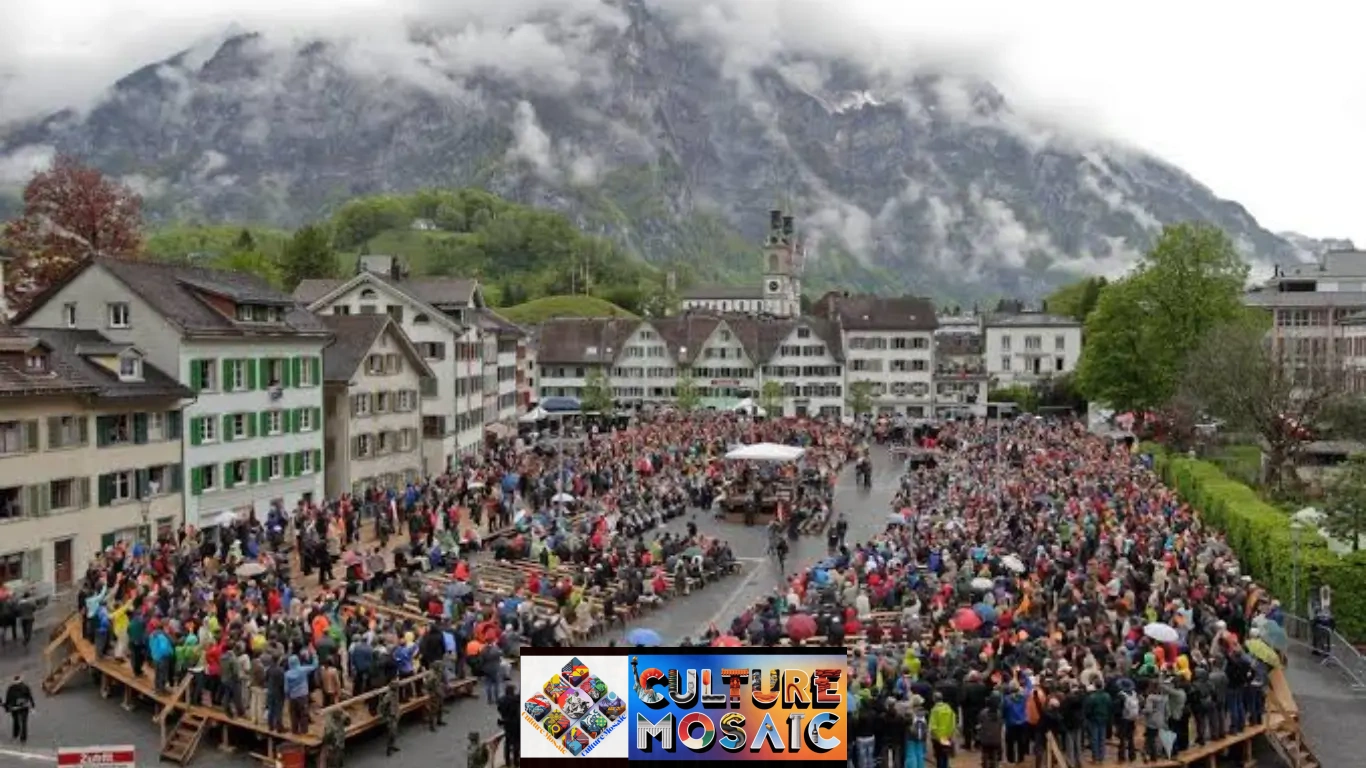
In the Swiss cantons of Appenzell Innerrhoden and Glarus, the Landsgemeinde — an ancient open-air assembly — still meets annually. Citizens gather in a public square and vote by show of hands on cantonal laws and elections. There is no secret ballot, no online portal, no postal vote. Your presence is required, and your raised arm is your civic signature. The Landsgemeinde is one of the oldest continuous vernacular governance structures in the Western world, and its persistence is not sentimental: it continues because it works, and because the communities it serves have never found a substitute that does what it does.

What makes the Landsgemeinde a forensic marker of vernacular governance structures is not just the tradition but the physical evidence it leaves. The square itself — its dimensions, wear patterns, sight lines — has been shaped by the act of collective decision-making over centuries. The assembly has shaped the architecture of the space, and the space in turn shapes the assembly. This reciprocal dialogue is precisely what distinguishes resilient vernacular governance structures from governance systems that are merely imposed on a community and then forgotten.

The Andean Ayllu: Governance Written in the Landscape

In the Andes, the ayllu is a pre-Columbian system of community land-sharing and mutual obligation that still functions in modified form across Bolivia, Peru, and Ecuador. The ayllu is one of the most rigorously documented examples of vernacular governance structures anywhere in the world. What makes it remarkable is that it is not just a social agreement — it is an ecological one, encoded directly into the physical landscape through terrace farming, shared irrigation channels, and communal grazing rotations. The vernacular governance structure of the ayllu is not stored in a document. It is cut into the hillside.

Andean Ayllu Topographic Governance Map: Terrace Farming Zones and Irrigation Channels A topographic illustration of an Andean mountain landscape showing the ayllu governance system encoded in the physical terrain. Stepped terrace boundaries are drawn in dark red across four community zones: Ayllu Qollasuyu at the upper terraces, Ayllu Chinchasuyu at the mid terraces, Ayllu Antisuyu at the lower fields, and Ayllu Kuntisuyu in the eastern zone. Each terrace strip is colour-filled in graduated greens to indicate cultivated agricultural land. Blue lines representing irrigation channels descend from a single main source near the mountain peak and branch outward to serve all community zones equally, with directional arrows showing water flow. A legend in the lower right identifies terrace boundaries as physical contracts, irrigation channels as shared obligations, and green fills as cultivated zones by ayllu group. A dark title bar at the bottom reads: Andean Ayllu — Topographic Governance Map — Terrace System and Irrigation as Communal Contract. Ayllu Qollasuyu — Upper Terraces Ayllu Chinchasuyu — Mid Terraces Ayllu Antisuyu — Lower Fields Ayllu Kuntisuyu — Eastern Zone LEGEND Terrace boundaries (physical contract) Irrigation channels (shared obligation) Cultivated zone by ayllu group ANDEAN AYLLU — TOPOGRAPHIC GOVERNANCE MAP · TERRACE SYSTEM & IRRIGATION AS COMMUNAL CONTRACT
Fig. 3 — Andean Ayllu Landscape: Each terrace boundary marks a community obligation. Each irrigation channel is a shared contract, maintained collectively and encoded in the physical geography. The landscape is the governance document — it cannot be deleted, amended by committee, or stored in a cloud server.

The terraces are the governance. The irrigation channels are the contract. When an archaeologist excavates an Andean site and finds specific communal storage pits or shared water management ruins, they are reading the material record of a vernacular governance structure that functioned for centuries without a legislature, a bureaucracy, or a digital platform. The choices made by these communities are still physically present in the landscape. That is a kind of civic memory that no digital archive has yet been able to replicate — and it is precisely why vernacular governance structures remain a subject of urgent contemporary relevance, not merely historical curiosity.

Forensic Stratigraphy Cross-Section: Andean Ayllu Archaeological Profile Showing Governance Layers A vertical archaeological cross-section diagram of an Andean hillside site, drawn as a scientific soil profile. Five distinct horizontal strata are labelled from surface to bedrock. The topmost layer is the modern cultivation surface in light tan. Below it, a compacted terrace wall foundation layer in dark brown indicates deliberate construction. The third stratum, in mottled ochre, shows refuse and midden deposits including ceramic sherds and organic material, readable as evidence of communal feasting and resource-sharing activity. The fourth stratum, in reddish-brown, marks an earlier terrace construction layer with water-smoothed channel-cut stones indicating irrigation infrastructure. The deepest pre-human stratum is sterile bedrock in grey. Four vertical sampling columns are drawn through the profile, labelled with forensic annotations: phosphate concentration zones indicate food preparation sites, charcoal density rings indicate communal hearth use cycles, compaction gradient maps trace foot-traffic patterns, and ceramic typology clusters identify community zone boundaries. A title bar reads: Ayllu Forensic Stratigraphy — Each Governance Decision Leaves a Chemical Signature in the Soil. AYLLU FORENSIC STRATIGRAPHY — ARCHAEOLOGICAL CROSS-SECTION · GOVERNANCE WRITTEN IN SOIL STRATUM V — STERILE BEDROCK · pre-human deposit · no anthropogenic signature STRATUM IV — EARLY TERRACE CONSTRUCTION · water-channel cut stones · irrigation infrastructure c.800–1200 CE STRATUM III — MIDDEN / REFUSE DEPOSIT · ceramic sherds, charcoal, bone · communal feasting & resource-sharing evidence STRATUM II — TERRACE WALL FOUNDATION · deliberate construction layer · compacted fill & retaining stones c.1200–1500 CE STRATUM I — MODERN CULTIVATION SURFACE · active ayllu agriculture · living governance system PHOSPHATE CONCENTRATION CHARCOAL DENSITY RINGS COMPACTION GRADIENT CERAMIC TYPOLOGY ↑ food prep site = shared meals ↑ hearth cycles = governance frequency ↑ foot-traffic = civic path ↑ zone boundary = community ID 0 — 2 metres depth
Fig. 4 — Forensic Stratigraphy Cross-Section: Each horizontal layer is a governance record. Phosphate concentrations mark communal food-preparation sites. Charcoal density rings track the frequency of communal hearth gatherings. Compaction gradients map the civic paths worn by foot traffic. Ceramic typology clusters identify community zone boundaries. The ayllu did not merely govern the land — it wrote its decisions into the soil’s chemistry. A future archaeologist could reconstruct the political geography of this community from its dirt alone.

The Social Isotope Framework

What follows is a comparative framework for understanding how different governance systems encode, transmit, and preserve their decisions. Placing vernacular governance structures alongside bureaucratic and ancestral systems side by side makes the forensic differences immediately visible. The “Archaeological Trace” column is the heart of this analysis: every governance mode — including vernacular governance structures — leaves a chemical and material signature in the historical record, just as a communal fire leaves concentric rings of ash whose density records the intensity and frequency of community use over time.

Governance Type Primary Medium Communication Mode Archaeological Trace
BureaucraticModern state systems Digital PDF / Printed paperworkSingle-direction; no physical witness One-way broadcastAnnouncement, not deliberation Fragmented metadata; server logs; no spatial signatureInvisible to future archaeologists
VernacularCommunity-rooted structures The communal hearth; the shared squareEmbodied, witnessed, sensory Dialectic conversationReciprocal; power distributed spatially Concentric ash deposits; wear patterns on threshold stones; communal storage pitsLegible to archaeology centuries later
AncestralPre-state indigenous systems Memory-objects — wampum, totems, knotted cordMaterial, non-reproducible record Oral lineage; ceremonial re-enactmentTransmitted through body, not text Stylised material iconography; site-specific artefact clusters; middens encoding community diet and ritualSocial relations readable in refuse

Table 1 — The Social Isotope Framework: Governance modes mapped against their material and forensic signatures

Vernacular Governance and the Formal State

A Relationship Built on Tension and Negotiation

It would be a mistake to read this article as an argument against formal governance. Vernacular governance structures and state institutions exist in a permanent, often productive tension. The state provides the frame — legal protections, infrastructure, the enforcement mechanisms that allow agreements to hold between strangers. Vernacular governance structures fill the frame with human meaning, contextual knowledge, and the relational accountability that no statute can manufacture.

The most resilient communities are those that manage to negotiate this boundary intelligently. They use the tools of the state without surrendering the authority of local knowledge. In many Pacific contexts, formal legal entities such as incorporated land trusts have been deliberately designed to house and protect the decision-making processes of vernacular governance structures. The legal wrapper is modern. The governance inside it is ancient. This kind of institutional nesting — where formal law creates a protected space for vernacular governance structures to operate — is perhaps the most promising model for communities navigating twenty-first-century pressures without sacrificing what makes them coherent.

The danger arises when formal systems do not recognise what vernacular governance structures provide — and attempt to replace them outright. Community self-organisation is not inefficiency. It is load-bearing. When vernacular governance structures are removed, the social fabric above them loses its foundation, and the resulting fragmentation is very difficult to reverse. Decades of development literature document this failure repeatedly, yet policymakers continue to be surprised by it.

Vernacular Leadership: The Person Who Holds the Room

Vernacular governance structures produce a particular kind of leader — one who is almost invisible in formal governance literature because they rarely hold an official title. They are the person everyone in the village knows to go to when there is a dispute. The woman who remembers the old boundary agreement. The elder whose silence in a meeting carries as much weight as anyone else’s speech. Vernacular leadership of this kind does not exist apart from vernacular governance structures: it emerges from them, is sustained by them, and in many ways embodies them.

What makes vernacular leadership legible to the community is not appointment but recognition. It accumulates slowly, through demonstrated judgment, through being present at difficult moments, through being trusted with things that matter. Within vernacular governance structures, this form of social credit cannot be transferred, delegated, or inherited. When that person dies or moves away, a community feels the loss in ways that are hard to articulate but immediately real. It is one of the reasons why the erosion of vernacular governance structures is so costly: the leadership it produces cannot simply be replaced by appointing someone to a committee.

The Origins of Vernacular Governance Structures

Vernacular governance structures do not emerge from design. They emerge from necessity. Most examples we can trace archaeologically begin with a shared problem: a water source that needs managing, a common resource that could be depleted by individual overuse, a boundary dispute that recurs unless it is ceremonially resolved. The structural sophistication of vernacular governance structures is not the product of deliberate institution-building. It is the residue of repeated, practical problem-solving carried out by people who had to live with the consequences of getting it wrong.

Elinor Ostrom, who received the Nobel Prize in Economic Sciences in 2009, spent her career documenting exactly this phenomenon. Her research into common pool resource management found that communities around the world had independently developed sophisticated vernacular governance structures for managing shared resources — and that these systems consistently outperformed both private ownership and state management in long-term sustainability. The key characteristics she identified — local knowledge, graduated sanctions, collective choice arrangements, and mechanisms for conflict resolution — are precisely the features that distinguish functional vernacular governance structures from the bureaucratic alternatives that have so often displaced them. The material record corroborates her findings: from the ceramic assemblages left by communal kiln communities — where the biochemistry of salt-glaze fermentation reveals shared firing schedules and collective resource pooling — to the ash deposits of communal hearths, the forensic evidence of governance is written into the objects that communities make together. Ostrom’s work remains the most rigorous empirical defence of vernacular governance structures available in the social science literature.

Impact on Local Decision-Making

Why Local Knowledge Is Not Parochialism

One of the persistent misunderstandings about vernacular governance structures is that they represent a retreat from complexity — a nostalgic preference for the small-scale. This is a category error. The local knowledge embedded in vernacular governance structures is not parochialism. It is precision. Dismissing it as unsophisticated is the governance equivalent of calling a master craftsman’s intuition unscientific because it cannot be expressed in a spreadsheet.

When a community in the Sahel manages its grazing rotation according to a system refined over centuries through its vernacular governance structures, it is applying an extraordinarily sophisticated model of local ecology that no externally designed framework can replicate from a distance. The same is true of Pacific fishing communities whose traditional vernacular governance structures for resource management anticipate ecological science by hundreds of years. It also holds for the textile-producing communities of South Asia and West Africa, where questions of ethical textile provenance are inseparable from the vernacular governance of the supply chain — who grows the fibre, who sets the price, and who arbitrates a dispute between a dyer and a weaver are governance questions answered not by contracts but by community structure. The knowledge is real. The governance is real. The only thing that is sometimes missing is formal recognition.

The empirical record is clear: communities that retain intact vernacular governance structures consistently demonstrate better resource stewardship, faster conflict resolution, and higher rates of civic participation than those where formal systems have fully displaced local alternatives. That is not a romantic argument. It is an observable, replicable pattern in the data — and it is the strongest possible argument for taking vernacular governance structures seriously as objects of policy analysis, not just anthropological curiosity.

Civic Memory and Continuity

Civic memory is not the same as institutional memory. Institutional memory is the records a government keeps. Civic memory is the living knowledge held in the bodies and relationships of community members — the understanding of why a particular rule exists, who made it, what problem it was designed to solve, and what it cost to establish. Vernacular governance structures are the primary vessels of civic memory, and what makes them so difficult to replace is precisely that the two things — the structure and the memory — are inseparable.

Vernacular governance structures transmit civic memory through practice rather than documentation. The act of gathering in the same place, following the same protocols, hearing the same cadences of deliberation, is itself a form of transmission. Each generation does not just inherit a set of rules. It inherits a living practice — with all the contextual knowledge that practice embeds in the body and the social landscape. Remove the vernacular governance structure, and the rules survive on paper while the wisdom evaporates.

The loss of civic memory is one of the most significant and least discussed costs of rapid modernisation. When communities are displaced, when traditional meeting places are demolished, when new residents arrive without initiation into local protocols, the continuity breaks. The rules may be written down. But the knowledge of how to use them wisely — the knowledge that only vernacular governance structures can hold and transmit — is gone.

Community Self-Organisation and the Limits of Design

There is a growing body of evidence from complexity science and organisational theory that designed systems have a fundamental limitation: they can only account for what their designers already know. Community self-organisation — the engine at the heart of vernacular governance structures — does something different. It is adaptive. It responds to conditions that no designer could have anticipated, because it is operated by people with direct, real-time knowledge of those conditions. Vernacular governance structures are not slow or primitive alternatives to rational design. They are faster, more accurate, and more contextually intelligent than any system that relies on distant authorities processing delayed information.

Vernacular governance structures function as distributed intelligence systems. They process social, ecological, and economic information through a network of relationships rather than a central authority. This is why they are so resilient. When one node in the network fails, others compensate. When conditions change, the vernacular governance structure adapts. When an external shock arrives — a flood, a market collapse, a sudden influx of strangers — the pre-existing relationships and decision-making habits embedded in vernacular governance structures allow the community to respond faster and more effectively than any externally designed emergency protocol could manage.

Haptic Governance in the Digital Age

The challenge facing vernacular governance structures today is not irrelevance. If anything, the fragility of centralised digital systems has made the argument for locally embedded vernacular governance structures more urgent than at any point in the past century. The challenge is translation: how do you preserve the haptic dimension of governance — the physical presence, the sensory anchoring, the embodied accountability — in an age when more and more civic life migrates online? How do you protect what vernacular governance structures do when the platforms that host civic life have no architecture for it?

In New Zealand, Maori governance bodies have developed hybrid models that offer a partial answer. They use digital tools for administration and information sharing, while deliberately protecting physical gathering as the site of actual decision-making. The marae remains the place where consequential decisions are made, even when most administrative work happens online. The vernacular governance structure is protected not by rejecting technology but by maintaining a clear boundary between where administration happens and where governance happens. That distinction — between the site of administration and the site of genuine authority — is one that communities everywhere need to make consciously, because if they do not make it deliberately, digital convenience will make it for them.

Auditing Your Local Vernacular Governance

The following questions are designed to help you assess the vernacular character of your own community’s vernacular governance structures. There are no correct answers, only revealing ones. The goal is not to score your community but to make visible the elements of vernacular governance that may already be present and the gaps where frictionless bureaucracy has quietly displaced them.

Is Your Local Vernacular Governance Structure Intact or Frictionless?

  1. Where do you meet? Is it a rented office building with generic furniture, or a place that carries the memory of previous gatherings? Does the space feel chosen or merely available?
  2. How is the record kept? Is the archive a cloud folder that could vanish with a password change, or does it have a physical dimension — a ledger, a bound minute book, a wall of framed decisions?
  3. What is the material of the decision? Is it an electronic click, private and unwitnessed, or the audible and visible act of a raised hand in a shared room?
  4. Who holds the institutional memory? Is there a person in your community who could trace the genealogy of a current decision back three generations? If not, where did that knowledge go?
  5. When is the community most cohesive? During official processes, or during the informal ones that happen around them — the conversations in the car park, the cup of tea after the meeting, the shared meal?

The Return to the Human Scale

We have spent several decades in many parts of the world treating governance as a technology problem. If we could only design the right platform, the right algorithm for aggregating preferences, then democracy would function better, communities would cohere, and the chronic deficits of civic participation that plague modern states would resolve. In doing so, we have systematically undervalued and dismantled the vernacular governance structures that were quietly doing the work that no platform can replicate.

That bet has not paid off. The evidence suggests it has accelerated the very fragmentation it was meant to solve. What is missing is not better technology. What is missing is the recognition that governance is fundamentally a relational and embodied practice — and that vernacular governance structures, precisely because they are rooted in specific soil, stone, and collective memory, are the structures which sustain it most reliably. The answer to our governance crisis is not a better app. It is a renewed commitment to the vernacular governance structures that communities have built, tested, and refined over generations.

Vernacular governance structures are not a relic. They are a template. Not to be copied wholesale into different contexts, but to be read carefully — the way you would read a load-bearing wall before deciding whether it is safe to remove. If this article has done its job, you will never again look at a community meeting, a shared field, a town ledger, or an open-air assembly without recognising it for what it is: a vernacular governance structure doing essential work that nothing else in our civic architecture can do.

We must stop being users of government and start being architects of our own vernacular governance structures. The tools are already there — older than the state, and in many communities still quietly functioning.

The structural foundation of a durable civic life

Frequently Asked Questions

What is the difference between vernacular governance and traditional governance?

Vernacular governance structures refer to organic, locally developed systems that communities use to manage shared life, regardless of whether those systems are ancestral or recently evolved. Traditional governance is one subset of vernacular governance structures, but vernacular governance structures can also emerge in new communities, urban neighbourhoods, or modern cooperatives that have developed their own working systems over time. The defining characteristic is not age but embeddedness: vernacular governance structures are inseparable from the community and landscape that produced them.

Can vernacular governance structures scale to large populations?

Generally, vernacular governance structures work best at the community level, where relational density is high enough to sustain the civic memory and mutual accountability that make them function. However, many large-scale governance systems — such as the Swiss federal structure — have successfully preserved vernacular governance structures at the local level while delegating other functions to formal institutions. The key is recognising which functions each type of governance does well, and protecting vernacular governance structures from being replaced by administrative convenience.

How do formal institutions interact with vernacular governance structures?

The relationship between formal institutions and vernacular governance structures varies enormously by context. Formal institutions can actively support and protect vernacular governance structures through legal recognition, funding, or constitutional provision. The most effective contemporary approaches involve negotiated frameworks that give legal force to the decisions made within vernacular governance structures while preserving local autonomy over the decision-making process itself.

Is haptic governance just another term for direct democracy?

Not exactly. Direct democracy is a formal mechanism — a system where citizens vote directly on laws. Haptic governance is a quality embedded in vernacular governance structures: it refers to the degree to which decisions are made through embodied, physically present processes. An entirely online direct democracy would have low haptic character. A representative system built around vernacular governance structures — where communities gather physically to deliberate and witness decisions — could have very high haptic character.

How can communities begin to strengthen their vernacular governance structures?

Start with an audit of what already exists. Most communities have more functioning vernacular governance structures than they recognise — informal decision-making processes, trusted individuals, regular gathering points, shared protocols. The first step is making these visible and valuing them explicitly. From there, consider how physical meeting spaces can be designed to support deliberation, how records can be kept in ways that build civic memory rather than replacing it, and how new members can be initiated into the community’s vernacular governance structures rather than simply handed a rulebook.

AM
Political Anthropologist · Governance Advisor · London School of Economics and Political Science

Dr. Arthur Mason is a political anthropologist and governance scholar based at the London School of Economics and Political Science, where his research spans the intersection of vernacular governance structures, civic memory, and the material record of communal decision-making. His first-hand fieldwork includes seven seasons embedded with ayllu communities in the Bolivian altiplano and the Peruvian Sacred Valley, examining how terrace-based land governance encodes communal obligation directly into the physical landscape. He has attended the Landsgemeinde assemblies in both Appenzell Innerrhoden and Glarus as an accredited observer on four separate occasions, recording the spatial, acoustic, and archival dimensions of open-air civic assembly and measuring their haptic governance properties.

This direct observational record — soil samples taken from communal hearth sites in the Colca Canyon, acoustic measurements recorded in stone council chambers of the Bernese Oberland, ledger analysis conducted in the cantonal archives of Glarus — provides the forensic foundation for the analysis presented here. Dr. Mason’s approach treats governance not as a text to be read but as a material record to be excavated: governance written in soil, ceramic, and stone as well as statute.

He has consulted for the United Nations Development Programme, the World Bank, and numerous national governments on participatory governance frameworks. His writing has appeared in the Journal of Political Ecology, the Cambridge Handbook of Community Governance, and Comparative Political Studies. He works alongside colleagues at the Centre for Social Architecture on a multi-year project mapping the civic memory of post-industrial communities, and is completing a monograph on haptic governance tentatively titled The Weight of the Raised Hand.

Vernacular Governance Structures Social Architecture Civic Memory Community Self-Organisation Vernacular Leadership Haptic Governance Analogue Sovereignty Landsgemeinde Ayllu Systems Elinor Ostrom

Leave a Reply

Your email address will not be published. Required fields are marked *