
 By Culture Expert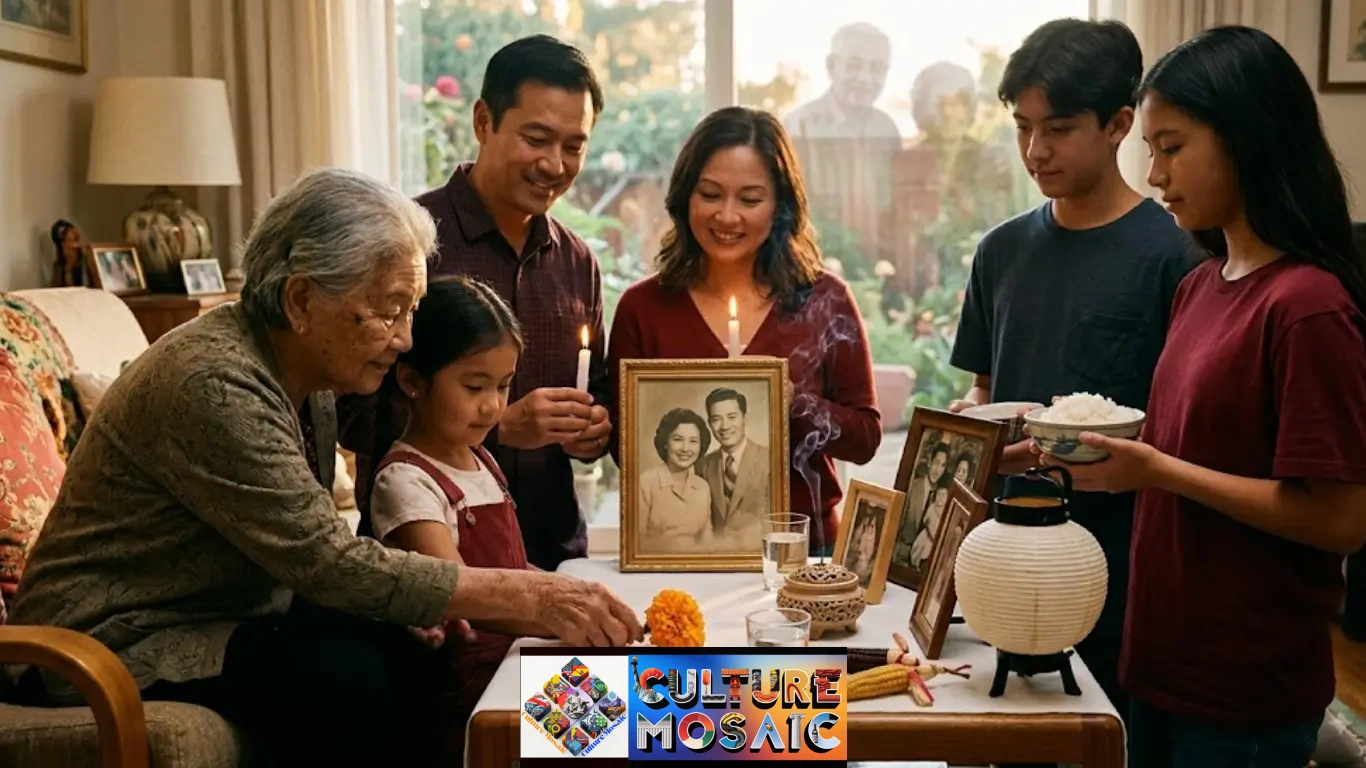
Quick Summary
| What it is: Ancestral Gathering Traditions are the rituals, feasts, and altar practices through which living communities honour, feed, and stay in conversation with the dead who came before them. Where you’ll find them: Every continent. China’s Qingming Festival, Mexico’s Día de los Muertos, West Africa’s Egungun masquerades, and England’s own Samhain and Souling customs all count. The core act: Most traditions centre on three things — an altar or sacred space, a food or drink offering, and spoken words that name the dead out loud. Why it still matters: Anthropologists estimate some form of ancestor veneration exists in the majority of the world’s documented cultures, which tells you this isn’t a fringe practice. It’s closer to a human default setting. How to start your own: A photograph, a candle, and a glass of water on a small shelf is enough. The rest — food offerings, spoken prayers, seasonal rituals — can grow from there. |
I’ve spent close to two decades reading grave goods, oral histories, and half-forgotten harvest customs for a living, and I’ll tell you the thing that still catches me off guard: how similar we all are about this. Strip away the geography and the theology, and a Yoruba family setting a plate at the edge of the eating mat is doing something structurally identical to a Yorkshire farmer leaving the last sheaf of corn standing in the field for the Harvest Spirit. Different words. Same instinct. We do not want our dead to simply vanish, so we build small, repeatable acts that keep them present.
Here are the seven things I want to walk you through, in order: what these rituals actually mean, real ancestor worship examples from around the world, the English traditions people wrongly assume don’t exist, the African ancestral altar, food offerings and what happens to them afterward, how to build your own practice from nothing, and why all of this still matters right now.
The Problem: We’ve Lost the Thread
Here’s the uncomfortable part. In much of the industrialised West, ancestral gathering traditions have thinned out to almost nothing. We’ve swapped the dumb supper and the harvest feast for a text message on a birthday that isn’t celebrated anymore, or nothing at all. I hear this constantly from readers: a grandmother’s recipe nobody wrote down, a grave nobody has visited in a decade, a name that gets fuzzier every time someone tries to say it. That loss has a cost.
Family therapists and anthropologists alike have connected weak intergenerational ritual with a thinner sense of identity — people who genuinely don’t know where they come from, and who feel that absence as a low, persistent ache even when they can’t name it.
I don’t think that’s dramatic. I think it’s just true, and I’ve watched it up close in my own research trips.
Secret 1: What Are Ancestral Gathering Traditions, Really?
Ancestral rituals meaning, boiled down, is this: a repeated, intentional act that keeps a relationship alive between the living and someone who has died. Not a memory. A relationship. That distinction matters enormously to anthropologists, because a memory is passive — it happens to you — while a ritual is something you do, on purpose, on a schedule, usually with other people watching or participating.
| “Memory is passive. Ritual is something you do, on purpose.” |
The building blocks show up again and again across wildly different cultures:
- A dedicated space. An altar, a grave, a household shrine, a corner of a kitchen table.
- An offering. Food, drink, incense, flowers, tobacco, paper money — something given rather than merely said.
- Words. Names spoken aloud, prayers, praise poems, or simply a one-sided conversation about the week.
- Timing. A death anniversary, a harvest, a lunar new year, a liminal date like Samhain when the calendar itself seems to thin.
- Witnesses. Rarely done entirely alone. Ancestral gathering traditions are, almost by definition, gathering traditions — they pull people together.
That last point is the one people miss. These aren’t private grief rituals tucked away in a bedroom. They’re communal. Museum curators who study East Asian ancestor portraiture note that setting up a household altar image of someone who has died gives the living family a face to address during shared rituals, not a private keepsake tucked in a drawer. That act of display, of shared seeing, is doing social work as much as spiritual work. It’s binding a family or a village back together around a shared story.
Secret 2: Ancestor Worship Examples From Around the World
I want to walk you through a handful of real, documented ancestor worship examples, because the diversity here is honestly the best argument for why this topic deserves your attention.
Here’s the quick-reference version, before we go region by region:
| Region / Culture | Tradition / Festival | Key Ritual Elements | Primary Symbol or Offering |
| China | Qingming Festival | Sweeping graves, burning joss paper | Food, tea, wine, incense |
| Japan | Obon Festival | Floating paper lanterns, Bon Odori dance | Fruit, flowers, light |
| Mexico | Día de los Muertos | Family graveside picnics, building ofrendas | Marigolds, sugar skulls, favoured foods |
| West Africa (Yoruba) | Egungun Masquerade | Drumming, lineage dance, masked embodiment | Libations, lineage respect |
| Scandinavia / Slavic lands | Blót and Dziady | Shared feasts, mead, fireside storytelling | Mead, bread, spoken names |
| Ancient Egypt | Tomb feasting | Bread and beer left at family tombs | Bread, beer, household shrine goods |
| England | Samhain and Souling | Hearth-relighting, mumming, souling for cakes | Soul cakes, bonfires, corn dolls |
- China’s Qingming Festival. Held in early April, families visit and sweep ancestral graves. Food, tea, and rice wine get set down at the gravesite, and lit incense carries the family’s respects skyward. Some burn “joss paper” — model money, houses, even paper cars — believing it equips the dead with comfort in the afterlife.
- Japan’s Obon Festival. Each summer, families clean and freshen the home altar, set out fruit and flowers, and float paper lanterns down rivers to guide ancestral spirits back home for a few days before sending them off again. Bon Odori dances accompany the whole thing — grief expressed, oddly and rather beautifully, through choreography.
- Mexico’s Día de los Muertos. Marigolds, sugar skulls, and a family graveside picnic that looks nothing like a Western funeral and everything like a party the dead are still invited to.
- West Africa’s Egungun masquerade. Among the Yoruba, scholars are careful to separate veneration from worship — this is framed as a family duty, a debt of respect owed to lineage, rather than a plea for favours. The Egungun festival honours ancestors through drumming, music, and elaborate costumed dance, with masked performers understood to embody the visiting dead.
- Norse Blót and Slavic Dziady. Scandinavian feasting ceremonies honoured gods, spirits, and ancestors with mead and song, while the Slavic “Forefathers’ Eve” invited spirits home with a shared meal, prayer, and storytelling by firelight.
- Ancient Egypt. Families tended household shrines and brought bread and beer to tombs to sustain the ka, the spiritual essence of the departed — and that habit didn’t die with the pharaohs. According to curatorial research from the British Museum’s Egyptian collection, the custom of gathering at a family tomb to eat and share food with the dead survived the fall of the pharaohs entirely intact, and both Muslim and Christian Egyptians still keep some version of it today.
Notice what none of these have in common: geography, language, religion, or century. What they share is structural. Offering, altar, timing, witness.
Secret 3: Ancestral Gathering Traditions England Actually Has
I get asked this a lot, usually with a slightly apologetic tone, as though English culture doesn’t have “real” ancestral traditions the way, say, Mexico or China does. I want to push back on that, hard. It has plenty. They’ve just gone quiet, or gotten rebranded as something else.
- Samhain and the thinning veil. Long before Halloween candy, Samhain marked the end of the harvest and the start of the dark half of the year. The Celts treated it as a genuinely liminal moment, when the boundary between worlds was thought to grow thin, and bonfires were lit both to honour the ancestral dead and to protect the community through the coming darkness. Households would let their hearth fires go out entirely and relight them from a single shared bonfire — practical thrift dressed up as sacred renewal.
- Harvest Home and the corn doll. England’s own farming-year festival, arguably the country’s oldest ancestral gathering tradition still in living memory. At Harvest Home, a corn doll representing the Spirit of the Field was woven from the very last stand of corn cut, kept safe through winter, and ploughed back into the soil the following spring — a small, stubborn ritual of continuity between last year’s harvest and next year’s.
- Souling and the mummers. In parts of England, Souling plays were performed door to door around All Souls’ Day, requesting soul cakes in exchange for prayers for the dead — a direct, transactional bridge between the living and the departed that predates trick-or-treating by centuries.
If you have English ancestry and feel a bit unmoored around this time of year, you’re not imagining it. The customs are there in the historical record. They just require a bit of digging to find, the way most good family history does. This is exactly the territory covered in our broader look at traditional world festivals cultural heritage, if you want the fuller seasonal picture.
Secret 4: The African Ancestral Altar: Meaning and Structure
Ask about ancestral altar meaning across the African continent and its diaspora, and you’ll get variation — but also a remarkably consistent core. Altars are one of the oldest anchors for ancestral gathering traditions on the continent, precisely because they give an otherwise abstract relationship a fixed physical address.
An African ancestral altar typically holds a photograph or object representing the deceased, a white cloth, a candle, and a vessel of water. Across African diaspora traditions such as Hoodoo, Vodou, and Espiritismo, practitioners tend to keep the altar deliberately simple, cleansing it with spiritual colognes and treating regular, direct communication as the whole point of the exercise rather than an elaborate one-off ceremony. In more structured Yoruba-based practice, this develops into what’s known as an Egun shrine, following specific lineage protocols rather than improvised personal taste.
I find the reciprocity framing here genuinely useful, even outside a religious context. The logic behind the offering, as Ifa practitioners describe it, is straightforward exchange: if you’re asking your ancestors for guidance, you owe them something in return. It’s not so different from bringing wine to someone’s dinner table. You don’t show up empty-handed to a relationship you want to keep.
Secret 5: Food Offerings for Ancestors: What They Mean (and What You Actually Do With Them)
This is the question I get most, hands down, usually phrased something close to: “so what happens to the food afterward — do people actually eat it?”
Short answer: usually not, and that’s the point. The food isn’t there because anyone believes a spirit needs literal calories. It’s there as a gesture — a way of honouring the memory of someone who once shared meals with the family, made physical rather than just spoken. In many African households, a small portion of every meal is placed at the edge of the eating mat before anyone else touches their plate — first respects, paid daily, without ceremony.
So what to do with food offerings to ancestors once the moment has passed? Practice varies, but a few patterns repeat:
- Leave it out for a set period, often overnight or up to a week, then remove it.
- Return it to the earth rather than the bin — buried, composted, or scattered outside as a gesture of giving the offering back to nature.
- Never re-serve it to the living. Once it’s been placed with intention, it has done its job.
- The wildcard option: some diaspora practitioners steep fruit offerings in water and use that water to feed houseplants or garden soil, treating the whole cycle — offering, decay, growth — as one continuous ritual rather than three separate steps.
I like that last one more than I probably should. It turns the offering into compost for something alive, which feels less like disposal and more like translation.
Secret 6: How to Connect With Your Ancestors Spiritually
If you’re wondering how to connect with your ancestors spiritually and have no existing family framework to borrow from, start smaller than you think you need to. You don’t need a decade of research or a fully formed practice — most ancestral gathering traditions started exactly this small, once.
| Get one name and one story. Not a full family tree — one grandparent, one detail. What did they grow, cook, sing, or build?Build a small, physical space. A shelf, a windowsill, a corner of a bookcase. A photograph or object is enough.Offer something simple, on a schedule. A glass of water each morning is a genuinely common starting ritual across traditions — cheap, low-stakes, and easy to sustain.Speak, even if it feels strange. Say the name out loud. Talk about your week. The awkwardness fades faster than you’d expect.Anchor it to a date that already exists in your calendar — a birthday, a death anniversary, or a seasonal marker like Samhain — so the practice has a rhythm instead of relying purely on willpower. |
None of this requires a specific religion. I’ve watched thoroughly secular people build altars that function beautifully, because the mechanism isn’t really theological. It’s about regular, embodied attention.
Secret 7: Why Ancestral Gathering Traditions Still Matter
Here’s my actual opinion, not the neutral academic hedge: I think the modern world has a hunger for exactly this kind of gathering, and we’re currently trying to fill it with substitutes that don’t quite work — brunch, group chats, an Instagram memorial post once a year. They’re not nothing. They’re just thinner than what came before.
You don’t have to look at religious ritual to see the pattern repeating. Plenty of secular, civic, and even food-and-drink festivals do the same underlying job — pulling a scattered community back to one place, once a year, to remember where it came from. The Washington Whiskey Rebellion Festival exists because a community decided a piece of its founding history was worth re-enacting together, year after year, rather than letting it fade into a textbook footnote. When Is the Great Reno Balloon Race? is nominally about hot air balloons, but ask longtime attendees why they keep coming back and you’ll hear the same language used for any ancestral gathering: it’s tradition, it’s family, it’s where I’m from.
Latino communities have kept an explicitly ancestral thread running through their festival calendars far more visibly than most; if you want a practical framework for building a similarly rooted community event, our guide on How to Plan a Latino Cultural Festival is a genuinely good starting point, and our broader survey of Religious Festivals in the World shows how often remembrance sits underneath the celebration, even in festivals that no longer read as religious at all. Sicily’s own Festivalle 2026 belongs in that same conversation — a modern event built quite deliberately on top of much older harvest and remembrance customs.
None of this happens by accident, and it isn’t free. Our piece on What Is the Economic Impact of Music Festivals? makes the case that gatherings built around shared identity — ancestral or otherwise — generate a loyalty that ordinary events can’t buy, and that loyalty is precisely why these events keep getting funded, staffed, and rebuilt year after year even when they’re expensive to run.
Some of the most interesting modern responses skip the expense entirely and go small and deliberately temporary instead: what we’ve called Ephemeral Social Infrastructure, or the rise of Transformative Micro Festivals that borrow the bones of ancestral gathering — feast, fire, story, return — without the weight of an inherited religious framework. And for a direct, land-based take on what it actually means to honour the dead in a specific place, I’d point you toward this piece on Ancestral Gathering Traditions, a thoughtful essay on land and blood traditions from a practitioner’s perspective rather than an academic one.
If you’re building your own version of this — a family reunion with a remembrance table, a neighbourhood harvest gathering, anything at all — I’d start with our broader work at Culture Mosaic, where we cover the full range of festival planning, cultural heritage, and gathering traditions across dozens of cultures.
Frequently Asked Questions
What are 5 examples of family traditions?
Weekly shared meals, holiday-specific recipes passed down without a written recipe card, a particular seat or role assigned to the eldest at gatherings, storytelling about deceased relatives at anniversaries, and seasonal rituals like decorating a grave or altar around a specific date each year.
All five sit comfortably under the wider umbrella of ancestral gathering traditions — the common thread is repetition. A tradition only becomes one through doing it again.
What are some examples of ancestral veneration practices?
Grave-sweeping and food offerings during China’s Qingming Festival, lantern-floating and altar-cleaning during Japan’s Obon, Yoruba Egungun masquerades honouring lineage through dance and drumming, household libations in Norse Blót ceremonies, and England’s older Samhain and Harvest Home customs, where bonfires and corn dolls carried the same underlying function.
What are ancestor rituals?
Ancestor rituals are repeated, intentional acts — offerings, prayers, altar tending, seasonal feasts — performed specifically to maintain an ongoing relationship with deceased family members or a wider lineage. They differ from general mourning because they’re scheduled and often communal, rather than a one-time response to loss.
What is ancestor worship called?
Anthropologists generally use the term “ancestor veneration,” which many practitioners actually prefer, since “worship” implies deification and most traditions are careful to draw a line between honouring the dead and treating them as gods. Regional terms exist too — adimu egun in Yoruba practice, for instance — each carrying its own shade of meaning.
What should I do with food offerings to ancestors once the ritual is finished?
Most traditions agree on one thing: don’t eat it yourself. Leave it in place for a set period — commonly overnight to a week — then dispose of it respectfully, ideally by returning it to soil, water, or another natural setting rather than a household bin. The offering has already done its work by being given.
Sources and Further Reading
Asanee 44, Ancestor Veneration in African Spirituality — https://asanee44.com/ancestor-veneration/
Vaia, Ancestor Veneration: Definition & Rituals — https://www.vaia.com/en-us/explanations/anthropology/cultural-anthropology/ancestor-veneration/
Vaia, Ancestor Worship: Meaning & Significance — https://www.vaia.com/en-us/explanations/anthropology/cultural-anthropology/ancestor-worship/
Anthroholic, Ancestor Worship in Anthropology — https://anthroholic.com/ancestor-worship
British Museum, Frightening Fiestas and Sacred Ceremonies — https://www.britishmuseum.org/blog/frightening-fiestas-and-sacred-ceremonies
Smithsonian National Museum of Asian Art, Ancestor Portraits: Family Legacy Through Art — https://asia-archive.si.edu/learn/for-educators/teaching-china-with-the-smithsonian/lesson-plans/ancestor-portraits-family-legacy-through-art/
Smithsonian National Museum of Asian Art, Ancestor Worship Today: The Altars — https://archive.asia.si.edu/exhibitions/online/teen/funeral.htm
Historic England / Heritage Calling, 10 Eccentric English Customs, Traditions and Ceremonies — https://heritagecalling.com/2021/04/28/10-eccentric-english-customs-traditions-and-ceremonies-and-the-stories-behind-them/
Atlanta University Center, Robert W. Woodruff Library, African Traditional Religions Textbook: Ifa, Chapter 5 — https://research.auctr.edu/Ifa/Chap5Intro
NPR Life Kit, How to Make an Ancestral Altar: A Cross-Cultural Guide — https://www.npr.org/2022/11/11/1136051123/connect-with-your-ancestors