
 By Culture Expert
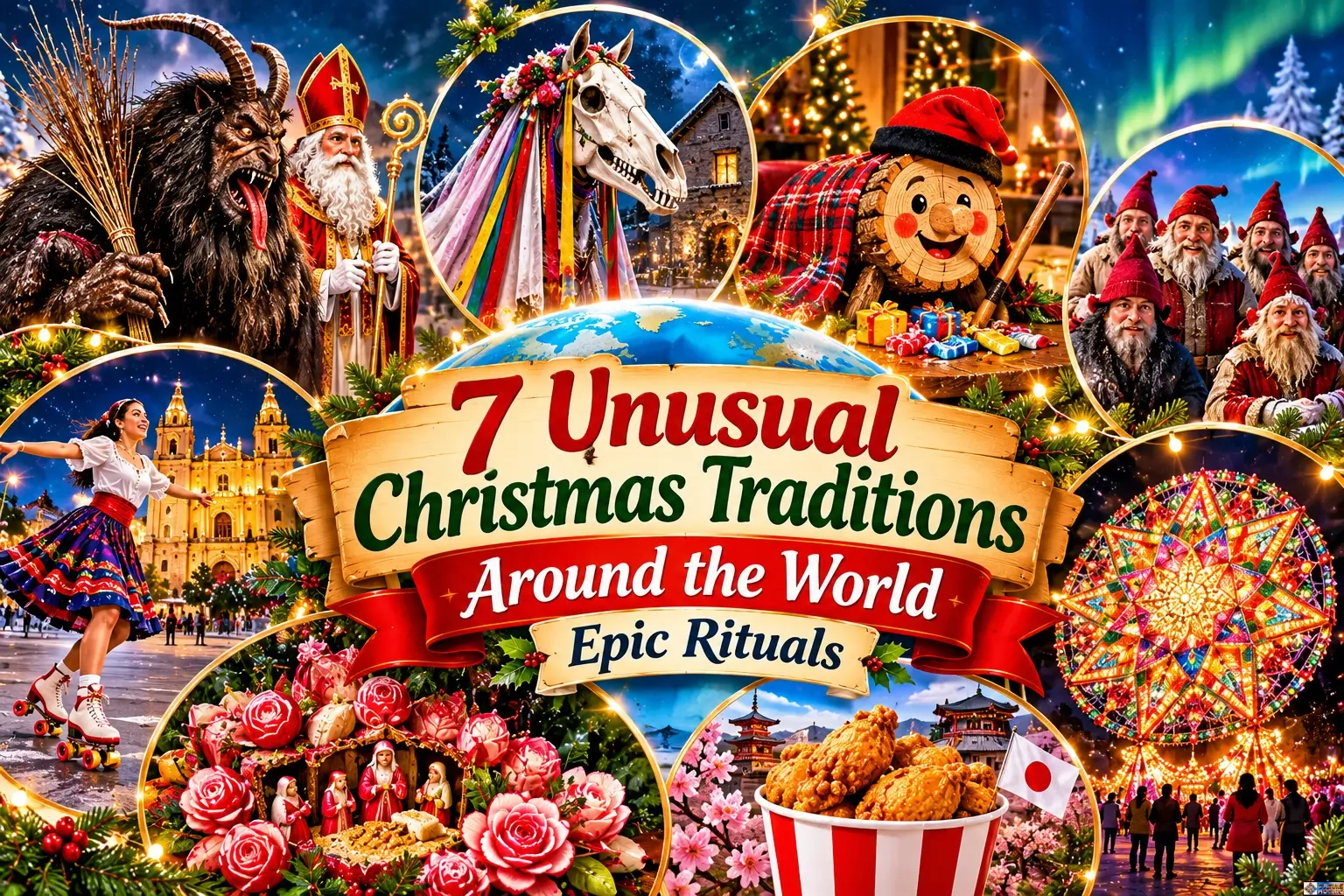
7 Unusual Christmas Traditions Around the World That Defy Modern Holidays
If your December feels like the same playlist, the same shop windows and the same chocolate advent calendar, you’re not alone. The good news is that elsewhere, midwinter is far stranger, and the history behind it is richer than any high-street display.
Here are seven customs worth knowing, grouped by region. For more, browse our guides to Christmas culture traditions and global Christmas customs.
Europe and the UK
Austria and the Alps: Krampus, the terrifying side of Christmas
On the night of 5 December, the eve of St Nicholas Day, a horned, hairy figure called Krampus is said to accompany Saint Nicholas. Nicholas rewards good children with small gifts; Krampus threatens the rest with birch rods. Towns hold a Krampuslauf (Krampus run), where people in carved masks, fur and bells rush through the streets.
Where it came from is unclear: some folklorists suspect pre-Christian roots, though the popular claim that the church tried to ban it in the 12th century is unverified. What makes it unusual is that Santa has no enforcer.
The custom has also spread across North America; see our guide to the best Christmas celebrations in the US.
Wales: the Mari Lwyd
Imagine a knock at the door and a horse’s skull peering in. The Mari Lwyd is a skull on a pole, draped in a white sheet and ribbons, often with glass eyes and a snapping jaw. The party outside and the household inside trade verses in a Welsh rhyming contest called the pwnco; when the household runs out of excuses, the horse is let in for food and drink.
The first published account dates to around 1800. The name is debated (“grey mare” or “Holy Mary”), and claims of pagan origins are contested.
The custom nearly vanished, then returned from the 1960s. It is one of the best-known unusual Christmas traditions in the UK; more in our historic Christmas traditions UK guide.
Catalonia, Spain: Caga Tió, the log that delivers presents
From 8 December, children “feed” a smiling wooden log wearing a red barretina hat and keep it warm under a blanket. On Christmas Eve or Day they beat it with sticks while singing, and it “poops” out sweets, nougat and small gifts. Naughty children may get coal.
Its roots lie in older hearth and Yule-log customs, which is what makes this a log-based Santa substitute.
Iceland: thirteen Yule Lads
Iceland has thirteen Santas. For the thirteen nights before Christmas Eve, children leave a shoe on the windowsill; the Yule Lads leave small treats, or a rotten potato for bad behaviour.
According to the National Museum of Iceland, they descend from trolls and began as bogeymen used to scare children. The friendly gift-giving version is largely a 20th-century development, popularised by Jóhannes úr Kötlum’s 1932 poem.
Their mother, the giantess Grýla, is said to hunt naughty children.
Latin America
Venezuela: skating to dawn Mass in Caracas
From 16 to 24 December, Venezuelan churches hold early-morning services called Misas de Aguinaldo. In Caracas, many people skate to them, and roads are closed to cars until about 8am to keep skaters safe.
The custom is usually dated to the 1950s, when children wanted to use the roller skates they had received as gifts. Skating is not a year-round passion there; it is purely a Christmas habit, which is exactly what makes it odd.
For the religious backdrop, see religious festivals in the world.
Mexico: the Night of the Radishes in Oaxaca
On 23 December, the city of Oaxaca fills its main square with sculptures carved from giant radishes: nativity scenes, historical tableaux and scenes of local life.
Farmers began carving radishes more than 120 years ago to make their produce stand out in the market, and in 1897 the city’s municipal president, Francisco Vasconcelos, made it an official annual contest. The city grows the radishes on plots near the airport, and entrants harvest their assigned plot a few days before the event. There are “traditional” entries that must reflect Oaxacan culture and “free” entries on any theme.
Nothing else on this list is built from a vegetable that will wilt within hours.
Asia
Japan: a bucket of fried chicken on Christmas Eve
Christmas in Japan has no long-standing feast. Instead, KFC’s 1974 campaign, Kurisumasu ni wa Kentakkii! (“Kentucky for Christmas!”), sold a party bucket with a bottle of wine for adult Christmas parties.
The company says the idea began when a foreign customer in Tokyo remarked that he couldn’t find turkey. Takeshi Okawara, who managed the first Japanese KFC, is widely credited as the brains behind it. Today many families pre-order well ahead of 24 December.
It is the one tradition on this list that began as an advertising campaign, so treat the origin story as the company’s own account. Compare it with other holiday menus in our Christmas celebration foods guide.
The Philippines: the Giant Lantern Festival
Each December, villages (barangays) in San Fernando, Pampanga, compete with enormous lanterns that mark the start of the Philippine Christmas season. Today’s lanterns are about 20 feet across and lit by thousands of bulbs, with large rotors controlling the patterns. Each barangay builds one lantern as a community effort.
The festival grew out of the lubenas, a religious activity in nearby Bacolor where roughly two-foot lanterns were paraded through the neighbourhoods during the pre-Christmas novena.
Sources date the San Fernando event to 1904 or 1908, and electric lights, added in 1931, mark the first Giant Lantern Festival. It turns a quiet devotional custom into a street-scale light show.
Seven Weird Christmas Facts at a Glance
Pick one to look up before December arrives; each has dates worth planning around. For even more ideas, see this roundup of unusual Christmas traditions around the world.
| Tradition | Country | When | What happens | Origin |
|---|---|---|---|---|
| Krampus Night | Austria and the Alps | 5 December | Masked runs; Krampus punishes the naughty | Unclear; possibly pre-Christian |
| Mari Lwyd | Wales | Midwinter | Skull horse trades rhymes at doors | First recorded c. 1800; debated |
| Caga Tió | Catalonia, Spain | 8 to 25 December | Fed, then beaten until it “poops” gifts | Hearth and Yule-log customs |
| Yule Lads | Iceland | 13 nights before 24 December | Shoes on windowsills | Troll folklore; modern form 20th century |
| Misas de Aguinaldo | Caracas, Venezuela | 16 to 24 December | Skating to dawn Mass | 1950s |
| Night of the Radishes | Oaxaca, Mexico | 23 December | Radishes carved into dioramas | Market custom; official contest since 1897 |
| Kentucky for Christmas | Japan | 24 December | Party bucket of fried chicken | 1974 campaign |
| Giant Lantern Festival | San Fernando, Philippines | December | Villages compete with giant lit lanterns | Bacolor lubenas lanterns; electric from 1931 |
Frequently Asked Questions
What are some unique Christmas traditions from different countries?
Austria’s Krampus runs, Wales’s Mari Lwyd, Catalonia’s Caga Tió, Iceland’s thirteen Yule Lads, Caracas’s roller-skating to Mass, Oaxaca’s radish carving, the Philippines’ giant lanterns and Japan’s KFC Christmas are seven well-documented examples.
What are some terrifying Christmas traditions?
Krampus is the best known, a horned figure who punishes misbehaving children. Iceland’s Grýla, the child-hunting giantess, and Wales’s skull-headed Mari Lwyd are also unsettling, though the Mari Lwyd is more mischievous than menacing.
What are some unusual Christmas traditions in the UK?
The Mari Lwyd in Wales is the standout: a decorated horse skull that visits houses and challenges residents to a rhyming duel. Explore more in our guide to historic Christmas traditions UK.
How old are these traditions?
They vary widely. The Yule Lads first appear in 17th-century stories, the Mari Lwyd in records from around 1800, Caracas’s skating in the 1950s, Oaxaca’s official radish contest in 1897, the Philippines’ electric lantern festival in 1931 and Japan’s KFC custom in 1974.
Krampus’s origins are unclear, and claims of ancient pagan roots for several customs are debated. See Christmas festival history for context.
Which Christmas traditions around the world suit kids?
Leaving a shoe on the windowsill for the Yule Lads and feeding Caga Tió are playful for children. Roller-skating to Mass suits families too. Krampus is deliberately frightening, so it may not suit young children.
Sources
- Krampus and Krampusnacht, University of Nebraska Medical Center
- The Yule Lads, National Museum of Iceland
- The thirteen Icelandic Yule Lads, Arctic Portal
- The mystery of Mari Lwyd, Horniman Museum
- Mari Lwyd: Wales’ skeletal Christmas horse, HISTORY
- Christmas traditions, Barcelona City Council
- Will Venezuela’s Christmas roller-skating tradition make a comeback?, Atlas Obscura
- How Kentucky for Christmas began in Japan, KFC
- Why Japan is obsessed with KFC on Christmas, Smithsonian Magazine
- Why radish carving has become a popular holiday event in Oaxaca, Smithsonian Magazine
- Giant Lantern Festival, Wikipedia