
 By Culture Expert
Quick Summary
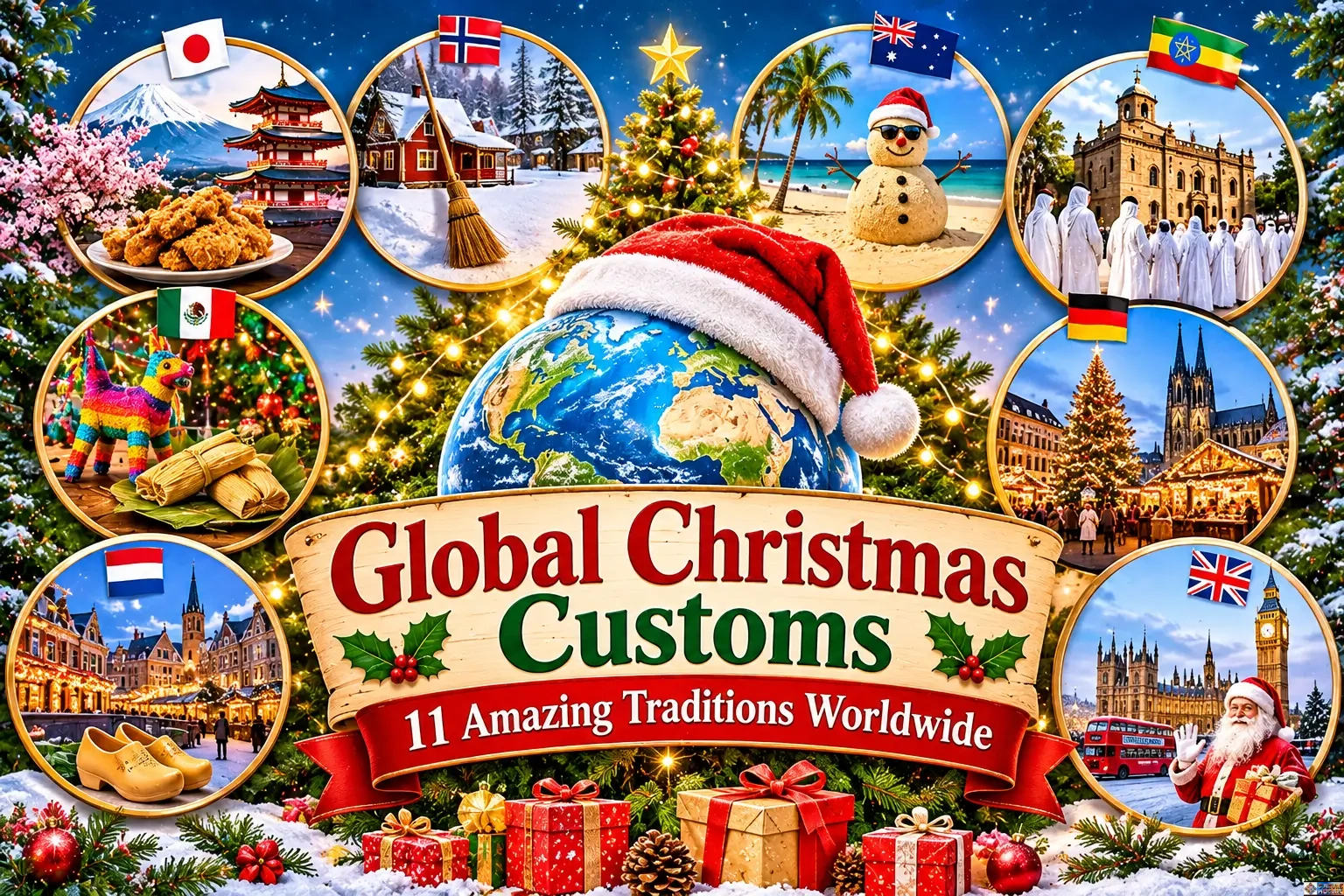
Global Christmas customs differ by date, food, gift-bringer, and even climate, yet almost all of them are built around light, food, family, and giving. The short version:
- Dates vary: Most of the world celebrates on December 25 or 24, but Ethiopia and many Orthodox churches mark Christmas on January 7, and the Netherlands gives its main gifts on December 5.
- Gift-bringers vary: Santa Claus shares the stage with the German Christkind, Iceland’s thirteen Yule Lads, and the Dutch Sinterklaas.
- Food varies most: Fried chicken in Japan, tamales and ponche in Mexico, rice cakes in the Philippines, summer barbecues in Australia.
- The odd customs have reasons: Japan’s KFC Christmas began as a 1974 marketing campaign, Venezuela’s roller-skating to Mass is a 20th-century habit, and Iceland’s book-giving grew out of wartime paper supplies.
Below: eleven countries and regions across six continents, a comparison table, answers to the questions people search most, and sources you can check.
Why Christmas Looks So Different Around the World
You search for “Christmas traditions around the world” and get a pile of lists that all say the same thing: people do strange things in December. That’s unsatisfying. You want to know why a country eats fried chicken, hides its brooms or moves the whole holiday to January, and whether any of it is still practised or just repeated online.
That is the problem with most roundups: they give you the oddity but not the reason. The reasons are where the interest lies, and they usually come down to three things: a calendar (Julian versus Gregorian), a climate (a Southern Hemisphere summer changes everything), or a history (a saint’s feast day, a wartime shortage, a clever advertising campaign).
The date itself is a good place to start. The earliest surviving record of Christ’s birth being marked on December 25 is the Roman almanac known as the Chronography of 354, and scholars still debate whether the date came from early Christian calculation or from the Roman sun festival. The popular claim that the Council of Nicaea fixed the date is false. Christmas never had one origin, so it never had one set of customs.
For deeper background on how the holiday took shape, see Christmas Festival History and Christmas Culture Traditions on Culture mosaic, or Religious Festivals in the World for the wider calendar. Here is the tour, country by country.
Global Christmas Customs, Country by Country
Japan: Fried Chicken on Christmas Eve
In Japan, Christmas is mostly a festive evening for couples and families rather than a religious day. The signature meal is KFC. In 1974 the company launched its “Kentucky for Christmas” campaign, selling a party bucket with a bottle of wine, after a staff member overheard a foreign customer say he couldn’t find turkey in Japan. Some families now pre-order weeks ahead to avoid long queues. Colonel Sanders statues even get Santa outfits. A sponge-and-cream Christmas cake usually follows. Date: December 24 is the main night.
Norway: Hiding the Brooms
Norwegian folklore holds that witches and spirits roam on Christmas Eve looking for brooms to ride, so families hide their brooms. Treat it as folklore rather than universal practice: one writer who tried to trace the custom found very little documentation, and others describe families doing it “just in case” or as a nod to heritage. December 23 is Lille Julaften (Little Christmas Eve), and gifts come on the evening of December 24.
Australia: Christmas in Midsummer
Christmas lands at the height of summer, so lunch is often a beach, park or backyard barbecue with seafood and cold ham rather than a heavy roast, followed by backyard cricket. Carols by Candlelight was popularised in Melbourne in 1938 by radio announcer Norman Banks and is now a national event. Homes are decorated with native plants such as Christmas bush and waratah. Date: December 25, with Boxing Day sport on December 26. Gift-bringer: Santa, traded for boardshorts in the popular imagination.
Ethiopia: Genna on January 7
Ethiopian Orthodox Christians celebrate Genna on January 7 (Tahsas 29) in the Ethiopian calendar, after a 43-day Advent fast. Worshippers dress in white handwoven netela and kuta, and many attend all-night services, with Lalibela’s rock-hewn churches the best-known gathering place. The fast breaks with a family feast of chicken, beef and lamb. Men and boys also play a hockey-like game, also called ganna. It is a quiet, church-centred holiday with no Santa and little commercialism.
The Philippines: The World’s Longest Christmas Season
Filipinos start playing carols in September, in the so-called “Ber months”, and the season runs until the Feast of the Epiphany in January. The heart of it is Simbang Gabi, nine pre-dawn Masses from December 16 to 24. Homes and streets glow with the parol, a star-shaped lantern that once lit the way to those Masses. After the final Mass comes Noche Buena, the midnight family feast, with rice cakes such as bibingka and puto bumbong sold outside churches.
Mexico: Las Posadas
From December 16 to 24, neighbourhoods hold Las Posadas (“the inns”), candlelit processions that re-enact Mary and Joseph’s search for lodging. Each night ends in a party with tamales, hot fruit punch (ponche) and a piñata. Traditional piñatas have seven points for the seven deadly sins, though most people now see them mainly as a children’s game. The nativity scene (nacimiento) is the key home decoration and is set up by December 16. Date: the posadas build up to Nochebuena on December 24.
Venezuela: Skating to Dawn Mass
In Venezuela, early-morning Misas de Aguinaldo run from December 16 to 24. In Caracas, roads close to traffic and residents roller-skate to church; children dangle strings from their windows so passing skaters will tug them. It is a surprisingly young custom: a Catholic magazine’s reporting places the skating in the 1950s, though nobody agrees on exactly why it started. Families also make hallacas together and listen to gaita music.
Germany: Advent, Markets and Three Gift-Bringers
Germany treats Advent as part of Christmas, with calendars, candles and a Weihnachtsmarkt in almost every town. Children put a boot out on the evening of December 5 for Nikolaus on December 6, who sometimes travels with the fearsome Krampus or Knecht Ruprecht. The main gift-giving, the Bescherung, happens on December 24, brought by the Christkind in many Catholic and southern areas and by the Weihnachtsmann elsewhere. Martin Luther is credited with moving gift-giving from December 6 to Christmas Eve as part of the Reformation’s break with saint-centred customs.
Iceland: Thirteen Yule Lads and a Flood of Books
Iceland has thirteen Yule Lads who visit on the thirteen nights before Christmas, leaving small gifts in shoes (or a rotting potato for naughty children). Their mother Grýla and the Yule Cat belong to the same folklore. The modern custom is Jólabókaflóð, the “Christmas book flood”: during World War II, import restrictions made most gifts scarce, but paper was not rationed, and in 1944 the publishers’ association began mailing a free catalogue, the Bókatíðindi, to every home. The ritual is to read your new book on Christmas Eve, often with something warm to drink.
The Netherlands: Sinterklaas on December 5
Dutch children get their main presents on Pakjesavond (December 5), from Sinterklaas, who arrives by steamboat from Spain in mid-November. Expect chocolate letters, marzipan and pepernoten. His helper Zwarte Piet is now one of the most disputed figures in Europe: since the debate intensified in 2011, many people have called the blackface depiction racist, and many towns and broadcasters have switched to soot-marked or rainbow-coloured Pieten.
Ukraine: A Holiday That Changed Its Date
Ukraine is the clearest recent example of a calendar changing a custom. Traditionally, Ukrainian churches kept the Julian calendar and celebrated on January 7. In July 2023, Zelenskyy signed a law moving the official public holiday to December 25, and the Orthodox Church of Ukraine adopted the Revised Julian calendar from September 1, 2023. People didn’t all switch at once: a late-2022 poll found 55% still held to January 7, while 36% celebrated on December 25 or on both dates.
Global Christmas Customs at a Glance
The dates cluster around December 24–25, but three countries below keep a different main day. Sorted by date.
| Country | Main day | Defining custom |
|---|---|---|
| Netherlands | December 5 (Pakjesavond) | Gifts from Sinterklaas, who arrives by steamboat from Spain |
| Germany | December 24 (Bescherung); Nikolaus on December 6 | Advent markets; Christkind or Weihnachtsmann brings gifts |
| Iceland | December 24 | Thirteen Yule Lads; giving and reading books (Jólabókaflóð) |
| Norway | December 24 | Folklore of hiding brooms from witches; Little Christmas Eve on December 23 |
| Japan | December 24 | KFC party buckets since the 1974 campaign |
| Mexico | December 24 (Nochebuena), after posadas from December 16 | Candlelit posadas, piñatas, ponche |
| Philippines | Midnight on December 24 (Noche Buena); season runs September to January | Nine dawn Masses (Simbang Gabi) and the parol lantern |
| Venezuela | December 24–25, after Masses from December 16 | Roller-skating to dawn Mass in Caracas |
| Australia | December 25 | Summer barbecues and Carols by Candlelight |
| Ukraine | December 25 (official since 2023); many still keep January 7 | Calendar shift from Julian to Revised Julian |
| Ethiopia | January 7 (Tahsas 29) | 43-day fast, white netela, the ganna game |
Sources for each row are linked in the country sections above.
The Strangest Christmas Traditions, Explained
Why do people in Japan eat KFC for Christmas?
Because a 1974 marketing campaign filled a gap. Japan had no established Christmas meal, and KFC offered a festive, Western-style one, built on the story of a customer who couldn’t find turkey. The result is a seasonal tradition that the company says continues today. Note that the “overheard customer” detail is KFC’s own account of its origins, and other versions of the story circulate.
Why do Norwegians hide their brooms on Christmas Eve?
The folklore says witches and evil spirits are active that night and might steal brooms to ride. Many modern Norwegians treat it as a heritage story more than a daily practice, and written evidence of how widely it was kept historically is thin.
Why is Christmas celebrated during the summer in some countries?
In the Southern Hemisphere, December falls in summer, so Australians hold beach barbecues and carol concerts outdoors while European imagery of snow and roast dinners stays on the cards. Tropical countries such as the Philippines and Venezuela have warm Decembers too, with the Philippines marking the season in its cooler nights.
Why do some countries celebrate Christmas in January?
The cause is the calendar. The Julian calendar runs 13 days behind the Gregorian, so December 25 on the Julian calendar is January 7 on ours. Churches that kept it, including Ethiopia’s, celebrate on that date. Some Orthodox countries, such as Russia, Serbia and Georgia, are also listed as marking January 7. For British customs with their own odd rules, see historic Christmas traditions UK, and for another travel operator’s list of unusual traditions, see Global Christmas Customs.
Global Christmas Customs: Frequently Asked Questions
1. Which country has the longest Christmas season?
The Philippines is widely described as having the world’s longest Christmas season. Carols and decorations begin in the “Ber months” from September, and the season continues through the Feast of the Epiphany in early January. In between are the nine dawn Masses of Simbang Gabi (December 16 to 24) and the Noche Buena feast. This is a cultural claim rather than an official ranking.
2. Why do some people celebrate Christmas on January 7?
They follow a calendar that is 13 days behind the Gregorian one. The Ethiopian Orthodox Church, the Russian Orthodox Church and several other Orthodox churches observe Christmas on the Julian calendar’s December 25, which falls on January 7. Not every Orthodox church does: the Orthodox Church of Ukraine, for example, moved to the Revised Julian calendar in 2023 and now marks December 25.
3. Who brings the gifts in different countries?
It depends on the place. Germany has three figures: Nikolaus on December 6, and on December 24 either the Christkind or the Weihnachtsmann. Iceland has thirteen Yule Lads, the Netherlands has Sinterklaas on December 5, and Ethiopia’s Genna has no gift-bringer at all, being a church-centred holiday. In Australia, Santa Claus still visits, only in summer clothes.
4. Why do Australians have Christmas in summer?
Because December is summer south of the equator. Christmas customs came from Britain and Ireland, but they have been adapted to the heat, with outdoor Carols by Candlelight, beach or backyard barbecues, seafood and backyard cricket. Even the date is the same as in Europe; only the weather differs.
5. Are strange traditions like KFC in Japan or hiding brooms in Norway real?
They are real, but they are not the same kind of tradition. Japan’s KFC meal comes from a documented 1974 corporate campaign that became a habit. Norway’s broom-hiding is a folklore custom that is widely repeated but thinly documented, and practised more as a heritage nod by some families. Before you add either to a trip, a story or a school project, check which kind you are dealing with.
What These Customs Reveal
Follow any of these traditions back far enough and the same needs appear. Light against the dark: the parol, candlelit posadas, Norwegian brooms put away before night falls. Food as welcome: ponche, Noche Buena, the feast that ends Ethiopia’s fast. Journey and shelter: the posadas, the dawn walk to Simbang Gabi, the skaters rolling through Caracas. And always the people you share it with, whether that’s a family sharing a bucket of chicken or an Icelandic household reading in near silence.
What changes is the way each place answers those needs with what it has: a calendar, a climate, a wartime paper supply, a saint’s feast day. Christmas travels well because it never needed one shape, and the customs that survive are usually the ones that gave people something to gather around. Ukraine’s recent shift to December 25 is a reminder that traditions keep being chosen, not only inherited.
If you want to continue, try Christmas Celebration Foods, Classic Christmas Themed Events, Famous Christmas Artwork or Christmas Religious Stories. If you plan to visit any of these places, confirm the current year’s dates and opening hours with local sources first (including checking What’s Open on Christmas Day 2025).
Sources and Further Reading
All pages below were retrieved while writing this article. Several are news or travel pieces rather than academic work, so treat folklore and origin stories (the Norway brooms, the KFC “overheard customer”) as reported accounts. Last checked November 3, 2026.
Origins and dates
- Why is Christmas Day on the 25th December? (Countryfile): Chronography of 354 and early date.
- Was the date for Christmas decided at the Council of Nicaea? (Bad Ancient): cites Burgess (Journal of Late Antiquity, 2012) and Nothaft (Church History, 2012).
- Ethiopians, others celebrate Christmas on January 7 (Gleaner) and Fana Broadcasting.
Country sources
- Japan: KFC global: How Kentucky for Christmas began; TableCheck; The Daily Meal.
- Norway: Afar; Wyrd Words and Effigies; Lingopie.
- Australia: Adelaide College; UniLodge; Tota.
- Ethiopia: The Continent photo essay; The Caribbean Camera.
- Philippines: Catholics & Cultures; BusinessWorld; Filipino Chronicle.
- Mexico: Journey Mexico; Stephanie Wood, RP Times.
- Venezuela: Guideposts; America Magazine; Holafly.
- Germany: IamExpat: Nikolaus, Weihnachtsmann, Christkind; German Way; Wikipedia: Weihnachten.
- Iceland: Supadu: Jólabókaflóð; Globetrotting Kids.
- Netherlands: DutchNews: Pakjesavond; SBS: Black Pete debate.
- Ukraine: America Magazine / OSV News; LB.ua on the law and Church calendar; Euromaidan Press, citing Sky News and a 2022 poll.
More from Culture Mosaic
historic Christmas traditions UK · Best Christmas Celebrations in US · Glad Voices of Christmas · Newport Beach Christmas Boat Parade · Christmas Cooking List · Top US Christmas Foods · Art of Christmas Gala · Christmas Background