
 By Culture Expert
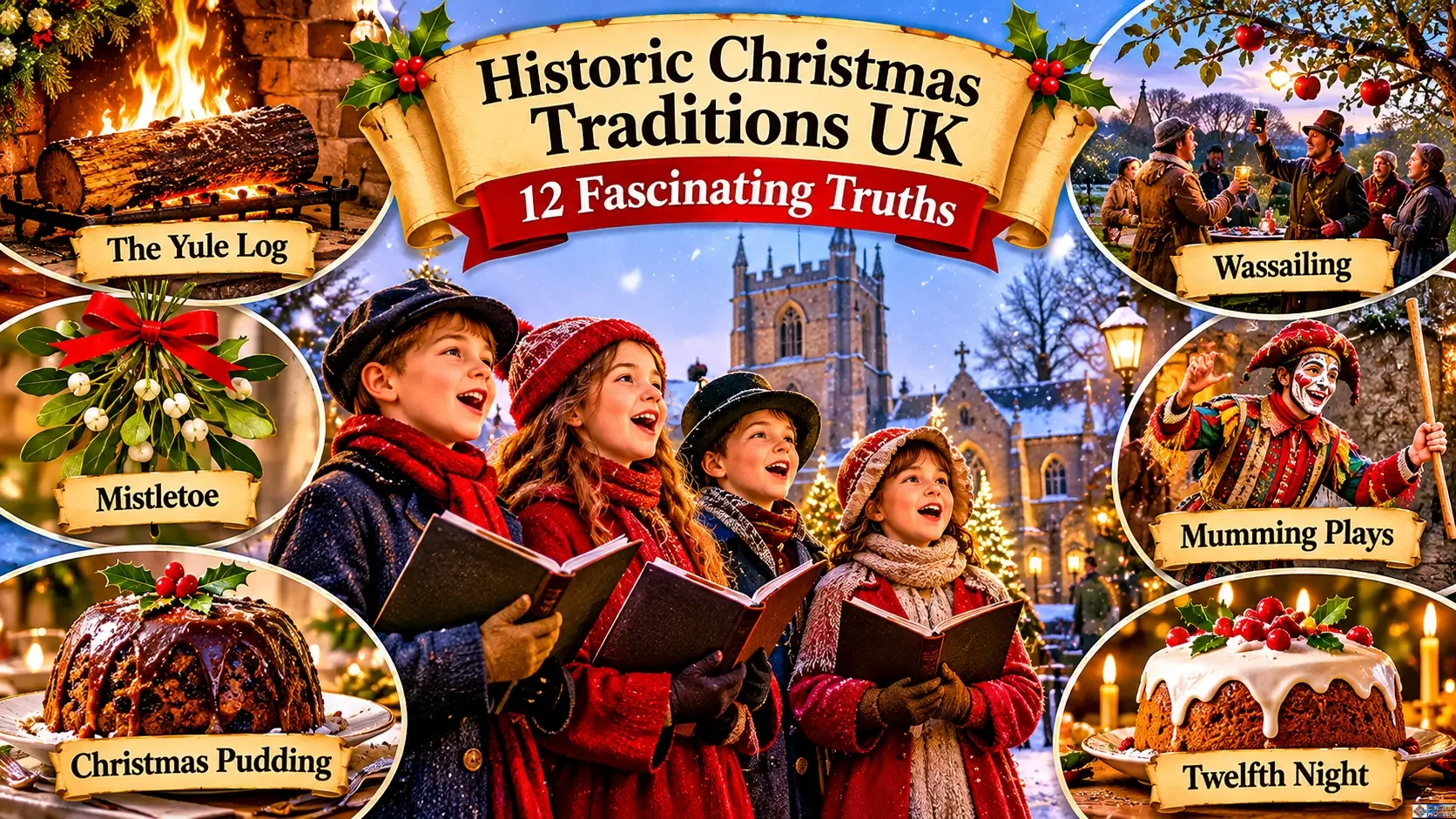
December disappears for most of us. Lists, deliveries, a playlist on a loop, and suddenly it’s the 27th and you can’t say what happened. I think that’s the real problem, more than any complaint about commercialism. We’ve kept the pace of the festival and lost the texture.
The past offers a fix, and it isn’t nostalgia for its own sake. Older Christmases were slow, loud, smoky and communal. They ran for twelve days, not one. If you want that depth back, exploring historic Christmas traditions UK-wide helps you understand what these seasonal customs were truly for on Culture mosaic. Here is the story, with the myths marked.
1. Before Christmas: Yule and the Midwinter Question
The Anglo-Saxon monk Bede, writing in the early 700s, names a month called Giuli (Yule) and says the English began their year on 25 December, with a night they called Modranect, “mothers’ night”. That is about all the hard evidence we have for ancient Yule traditions Britain can claim. The historian Ronald Hutton has argued for decades that detailed claims about pagan midwinter rituals, such as sacred logs and tree worship, rest on very little.
So where does that leave the idea of pagan historic Christmas traditions UK readers often hear about? Partly true, partly folklore. Midwinter mattered, obviously. Cold, dark, thin stores. Feasting at the turning of the year makes practical sense. But the church placed Christmas on 25 December by the fourth century, and the English folded their older habits around it. We don’t know what those habits were in any detail. I’d rather say so plainly than hand you a druid fantasy.
Traditional British winter solstice customs do survive as a mood, even if not as documented ritual. You can see it in the evergreens, the fires and the toasts that follow.
2. The Twelve Days: Christmas Was a Season, Not a Day
Medieval Christmas ran from 25 December to Epiphany on 6 January. Laws attributed to Alfred the Great gave working people those days off. William the Conqueror chose Christmas Day 1066 for his coronation at Westminster Abbey, and the court kept the season at full tilt for centuries afterwards.
Twelfth Night, the eve of Epiphany, was the peak: cake, a hidden bean or pea, a “king” for the night. Then came Plough Monday, the first Monday after, when the farm work started again and the party ended.
One fun correction: “The Twelve Days of Christmas” song first appears in print in 1780, in a children’s book called Mirth Without Mischief. It was probably a forfeits game, where you lost a sweet or a kiss for forgetting a line. It isn’t a coded Catholic catechism, whatever the email chains say.
3. The Yule Log, Holly and the Mistletoe Myth
Among the oldest historic Christmas traditions UK households observed, the Yule log was a huge block of wood dragged in on Christmas Eve and kept burning through the festival. Households saved a charred piece to light next year’s log, a small thread of luck passed between winters. The poet Robert Herrick described the custom in the 1640s, and it was well established in country houses and farmhouses by then.
Holly and ivy brought green into the house in the dead of the year. The Christmas carol “The Holly and the Ivy” captures the pairing.
Mistletoe needs a caution. Pliny describes Druids cutting it, which is where the pagan story comes from. But kissing under it looks like an 18th-century servants’ custom, and churches often kept it out. If someone tells you it’s 2,000 years of Christmas romance, they’ve skipped a few centuries.
4. Wassailing: Toasting the Orchards and Knocking on Doors
Wæs hæl, Old English for “be well”. Wassailing came in two forms. In cider country (Somerset, Herefordshire, Gloucestershire, Sussex), people processed through orchards in January, hung toast soaked in cider on the boughs for the robins, sang to the trees and made as much noise as possible to scare off bad luck. In towns and villages, the poor carried a decorated bowl door to door and sang for a drink or a coin.
That second form is where carolling partly comes from. “Here We Come A-Wassailing” is a begging song with a lovely tune. The social deal underneath was simple. The rich would feast, and the hungry had a recognised right to knock. It’s worth remembering when we describe Christmas as being about generosity. The old version enforced it a little.
5. Mumming Plays and the Lord of Misrule
Christmas in Tudor England was rowdy. Great households and the Inns of Court appointed a Lord of Misrule to run the revels: a temporary ruler who turned rank upside down for a few days. Henry VIII’s court kept one. The point, I think, was pressure release. You let the servants play king, then you got your order back.
Mummers’ plays are the folk-theatre cousin. A hero, usually St George, fights and is killed, a comic doctor revives him, and everyone collects money. Most surviving texts come from the 18th and 19th centuries, and claims of unbroken pagan origins are disputed. Still, the plays lasted because they were fun and hard to kill off.
The weirdest survivor is the Haxey Hood in Lincolnshire, played around 6 January, where villages shove a rolled leather “hood” toward their pub in a giant scrum. It’s one of the best weird UK Christmas traditions you can actually watch.
6. The Feast: Boar’s Head, Mince Pies, Pudding and Turkey
Medieval feasting was status on a plate. A boar’s head was carried in with a carol, a ceremony still staged at The Queen’s College, Oxford. For many in the same period, the Christmas table was less glamorous: bread, ale and whatever the winter allowed.
Some of the culinary details people search for when researching historic Christmas traditions UK:
- What’s hidden in a Christmas pudding? A silver coin, traditionally a sixpence, plus charms like a ring or a thimble in Victorian puddings. The finder gets luck for the year.
- Where did it come from? A spiced meat-and-fruit “plum pottage”. By the 18th century it had hardened into a pudding. George I was nicknamed “the pudding king” after serving one in 1714. Making it on “Stir-up Sunday” comes from the Book of Common Prayer’s collect for the Sunday before Advent, which opens with the words “Stir up”.
- When did people start eating turkey? Turkeys reached England in the early 1500s. Thomas Tusser lists turkey among Christmas fare in 1573. But goose and beef remained the usual choices for most families until the 19th century. Railways carried Norfolk birds to London, prices fell, and by the late Victorian period turkey had won.
- Mince pies were once filled with meat as well as fruit and spice. The sugar-heavy version came later.
For modern recipes with a historical backbone, see our guides to Christmas Celebration Foods and the Christmas Cooking List. If you’re curious how the Americans do it, Top US Christmas Foods makes a revealing contrast, as does our explore on Best Christmas Celebrations in US and the Newport Beach Christmas Boat Parade.
7. Why Did Oliver Cromwell Ban Christmas?
Short answer: Cromwell didn’t personally start it, though his name stuck. The ban came from Puritan-dominated Parliament. In 1644 it ordered a monthly fast that landed on 25 December. In 1647 an ordinance abolished Christmas, Easter and Whitsun as holy days. Shops were meant to stay open. Soldiers took down greenery. People rioted, notably in Canterbury, and the tension rumbled on through the Commonwealth and Cromwell’s Protectorate. The Restoration of Charles II in 1660 brought the festival back.
The Puritan argument was religious: no scriptural basis for Christmas, and the drinking, gaming and misrule looked like the opposite of piety. I find it a more serious argument than the cartoon version suggests. I also think it failed because the festival had too many people attached to it.
Was Christmas banned in Scotland longer than in England?
Effectively, yes. When comparing historic Christmas traditions UK timeline differences across nations, here is how England and Scotland compare:
| Stage | England | Scotland |
|---|---|---|
| Opposition begins | 1640s Puritan Parliament | 1560 Reformed Kirk rejects feast days |
| Formal ban | 1647 ordinance | Act of 5 June 1640 (partly repealed 1686, re-imposed 1690) |
| Ban ends | Restoration, 1660 | Repealed 1712; Kirk disapproval lingers |
| Bank holiday | Christmas Day, 1871 | Christmas Day, 1871 |
| Public holiday | Long established | Christmas Day 1958; Boxing Day 1974 |
The 1958 date was a change in working practice, adopted council by council, not a single national law. Scotland put its energy into Hogmanay and first-footing instead. Learn more about broader timeline details in our Christmas Festival History piece.
8. Why Is Boxing Day Called Boxing Day?
Boxing Day falls on 26 December, St Stephen’s Day. The best-supported explanation is the “Christmas box”: a gift of money given to servants, tradesmen and the poor the day after Christmas, when the household had been fed and waited upon. Church alms boxes opened on St Stephen’s Day add to the story. The Bank Holidays Act 1871 made the day an official holiday in England and Wales.
The carol “Good King Wenceslas”, published in 1853, hangs the same idea on a story of winter generosity. I like that. The day was always about those who worked while others feasted.
9. The Victorians Reinvented Christmas (Yes, Really)
I’d argue the Victorians did more to define popular historic Christmas traditions UK families practice today than any earlier age. They didn’t invent it. They repackaged it for the home, at the moment industrial Britain was working people harder than ever.
- Dickens: A Christmas Carol appeared in December 1843. It pushed charity, family and a warm table into the centre of the season, and it’s still the most quoted Christmas book in English.
- The card: Henry Cole commissioned the first commercial Christmas card in 1843, illustrated by John Callcott Horsley. The Penny Post made cards cheap to send within a few decades.
- The tree: Queen Charlotte had a tree at Windsor in 1800, but the real breakthrough was the Illustrated London News engraving of Victoria, Albert and their children around a tree in 1848. The middle classes copied it within a season.
- The cracker: Tom Smith, a London confectioner, created the cracker in the 1840s after seeing French sweets wrapped in twisted paper.
- Carols: William Sandys published Christmas Carols Ancient and Modern in 1833, rescuing many from oblivion.
And one early-20th-century addition belongs here. In 1918, King’s College, Cambridge, held its first Nine Lessons and Carols service. George V’s first Christmas radio broadcast followed in 1932.
For the art side of this story, see Famous Christmas Artwork, and for the spiritual roots, our piece on Christmas Religious Stories.
10. How Christmas Varied by Region and Class
| Custom | Where / who | What it shows |
|---|---|---|
| Mumping or “goodying” | Staffordshire and Cheshire, 21 December | The poor, widows especially, went door to door for food or money on St Thomas’s Day |
| Tom Bawcock’s Eve | Mousehole, Cornwall, 23 December | A fishing village’s winter-survival story, now marked with stargazy pie |
| Plygain | Wales | Dawn carol singing, often unaccompanied, by family groups |
| Mari Lwyd | Wales | A horse skull on a pole, with rhyming duels at the door |
| Great-house feasting | Gentry and aristocracy | Status displayed through food, music and hospitality |
| Hogmanay | Scotland | The bigger festival when Christmas was suppressed |
Class mattered at every turn. The gentry had Lords of Misrule and great hall banquets. Labouring families had doles, borrowed food and carol-singing for a coin. The one thing they had in common was the idea that Christmas obliged people to look after each other. Explore more about regional variance in our guide on Christmas Culture Traditions.
11. Where to Feel It: Historic Towns and a Dickensian Christmas Market UK
If you want to experience authentic historic Christmas traditions UK destinations have to offer, the cathedral cities are the strongest bet:
- Winchester. The Cathedral Christmas Market runs 20 November to 22 December 2026, with timber chalets in the Close and free entry.
- York. St Nicholas Fair runs 12 November to 21 December 2026 around Parliament Street. The medieval lanes are the draw, and I’d go on a weekday morning.
- Bath. The market runs 26 November to 13 December 2026. That’s a short window, so book early.
- Lincoln. The big street market has gone. The cathedral now runs a smaller ticketed Christmas market on 3–5 December 2026, inside a building begun in 1072. It’s worth seeing, but it is a different experience.
- Rochester, Kent. The Dickensian Christmas Festival falls on 5–6 December 2026, with the Rochester Christmas Market running across several weekends from 27 November.
These are the announced 2026 dates, but check each organiser’s site before you travel. Our guide to Classic Christmas Themed Events is a good place to start planning. Closer to home, Glad Voices of Christmas covers carol culture, and the Art of Christmas Gala covers its more formal side. If you want to see what’s open on the day itself, our What’s Open on Christmas Day 2025 guide shows what to expect.
The English Heritage page on historic Christmas traditions UK also lists seasonal events at its sites.
12. How to Celebrate an Old-Fashioned Christmas in the UK
You don’t need a manor house. Pick what suits you.
Stir the pudding on Stir-up Sunday. Hang greenery rather than plastic—a few sprigs of holly and ivy is enough. Light a candle on the table for the twelve days instead of just Christmas Day. Sing something, even badly. Hold a small Twelfth Night supper on 5 January with a hidden bean in a cake, and let whoever finds it be king for the evening. Leave the decorations up until then.
Teachers and parents will find a natural link to Key Stage 2 history here: the Victorians, Dickens, the first Christmas card and the postal system all fit neatly into a primary classroom. For the religious side of the festival and how it compares worldwide, see Religious Festivals in the World, and for the visual mood, Christmas Background offers design ideas.
And the wildcard, the one I’d actually try: borrow a Welsh idea and hold a plygain. Gather family, pick a carol, and sing it unaccompanied by candlelight, one family group at a time. It’s odd. It’s also oddly moving.
Christmas was never one perfect day. It was a stretch of dark weeks that people made bearable by doing things together, and that part hasn’t aged at all.
Frequently Asked Questions
The Twelve Days, from Christmas to Epiphany, is among the oldest, with early medieval roots and laws attributed to Alfred the Great giving holiday time. Feasting, evergreen decoration and the Yule log are also long-standing, though the surviving documentation for the log is mostly 17th-century. Claims about pagan origins are popular but much less certain than they sound.
Puritan reformers in Parliament saw Christmas as unscriptural and tied to drunkenness and misrule. Parliament abolished it as a holy day in 1647, before Cromwell ruled as Lord Protector. The Restoration in 1660 ended the ban, and the festival returned.
The most likely explanation is the tradition of giving “Christmas boxes” of money or gifts to servants and tradespeople on 26 December, along with church alms boxes opened on St Stephen’s Day. It became an official bank holiday in England and Wales in 1871.
A silver coin, traditionally a sixpence, hidden in the mixture. Victorian puddings could also hide charms such as a ring or a thimble. Whoever finds the coin is said to have good luck in the coming year.
Turkeys arrived in England in the early 16th century, and Thomas Tusser listed one among Christmas dishes in 1573. For most households, though, goose and beef stayed more common until the 19th century. Cheaper transport and Victorian tastes made turkey the usual centrepiece.
So here’s my question for you. Which old-world tradition are you bringing into your home this December: a Twelfth Night supper, a candlelit plygain, a pudding stirred on Stir-up Sunday? Or is there a local custom I’ve missed that your family has kept alive? Tell us in the comments below. I read them all, and I’d like to hear which ones are still going.
Sources
- Hutton, Ronald. The Stations of the Sun: A History of the Ritual Year in Britain. Oxford University Press, 1996.
- Hutton, Ronald. The Rise and Fall of Merry England: The Ritual Year 1400–1700. Oxford University Press, 1994.
- Flanders, Judith. Christmas: A Biography. Picador, 2017.
- Bede. De Temporum Ratione (The Reckoning of Time), ch. 15 (on the English months).
- Records of the Parliaments of Scotland, Act of 5 June 1640 (abolition of Yule vacance).
- Firth, C. H. and Rait, R. S. (eds). Acts and Ordinances of the Interregnum, 1642–1660. HMSO, 1911 (Ordinance of 8 June 1647).
- Herrick, Robert. Hesperides, 1648.
- Tusser, Thomas. Five Hundred Points of Good Husbandry, 1573.
- Dickens, Charles. A Christmas Carol. Chapman & Hall, 1843.
- Illustrated London News, 23 December 1848 (Royal family Christmas tree engraving).
- Victoria and Albert Museum, collection record for the 1843 Cole/Horsley Christmas card.
- Royal Collection Trust, material on Queen Charlotte’s Christmas tree, 1800.
- Bank Holidays Act 1871 (UK legislation).
- English Heritage, Christmas traditions.