The Living Canvas: A Definitive Guide to Leonardo da Vinci’s Paintings

Beyond the pigment, Leonardo’s work represents the first “Ritual Economy” of the Renaissance — where art, science, and human soul synchronised.

About the Author View Author Profile

Dr. Elena Caruso is a Renaissance art historian and independent scholar with over fifteen years of fieldwork across Italian museums, private collections, and academic archives. Her research centres on the interplay between Leonardo da Vinci’s scientific notebooks and his painted works. She writes regularly for Culture Mosaic, exploring how the Renaissance continues to shape contemporary culture.

Why Leonardo da Vinci Paintings Images Still Stop Us Cold

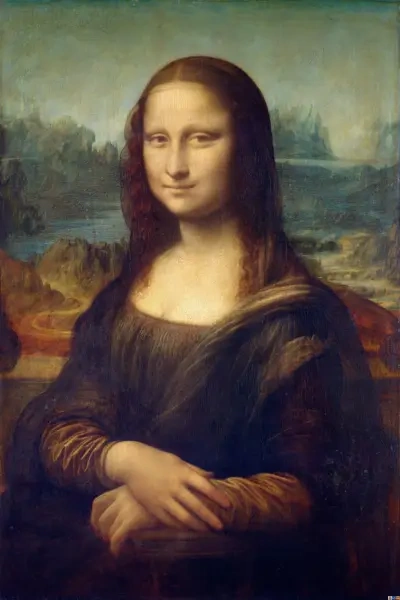
I’ve stood in front of the Mona Lisa more times than I can count. And every time, it’s the same jolt. Not awe, exactly. Something quieter. It is like the painting is looking. That isn’t an accident. When you study Leonardo da Vinci paintings images with any seriousness, you realise the man wasn’t simply painting what he saw. He was engineering perception itself.

This guide is for anyone who wants to move past the postcard version of Leonardo and actually understand what makes his surviving paintings so unusual. Technique, context, chronology, and the digital tools now revealing things his contemporaries never even saw.

The Sfumato Secret: Why His Images Breathe

What Sfumato Actually Is

Sfumato comes from the Italian fumo — smoke. Leonardo described it as painting without lines or borders, in the manner of smoke. In practice, he built up dozens of ultra-thin glazes of oil paint, each one barely more than a tint, until forms emerged from shadow the way objects emerge from fog at dawn.

The result is that there are no hard edges anywhere in his major works. Look at the Mona Lisa’s jawline. It doesn’t end — it dissolves. That continuous, unmarked transition from light to dark is what gives Leonardo da Vinci paintings images their peculiar sense of warmth and motion. His contemporaries used firm outlines. He used air.

A high-resolution visual comparison of Renaissance portraiture, demonstrating how Leonardo da Vinci's paintings images used sfumato to eliminate the 'hard lines' of earlier masters like Ghirlandaio.
Hard Lines vs. Sfumato: Notice how Leonardo eliminates the border between the subject and the atmosphere. [For CMS: replace this panel with an interactive slider widget using the high-resolution Mona Lisa jawline crop].

Why Other Renaissance Painters Didn’t Follow Suit

Because it was almost impossibly slow. Leonardo sometimes applied as many as thirty-five glazes to a single section of a painting. That kind of patience didn’t match the commission economy of fifteenth-century Florence, where painters were paid to finish, not to linger. It’s one reason his catalogue is so small.

A Chronology of Genius: The Key Paintings in Order

The Annunciation (c. 1472): Youthful Precision

The Annunciation (c. 1472): Youthful Precision

Leonardo was barely twenty when he painted The Annunciation, and it shows — in the best possible way. The botanical detail in the meadow is almost obsessive. He’d already started studying plants as a scientist, not just as a decorator. The angel’s wing, critics later noted, is anatomically correct for a bird. Not a symbol. An actual bird’s wing, scaled up.

Ginevra de’ Benci (c. 1474): The Psychological Breakthrough

Ginevra de' Benci (c. 1474): The Psychological Breakthrough
Ginevra de’ Benci (c. 1474): The Psychological Breakthrough

This one doesn’t get the attention it deserves. Ginevra de’ Benci, now held at the National Gallery of Art in Washington, is arguably the first true psychological portrait in Western painting. The subject isn’t performing for the viewer. She’s thinking something we’re not privy to. That interiority — that sense of a mind behind the eyes — is entirely new in 1474.

The Last Supper (1495–1498): Civic Scale

The Last Supper (1495–1498): Civic Scale

The Top 10 Best Painters Artists lists invariably feature Leonardo, and The Last Supper is the reason why. It was painted on the refectory wall of Santa Maria delle Grazie in Milan. Leonardo used linear perspective so precisely that the painted room appears to be a physical extension of the actual room.

Mona Lisa (c. 1503–1506): The Considered Gaze

Mona Lisa (c. 1503–1506): The Considered Gaze

Every year, people ask How Much Is the Mona Lisa Worth. The honest answer is that it’s insured at a figure, but its cultural value is simply incalculable. The sfumato in the background blurs the horizon line so thoroughly that you genuinely cannot tell whether it is day or twilight.

“The Virgin and Child with Saint Anne” (circa 1503): Family as Geometry

The Virgin and Child with Saint Anne (c. 1503): Family as Geometry
“The Virgin and Child with Saint Anne” (circa 1503): Family as Geometry

Three figures arranged in a pyramidal composition, each one emerging from the next. The geometry is deliberate — a family unit compressed into a single triangular form, stable and timeless. It’s structural thinking applied to devotional painting.

The Civic Scale: The Last Supper as Social Technology

I keep coming back to The Last Supper because it illustrates something critical about how Leonardo thought. He wasn’t making an image for the room — he was making the image part of the room. The painted ceiling continues the actual ceiling. The tapestries on the painted walls echo the real ones. The vanishing point sits directly behind Christ’s head, so the eye is always drawn back to him regardless of where you stand in the hall.

Architectural Deep Dive: The Last Supper as Civic Infrastructure

All perspective lines in The Last Supper converge on a single vanishing point positioned directly behind Christ’s head. Leonardo calibrated this geometry precisely to the actual refectory in Milan: a diner seated at the monks’ tables would have experienced the painted room as a seamless extension of the physical room.

Zone A — The Physical Refectory

Actual stone floor, actual ceiling beams, and actual light falling from the left-side windows.

Zone B — The Threshold

Where Leonardo’s painted wall begins, continuing the architectural rhythm without a visible seam.

Zone C — The Painted Room

Tapestries, ceiling coffers, and three rear windows flooding the scene with the same directional light as Zone A.

That kind of spatial thinking is closer to architecture than painting. It’s why The Last Supper is sometimes called the first truly civic-scale work of the Renaissance: not a picture hung on a wall, but a picture that expanded the room itself. A social technology.

The 80/20 Rule of Da Vinci’s Catalogue

Of the fewer-than-twenty paintings universally attributed to Leonardo, a handful carry the full weight of his reputation. The 20% of works that account for 80% of everything scholars write about him:

Painting Why It Matters
Mona Lisa A study in human optics, light refraction, and psychological portraiture.
The Last Supper An exploration of emotion, civic space, and the limits of narrative painting.
Lady with an Ermine A revolution in the three-quarter portrait pose — the template all later portraiture borrowed.
Vitruvian Man The bridge between mathematical precision and anatomical observation. Technically a drawing, but foundational to the painted works.
The Virgin of the Rocks Two versions: Paris and London. The differences between them are a masterclass in how Leonardo revised his own thinking.

Lady with an Ermine: The Portrait That Changed Pose

Lady with an Ermine: The Portrait That Changed Pose

Cecilia Gallerani is shown at a three-quarter angle with her body turned slightly toward the viewer. Before Leonardo, formal portraits were almost exclusively in profile — flat, heraldic, like a coin. He introduced the idea that a sitter could exist in space, could be turning. That shift alone changed portraiture for five centuries. Compare it with The Kiss Gustav Klimt — another work where pose carries the entire emotional weight — and you start to see how body language became the real language of Western figurative art.

Anatomical Knowledge and Why It Changed Everything

Leonardo dissected over thirty human corpses. The knowledge went directly into his paintings. Look at the hands in The Last Supper: each one is anatomically specific, each one expressing a different emotional state through its own distinct gesture. That isn’t artistic convention. That’s a man who knows how tendons attach to knuckles.

His notebooks — scattered across institutions from Windsor Castle to the Biblioteca Nacional de España — contain thousands of drawings that informed every painting. When you look at Leonardo da Vinci paintings images, you’re seeing the visible tip of an iceberg of private research.

Atmospheric Perspective: The Science Behind the Softness

Atmospheric perspective is the observation that distant objects appear bluer, lighter, and less distinct because of the particles in the air between them. Leonardo systematised this and applied it rigorously to his backgrounds. The mountains behind the Mona Lisa are almost blue-grey, with softened outlines, implying vast distance without a single size cue. This is what gives Leonardo da Vinci paintings images that sense of real, breathable space.

Dove Picasso and the Long Shadow of Leonardo

The psychological interiority Leonardo pioneered ran through Dutch Golden Age portraiture, through Romanticism, and eventually into the radical reconfigurations of the early twentieth century. Dove Picasso and his Cubist contemporaries were in direct dialogue with the Renaissance — rejecting its conventions, yes, but knowing them precisely enough to reject them purposefully. You cannot understand what Picasso broke without first understanding what Leonardo built.

2026 and the Digital Restoration Trend

How Multi-Spectral Imaging Is Rewriting the Record

Multi-spectral imaging — scanning paintings with infrared and ultraviolet light — is revealing the underdrawings beneath Leonardo’s painted surfaces. Researchers examining the Mona Lisa found a preparatory sketch beneath the paint layer showing a completely different position for Lisa’s left hand. The final painting was a revision of the revision.

For 2026, several major institutions are preparing new digital releases of high-resolution Leonardo da Vinci paintings images derived from these scans. When you find them, look for versions with enhanced contrast — they’ll show the grain of the poplar panels he preferred, the actual texture of the paint surface, and in some cases the ghost outlines of earlier compositions underneath.

What to Look for When Viewing Leonardo Online

Not all digital reproductions are equal. Here’s what I look for:

  • Poplar grain visible through thin paint layers — a sign of high-resolution capture
  • Craquelure (the network of fine cracks) rendered clearly, not smoothed for aesthetics
  • Colour calibrated to match the original panel, not brightened for marketing appeal
  • Metadata from the museum’s conservation team, citing the scanning equipment used

The Notebooks: Where the Real Images Live

The majority of Leonardo’s visual legacy isn’t on walls or panels — it’s in his notebooks. The Codex Atlanticus, the Windsor Folios, the Codex Leicester: together, something close to thirteen thousand pages of drawings, diagrams, and notes in his famous mirror script.

His study of the human heart, completed around 1513, was so accurate that cardiologists reviewing it in the twentieth century found observations not formally documented in medical literature until centuries later. These aren’t just art-historical curiosities. They’re scientific documents that happen to be drawn by someone who was also the greatest painter of his age.

The Unfinished Masterpieces: What Leonardo Left Behind

The Adoration of the Magi sits in the Uffizi, technically unfinished. Leonardo abandoned it when he left for Milan. What remains is a detailed underdrawing in earth tones — a complete compositional sketch never painted over. Scholars treat it as one of his most important works precisely because you can see his process, unobscured by the final painted surface.

How to Find the Best Leonardo da Vinci Paintings Images Online

If you’re doing serious research — or just want something worth looking at:

  • Google Arts & Culture: The Louvre and Uffizi both have high-resolution uploads with zoom capability
  • Web Gallery of Art (wga.hu): Old interface, exceptional image quality and scholarly annotations
  • Royal Collection Trust (rct.uk): Best source for the Windsor Folios and notebook drawings
  • Museo Nacional del Prado (museodelprado.es): Holds a workshop copy of the Mona Lisa — invaluable for comparison
📌

CMS Note — Archival Gold Hover Style

Apply the ‘Archival Gold’ hover effect (#B8860B underline transition) to the following internal links to maintain brand consistency:

Frequently Asked Questions

What is the most famous Leonardo da Vinci painting image?

The Mona Lisa, housed in the Louvre, is the most recognised painting in the world — celebrated for its pioneering sfumato and the subject’s haunting, ambiguous expression.

How many Leonardo da Vinci paintings survive?

Fewer than 20 paintings are universally attributed to him. Many of his other images exist in his notebooks as drawings and anatomical studies rather than finished painted works.

What makes his paintings different from other Renaissance artists?

His use of atmospheric perspective combined with anatomical precision made his paintings appear more lifelike than those of his peers. Sfumato, his layered glazing technique, was genuinely without precedent.

Where can I view high-resolution Leonardo da Vinci paintings images?

The Louvre’s digital collection, Google Arts and Culture, and the Web Gallery of Art all offer high-resolution images suitable for scholarly or educational research.

What is sfumato and why does it matter?

Sfumato is Leonardo’s technique of blending tones so gradually that edges dissolve like smoke. It creates a soft, three-dimensional quality that makes Leonardo da Vinci paintings images feel alive and perpetually in motion.

Your Cultural Story

In an age of instant digital filters and algorithmic feeds, which Leonardo masterpiece carries the most meaning for you? Is it the precision of his anatomical sketches, the soft mystery of his oils, or the sheer civic ambition of The Last Supper? I think the answer says something real about how you see the world.

Share your voice below — and if you want to keep exploring the art that shaped Western culture, Culture Mosaic is where the conversation continues.

Leave a Reply

Your email address will not be published. Required fields are marked *