
 By Marcus J. Holloway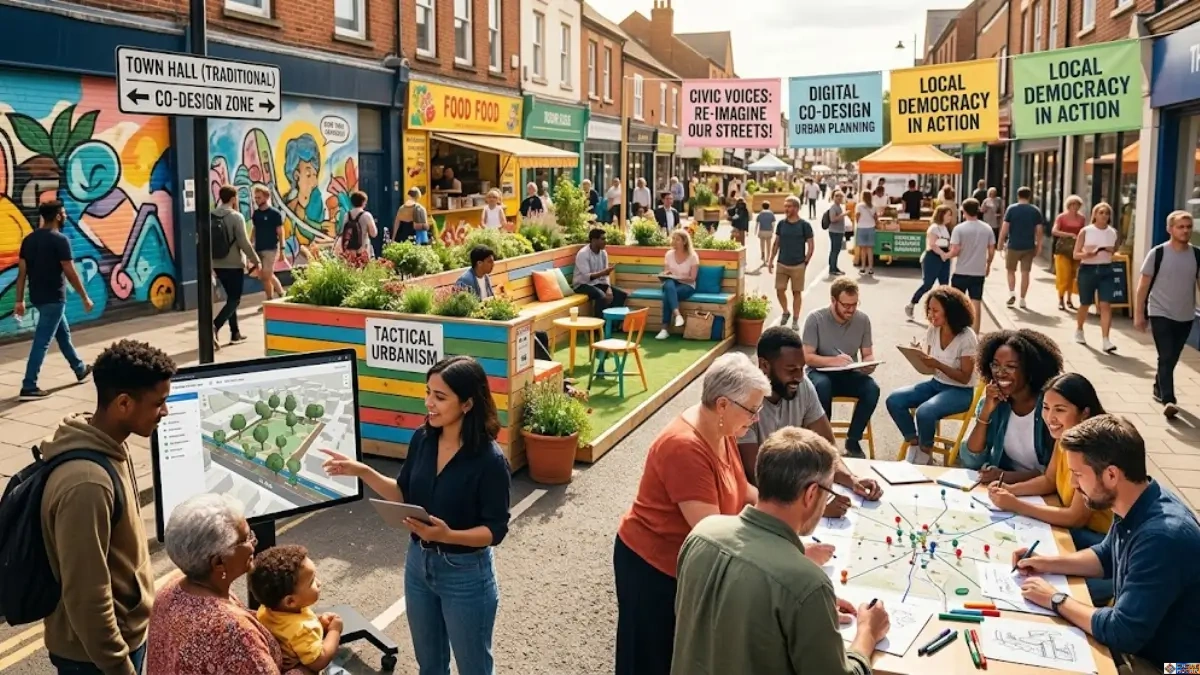
- ● Digital civic engagement urban planning blends online consultation platforms, participatory budgeting apps, and tactical urbanism so residents can shape their streets without waiting for one annual meeting.
- ● Traditional town halls typically reach a narrow, older, already-engaged slice of a community; well-designed digital and tactical tools widen that pool considerably, particularly among under-35s, shift workers, and carers.
- ● The councils getting this right in the UK — East Riding, Walsall, Cambridge — aren’t choosing digital over physical. They’re pairing a consultation hub with pop-up events, parklets, and street-level trials.
- ● The real risks aren’t the technology. They’re “engagement theatre” (gathering opinions nobody acts on), the digital divide, and mistaking a busy dashboard for genuine influence over the plan.
The Meeting Room Is Half-Empty, and Everyone Knows It
I’ve sat through enough local plan consultations to know the pattern before the chair even opens the floor. Rows of folding chairs. A handful of retirees who’ve been coming for a decade. A council officer standing at a projector, working through forty slides of technical drawings while people check their phones. Nobody under forty in the room. Nobody who works nights.
That’s the traditional town hall, and it isn’t malicious — it’s just built for a version of civic life that doesn’t match how most people actually live now. A single 90-minute slot on a Tuesday evening filters out anyone with childcare, a second job, a disability that makes a draughty hall hard going, or simply no car to get there. What gets recorded as “public opinion” ends up being the opinion of whoever had the free evening and the confidence to speak into a microphone.
This matters because civic engagement isn’t a box-ticking add-on to planning — it’s the mechanism through which a plan gets its legitimacy. When that mechanism only hears from a sliver of the population, the resulting decisions carry a democratic deficit that shows up later as appeals, judicial reviews, and residents who feel a scheme was “done to them.” Real civic literacy starts with knowing that consultation isn’t the same thing as consent, and most people never get taught the difference.
Who Actually Gets Shut Out
Here’s the part that stings. It’s rarely the loudest objectors who disappear from the room — they show up regardless. It’s the quieter, harder-to-reach residents: young renters who assume planning “isn’t for them,” parents juggling bedtime, night-shift NHS and transport workers, people who don’t speak English as a first language and find a dense planning document genuinely impenetrable, and disabled residents for whom the venue itself is the barrier.
I don’t think most planning officers want this outcome. Most of the ones I’ve read about are stretched thin, running statutory consultations on tight budgets with legacy processes inherited from a pre-internet era. The problem isn’t bad faith. It’s that the format hasn’t caught up with the people it’s meant to serve. Understanding that gap is really a question of understanding civic duty on both sides — the resident’s and the institution’s.
The Fix: Nine Ways Digital Tools and Tactical Urbanism Are Rewriting the Rules
None of what follows replaces judgment, and none of it is a silver bullet on its own. But stacked together, these approaches are what a serious digital civic engagement urban planning strategy actually looks like in practice, and they’re measurably widening who gets heard in UK planning decisions.
1. Trade the One Annual Meeting for an Always-On Digital Hub
Instead of a single evening, councils are standing up map-based consultation hubs that stay open for weeks. Commonplace — the platform behind well over a thousand UK planning consultations, recently acquired by the govtech firm Zencity — lets residents drop a pin on a specific street corner and leave a comment at 11pm on a Sunday, from a phone, in the time it takes to wait for a kettle. East Riding of Yorkshire Council procured a corporate Commonplace licence specifically to “diversify communication with residents of all ages using technology” and to strengthen evidence for funding bids under the UK Shared Prosperity Fund. That’s not a gimmick — it’s a documented procurement objective.
These platforms sit inside a broader shift toward digital civic participation platforms that treat consultation as an ongoing relationship rather than a single event. Building a working relationship with residents rather than a one-off ambush is one of the local civic engagement strategies I’d put at the top of any council’s list.
2. Let Residents Co-Design, Not Just Comment
There’s a meaningful difference between asking “what do you think of our plan?” and asking “what should the plan be?” The first is consultation. The second is co-design, and it’s a much bigger ask of an institution, because it means sharing genuine authorship.
Digital co-design urban planning tools — shared mapping layers, sketch-and-annotate tools, live polling during a workshop — let residents propose alternatives rather than just react to a finished drawing. It’s slower and messier than a straightforward consultation, and it produces plans that people actually recognise as theirs. I’ve covered the mechanics of this shift in more depth in Co-Design in Urban Planning and Civic Engagement, including how co-design methodologies municipal planning teams are experimenting with tend to succeed or stall based on how much real decision-making power gets handed over, not just how nice the software looks.
3. Put a Price Tag in Residents’ Hands
Participatory budgeting apps take this a step further by attaching an actual sum of money to resident decisions — not “tell us what you’d like,” but “here is £150,000, and you decide how it’s spent on your street.” It’s one of the clearest ways I know to convert vague goodwill into engaged, informed participation, because people who are handling real trade-offs (a new play area versus better lighting versus tree planting) engage with far more seriousness than people leaving a comment into the void.
I’d point anyone curious about where this sits within the wider toolkit toward civic participation tools, which surveys the free and low-cost platforms UK groups are actually using rather than the vendor demos.
4. Test Ideas on the Street Before You Build Them
This is where tactical urbanism earns its keep. The term was popularised by Mike Lydon and Anthony Garcia in their 2011 book on short-term, low-cost interventions that catalyse long-term change, though the underlying instinct goes back further — Rebar’s 2005 conversion of a single San Francisco parking space into a tiny park kicked off what’s now the global PARK(ing) Day movement. A parklet, a weekend pedestrian trial, a chalk-and-cone mock-up of a new junction — these let residents experience a proposed change physically, for a few days, before a council commits to pouring concrete.
Tactical urbanism examples like these matter because they turn an abstract planning drawing into something you can walk through, argue about on the spot, and photograph on your phone to share with a neighbour who couldn’t make it down. That’s a genuinely different register of feedback than a written consultation response, and it’s worth reading more on how tactical urbanism in community civic engagement actually plays out on the ground, alongside the practicalities covered in DIY placemaking community engagement.
5. Blend the Pavement and the Pixel
The councils I rate most highly don’t treat “digital” and “in-person” as competing budgets. They run a physical pop-up on a Saturday morning — a gazebo, a map on a trestle table, biscuits — and use it to drive people to the same digital hub that’s collecting responses online. Bridging physical and digital civic engagement this way means the digital tool isn’t a replacement for the street conversation; it’s the thing that keeps that conversation running after the gazebo comes down.
Community-led culture does a lot of this bridging work quietly and well. A neighbourhood mural project, the kind covered in Community Street Murals UK and Grassroots Murals UK Civic Engagement, often starts as a planning-adjacent placemaking exercise and ends up drawing in residents who’d never open a council consultation portal. The same is true of civic-minded cultural groups — I’ve seen it in how UK community choirs end up as informal sounding boards for local change long before any formal consultation opens. None of it looks like “planning” on the surface. All of it feeds back into the process.
6. Build a Digital Twin People Can Actually Argue With
A digital twin is a live, data-fed virtual model of a real place — Cambridge built one with the University of Cambridge and Cambridgeshire County Council specifically to test how housing developments, road schemes, and remote-working patterns would change commuting across the city, layering demographic and employment data over existing traffic data so residents and officers could see effects before anything got built. Researchers at the University of Cambridge’s Centre for Smart Infrastructure and Construction have been explicit that a city-scale digital twin only earns its keep if it engages honestly with the social and political processes it’s meant to serve, not just the engineering.
Used well, digital twin public deliberation turns “trust us, the model says it’ll work” into “come and see the model, and tell us where it’s wrong.” That distinction is everything. I’ve written more on the practicalities of this kind of structured online debate in Hyperlocal Digital Deliberation, and on the institutional side of it in Vernacular Governance Structures.
7. Meet Young People Where They Already Are
Under-25s are consistently the group most absent from town hall attendance figures and most present on the platforms councils are reluctant to use for consultation. That’s a mismatch worth fixing directly rather than lamenting. A youth engagement strategy built around short, mobile-first surveys, school and college partnerships, and social content that explains a planning decision in ninety seconds rather than a ninety-page document tends to outperform any amount of poster campaigns in a library window.
Walsall’s council ran a Commonplace-based engagement drive explicitly aimed at “younger and diverse voices” as part of its wider Borough Plan consultation, precisely because it recognised its standard channels weren’t reaching them. If you’re wondering where to start locally, how to get involved in local civic issues online is a reasonable first stop, whatever your age.
8. Replace the Public Hearing, Don’t Just Duplicate It
The most common mistake I see is councils bolting a digital form onto an unchanged process — same jargon, same timeline, same one-way flow of information — and calling it innovation. Genuine alternatives to traditional public hearings rethink the sequence: short explainer video first, an open comment period with real-time visible responses second, a structured deliberation session (in person or online) third, and only then a formal decision report that shows residents exactly which of their points changed the outcome and which didn’t.
That last step is the one almost everyone skips, and it’s the one that builds trust. How Public Feedback Shapes Local Policy and Why Public Consultation Is Important both dig into why closing that loop matters more than the platform you use to open it. And if you’re unclear on where the line sits between a resident’s comment and something with legal weight, What Is Public Commentary? is worth a read before you submit anything formal — the same way understanding why voting is important in local elections or knowing how to register to vote in the UK sits alongside, rather than instead of, engaging with a specific planning application.
9. Know the Limits Before You Trust the Data
I want to be straight about the risks, because a lot of coverage of civic tech skips this part.
- The digital divide is real and undersold. Not everyone has reliable broadband, a smartphone, or the confidence to use either for something as formal-sounding as a planning consultation. A digital-only strategy simply re-excludes a different, overlapping group of residents rather than solving exclusion.
- “Engagement theatre” is a genuine risk, not a cynical exaggeration. Sherry Arnstein named this back in 1969 in her landmark “Ladder of Citizen Participation,” distinguishing genuine partnership and delegated power from what she called tokenism — consultation designed to look participatory while power-holders retain every real decision. A slick dashboard full of pins and comments can be just as tokenistic as a town hall nobody attends if none of it changes the plan.
- Data isn’t neutral. A platform that only reaches people already online will produce a skewed picture that looks scientific because it comes with a heatmap. Treating ethical grassroots advocacy as a discipline — being honest about who’s missing from your sample, not just who’s in it — is what separates a genuinely representative process from a well-designed illusion of one. The real-world problems this can cause down the line, from stalled schemes to community distrust, are entirely avoidable if that honesty is built in from day one.
The comparison below is the clearest way I know to see the trade-offs, and it’s the one table I’d want in front of any council weighing up its digital civic engagement urban planning options for the year ahead.
Traditional Town Hall vs Tactical & Digital Co-Design
The honest answer, based on the case studies above, is yes — but not automatically, and not by magic. Swapping a paper form for a web form on its own barely moves the needle. What shifts the demographics is redesigning the process around when and how people already spend their time: mobile-first surveys, evening push notifications instead of a fixed meeting slot, comment periods measured in weeks rather than one evening, and content pitched at plain English rather than planning jargon.
Walsall’s experience is instructive here precisely because it was measured, not assumed: the council explicitly tracked engagement with minority ethnic and younger residents as a named objective of its digital rollout, rather than hoping a new platform would fix representation on its own.
Does Digital Civic Engagement Replace Face-to-Face Planning?
No, and I’d be suspicious of anyone selling it that way. Every credible case study I’ve come across pairs the two rather than substituting one for the other. The digital hub extends the reach and the hours; the physical pop-up, workshop, or tactical trial supplies the depth, the body language, and the trust-building that a comment box can’t replicate. Social change in modern society rarely happens through a single channel, and civic planning is no exception. The goal isn’t choosing a winner between pavement and pixel — it’s making sure neither one is quietly excluding the other’s audience.
What Are the Main Risks or Limitations?
Beyond the digital divide and engagement theatre already covered above, the practical risks worth watching are: consultation fatigue from too many overlapping platforms per resident, data privacy concerns when councils hold detailed geolocated opinion data, and the temptation to treat participation numbers as a success metric in themselves rather than checking whether the resulting plan actually improved. None of these are reasons to avoid digital tools. They’re reasons to run them with the same scrutiny you’d apply to any other public decision-making process.
Anyone weighing up digital civic engagement urban planning tools for their own street or ward should read this section before the last one.
A Simple Framework for Getting Started
If you’re a resident rather than a council officer, the practical starting point is smaller than it sounds:
- Find out what your council’s current live consultations are — most now list them on a dedicated engagement hub rather than burying them in committee papers.
- Show up to one pop-up or tactical trial in person, even briefly, because it’s still the fastest way to understand a proposal’s real-world footprint.
- Use whatever digital deliberation tool the council provides — even a short comment carries weight when it’s specific rather than general.
- Ask, explicitly, how your feedback will be reported back. A council that can’t answer that question hasn’t closed the loop yet.
That’s the digital civic engagement urban planning framework in miniature: show up where you can, comment where you can’t, and always ask what happens to what you say.
Keep Building Your Civic Toolkit
If this piece has you wanting to go further than reading about it, a few starting points worth bookmarking: 10 Civic Engagement Opportunities for concrete first steps, Community Activism Strategies and the Community Advocacy Toolkit for organising beyond a single planning application, and Civic Voice for the broader democratic picture. Volunteer for Civic Education Programs is worth a look if you’d rather help others get engaged than push your own project, and What Is the Value of Civic Participation? makes the underlying case better than I can in a single paragraph here.
For readers working in mixed or contested communities, Diverse Civic Harmony and Hyperlocal Advocacy Strategies (alongside the broader Hyperlocal Advocacy Toolkits) are worth reading together. And if you want the bigger-picture direction of travel, Civic Engagement Trends, From Hashtags to Agency 2026, the Civic Leader’s Playbook, and the 2026 Civic Agency Movement all track where this is heading next. If your own interest runs toward telling your community’s story rather than its planning process, Narrative Advocacy is a good next stop, and small-scale funding like the Love Your Block Grant 2026 shows how micro-civic interventions can start with very little money at all.
Frequently Asked Questions
1. What exactly does “digital civic engagement urban planning” mean?
It’s the umbrella term for using online consultation platforms, co-design software, participatory budgeting apps, and data tools like digital twins to let residents shape planning decisions — usually alongside, not instead of, in-person meetings and tactical street trials.
2. How does digital engagement change who participates?
It generally broadens participation toward younger residents, renters, shift workers, and people with mobility or caring constraints, but only when the tools are deliberately designed around their schedules and habits — swapping a paper form for a web form alone rarely changes who shows up.
3. Does digital civic engagement replace face-to-face planning?
No. Every well-documented UK case study pairs digital tools with physical pop-ups, workshops, or tactical urbanism trials. Digital extends reach and hours; in-person builds trust and shows real-world impact that a screen can’t.
4. What’s the difference between tactical urbanism and digital co-design?
Tactical urbanism tests a physical change on the street for a short period — a parklet or a pop-up crossing — so people can experience it before it’s permanent. Digital co-design lets residents actively shape the plan itself using shared digital tools, rather than just reacting to a finished design.
5. What are the main risks or limitations of digital civic engagement?
The digital divide, “engagement theatre” (collecting opinions without acting on them, as described in Arnstein’s 1969 Ladder of Citizen Participation), consultation fatigue, and treating raw participation numbers as success rather than checking whether the resulting plan actually improved.
Sources
- Arnstein, Sherry R. “A Ladder of Citizen Participation.” Journal of the American Institute of Planners, Vol. 35, No. 4 (1969), pp. 216–224. https://doi.org/10.1080/01944366908977225
- East Riding of Yorkshire Council. Commonplace Digital Engagement Platform, contract award notice. UK Find a Tender Service. https://www.find-tender.service.gov.uk/procurement/ocds-h6vhtk-04fd1f
- PropTech Innovation Fund Round 2: Walsall Final Report. Local Digital / DLUHC. https://media.localdigital.gov.uk/uploads/2023/08/08125810/PropTech-Innovation-Fund-Round-2-Walsall-Final-Report.pdf
- Nochta, Timea. “Developing City-Scale Digital Twin Applications.” PBC Today, citing research from the University of Cambridge Centre for Smart Infrastructure and Construction. https://www.pbctoday.co.uk/news/digital-construction-news/city-scale-digital-twins/68014/
- “Zencity Acquires Commonplace, an Engagement Tool for Public Bodies.” Tech.eu. https://tech.eu/2025/01/22/zencity-acquires-planning-engagement-platform-commonplace/
- “Newest Urbanism.” Architect Magazine, on the origins of tactical urbanism and PARK(ing) Day. https://www.architectmagazine.com/?p=114243