
 By Marcus J. Holloway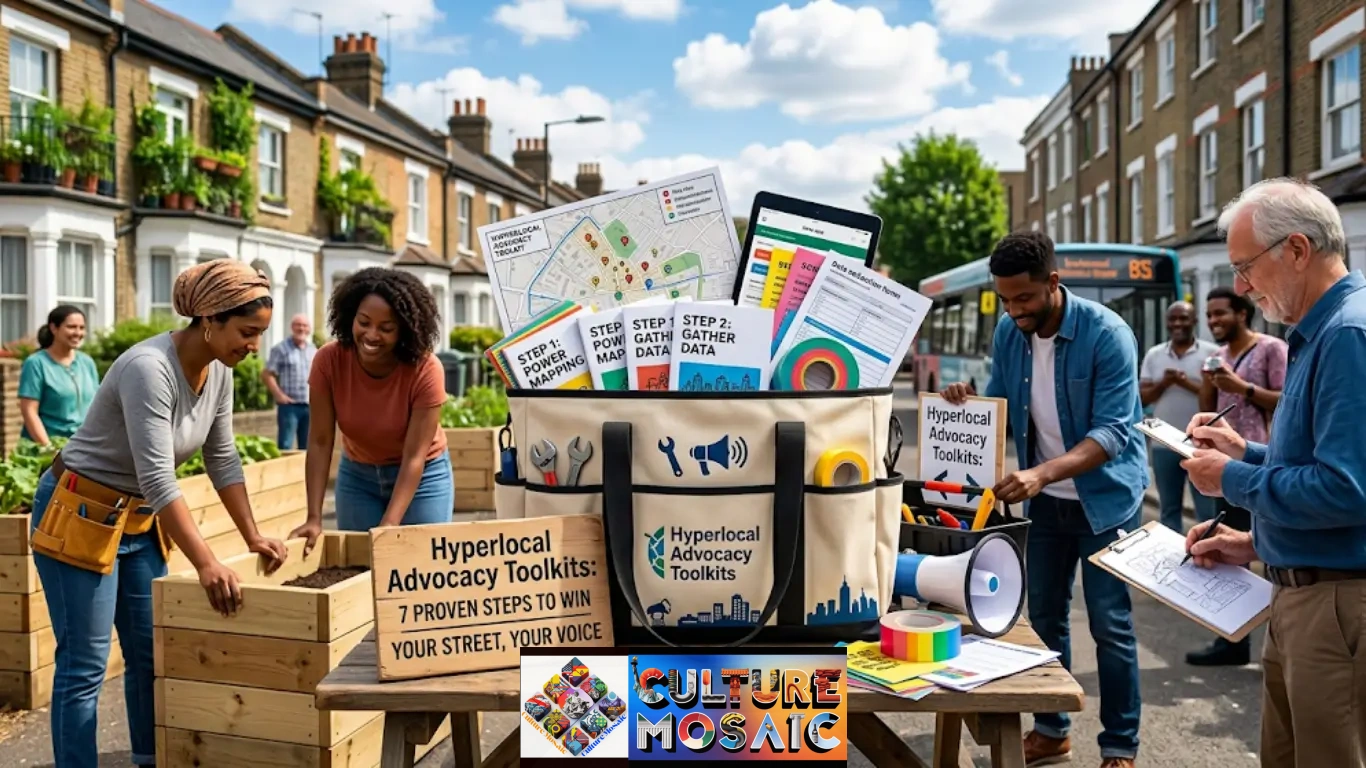
How Hyperlocal Advocacy Toolkits empower everyday residents to collect street-level data, run rapid pop-up actions, and drive real council change.
Quick Summary: A Hyperlocal Advocacy Toolkit is a street-level, action-oriented framework that equips neighborhood organizers with concrete templates, hyper-local data collection tools, and micro-governance strategies to drive immediate civic change. Unlike broad, citywide campaign guides that often stall in municipal red tape, hyperlocal toolkits focus strictly on micro-geographic boundaries—usually within a 15-minute walking radius—to transform neglected public spaces, influence local council policy, and deliver rapid, visible wins.
The Shift from Macro to Micro-Civic Action
Your street needs a safer pedestrian crossing. A vacant, overgrown lot could become a vibrant community garden. An abandoned shopfront is sitting derelict while local creators lack space. You have likely spent months—perhaps years—wondering who to call or which bureaucratic lever to pull.
Traditional civic participation can feel relentlessly exhausting. You attend a formal council meeting, submit a public consultation form, and wait six months only to discover your petition has been swallowed by administrative delays. Meanwhile, daily neighborhood life remains unchanged.
This friction is where macro-level campaigns fail and Hyperlocal Advocacy Toolkits succeed. Rather than navigating broad, distant bureaucracies, hyperlocal organizing flips the script by focusing strictly on the environments you interact with every single day. By applying targeted Micro-Civic Interventions and structured Local Civic Engagement Strategies, residents can bypass top-down inertia to reclaim their immediate surroundings. Real civic power doesn’t always cascade down from city hall; it frequently grows upward from a single street corner.
Macro vs. Hyperlocal Advocacy: Understanding the Difference
To build an effective local campaign, organizers must understand how street-level initiatives diverge from traditional citywide advocacy.
| Dimension | Traditional Advocacy Toolkits | Hyperlocal Advocacy Toolkits |
| Geographic Scope | Citywide, regional, or national boundaries | Specific blocks, wards, or a 15-minute walking radius |
| Data Sources | Regional census data, macro-economic reports | Street-level air sensors, manual foot-traffic counts, lived experience |
| Target Audience | Members of Parliament, city mayors, cabinet members | Ward councilors, parish councils, neighborhood officers, local traders |
| Impact Velocity | 12 to 36 months (policy changes, legislation) | 2 to 12 weeks (pop-up demonstrations, micro-grants, quick fixes) |
| Primary Mechanism | Formal lobbying, policy briefs, large-scale petitions | Tactical Urbanism in Community Civic Engagement, co-design, direct action |
Core Components of an Effective Hyperlocal Toolkit
A successful street-level toolkit isn’t a 100-page theoretical document; it is a lean, highly practical utility kit. Every robust toolkit requires three core pillars: empirical proof, persuasive narrative, and structured power mapping.
1. Gathering Civic Proof That Actually Matters
Municipal officers routinely cite a “lack of evidence” when denying requests for street safety improvements or community infrastructure. Hyperlocal toolkits bridge this gap by teaching residents how to collect authoritative, micro-level data:
- Low-Cost Environmental Monitoring: Portable air-quality sensors (costing under £150) or temperature monitors expose extreme hyper-local microclimates and pollution hotspots that citywide sensors miss entirely.
- Manual Traffic & Pedestrian Audits: Conducting structured 30-minute foot-traffic counts during peak school run hours provides immediate, unassailable evidence of pedestrian volume and safety risks.
- Visual Problem Mapping: Documenting hazardous intersections or inaccessible pavements with geotagged, timestamped photography turns subjective frustration into objective reporting.
2. Power Mapping Your Actual Decision-Makers
Avoid wasting months lobbying officers who lack budget authority. Effective toolkits include a power mapping workflow:
- Identify the Budget Holder: Distinguish between local ward councilors (who often control small discretionary funds), highways engineers, and private land developers.
- Find Your Core Ten Neighbors: You do not need a petition of thousands to start. A dedicated core of 10 neighbors creates the critical mass needed to attend public meetings, divide tasks, and represent a visible voting bloc.
- Build an Open Paper Trail: Copy relevant councilors, cabinet members, and neighborhood associations on key correspondence. Transparent record-keeping creates public accountability.
3. Narrative Advocacy
Data shows what is happening, but compelling narrative explains why it demands urgent resolution. Utilizing Narrative Advocacy techniques allows organizers to frame technical issues through human experience—such as an elderly resident unable to reach a local pharmacy safely—keeping communications under 300 words for maximum impact on busy council officers.
Tactical Urbanism & Micro-Demonstrations
Before committing thousands of pounds to permanent infrastructure, local authorities often want proof that a proposed concept will work. This is where Tactical Urbanism in Community Civic Engagement and DIY Placemaking Community Engagement serve as vital toolkit components.
+-----------------------------------------------------------------+
|               TACTICAL URBANISM EXECUTION FLOW                  |
+-----------------------------------------------------------------+
|  1. IDENTIFY ISSUE    --> Inaccessible or unsafe public space   |
|  2. POP-UP TEST       --> Temporary planters, chalk crosswalks  |
|  3. MEASURE IMPACT    --> Collect foot traffic data & feedback  |
|  4. PRESENT PROOF     --> Submit findings to local authority    |
|  5. PERMANENT CHANGE  --> Secure capital funding/planning entry |
+-----------------------------------------------------------------+
By installing temporary, non-permanent interventions—such as pop-up seating, temporary planters, or street chalking—organizers can run a weekend trial. Documenting user participation and gathering public feedback during a pop-up trial provides concrete proof that a permanent intervention is worth funding.
Bridging the Digital Divide: Access & Safeguarding
A common pitfall of modern community campaigns is relying entirely on digital apps, which risks excluding non-digital residents, elderly neighbors, or low-income households. A well-designed toolkit embeds digital inclusion support into its foundational framework.
Free Digital Inclusion & Organizing Platforms
| Tool Category | Recommended Platforms | Primary Use Case | Accessibility & Inclusion Features |
| Digital Deliberation | CitizenLab, Consul | Neighborhood ideation & voting | Multilingual translation, screen-reader compliance |
| Spatial Mapping | OpenStreetMap, Felt | Mapping neighborhood assets/hazards | Visual-first interfaces, exportable PDF maps |
| Grassroots Grants | Local Council Discretionary, Lottery | Funding equipment & venue hires | Simple paper application options available |
| Hardware Access | UK Digital Inclusion Hubs | Sourcing free/refurbished devices | Direct referral pathways for digital inclusion scheme free laptops |
Organizers must complement online tools like Hyperlocal Digital Deliberation platforms with offline mechanisms—such as physical noticeboards, paper surveys dropped through doors, and localized street meets—ensuring that broader efforts in Civic Literacy and Ethical Grassroots Advocacy remain accessible to all.
Legal, Safety, and Safeguarding Protocols
When coordinating street-level action, toolkits must establish clear safeguards to protect volunteers and residents:
- Data Protection & GDPR: Collect only essential contact details for campaign updates. Use secure, encrypted forms and never share personal data without explicit opt-in consent.
- Public Liability & Safety: Ensure pop-up events or street cleanups operate off highways unless formal street closure permits are secured. Carry risk assessment checklists for any physical volunteer work.
- Conflict De-escalation: Equip organizers with clear guidelines for handling opposition from disgruntled drivers or skeptical property owners neutrally and professionally.
Frequently Asked Questions
What is the difference between a traditional advocacy toolkit and a hyperlocal toolkit?
A traditional advocacy toolkit addresses citywide or national policy issues using high-level legal frameworks, macro-data, and long-term lobbying strategies aimed at central government or whole councils. A hyperlocal toolkit focuses strictly on micro-geographic areas (a single street, park, or neighborhood ward), utilizing street-level data, quick pop-up demonstrations, and direct engagement with ward councilors to deliver rapid, visible improvements.
What legal or safety safeguards should be built into a grassroots toolkit?
Every grassroots toolkit should include a GDPR-compliant data consent form for mailing lists, a simple risk-assessment template for public gatherings, de-escalation guidelines for volunteers, and clear instructions on public liability insurance requirements when running physical events on council-managed land.
How do you find accurate “hyperlocal data” to include in a toolkit?
Accurate hyperlocal data can be gathered through citizen-science tools such as low-cost handheld air quality monitors, manual pedestrian/vehicle counting sheets, open-source mapping platforms (e.g., OpenStreetMap), and neighborhood surveys. Additionally, UK organizers can access open ward-level data via Office for National Statistics (ONS) neighborhood statistics and local council open-data portals.
How can we ensure a local toolkit is accessible to all neighborhood residents?
To ensure universal accessibility, combine digital tools with offline methods. Distribute printed summary leaflets, hold face-to-face workshops at accessible local venues, translate key materials into predominant local languages, and partner with local digital inclusion hubs to help residents who lack internet access or devices participate fully.
Where can grassroots campaigns find local digital inclusion grants or free hardware in the UK?
Grassroots initiatives in the UK can access digital inclusion support through the National Digital Inclusion Network (managed by Good Things Foundation), local council digital inclusion schemes, the National Device Bank (for refurbished laptops and tablets), and community innovation grants funded by the National Lottery Community Fund.
References & Further Reading
- Local Government Association (LGA): Practitioner’s Guide to Public Consultation and Community Engagement. [LGA Resource Portal]
- Good Things Foundation: Digital Inclusion Network & National Device Bank Framework.
- Cabinet Office: Code of Practice on Consultation and Public Participation. UK Government Publications.
- Shifting Power & Redefining Accessibility: Toolkits for Creative Participation, ArtsProfessional Guide on Hyperlocal Advocacy Toolkits.
- Culture Mosaic: Comprehensive resources on Community Advocacy Toolkits and Co-design in urban planning and civic engagement.