
 By Culture Expert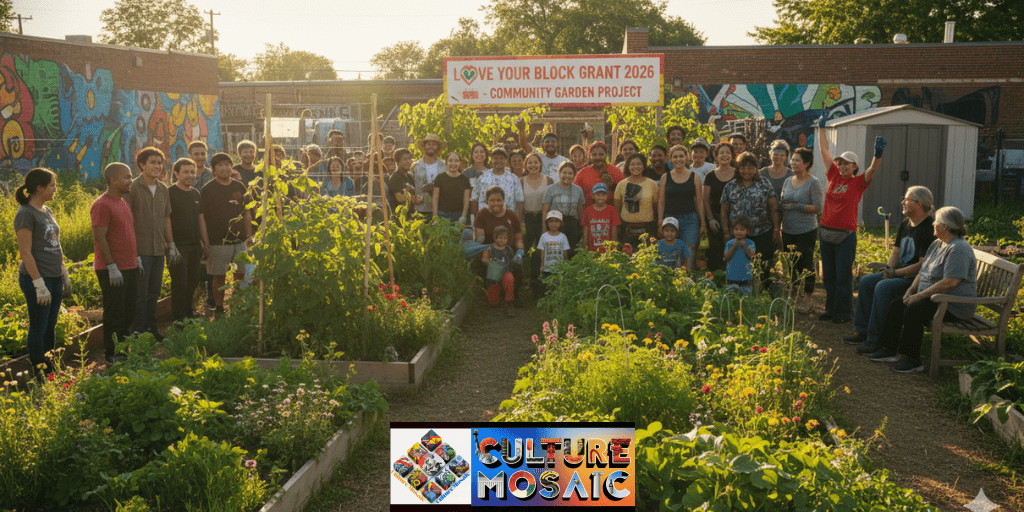
Reclaiming the Curb: How to Secure a Love Your Block Grant in 2026
Picture a vacant lot on the corner of your street. Broken glass. A rusted shopping cart. A half-collapsed chain-link fence that nobody has touched in three years. The kind of corner that tells you, quietly and persistently, that nobody is coming to fix it.
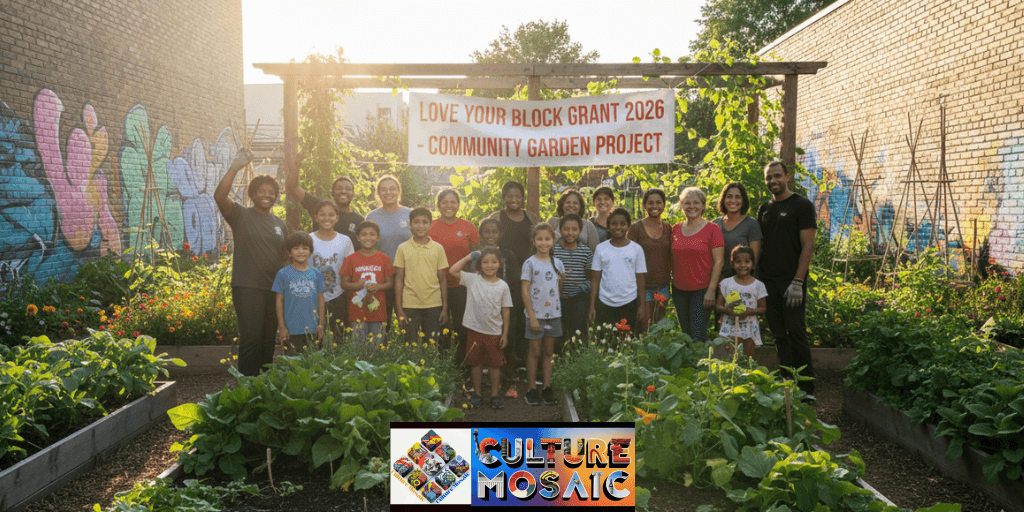
Now picture that same corner six months later: raised garden beds overflowing with tomatoes, a hand-painted mural across the back wall, folding chairs out on a Saturday morning while Neighbors gather over coffee and engage in a friendly debate about what comes next. That shift didn’t happen because a developer swooped in or a city council finally acted. It happened because six residents applied for the Love Your Block Grant 2026, got a few hundred dollars, and showed up on a Saturday with shovels.
That’s the whole model. Deliberately modest. Radically local. And in my experience, more durable than anything a planning department designs in isolation.
What Is the Love Your Block Grant 2026?
The Love Your Block (LYB) programme is a national initiative administered through the Bloomberg Center for Public Innovation at Johns Hopkins University, in partnership with Bloomberg Philanthropies and local municipal governments. It’s been running in various forms since the early 2010s, but the 2026-2028 cohort represents its most geographically expansive phase yet.
The core mechanism is a mini-grant model. Participating cities offer small awards, typically between $500 and $3,000 per project, to resident-led teams who want to carry out physical improvements on their block. The catch, and it’s a feature not a bug, is that the work must be done by volunteers. This isn’t a contractor programme. It’s a sweat-equity programme.
The Philosophy Behind the Love Your Block Grant 2026
The LYB model is deliberately modest by design. It’s not trying to solve systemic housing inequality or rezone a neighbourhood. It’s trying to answer a simpler, more immediate question: what happens when residents are given a small amount of money and genuine trust to improve the places they already live? The answer, consistently, is a great deal.
For a deeper look at how these civic micro-interventions build long-term community resilience, the work on Micro-Civic Interventions at Culture Mosaic is worth your time.
2026 Cities — Is Your Block Eligible?
This is the first question every prospective applicant should answer before spending an hour on their proposal. The Love Your Block Grant 2026 is not a federal programme with open national eligibility. Each participating city runs its own version of the programme under the LYB framework, which means eligibility is hyper-local.
For the 2026-2028 cohort, confirmed and historically participating cities include:
- Baltimore, MD — One of the original LYB cities. Grants are managed through the Mayor’s Office of Neighbourhood Safety and Engagement.
- Dallas, TX — Targets historically disinvested southern and western quadrants.
- Reno, NV — Ward 1, which covers parts of downtown and the older East Reno neighbourhoods, has been a primary focus.
- Boston, MA — Neighbourhoods like Roxbury and Dorchester have seen consistent LYB activity.
- Charleston, SC — Community development offices manage the local application window.
- San Bernardino, CA — Route 66 corridor projects have been a particular priority.
I’d strongly advise checking your city’s official website directly, since programme timelines and ward-specific eligibility shift year to year. The Love Your Block Grant 2026 programme page at Johns Hopkins is the cleanest source of truth.
Targeting Historically Disinvested Neighbourhoods
Most city programmes explicitly prioritise applications from neighbourhoods with higher vacancy rates, lower median incomes, or a history of reduced municipal investment. If your block qualifies on those terms, say so in your application. This isn’t cynicism. It’s knowing your audience.
The Anatomy of a Winning Love Your Block Grant 2026 Project
The programme funds a fairly specific category of work. Understanding the parameters early saves you from building a proposal around something that won’t qualify.
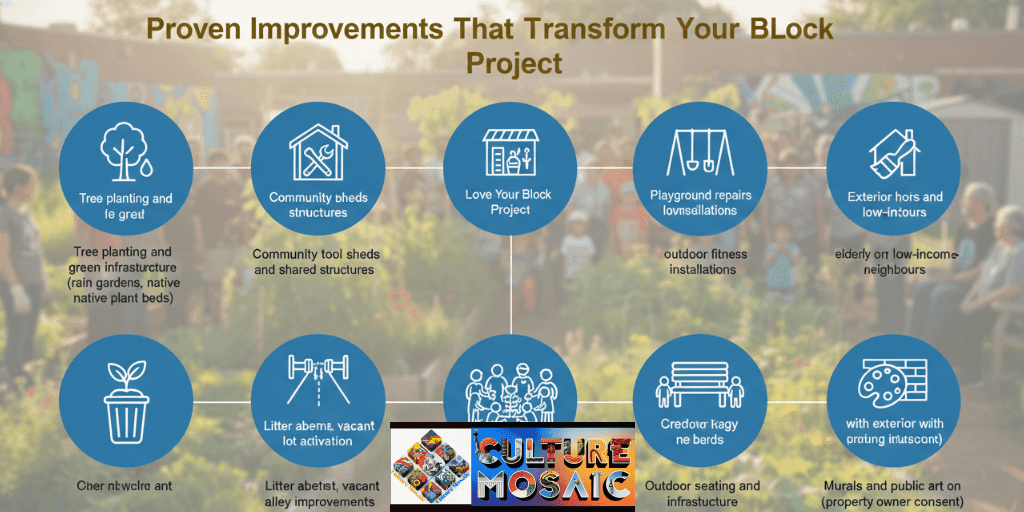
Proven Improvements That Transform Your Block
- Tree planting and green infrastructure (rain gardens, native plant beds)
- Community tool sheds and shared storage structures
- Playground repairs and outdoor fitness installations
- Exterior home painting for elderly or low-income neighbours
- Litter abatement, vacant lot activation, and alley improvements
- Outdoor seating and community gathering infrastructure
- Murals and public art on exterior walls (with property owner consent)
Social and Placemaking Projects
Beyond the physical, the LYB framework encourages what urban planners call placemaking: using design and programming to activate spaces and build social connections. A vacant lot transformed into an outdoor community cinema qualifies.
A block-wide composting station qualifies. A seasonal market that draws foot traffic qualifies, provided it has a physical infrastructure component.
For residents interested in how food and environmental stewardship intersect with civic pride, the piece on Kitchen Scraps Management for Balcony-Free Apartments offers some genuinely practical ideas that translate well to community-scale composting projects.
The Non-Negotiables
- Volunteer-led: Paid labour is not covered. Your community workday must be staffed by residents.
- Exterior spaces only: Interior repairs, private home renovations, and indoor facilities are not eligible.
- No personal purchases: Alcohol, personal electronics, and items that benefit a single household are excluded.
- No ongoing operational costs: The grant funds installation, not maintenance contracts.
The Love Your Block Grant 2026 Roadmap — Dates and Deadlines
City-specific windows vary, but the general timeline for the 2026 cohort follows a recognisable rhythm. Missing your application window by a week means waiting an entire cycle. Build these dates into your calendar now.
| Phase | Typical 2026 Schedule | Action Required |
|---|---|---|
| Application Window | Feb – May 2026 | Submit your project idea or full proposal to your city programme manager. |
| Notification | June – July 2026 | Awardees are selected, contacted, and oriented by city staff. |
| Implementation | Aug 2026 – June 2027 | Host your Community Workday and complete the physical installation. |
| Final Reporting | Aug 31, 2026 (varies) | Submit photos, receipts, and your Maintenance Plan to close out the grant. |
Note: Exact dates are set by individual city municipal offices.
Strategy — Building a Competitive Love Your Block Grant 2026 Application
I’ve reviewed enough grant applications to know that the ones that fail aren’t usually short on ideas. They’re short on specificity, community buy-in evidence, and a credible plan for what happens after the cameras stop rolling. Here’s what actually moves the needle.
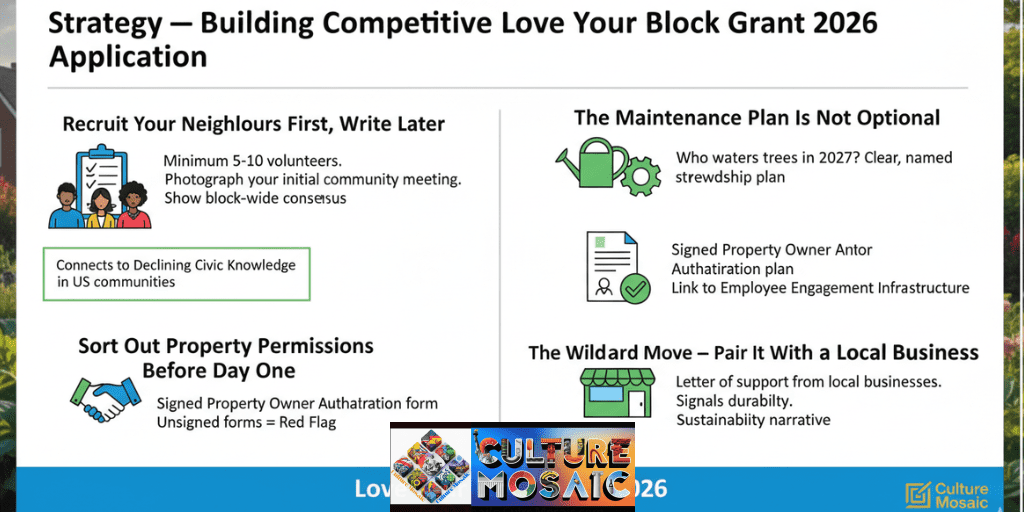
Recruit Your Neighbours First, Write Later
Most city programmes require a minimum of five to ten committed volunteers before you can even submit. But beyond meeting the threshold, a strong application demonstrates block-wide consensus. Knock on doors.
Get signatures. Photograph your initial community meeting. Applications that arrive with a sign-up sheet and a few quotes from actual neighbours read completely differently from solo submissions with big ambitions.
This connects directly to the broader challenge of Declining Civic Knowledge in US communities. The LYB programme is partly a corrective to civic disengagement, and reviewers notice when applicants have genuinely done the organising work.
The Maintenance Plan Is Not Optional
This is the single most underrated section of any LYB application. Who waters the trees in 2027? Who repaints the mural if it gets tagged? Who takes ownership of the tool shed inventory? The 2026 grants place heavy and explicit emphasis on sustainability.
A project that looks spectacular on paper but has no credible maintenance structure will lose to a simpler proposal with a clear, named stewardship plan every time.
Think about building your maintenance structure into your Employee Engagement Infrastructure model if you’re connected to a local business or institution. A nearby employer with volunteer time commitments is a genuine asset.
Sort Out Property Permissions Before Day One
If any element of your project touches private land, you need a signed Property Owner Authorisation form before you submit your application, not before your workday. Reviewers treat unsigned permission forms as an active red flag. The fastest way to disqualify a genuinely good project is to assume you can get the paperwork later.
The Wildcard Move — Pair It With a Local Business Commitment
Here’s something most applicants don’t think about: a letter of support from a local restaurant, hardware store, or service business carries real weight. It signals durability. If the corner taqueria has committed to hosting a seedling giveaway every spring in connection with your community garden, your project suddenly has an ongoing public touchpoint that reviewers can picture years from now.
Businesses benefit from the foot traffic and goodwill. You get a sustainability narrative that’s genuinely credible.
Eligibility Criteria — Who Can Apply for the Love Your Block Grant 2026?
Eligibility criteria vary by city, but the following conditions are consistent across most participating programmes:
- The lead applicant must be a resident of the block or neighbourhood being improved.
- Renters can apply with written permission from their landlord.
- Non-profit organisations may apply in some cities, but resident-led applications are given priority.
- The project must be entirely in a public or semi-public exterior space, or on private property with documented owner consent.
- Projects must be completable within the grant cycle, typically 12 months.
For a broader framework on how grassroots applications can be structured ethically and effectively, the Ethical Grassroots Advocacy Framework is a useful reference before you start drafting.
The Application Process — Step by Step
Step One — Contact Your City Programme Manager
Before anything else, identify the specific LYB programme manager in your city. In Baltimore, that’s the Mayor’s Office of Neighbourhood Safety and Engagement. In Reno, it’s the City Manager’s Community Engagement division. Each city has a designated point of contact, and reaching out early signals seriousness. It also gives you access to the most current application materials, which occasionally differ from what’s posted online.
Step Two — Draft Your Project Narrative
Your narrative should answer four questions clearly: What is the problem on your block? What is your proposed solution? Who is doing the work, and when? What does success look like in two years, not two months? Keep it under 500 words. Reviewers are reading dozens of applications. Clarity wins over ambition every time.
The principles behind Local Civic Engagement Strategies are worth internalising here. The strongest applications frame neighbourhood improvement as a shared civic act, not a personal project.
Step Three — Build Your Budget
LYB grants are typically between $500 and $3,000. Your budget should be itemised and realistic. Materials, tool rentals, signage, and safety gear are all fair game. Labour is not. If your project costs $4,500 but the grant maximum is $3,000, show where the remaining $1,500 comes from. In-kind donations, local business contributions, and neighbourhood fundraising all count.
Strategic Priorities That Align With the 2026 Programme Values
The Love Your Block Grant 2026 cohort comes at a moment when city governments are rethinking their relationship to resident participation. The Bloomberg Philanthropies framework that underpins LYB is explicitly designed around Socially Restorative Architecture: the idea that built environments shape social trust, and that improving them can rebuild civic bonds that years of disinvestment have frayed.
Projects that score well in 2026 tend to do three things simultaneously: they fix something broken, they create a recurring reason for neighbours to gather, and they produce a legible before-and-after that city staff can photograph and report upward. Knowing this should shape how you design your project from the start.
The Bigger Picture — Trust as Infrastructure
There’s a civic argument embedded inside every Love Your Block Grant 2026 application, and it’s worth making explicit. When residents show up to improve their own streets without waiting for city hall, they’re demonstrating something that’s harder to measure than a new tree canopy: they’re demonstrating that they believe their effort matters. That belief is fragile. It needs to be met.
The LYB model is one of the more honest attempts I’ve seen to close that loop. The city provides a small financial stake. Residents provide the ideas, the labour, and the local knowledge. What gets built isn’t just a garden or a mural. It’s a data point in the longer argument that cities and their residents can actually work together.
That’s worth a Saturday with a shovel.
Frequently Asked Questions — Love Your Block Grant 2026
Q. Can renters apply for the Love Your Block Grant 2026?
Yes, and this trips people up less than you’d think. Most participating cities allow renters to apply provided they get written landlord permission covering the project scope and the specific dates of any planned work. The key word is written. A verbal yes from your landlord in February will not hold up in August when you need a signed form to close out your grant. Get the letter, get it dated, and attach it to your application from day one.
Q. What is a Community Workday?
It’s exactly what it sounds like: a day, planned and publicised in advance, when your volunteer crew shows up and does the physical work. Planting, painting, building, clearing. The Community Workday is the LYB programme’s proof of concept — it’s where the grant stops being a piece of paper and becomes something you can stand in front of. Your city programme manager needs advance notice of the date. You’ll need to document it: attendance sheet, photos before and during, and a short written summary. All of that goes into your final report.
Q. What expenses are not covered by the Love Your Block Grant 2026?
Alcohol is the obvious one, and yes, people have tried. Beyond that: food for social events, interior home repairs of any kind, personal electronics, paid contractor labour, and anything that primarily benefits one household rather than the block as a whole. The rule of thumb I use is this — if you couldn’t photograph it for a city press release about community improvement, it probably doesn’t qualify. When genuinely uncertain, email your programme manager before buying. Not after.
Q. How many volunteers do I need to qualify?
The floor is usually five named volunteers at the time of application, though some cities push that to ten for larger-scale projects. But I’d stop thinking about the floor entirely. Applications that arrive with fifteen or twenty names — actual neighbours, not just family members from across town — read differently to reviewers. They signal that this project has real roots in the block. Five is technically sufficient. Twenty is persuasive.
Q. What happens if my project goes over budget?
The grant is a fixed amount. Full stop. If your materials run $400 over, that’s coming out of someone’s pocket, and the programme won’t cover it retroactively. This is the main reason I push applicants to build their budgets conservatively. Price the lumber at retail, not the sale price you found last week. Add a 10% contingency line. If you’re planning to bridge a gap with in-kind donations or a local business contribution, say so explicitly in your application — it actually reads as a strength, not a shortfall.