
 By Marcus J. Holloway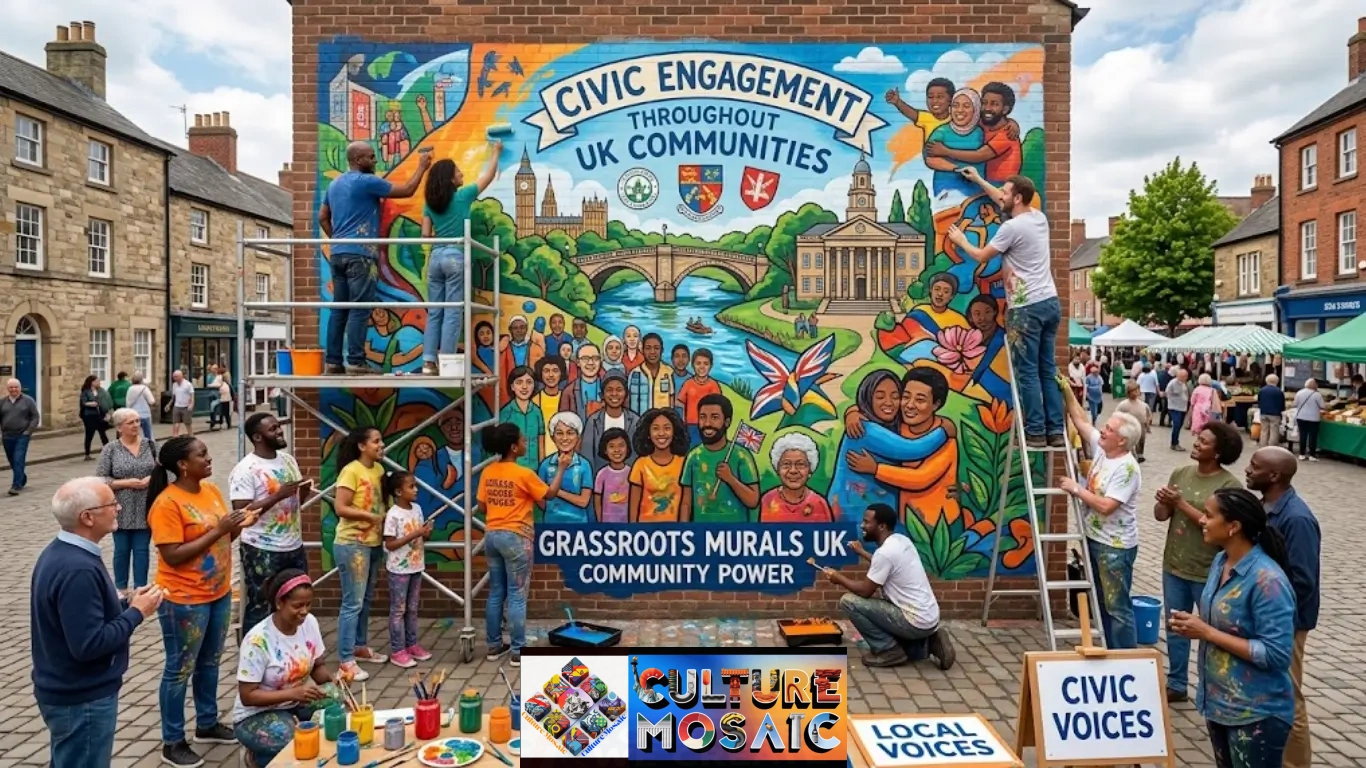
Quick Summary
Here’s the short version of everything below on Grassroots Murals UK Civic Engagement, if you’re short on time:
- Planning permission: Most artistic murals on non-listed buildings outside conservation areas fall under permitted development and don’t need a full planning application — but anything read as advertising needs Advertisement Consent, and listed buildings or conservation areas usually need Listed Building Consent too.
- Securing the wall: You need the owner’s written permission (a licence or memorandum of understanding), proof of public liability insurance, and — for council-owned walls — sign-off from the relevant department, not just a friendly nod from a caretaker.
- Consultation vs. co-design vs. co-production: Consultation asks people what they think of a finished idea. Co-design brings residents into the studio while the idea is still wet paint. Co-production hands over real authorship and, ideally, real budget control.
- Stopping the tag: The strongest deterrent isn’t a coating — it’s ownership. Murals that residents helped paint get vandalised far less than murals dropped on a wall from outside. A sacrificial anti-graffiti coating is the useful backup, not the main plan.
- Funding: Arts Council England’s National Lottery Project Grants (£1,000–£100,000), Postcode Lottery-backed Grassroots Grants, and council-level placemaking pots are the first three places to look.
Grassroots Murals UK Civic Engagement: Why a Blank Wall Is Never Just a Wall
I’ve spent a long time watching how people behave around public art that they had a hand in making, and I’ll say this plainly: a mural someone helped paint changes how they walk down that street for years afterward. That’s the whole argument for Grassroots Murals UK Civic Engagement in one sentence. It isn’t really about paint. It’s about who gets asked, who gets listened to, and who gets to leave a mark on the place they live.
Here’s the problem, stated without dressing it up. Councils across the UK are stretched thin, public consultation often arrives too late to matter, and residents — particularly younger ones and those in lower-income wards — report feeling like decisions about their own neighbourhood happen somewhere else, by someone else, for reasons no one explains.
Civic Literacy has quietly eroded in the process; people don’t just disengage from art, they disengage from planning meetings, from council votes, from the whole apparatus of local democracy. A blank, tagged, or peeling wall on a high street is a small daily reminder of that neglect. It says: nobody’s minding this place.
I’ve noticed that the pain here isn’t abstract. It’s the parent walking a child past a gang tag every morning on the school run. It’s the shopkeeper watching footfall drop because the street looks abandoned. It’s the pensioner who remembers when the community centre wall used to have something worth looking at, and now just has grey render and a “no fly-posting” sign nobody obeys. Multiply that by a few thousand streets and you get a genuine, if under-discussed, contributor to local disaffection — one that shows up later as low turnout on why is voting important in local elections, thin attendance at planning consultations, and a general sense that civic duty is something other people do.
The solution — and here’s where I get genuinely opinionated — is not a council-commissioned mural handed down from a communications team, however well-intentioned. It’s a grassroots one: designed with the people who will live alongside it, painted partly by their own hands, and owned by the street rather than the town hall.
Done properly, this single intervention does more for civic engagement than most awareness campaigns manage in a year. It gives residents a stake, a story, and — not incidentally — a reason to show up to the next thing the council asks them about. It also gives them, quietly, a working example of civic voice in action — proof that a resident’s opinion can shape something everyone else on the street will see for years.
What Counts as a Grassroots Mural, and Why Civic Engagement Depends on Who Holds the Brush
Not every painted wall counts, in the strict sense, as Grassroots Murals UK Civic Engagement. A branded campaign painted by a professional crew, however striking, is public art commissioned top-down. A grassroots mural, by contrast, starts with a local group — a residents’ association, a school, a faith group, a tenants’ and residents’ association (TRA), a youth project — identifying a wall, a story, and a reason. The artist’s role shifts from “author” to “facilitator,” translating dozens of half-formed ideas into a single composition that still reads as everyone’s.
This distinction matters enormously for the civic outcomes. Research on UK community art initiatives consistently finds that the process — who was in the room, how decisions got made, whether teenagers and elders had equal say — predicts long-term community pride and pride-linked upkeep far better than the finished image does. A mediocre design that fifty local people argued over, chose, and painted together will outlast a beautiful design nobody local was asked about. That’s an uncomfortable truth for anyone who thinks civic art is primarily an aesthetic project. It isn’t. It’s a governance project that happens to use paint.
There’s also a quieter, cumulative effect worth naming: participatory public art urban renewal doesn’t just brighten one wall. It seeds a habit. Residents who’ve sat through three planning meetings for a mural are measurably more likely to turn up for the next consultation on a bus route, a play park, or a licensing application — because they’ve learned, first-hand, that turning up can actually change what gets built. That’s the value of civic participation in miniature: proof of concept, delivered in bright colour on a wall you pass every day.
Do You Need Planning Permission for a Community Mural in the UK?
This is the question I get asked first, always, and the honest answer is: it depends on three things — whether the building is listed, whether it sits in a conservation area, and whether the design could be read as advertising.
Under the General Permitted Development Order, painting the exterior of a building is generally treated as permitted development rather than “development” requiring a planning application — provided the building isn’t listed and isn’t in a conservation area. Interior murals never need permission, and exterior murals on unlisted buildings outside conservation areas usually don’t either, as long as the mural reads as artistic rather than promotional. That’s the good news, and it covers the large majority of grassroots projects: a side return, a school hall wall, the flank of a community centre.
The complications stack up fast once either of two things is true. First, listed buildings and conservation areas: a mural on or affecting a listed building, or one in a conservation area, is likely to need listed building consent and/or planning permission where there’s a potential effect on the building’s or area’s character. Second, and this catches out more projects than conservation status does: advertisement law.
If a mural references a business, commercial activity, or logo, it may be classed as an advertisement, requiring an Advertisement Consent application under the Town and Country Planning (Control of Advertisements) (England) Regulations 2007 rather than a standard planning application, judged against a different — though broadly similar — set of policies. A mural celebrating a local haulage firm’s lorry livery has, in a real case, been treated exactly this way by a planning authority. A purely artistic composition celebrating local history, wildlife, or community figures, with no logos or slogans, is on much safer ground.
| Situation | Consent typically needed | Who to contact first |
| Unlisted building, outside conservation area, purely artistic design | Usually none — covered by permitted development | Building owner only |
| Listed building or conservation area | Listed Building Consent and/or planning permission | Local planning authority’s conservation officer |
| Design includes a business name, logo, or slogan | Advertisement Consent | Local planning authority’s advertisement/enforcement team |
| Council-owned wall or street furniture | Council department permission (separate from planning) | Relevant council team (parks, highways, housing, etc.) |
A growing number of councils have started publishing their own mural guidance notes precisely because this question comes up so often — Gedling Borough Council’s draft guidance, for instance, sets out definitions, benefits, appropriate themes, the consenting question, funding routes, and a recommended commissioning process for public art in one document. My advice, every time: email the planning duty officer with a photo of the wall and a rough sketch of the design before anyone picks up a brush. It costs nothing, takes a week, and saves you the nightmare of a stop notice halfway through a community painting day.
How Do You Legally Secure a Wall or Location?
Permission from the planning system is only half the job. You also need permission from whoever actually owns the bricks.
- Get it in writing. A verbal “yes” from a shop manager isn’t binding on the landlord, and landlords change. A short licence agreement or memorandum of understanding — even a one-page one — should cover: how long the mural can stay, who’s responsible for future maintenance or removal, and what happens if the building is sold.
- Check for leasehold complications. Many high-street units are leased, and the lease may restrict alterations to the exterior. Always trace ownership through the Land Registry if you’re unsure who actually holds the freehold.
- Insure the activity, not just the artist. Public liability insurance covering the painting event itself (scaffolding, paint spills, volunteers on ladders) is usually a condition of council permission and of most funders’ grant agreements.
- For council land, go through the right department. Highways, parks, housing, and regeneration teams each control different assets, and a mural on a housing association wall needs the housing provider’s sign-off, not just the council’s.
- Log everything. Keep the email chain. Grant funders and future maintenance disputes both go more smoothly with a clear paper trail than with everyone’s memory of a phone call from eighteen months ago.
This is the unglamorous, essential groundwork behind every successful project in 10 civic engagement opportunities worth pursuing at neighbourhood level — the paperwork is never the exciting part, but skipping it is how good projects get painted over by an embarrassed council within a year.
Consultation, Co-Design, and Co-Production: What’s the Real Difference?
Get this part wrong and the rest of your Grassroots Murals UK Civic Engagement plan wobbles. These three words get used almost interchangeably in grant applications, and that sloppiness causes real damage — because residents can tell, instinctively, which one they’ve actually been offered.
Consultation means the design already exists, more or less, and residents are shown it and asked for reactions. It’s fast, cheap, and useful for sanity-checking a near-final idea, but it offers no real authorship. Done as the only engagement step, it reads — correctly — as a tick-box exercise. How public feedback shapes local policy depends heavily on whether feedback arrives early enough to change anything; consultation late in the process rarely does.
Co-design goes further. Residents are in the room while the idea is still forming — sketching, choosing colours, telling the artist which local stories matter and which ones feel tired. As one practitioner described it, the essential difference from consultation is that co-design doesn’t fix the question in advance, keeping the process open unless closing it off early would genuinely harm the project. Academic reviews of the participation literature describe this as a genuine escalation from symbolic gestures like informing or consulting toward real collaborative authorship, often mapped using Hart’s Ladder of Participation, which runs from token gestures at the bottom to real shared decision-making near the top.
Co-production is the strongest form, and — worth being honest about — the rarest in practice on public land. It means residents share not just design input but ongoing responsibility: budget decisions, delivery, sometimes long-term stewardship of the finished mural. Some practitioners argue that statutory bodies structurally can’t fully deliver it, because legal accountability and governance constraints mean genuine co-design is achievable while full co-production, with equally shared decision-making all the way through, often isn’t on land a council remains legally responsible for.
That’s not a reason to avoid aiming for it — community-led trusts and long-running residents’ groups do achieve real co-production — it’s a reason to be honest with participants about which level you’re actually offering, rather than calling a one-evening feedback session “co-production” because it sounds better in a funding report.
| Approach | Who holds the pen | Typical duration | Best used for |
| Consultation | Artist/organisation, with resident feedback on a near-final design | Single session or short survey | Sense-checking, sign-off on detail |
| Co-design | Shared — residents shape concept, story, and visual direction from an early stage | Several workshops over weeks | Most grassroots murals |
| Co-production | Residents/community group, with genuine budget and delivery control | Ongoing, often tied to a long-term community organisation | Community-owned spaces, long-term placemaking programmes |
If you’re planning a project, aim honestly for co-design as your floor, not your ceiling — it’s the level that reliably produces both a good wall and a more engaged street, and it maps cleanly onto wider practice in co-design in urban planning and civic engagement.
Best Practices for Collaborating With Residents and Stakeholders
The best strategy for Grassroots Murals UK Civic Engagement is less about artistic technique and more about process discipline. Every successful grassroots mural I’ve looked at closely shares a handful of habits, and none of them are complicated:
- Start with a listening phase, not a design brief. Door-knock, hold a stall at the market, ask the school. Find out what the wall means to people before you propose what it should look like — this is the difference between why public consultation is important in theory and in practice.
- Recruit a genuinely mixed steering group. Age, ethnicity, length of residency, and disability access all shape whose story gets told. A steering group of five like-minded enthusiasts will produce a narrower mural than one that includes the teenager who skateboards past daily and the elder who’s lived there since the street was built.
- Make the co-design sessions tactile. Physical materials — printed photos, coloured card, tracing paper over a photo of the wall — get better ideas out of people than a verbal brainstorm ever will, echoing what is public commentary at its most generative: something people can point at and argue over, not just describe.
- Give people a literal paintbrush. A “paint-by-numbers” day where dozens of residents fill in sections under the lead artist’s guidance is the single biggest driver of long-term care for the finished piece. People don’t vandalise what they made.
- Document and publish the process, not just the result. A short write-up, some photos of the workshops, a thank-you to named contributors — this is narrative advocacy doing quiet, effective work, and it’s what funders want to see in your next application.
- Close the loop. Tell the steering group, in writing, what changed because of their input and what didn’t (and why). This single step does more for trust than almost anything else on this list — it’s the practical core of vernacular governance structures that actually respond to the people they serve.
None of this requires professional facilitation training. It requires patience, a willingness to be told your first idea was wrong, and a genuine belief that the people who live somewhere know things about it that you don’t. If you want a fuller walk-through of the logistics — timelines, insurance, volunteer rotas — a dedicated guide to organising a neighbourhood mural is worth reading before your first steering-group meeting, alongside the wider principles of ethical grassroots advocacy that should sit behind any project claiming to speak for a community.
How Do Projects Prevent Murals From Being Tagged or Vandalised?
This is the question that decides whether a Grassroots Murals UK Civic Engagement project survives its first winter. I’ll be blunt about something the industry doesn’t always say out loud: coatings help, but they are not the main answer. The main answer is who painted it.
Research consistently finds that murals significantly reduce vandalism, largely because community involvement in the painting process builds local pride and a sense of ownership over the space. That finding shows up again and again in UK case studies.
In Harlesden, Brent, a 2008 community project responding to persistent tagging resulted in a 25-panel mural by artist Mat Hand, painted with portraits of local schoolchildren, and was followed the next year by young people working alongside a local artist and Groundwork West London to repaint the graffiti-covered walls of a community centre as part of a wider river park regeneration project. The wall that had been tagged for years, once it belonged to the kids who painted it, stopped being a target.
That said, sensible physical precautions still earn their place:
- Sacrificial or permanent anti-graffiti coatings, applied once the paint has fully cured, let taggers’ marks be washed off or peeled away without damaging the artwork underneath — worth the modest cost on any street-level, high-visibility wall.
- Good lighting and natural surveillance. Well-lit areas, clear sightlines, and inviting, well-maintained public spaces all discourage the opportunistic vandalism that thrives in neglected corners.
- A visible “who made this” plaque or QR code. Naming the local group and the school that contributed sends a small but real signal: this belongs to someone, and it’s watched.
- A maintenance pledge from the outset. Fast touch-up of the first stray tag matters more than any coating — a mural left tagged for months invites more; one refreshed within days rarely gets touched again.
The underlying lesson generalises well beyond murals: it’s a close cousin of the reasoning behind tactical urbanism in community civic engagement, where small, visible, community-authored interventions tend to survive and spread precisely because the community treats them as its own.
Where Can Grassroots Art Projects Secure Funding in the UK?
Money is the recurring bottleneck for Grassroots Murals UK Civic Engagement work, so here’s a realistic shortlist rather than an exhaustive one.
Arts Council England — National Lottery Project Grants. This is the first port of call for most groups. It’s Arts Council England’s open access programme for arts, museums, and libraries projects, supporting individual practitioners as well as community and cultural organisations with grants ranging from £1,000 to £100,000 for activity that benefits people in England, applied for on a rolling basis. Visual arts and community-facing combined arts projects, including murals, fit comfortably within its scope.
Postcode Lottery-funded Grassroots Grants. Delivered by Groundwork, this programme provides unrestricted funding of up to £2,000 to around 700 small, local organisations in England each year, aimed at groups making a positive difference in their communities, with eligibility generally limited to organisations with annual income under £25,000. It’s a good fit for a first, modest mural rather than a multi-wall programme.
Council placemaking and public realm budgets. Increasingly, local authorities set aside small discretionary pots for exactly this kind of work — worth asking your ward councillor directly, and worth reading any published local mural policy first, since several councils (Gedling and Camden among them) have started formalising guidance on themes, process, and funding routes for public art on their patch.
Business Improvement Districts (BIDs) and local businesses. A high-street BID with a footfall or environment budget will often co-fund a mural that visibly improves the street it represents — approach them with a costed proposal, not just an idea.
Housing associations and health bodies. Where the wall in question belongs to social housing or sits near a GP surgery or community health hub, a small pot of “community wellbeing” or “social prescribing” funding is often available and under-applied-for.
| Funder | Typical grant size | Best fit |
| Arts Council England — National Lottery Project Grants | £1,000–£100,000 | Established groups, larger or multi-phase projects |
| Groundwork Grassroots Grants (Postcode Lottery) | Up to £2,000 | Small, first-time community organisations |
| Council placemaking/public realm budgets | Varies widely, often £500–£10,000 | Single-wall, ward-level projects |
| BIDs and local business sponsorship | Varies | High-street or town-centre locations |
| Local Trust / Big Local-style community grants | Varies by area | Areas within an active Big Local or similar programme |
Funding rarely arrives all at once. Most grassroots murals I’ve read about are stitched together from two or three smaller sources plus donated paint and volunteer time — a genuine community advocacy toolkit in action, built from patience rather than one lucky grant. Groups running more than one project at a time tend to keep a running set of hyperlocal advocacy toolkits — funder contacts, template licence agreements, past risk assessments — so the second mural takes a fraction of the admin time the first one did.
Beyond the Wall: Murals as One Piece of a Wider Civic Habit
I don’t think it’s an accident that towns with an active grassroots mural scene also tend to have livelier residents’ associations, better-attended planning consultations, and more people willing to stand for the parish or town council. Once you’ve watched a design go from a scrawled idea on a flip chart to fifty people painting together on a Saturday, the idea that “you can’t fight the council” starts to feel less true. That confidence transfers.
This is why I’d encourage any group starting a mural to treat it as the opening move in a longer campaign of local involvement, not a one-off. Sign the steering group up for volunteer civic education programmes once the paint is dry. Point the younger contributors toward hyperlocal digital deliberation platforms so the conversation continues online between wall projects. Use the mural’s launch day as a stall for wider how to get involved in local civic issues online sign-ups. None of this is a stretch — you already have a crowd, a shared achievement, and a genuine reason to talk to each other again.
It’s also worth situating murals alongside other community-led cultural activity rather than treating them as a category apart. UK community choirs and civic engagement research finds strikingly similar effects — regular, low-barrier, collectively-made culture builds the same kind of local trust a mural does, just through a different medium. The common thread across both is co-creative connection: people doing something together, in public, that outlasts the afternoon they made it.
At the small end of the scale, micro-civic interventions — a repainted bench, a planted verge, a single alleyway mural — matter more than their size suggests, because they’re achievable without a six-figure grant or a year of committee meetings. Not every real-world problem facing a neighbourhood needs a masterplan; some of them need forty tins of exterior masonry paint and a Saturday. That’s also the argument behind DIY placemaking community engagement more broadly, and behind schemes like the Love Your Block grant programme for 2026, which exist precisely to fund this scale of visible, resident-led change.
None of this replaces the bigger structures of local civic engagement strategies or the harder, slower work of social change in modern society — but it’s a genuinely good entry point. It asks less of people than a council seat, gives back more than a leaflet, and it leaves something behind that the whole street can point to.
If you want a single, low-cost, high-visibility way to build both diverse civic harmony and lasting neighbourhood pride, grassroots murals are one of the strongest tools going — and one of the clearest civic engagement trends worth backing right now. For a sense of the scale and variety already achieved across the UK, Book an Artist’s roundup of small-footprint murals with outsized local impact is worth a look, and it echoes exactly what this piece has argued: Grassroots Murals UK Civic Engagement works precisely because it’s small enough to be personal and public enough to matter.
If your group is standing in front of a blank wall right now wondering where to start, start with the listening phase this week, not the paint next month. Find the wall’s owner. Send the email to planning. Book the church hall for a Saturday session. The paperwork feels slow. The payoff — a street that looks cared for, and residents who believe their voice moves something — is worth it.
Frequently Asked Questions
Five questions on Grassroots Murals UK Civic Engagement come up more than any others — here they are, answered straight.
Do you need planning permission for a community mural in the UK?
Usually not, provided the building isn’t listed and isn’t in a conservation area, and the design doesn’t include any commercial branding, logos, or slogans — this scenario is generally covered by permitted development rights. Listed buildings and conservation areas typically require Listed Building Consent and/or planning permission, and any design read as advertising a business needs separate Advertisement Consent. Always confirm with the local planning authority before painting, since interpretation can vary between councils.
How do you legally secure a wall or location for a mural?
Get written permission from the building’s owner — a short licence agreement or memorandum of understanding is enough for most projects — and confirm whether the property is leasehold, since leases can restrict exterior alterations. For council-owned walls, contact the specific department that manages the asset (parks, highways, or housing), as planning permission and property permission are separate processes. Public liability insurance covering the painting day itself is usually required by both councils and funders.
What’s the real difference between consultation, co-design, and co-production?
Consultation asks people to react to a design that’s already largely finished. Co-design brings residents into the process while the concept is still being formed, giving them genuine influence over the story and visual direction. Co-production goes further still, sharing ongoing decision-making — including budget and delivery control — with the community, though this level is harder to achieve fully on land a public body remains legally accountable for. Most successful grassroots murals operate at the co-design level as a realistic, achievable standard.
How do projects stop murals from being tagged or vandalised?
The strongest deterrent is community involvement itself — murals that local residents helped design and paint are vandalised far less often than those installed without local input, because people generally don’t deface something they made. Physical measures like sacrificial anti-graffiti coatings, good lighting, clear sightlines, and rapid touch-up of any early tagging all provide useful backup, but they work best alongside genuine local ownership rather than instead of it.
Where can grassroots art projects find funding in the UK?
Arts Council England’s National Lottery Project Grants (£1,000–£100,000) is the main open-access route for community arts organisations. Smaller groups can look at Postcode Lottery-funded Grassroots Grants (up to £2,000, delivered by Groundwork), council placemaking or public realm budgets, Business Improvement District sponsorship, and, where relevant, housing association or health-sector community wellbeing funds. Most projects combine two or three smaller sources rather than relying on a single grant.
Sources
- Brodies LLP — Murals and street art in Scotland: do you need planning permission?
- Gedling Borough Council — Murals Guidance Note (Supplementary Planning Document)
- Arts Council England — National Lottery Project Grants
- Groundwork UK — Grassroots Grants (Postcode Lottery funded)
- The Consultation Institute — Balancing co-production and accountability in public engagement
- Oxford Academic, Perspectives on Public Management and Governance — The co-production spectrum: conceptual blurs in theory and practice
- Journal of Participatory Research Methods — Co-production in Action: Developing Community Solutions for Health Equity
- The NSMC — Reducing graffiti vandalism: Harlesden and St Raphael’s Community Centre case studies
- ICE Cleaning — Do murals prevent graffiti?
This article is part of Culture Mosaic‘s ongoing coverage of UK civic life, heritage, and community-led placemaking.