
 By Culture Expert
Forensic Case Summary: SITE-PROV-2026
| Subject | Geographic Fingerprinting of Heritage Fibers |
| Methodology | Multi-Isotope Ratio Mass Spectrometry (IRMS) & ICP-MS |
| Primary Markers | Strontium (87Sr/86Sr), Oxygen (δ18O), Hydrogen (δ2H) |
| Applications | Heritage Authentication, Luxury Fraud Detection, Cultural Repatriation, DPP Compliance |
A Forensic Examiner’s Introduction
I have been doing this work for eighteen years, and I still find myself stopping when I hold a piece of ancient cloth. There is something quietly extraordinary about the idea that a fragment of linen woven in the Nile Delta three thousand years ago still carries a chemical memory of the specific soil it grew in, the specific water that fell on it, the specific rock that dissolved into the groundwater beneath it. That memory does not fade. It does not wash out. It does not lie. And that is precisely what makes geographic fingerprinting of heritage fibers one of the most powerful tools in forensic textile science today.
The technique is built on a straightforward premise: no two places on Earth share an identical geochemical profile. Rainfall at altitude carries different oxygen isotope ratios than coastal rainfall. Floodplain soils dissolve different strontium ratios than volcanic basalt. Plants and animals absorb these local signatures as they grow, and those signatures are locked permanently into the cellulose and keratin that make up natural textile fibers. Once you understand that, you start to see every heritage textile not just as a cultural object but as a piece of geochemical evidence — a specimen with coordinates baked in at a molecular level.
For the human story woven into these fibers — the cultural and personal dimensions that the laboratory cannot capture — the Tactile Lexicon of Woven Identity is a compelling counterpart to everything I am about to walk you through scientifically.
What Geographic Fingerprinting of Heritage Fibers Actually Means
I want to be precise about this term, because it gets used loosely in the trade press. Geographic fingerprinting of heritage fibers is not a single test. It is a multi-isotope analytical strategy combining at least three independent geochemical markers to produce a geographic probability assignment for a fiber sample. The reason we use multiple markers is straightforward: any single isotope system can produce overlapping signatures between regions. Combine strontium, oxygen, and hydrogen, and the probability of a false geographic match drops to well under one percent for commercially significant textile-producing regions.
The three primary markers each tells us something different:
- Strontium (87Sr/86Sr): Reflects the age and mineral composition of the bedrock that dissolved into the groundwater and soil. Ancient crystalline shields produce high radiogenic strontium. Young volcanic rocks produce low values. This ratio is essentially immune to climate variation and has not changed meaningfully in any given location for thousands of years.
- Oxygen (delta 18O): Reflects the isotopic composition of rainfall and surface water, which varies with altitude, latitude, and distance from the ocean. The well-documented continental effect creates a predictable gradient across most landmasses.
- Hydrogen (delta 2H): Tracks the same atmospheric processes as oxygen but provides an independent signal. In high-altitude regions like the Andes, the combination of low delta 2H with a specific d-excess value is diagnostic for glacially influenced growing environments.
Figure 1: The Global Isoscape — Geography Baked Into Every Thread
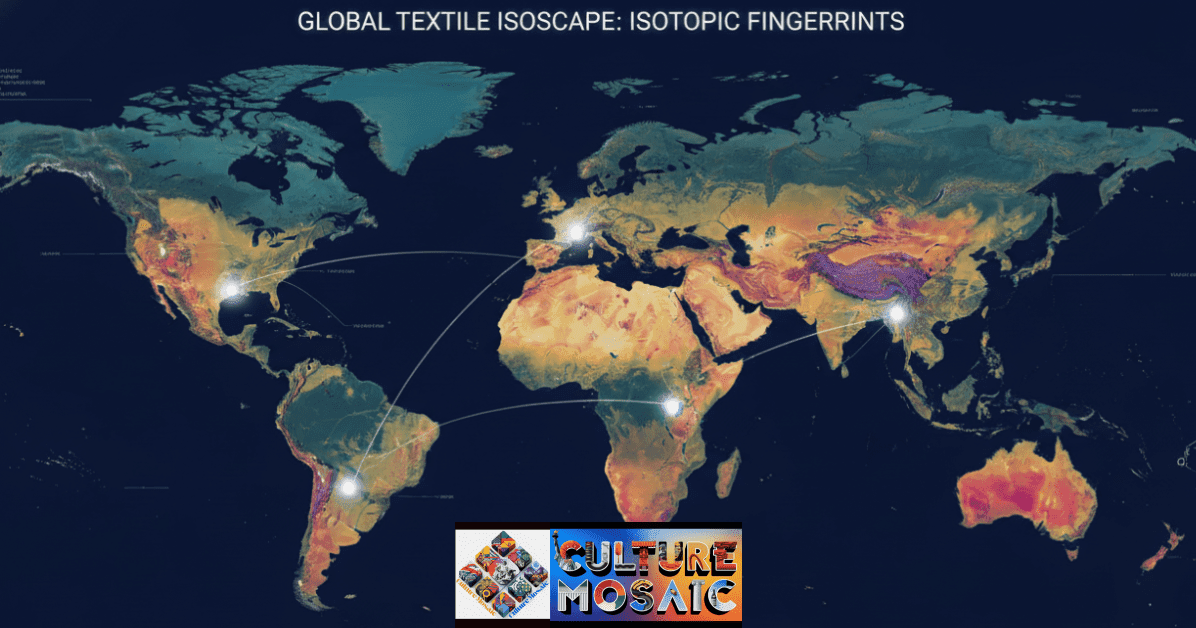
The concept of an isoscape — a map showing how isotope ratios vary across geographic space — is central to everything that follows. Researchers at institutions including the USGS, the IAEA, and a network of university laboratories worldwide have spent two decades building continental isoscape databases from measurements of thousands of water and soil samples. The database we consult in our laboratory now covers over 40,000 reference points globally. When a textile fiber is measured against these datasets, the match can locate its origin within a geographic zone of sometimes just a few hundred kilometres — occasionally narrower for regions with distinctive geology.
Methodology Deep-Dive: Three Field Procedures for Authentic Analysis
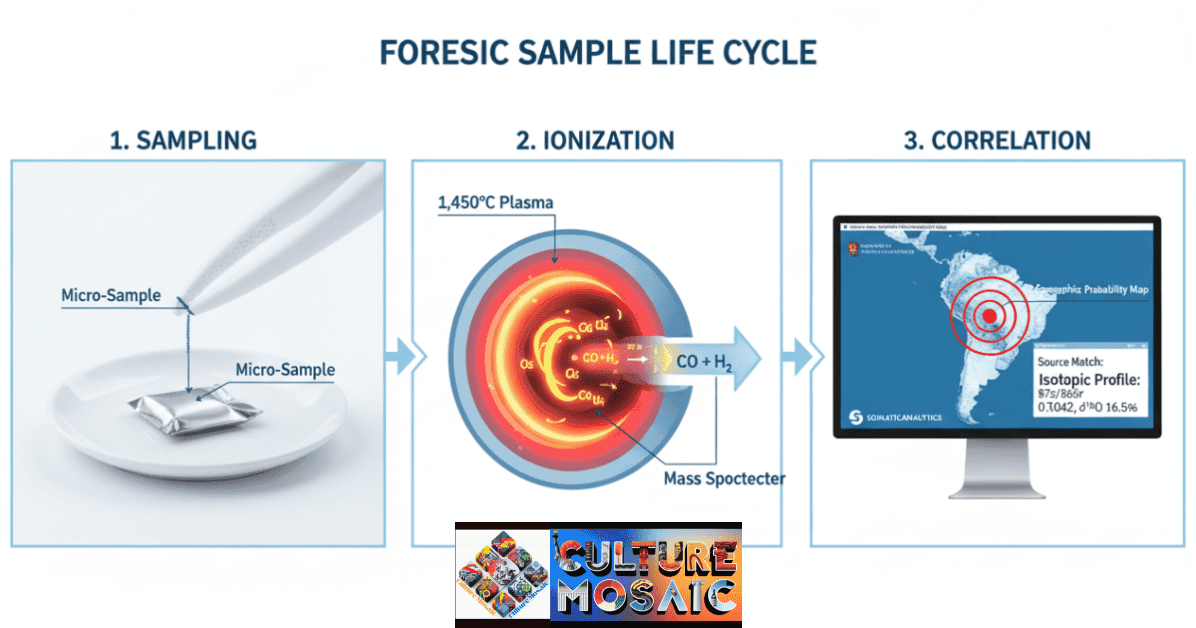
The power of geographic fingerprinting of heritage fibers lies in its rigorous, reproducible methodology. Here is how a qualified forensic audit proceeds from raw sample to courtroom-ready result.
Step 1: Sampling and Decontamination
The first challenge with any heritage fiber is contamination. A linen fragment that spent decades in a museum archive has been exposed to atmospheric pollutants, cleaning agents, conservation treatments, and the isotope signatures of everyone who has handled it. Before I can read the original geochemical record, I have to strip away everything added after the fiber left the ground.
We use a sequential solvent wash — petroleum ether first to remove lipids, then acetone for resin and conservation product contamination, and finally a weak acid rinse to clear superficial mineral deposits. The goal is what we call the virgin fiber core: the cellulose or protein matrix that formed during the plant’s or animal’s life cycle, sealed inside the fiber structure, untouched. Getting to that core without degrading the sample takes care and, frankly, patience. Rushing the decontamination step is how laboratories generate unreliable results.
Step 2: Ionization and Mass Spectrometry
Once the sample is clean, it is combusted or dissolved into individual atoms. For oxygen and hydrogen analysis, the clean fiber goes into a silver foil capsule and drops into a pyrolysis reactor at around 1,450 degrees Celsius. Silver rather than tin, because silver does not release interfering gases at these temperatures. The thermal breakdown releases carbon monoxide for oxygen isotope analysis and molecular hydrogen for deuterium analysis. These gases pass through a gas chromatography column and enter the mass spectrometer, where they are measured with precision down to six decimal places.
For strontium, the workflow is different. The fiber is dissolved in concentrated nitric acid, strontium is isolated by ion exchange chromatography, and the solution is loaded into a thermal ionisation mass spectrometer. This takes longer — a full strontium preparation and measurement requires about two days per batch — but the resulting ratio is extraordinarily precise, with an uncertainty of less than plus or minus 0.00002 on the 87Sr/86Sr ratio.
Step 3: Database Correlation
The final step turns numbers into geography. A fiber’s full isotope profile is plotted against reference databases — the IAEA global water isotope network, the Global Network of Isotopes in Precipitation, and proprietary soil mineral databases built from Geographic Fingerprinting of Heritage Fibers peer-reviewed research. The result is a probability distribution: this fiber’s signatures are consistent with these regions, and inconsistent with these others. The provenance case is built on the strength of that distribution.
The Fingerprint Matrix: Geographic Signature Comparison
The table below illustrates how different heritage fiber-producing regions each carry a distinctive combination of isotope markers. This matrix is the foundation of any forensic provenance assessment.
| Region of Origin | Primary Isotope Marker | Geochemical Source | Heritage Fiber Type |
|---|---|---|---|
| Giza, Egypt | High 87Sr/86Sr (~0.7085) | Nile Basin Alluvial Silt | Extra-Long Staple Cotton |
| Indus Valley | Medium δ18O (-4 to -6) | Himalayan Glacial Runoff | Short-Staple Desi Cotton |
| Andean Highlands | Low δ2H (-120 to -145) | High Altitude / Arid Zone | Vicuña and Alpaca |
| Kashmir Valley | Elevated δ18O + Low Sr | Alpine Meltwater / Karst | Pashmina (Changthangi Goat) |
| Irish Linen Coast | Low 87Sr/86Sr (~0.7035) | Atlantic Rainfall / Basalt Rock | Flax / Heritage Linen |
Table 1: Geographic fingerprinting of heritage fibers showing isotopic signatures across key global textile regions. Values are indicative ranges based on published isoscape data. Precise values vary by sub-region and growing season.
The Smoking Gun: Case Study in Heritage Fiber Fraud
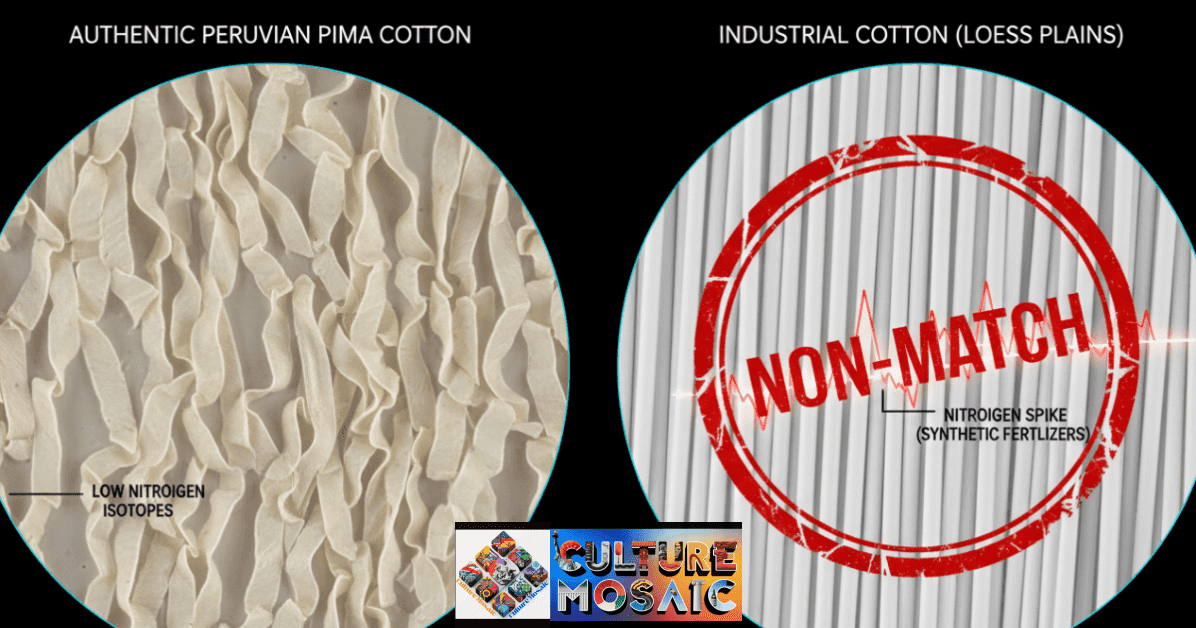
The Case of the Pima Pretender
In 2022, a luxury bedding brand marketing across Europe and North America was selling a flagship product as 100% Peruvian Pima cotton — a long-staple variety that justifiably commands a 60 to 80 percent price premium over standard cotton. The marketing materials showed Peruvian mountain landscapes and referenced generational farming families. It was beautifully done. It was also, as our analysis would demonstrate, fiction.
The audit was triggered by a competitor complaint and a customs anomaly: a shipment of greige fabric had transited through a third country on a routing inconsistent with direct Peruvian supply chains. Our laboratory received 40 fiber samples from different rolls within the same consignment.
The results were unambiguous. The nitrogen isotope ratio (delta 15N) across all 40 samples ranged from +12 to +15 per mil — a signature strongly consistent with heavy application of synthetic urea-based fertilisers. Authentic Pima cotton from small-scale Peruvian farms, which rely on compost and crop rotation, typically shows delta 15N values below +5 per mil. The strontium ratio further corroborated an origin in the loess plains of Xinjiang — a region with a well-documented geochemical fingerprint that is simply incompatible with Andean geology. The brand settled out of court before the case reached a full hearing. Our laboratory processed eleven similar cases in 2023 alone.
The broader ethical context here is significant. Understanding what Ethical Textile Provenance actually demands of brands and retailers requires this kind of analytical infrastructure to back it up — without independent laboratory verification, provenance claims remain marketing copy.
Field Report: How a Portable IRMS Scanner Works On-Site
Traditional IRMS instruments weigh upwards of 200kg. The portable generation achieves comparable precision for δ18O and δ2H in a unit the size of a carry-on suitcase. Here is the operational workflow for on-site authentication:
Why Heritage Fibers Survive: Intergenerational Textile Resilience
One question I get asked often is why this technique works on ancient textiles at all. If a linen shroud has been sitting in an Egyptian tomb for three thousand years, surely the isotope record has degraded? In practice, no — and understanding why requires a brief appreciation of fiber chemistry.
Cellulose, the structural polymer of plant fibers, is chemically inert under most preservation conditions. The oxygen atoms bonded into the cellulose ring during biosynthesis are not exchangeable under ambient conditions — they require acid hydrolysis to release. This means centuries of exposure to air, fluctuating temperatures, and low-level moisture does not overwrite the original geographic signature. Keratin in wool is similarly stable: the sulfur bridges that give wool its characteristic crimp actively protect the protein’s isotope record from diffusion. The result is what we call intergenerational textile resilience — the fiber’s molecular structure preserves a geochemical record far more durably than most other biological materials.
This durability is what makes fiber evidence so valuable for Traceable Ancestral Textile Remnants — institutions can commission an isotope audit of an entire heritage collection and build a rigorous evidence base for repatriation decisions, insurance valuations, and export licensing from samples smaller than a pinhead.
Limitations and Honest Caveats in Geographic Fingerprinting
Where the Method Reaches Its Limits
I want to be straight with you about where geographic fingerprinting of heritage fibers has genuine constraints, because overstating the technique’s capabilities does real damage to its credibility in legal and institutional contexts.
- Isotope exchange under extreme conditions: Fibers submerged in alkaline water for extended periods can show partial oxygen signature exchange. Marine archaeological textiles require correction factors that introduce real uncertainty.
- Overlapping isoscape zones: In some large alluvial plains, the geochemical environment is relatively homogeneous across thousands of kilometres. Distinguishing Egyptian Delta cotton from certain Sudanese varieties requires combining all three isotope systems.
- Agricultural irrigation: A cotton field irrigated with water sourced far from the growing region can partially overwrite the native isotope signature. A field in Arizona irrigated with Colorado River water will carry Colorado Basin oxygen isotopes regardless of location.
- Database gaps: Coverage remains patchy in parts of sub-Saharan Africa, Central Asia, and island Southeast Asia. Provenance assignments in these regions carry wider confidence intervals and should be stated as such.
Despite these limitations, multi-isotope approaches combining strontium, oxygen, hydrogen, and nitrogen typically yield enough independent signal to make confident geographic assignments for the vast majority of commercially significant heritage fiber regions.
The Digital Passport: Linking Laboratory Evidence to Blockchain Provenance
As of 2026, the EU’s Digital Product Passport regulation requires certain textile categories to carry a verifiable provenance record accessible via QR code or NFC tag. This is where the physical science of geographic fingerprinting of heritage fibers connects directly to the digital economy.
After a fiber batch has been isotopically analysed and its origin confirmed, the laboratory generates a signed data package — a structured record containing the sample ID, isotope values, geographic probability assignment, laboratory accreditation number, and a hash of the raw spectrometer output file. This is uploaded to a permissioned blockchain, creating a permanent, tamper-evident record linking that specific fiber batch to a specific geography, a specific analysis date, and a specific analyst.
The integration with Regenerative Cotton Benefits frameworks is particularly compelling: farms practising regenerative agriculture show distinctively low delta 15N signatures — independently verifiable through the same IRMS workflow — turning the laboratory report into a premium product differentiator with real scientific backbone.
Applications Beyond Fraud: Cultural Repatriation and Museum Science
Some of the most meaningful work I have been involved in has had nothing to do with commercial fraud at all. In 2019, isotope analysis of pre-Columbian textiles held in a European museum collection provided independent corroboration of Andean provenance claims, supporting a repatriation process that had stalled for over two decades due to insufficient documentary evidence.
Museum curators are increasingly commissioning pre-acquisition isotope audits as part of standard due diligence. This practice has already identified several objects presented as genuine pre-contact indigenous textiles that were in fact 20th-century reproductions — identifiable because machine-drawn fibers have a morphological regularity under the scanning electron microscope that is incompatible with hand-processing, and synthetic dyes alter the nitrogen signature in ways inconsistent with natural dyeing.
Explore more about the intersection of textile heritage and cultural ethics at Culture Mosaic.

Frequently Asked Questions About Geographic Fingerprinting of Heritage Fibers
FAQ 1: How much fiber is actually needed for analysis?
A full multi-isotope analysis covering oxygen, hydrogen, nitrogen, and carbon requires between 10 and 50mg of clean fiber — roughly equivalent to a few millimetres cut from a seam allowance. This is why the technique is classified as minimally destructive for heritage objects. Strontium analysis by TIMS can be performed on as little as 5mg. A complete provenance audit on a museum-grade specimen can be completed using less fiber than a typical loose thread.
FAQ 2: Can the technique distinguish between farms in the same region?
At sub-regional scale, precision depends on the degree of geological variation within the region. In areas with strong microgeographical variation — like Peru’s inter-Andean valleys — it is sometimes possible to narrow the assignment to a specific valley. In geologically homogeneous regions, the resolution is typically at the country or river-basin scale. I would be cautious about any laboratory claiming farm-level precision as a general capability; it is achievable in specific contexts but not as a routine outcome.
FAQ 3: Does synthetic dyeing interfere with the isotope record?
For most purposes, no. Synthetic dyes bond to the fiber surface rather than substituting into the polymer backbone, so they do not alter the core cellulose or keratin isotope record in fresh, well-preserved fibers. However, reactive dyes applied under high-temperature, high-pH conditions over extended periods can cause partial cellulose hydrolysis in degraded samples — another reason why the decontamination protocol is so important.
FAQ 4: Is this evidence admissible in legal proceedings?
In most jurisdictions, isotope ratio analysis performed by an accredited laboratory following ISO 17025 procedures is admissible as expert scientific evidence. Several fraud prosecutions in the EU and the United States have used isotope provenance data as primary evidence, and the methodology has survived Daubert challenges in US federal courts. The key is accreditation and chain-of-custody documentation — the science is robust, but legal admissibility depends on procedural rigour.
FAQ 5: How does isotope fingerprinting relate to DNA barcoding of fibers?
DNA barcoding and isotope fingerprinting are complementary, not competing, techniques. DNA confirms species identity — distinguishing genuine Vicuna from alpaca from sheep — but it cannot confirm geographic origin, since the same species grows in multiple countries. Isotope analysis supplies the geographic dimension that DNA simply cannot provide. Combined multi-marker approaches using both DNA and isotopes represent the current gold standard for high-value provenance disputes.
Conclusion: The Silent Geography in Every Thread
The science will continue to improve. Portable instrumentation is becoming more accessible, isoscape databases are growing denser, and the integration with digital provenance systems is accelerating. Within a decade, a customs officer at any major port will be able to run an on-site isotope screen in under fifteen minutes and receive an automated provenance probability assessment before a container is cleared.
That future matters not just to forensic auditors and luxury brands, but to every artisan community whose cultural heritage is encoded in the fibers they produce — and whose livelihood depends on that heritage being protected. We owe it to those communities to get the science right, to be honest about its limits, and to keep building the databases and institutional frameworks that make it useful in the real world.
Dr. Sarah Mitchell, PhD
Forensic Fiber Analyst & Isotope Geochemist
Dr. Sarah Mitchell has over 18 years of experience in textile provenance investigation. She holds a PhD in Analytical Chemistry from the University of Edinburgh and has served as an expert witness in textile fraud cases across the UK, EU, and the United States.
Her work bridges laboratory science and cultural heritage policy, making forensic provenance tools accessible to museum curators, customs agencies, and artisan communities. She writes regularly for Culture Mosaic on the intersection of fiber science, cultural identity, and supply chain ethics.